
Yes, floriography absolutely still matters. You’re steering a symbolic language that’s evolved from Victorian parlors to Pinterest boards, where red roses mean passion and yellow carnations signal disappointment—codes that transcend mere aesthetics. While few fully understand this language today, it’s experiencing a renaissance in weddings and celebrations, with 2026 trends showing significant growth in symbolism-driven arrangements. Flowers speak when words fail, carrying cultural weight from Japanese cherry blossoms to Day of the Dead marigolds. The deeper meanings await your discovery.
Victorian Flower Language History
While you might assume floriography originated organically from ancient traditions, the Victorian language of flowers actually emerged from a grand misinterpretation. Lady Mary Wortley Montagu, an English aristocrat visiting Constantinople in 1717, misunderstood the Turkish “sélam” game as an elaborate floral code system—and Europe ran with it. Publishers capitalized on this fascination by creating numerous flower meaning dictionaries, often with interpretations based on mythology or pure invention.
The Victorian flower language flourished precisely because it solved a cultural problem. You couldn’t openly express romantic feelings in proper society, but you could send a rose. Traditional flower symbolism matters because it reflected deeper social constraints—middle-class Victorians had newfound wealth, leisure time, and strict emotional boundaries all at once. Today, the connection between flowers and beauty remains strong, from luxury cosmetics incorporating floral essences to haute couture runway shows adorned with botanical motifs.
What Traditional Meanings Are
The beautiful chaos of Victorian floriography isn’t merely historical trivia—it’s an elaborate code system with astonishing specificity. You might dismiss traditional flower meanings as quaint relics, and yet they infuse contemporary weddings with layers of significance most guests never perceive. Red roses still scream passion, naturally, but did you know pink carnations whisper “I’ll never forget you” across ceremonial aisles?
The symbolic vocabulary extends far beyond love’s obvious declarations. Violets communicate modesty; begonias quietly warn; geraniums—rather brutally—suggest stupidity. Colors transform meanings entirely: yellow typically signals jealousy, white embodies purity, red chrysanthemums profess love. For centuries, these meaningful associations have been documented in texts like Collier’s Cyclopedia and other historical references. For your wedding, these traditional flower meanings offer extraordinary personalization opportunities—imagine including forget-me-nots for true love, peonies for marital happiness, and ivy representing fidelity. Just as Jewish wedding traditions incorporate specific symbolic elements to add depth to the ceremony, flower symbolism allows couples to weave meaningful narratives into their celebrations. It’s intellectual decoration, emotional shorthand, historical connection—all blooming simultaneously in your carefully curated arrangements.
Contemporary Relevance Question
Should anyone still care about floriography in our rapid-text world, where emoji roses substitute for actual blooms? The evidence is mixed. Most people today couldn’t tell you that chrysanthemums signify death in some cultures—yet brides still agonize over symbolic flowers for wedding arrangements, seeking deeper meaning beyond aesthetics.
You’re not alone if your flower meaning knowledge begins and ends with red roses. Despite over 100 floral dictionaries published in the 20th century, the Victorian system has faded from collective consciousness. And yet, flower meaning relevance persists in surprising corners. Mourners still bring lilies to funerals, veterans wear poppies, and lovers send roses—all participating in ancient symbolic traditions they may not fully comprehend.
The language of flowers survives in fragmented form, cultural muscle memory rather than fluent dialogue. Like inherited jewelry that becomes vessels of heritage, flowers carry meanings across generations even when their symbolic vocabulary fades from everyday conversation. Perhaps we don’t need encyclopedic knowledge, just appreciation for the whispered meanings that persist despite our digital distractions.
When Symbolism Enriches vs Constrains Design
Looking beyond appreciation to application, we enter the delicate dance between symbolic resonance and design freedom. You’ll find the language of flowers creates both structure and limitation—a scaffold that sometimes elevates your expression and sometimes boxes it in.
| Context | Enriches When | Constrains When |
|---|---|---|
| Wedding | Couples infuse personal narrative through intentional flower meanings | Bride panics over chrysanthemums symbolizing death in some cultures |
| Cultural | Global flower traditions expand your expressive vocabulary | Cross-cultural miscommunication occurs without shared understanding |
| Modern Use | Selective symbolism creates layered emotional experiences | Rigid Victorian codes limit contemporary aesthetic possibilities |
The flower meaning relevance question isn’t binary but contextual. You’re most successful when approaching floriography as a starting point rather than scripture. Victorian rigidity has given way to fluid interpretation, and yet—knowing chrysanthemums represent death in Japan might still matter for your international wedding guests. Contemporary Japanese skincare rituals demonstrate how traditional symbolic systems can evolve into modern practices that honor heritage while embracing innovation.
Cultural Variations in Flower Meaning
While Victorian England may have formalized the language of flowers for Western audiences, stepping beyond these borders reveals a kaleidoscope of floral symbolism that varies dramatically across continents and cultures. What comforts in one context might offend in another—chrysanthemums celebrate imperial power in Japan yet whisper of death across much of Europe.
You’ll find these contradictions everywhere you look:
- Lotus flowers symbolize spiritual awakening in India and Buddhism, utterly sacred in religious contexts
- Marigolds guide spirits during Day of the Dead festivals, their lively orange a bridge between worlds
- Red poppies speak of remembrance in the UK, honoring war dead with their blood-bright petals
- Cherry blossoms embody life’s impermanence in Japan, beloved by samurai for their brief, brilliant flowering
- Chrysanthemums represent both death (Europe) and longevity (China)—a perfect example of symbolic dissonance
Understanding these cultural nuances becomes especially important when planning celebrations at culturally significant venues like the Solomon R. Guggenheim Museum, where thoughtful floral choices honor both tradition and setting.
Personal Meaning vs Prescribed Interpretation
When we debate the merits of floral language, we inevitably confront the tension between dictionary-defined symbolism and our own emotional attachments.
You might rigorously adhere to Victorian floriography—where red roses mean passionate love and forget-me-nots signify remembrance—and yet, your personal connection to daisies because they lined your childhood home’s walkway trumps any prescribed meaning. This isn’t mere sentiment; it’s the intersection of sensory experience, memory, and emotional resonance that standardized meanings simply cannot capture.
Consider how white lilies simultaneously represent purity in traditional texts while functioning as funeral flowers in contemporary practice. Your interpretation needn’t be either/or. The language of flowers operates on a human continuum transcending rigid definitions—a flexible system where prescribed meanings provide foundation, but your sensory delight and lived experience complete the communication. The most authentic floral expressions balance both: acknowledging tradition while honoring your personal symbolic terrain. Wedding planners in destinations like The Bahamas understand this deeply, working with certified wedding professionals to help couples select blooms that honor both traditional symbolism and the unique story of their relationship against backdrops ranging from pink sand beaches to tropical gardens.
Does Anyone Actually Care
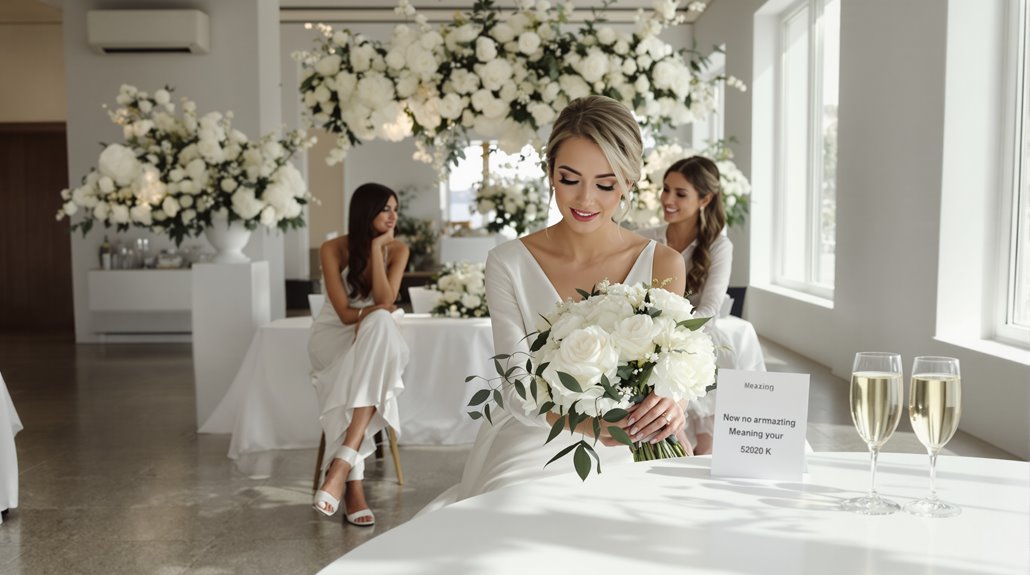
How deeply do we still involve ourselves with floral symbolism in an era of Instagram aesthetics and rapid-fire visual consumption? The evidence suggests profoundly. You’re selecting flowers with deliberate emotional resonance, not just visual appeal—something 2026 wedding trends confirm with their Victorian-inspired calla lilies and delphinium arrangements. You care about what your blooms communicate.
Modern aesthetics may shift, but our relationship with flowers remains rooted in their timeless symbolic language—we speak through petals as intentionally as ever.
- Calla lilies and lilies of the valley dominate wedding arrangements specifically for their symbolic associations with purity and “return to happiness”
- Delphinium earned 2026 Flower of the Year status by embodying optimism and serenity
- Monofloral Victorian-inspired bundles represent significant market growth
- Color functions as intentional emotional language, not random selection
- Early 2026 sales data shows consumers actively seeking flowers with established meanings
The market speaks clearly: you’re not just buying pretty stems, you’re purchasing emotional narratives. Just as the Catholic marriage sacrament treats union as a sacred covenant rich with symbolic meaning, floral choices at weddings carry weight beyond mere decoration. Aesthetic appeal matters, and yet meaning matters more—a deliberate return to floriography that complicates our supposedly superficial visual culture.
Conclusion
Despite decades of texting, emojis, and digital shorthand, the language of flowers refuses to wither in our collective consciousness. You’ve witnessed its evolution—from Victorian parlors to Pinterest boards—yet its essence remains intact: flowers speak when words fail us. They always have.
| Flower | Traditional Meaning | Modern Interpretation |
|---|---|---|
| Rose | Passionate love | Celebration of connection |
| Lily | Purity, rebirth | New beginnings, passages |
| Forget-me-not | Remembrance | Digital-age loyalty |
You’ll find floriography thriving at weddings, funerals, apologies—moments when we need symbolism most. The language has simplified, yes, and yet it’s gained new dimensions, incorporating cultural fusions and personal meanings that Victorian enthusiasts couldn’t have imagined. Your grandmother’s knowledge of chrysanthemums signifying death in Asian cultures matters now more than ever in our global society.
The language of flowers endures because it must—we’re hardwired to seek meaning beyond words. Like bridal accessories that transform aesthetic choices into value statements, floral selections continue to serve as visual narratives that communicate what plain language cannot capture.