
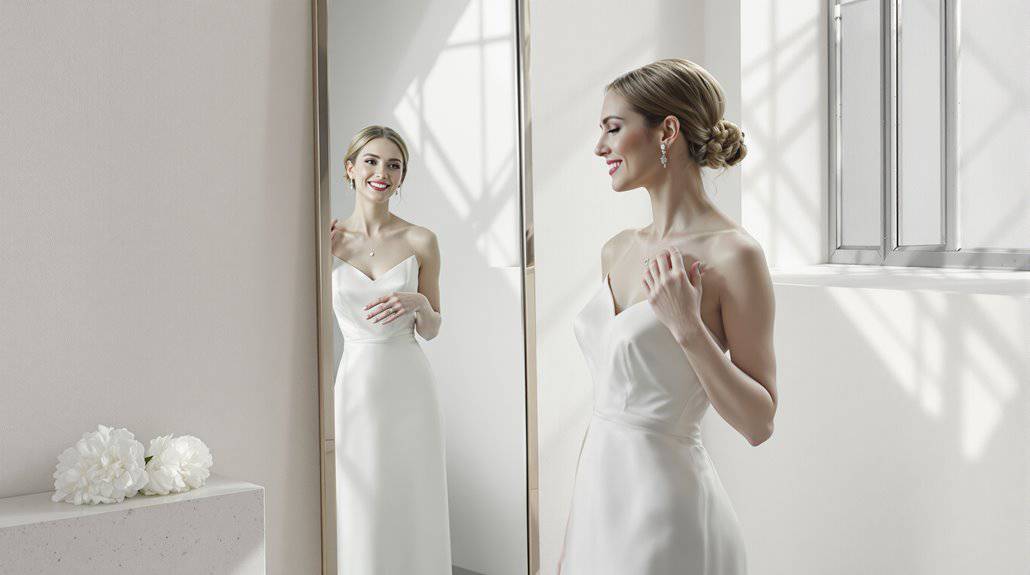
Wedding beauty has fundamentally shifted—79% of vendors now prioritize refinement over transformation. You’re not trying to become someone else; you’re revealing your most polished self. Your freckles, unique features, and natural radiance deserve celebration, not concealment. The science confirms it: heavily made-up faces appear less authentic, even when rated attractive. Opt for dewy skin tints, soft-diffused eyeshadow, and pre-wedding treatments that boost your existing beauty. The most enchanting brides simply look like themselves, uplifted.
The Transformation Industry – Essay opening
While the wedding industry has spent decades convincing brides they should be utterly transformed for their big day—unrecognizable to partners who fell in love with their actual faces—a seismic shift has finally occurred. You’ve been sold a wedding beauty philosophy that demands you become someone else, and yet the data reveals couples themselves are rejecting this premise, with 79% now prioritizing personalization over performative elements.
For years, you endured foundation so thick it could patch drywall, contouring that suggested facial reconstruction rather than enhancement, and enough glitter to violate environmental regulations. But 2026 marks the official death of transformation-focused beauty. The quiet luxury aesthetic has replaced mask-like application, and vendors across 30 markets confirm it’s not merely aesthetic evolution—it’s philosophical revolution.
Your wedding day deserves your actual face, just emphasized with intention, refinement, and strategic luminosity. This mirrors the broader movement toward personalization and intentionality across all wedding design elements, from color palettes to ceremonial moments. This approach aligns perfectly with the emerging trend toward authentic, real-time moments that define the most meaningful celebrations.
Bridal as Performance vs Enhancement
For decades, the beauty industry has positioned bridal makeup as a performance—a theatrical transformation where you become an idealized “bride” rather than yourself. You’re sold a radical before-and-after, not enhancement of your existing beauty.
Science contradicts this approach. Studies show faces with makeup rate substantially higher (4.89 vs 1.75 on attractiveness scales), but the most successful bridal beauty emphasizes rather than masks. Your identity remains intact—just polished. Think subtle contour highlighting bone structure you already have, not reshaping your entire face.
The smartest brides invest in their skin months before—LED therapy, microneedling, deliberate hydration—creating that luminous complexion that requires less coverage, not more. Starting treatments 3-6 months before the wedding allows for true skin transformation that outshines any makeup. The 2025 trend toward dewy skin tints over heavy matte foundation confirms it. Your bridal beauty shouldn’t feel like cosplay; it should feel like the most radiantly confident version of you, recognized by everyone who loves you.
Why Peak You Beats Costume You
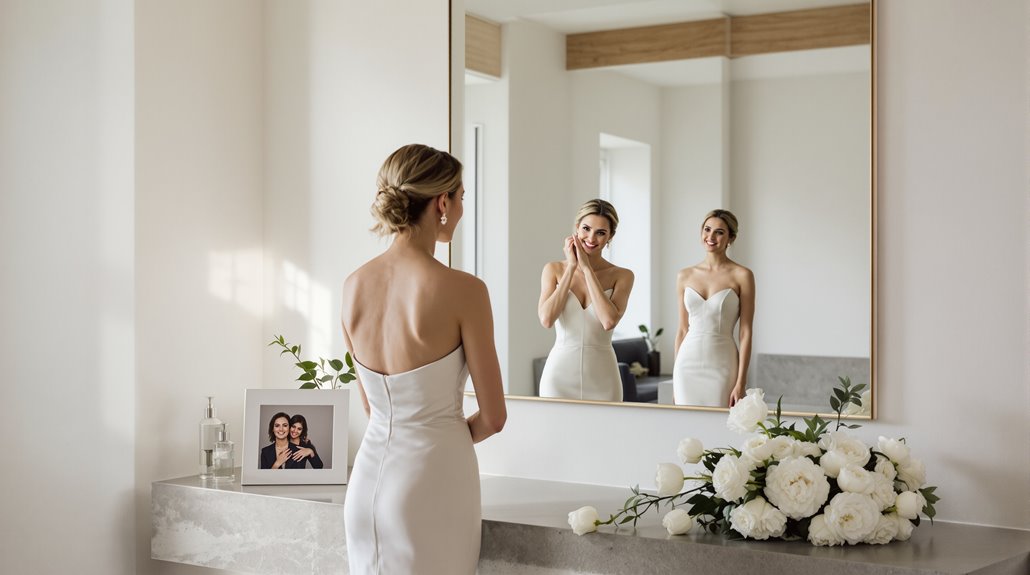
Despite the powerful allure of total transformation, your authentic self—elevated to its pinnacle—consistently outperforms any theatrical reinvention on your wedding day. This wedding beauty philosophy isn’t mere sentiment—it’s pragmatic truth. Recognize what happens when you surrender to costume-level makeovers: you risk becoming unrecognizable in photographs that should capture your essence, not some airbrushed stranger’s.
Think of your features as starting points, not problems to obliterate. That distinctive nose? It’s your heritage. Those freckles? Character incarnate. The beauty industry’s transformation paradigm relies on your self-doubt for profit—yet the most memorable brides are those who appear magnificently themselves.
Your partner fell for you, not some idealized avatar. And your confidence—that radiant self-possession—emerges from enhancement, not erasure. The most sophisticated wedding beauty approach acknowledges this paradox: becoming more intensely yourself requires careful intervention, but never reinvention. Consider how luxury French beauty brands like Lancôme have perfected this philosophy, offering elegant formulations that enhance rather than mask your natural features.
Resisting Beauty Industry Transformation Pressure
The beauty industry’s transformation agenda thrives on your insecurities, yet you possess extraordinary power to resist its pressures. The statistics don’t lie—215.8% growth in “wedding makeup” TikTok searches reveals our collective anxiety about looking “bridal enough.” And yet, the most authentic wedding looks enhance rather than mask your natural features.
| Pressure Point | Industry Messaging | Your Empowered Response |
|---|---|---|
| Social Media | “Transform completely” | Curate feeds showing natural brides |
| Trial Sessions | “More is better” | Document and enforce your preferences |
| Product Selling | “You need everything” | Prioritize enhancement, not reconstruction |
| Day-of Changes | “Let’s try something new” | Stick to your practiced authentic look |
| Photography | “Perfect for Instagram” | Focus on feeling comfortable, not viral |
When 78% of couples seek professional hair services, they’re not necessarily seeking transformation. Your wedding makeup should feel like you—just elevated. Remember: guests want to recognize the person they’ve come to celebrate. If you’re seeking a venue that celebrates authentic beauty in an artistic setting, consider the Whitney Museum’s private event spaces that honor individual expression over cookie-cutter perfection.
Beauty as Refinement Not Change
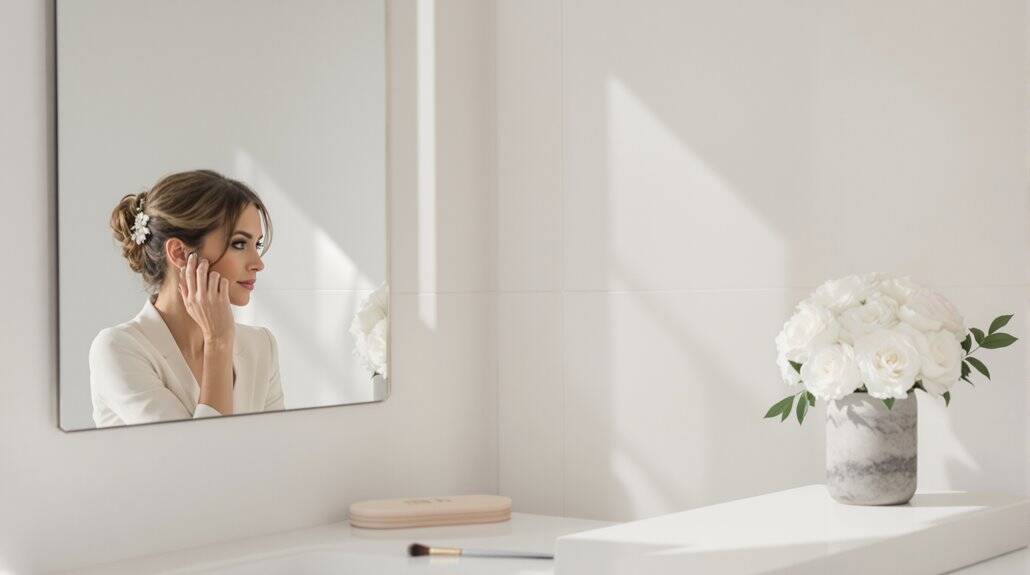
Refinement celebrates your existing beauty rather than erasing it. It’s the crucial distinction between transformation and enhancement—one obliterates your identity, while the other honors it. Your wedding beauty approach should build upon what’s already there: soft-diffused eyeshadow that enhances your natural eye shape, sheer foundation that allows freckles to peek through, blush buffed into cheekbones you’ve always had.
This refinement philosophy extends beyond makeup. Start treatments 5-6 months before your wedding, focusing on collagen stimulation before moving to injectables at the 3-4 month mark. And yet, the goal isn’t to emerge unrecognizable—it’s to appear as yourself, just more polished. Your monthly hydrating facials build cumulative quality without dramatic shifts; your bridal beauty emerges through thoughtful layering rather than wholesale reinvention. The result? A face that’s unmistakably yours—fresh, camera-ready, refined—not someone else’s definition of “bridal perfection.” If you’re planning a celebration at iconic venues like the Getty Center or Villa, your refined, authentic look will photograph beautifully against their stunning architectural backdrops.
Examples: Enhanced vs Transformed
While wedding beauty trends evolve constantly, understanding the difference between improvement and transformation provides your clearest path forward. You’re not aiming to look unrecognizable—your identity remains central to your bridal beauty. That 70% of brides choose facial surgery isn’t an instruction; it’s context for a decision that’s deeply personal, and yet markedly influenced by cultural pressure.
| Enhanced Features | Transformed Features |
|---|---|
| “Micro-dosed” Botox | Complete facial reconstruction |
| Dermaplaning for natural glow | Heavy makeup that masks features |
| Tactical fat transfer | Dramatic weight loss via GLP-1s |
| Baby lip flips | Overfilled lips changing mouth structure |
The 152% surge in “natural glowy wedding makeup” searches tells us something vital—brides want to look like themselves, just elevated. Your wedding beauty should emphasize what’s already there, not erase your identity in pursuit of a standardized bridal aesthetic. You’re refining, not replacing. Much like how leftover rice transforms into comfort food with just a fried egg and soy sauce, the best beauty approaches work with what you already have rather than starting from scratch.
Conclusion
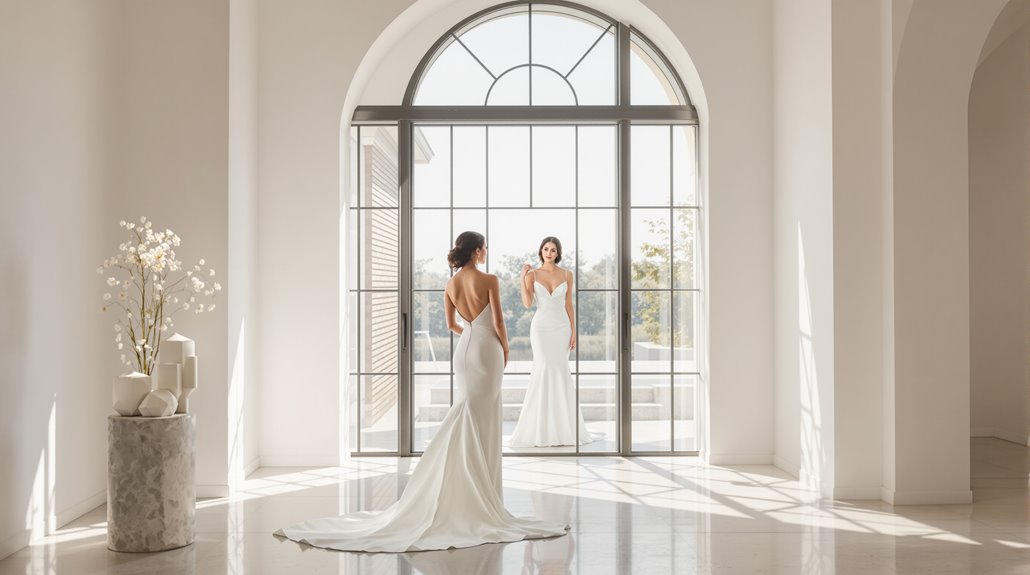
When did wedding beauty become less about transformation and more about authentic revelation? Somewhere between the 79% of vendors prioritizing personalization and the rise of natural radiance as the new foundation standard, we witnessed a seismic shift in wedding beauty philosophy. You’re no longer expected to become someone else for your celebration—and yet, the expectation for refinement remains steadfast.
This evolution reflects something deeper than mere aesthetic preference. It’s the recognition that your most meaningful day deserves your most authentic self, heightened rather than erased. The skincare-first approach, the deliberate lightness in product application, the cultural fusion with editorial polish—these aren’t trends but reclamations. Bobbi Brown’s approach to wedding makeup emphasizes enhancing your natural features rather than masking them, proving that simplicity and sophistication can coexist. You’re taking back wedding beauty from an industry that once demanded transformation as the price of admission.
The new bridal beauty standard isn’t about becoming unrecognizable. It’s about being unmistakably, confidently, radiantly you.