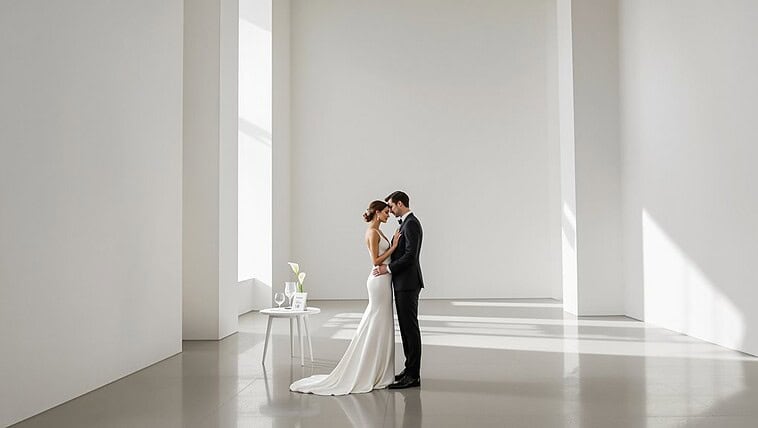

There’s no “too small” for a wedding—only what feels authentic to your relationship. Evidence indicates 20-person gatherings promote depth but exclude friends, while 50-guest celebrations hit the sweet spot between intimacy and energy. Larger gatherings (80+) increase marital consistency through public witnessing, yet sacrifice meaningful interactions. Your ideal count reflects your relationship inventory: immediate family (20), close friends (50), or broader network (80+). The numbers matter less than creating space for your genuine love story to unfold.
The Guest Count Psychology Question

While planning your wedding, you’ve likely fretted over the guest list more than any other detail—and with good reason. This single decision shapes not just your wedding day experience but possibly your marriage itself.
Research suggests a captivating psychological component to your intimate wedding guest count: public commitments witnessed by more people create stronger marital bonds. When 80 people watch you exchange vows, you’re 10% more likely to maintain consistency between those promises and your actions. And yet, smaller gatherings of 20-50 guests often create more meaningful interactions, deeper community bonds. Studies have found that greater wedding attendance is linked to improved marriage outcomes, regardless of income or education levels.
Your small wedding size reflects more than budget constraints—it’s a declaration about how you define celebration, connection, and commitment. Modern couples increasingly prioritize authenticity over obligation, carefully selecting guests based on relationship proximity rather than social expectation. Consider that intimate venues often present operational constraints that naturally limit guest counts, from narrow load-in routes to restricted capacity, making smaller gatherings a practical necessity. The question isn’t simply “how many?” but “who truly matters in witnessing this crucial moment?”
20 Guests: Immediate Family Only Trade-offs
Choosing to celebrate with only immediate family—a radical act in a culture that often equates wedding significance with headcount—transforms your entire celebration calculus. With an intimate wedding number of just 20, you’ll spend more per guest ($300-800+) but potentially less overall, redirecting those funds toward elevated experiences rather than sheer volume.
Your small wedding how many question unblocks venue flexibility you wouldn’t otherwise have—boutique spaces, meaningful locations, non-traditional settings—all suddenly viable when you’re not accommodating distant cousins and workplace acquaintances. Before finalizing your intimate gathering, ensure you understand the marriage registration requirements in British Columbia to avoid any administrative surprises.
The guest count intimate approach creates deeper connections with those present. You’ll actually remember conversations instead of managing a receiving line blur. According to recent studies, this aligns with the trend where approximately 13% of couples invite between 1-50 guests, prioritizing quality interactions over quantity. And yet, this exclusivity creates relationship complexities. When you omit close friends while including siblings, you’re making statements about relational hierarchies that might reverberate beyond your wedding day. The trade-off? Profound presence over performative inclusion.
50 Guests: Sweet Spot for Many Couples

For many couples steering the wedding planning maze, the 50-guest sweet spot represents the elusive middle ground between micro-wedding intimacy and reception-hall anonymity. Your guest count intimate decisions emerge at this threshold—where you can still greet everyone personally yet maintain enough critical mass for genuine celebration energy.
At 50 guests, you’ve struck the delicate balance where every invitation carries deliberate intention. You’ll fall well below the national average of 117 attendees, and yet this intimate wedding threshold allows sufficient numbers to justify traditional reception elements without breaking budgets. The math works: inviting approximately 60-65 people should yield your target headcount when accounting for the typical 15-25% decline rate.
Your venue options expand dramatically at this size—spacious enough to accommodate formal dining arrangements, but small enough to maintain that coveted feeling where everyone knows each other. With per guest costs ranging from $300 to $800 for intimate weddings under 50 people, this size allows you to allocate budget strategically without the financial strain of larger celebrations. Comfortable, meaningful, defensible. Neither apologetically tiny nor wastefully bloated.
80 Guests: Inclusion vs Intimacy Tension
The wedding invitation paradox strikes every couple ultimately: guest list decisions represent your most emotionally charged planning puzzle. Every addition creates ripples affecting your budget, venue selection, and—most critically—the entire experiential texture of your celebration.
With the national average hovering around 117 guests, you’re navigating the tension between inclusion and meaningful connection. At 20 guests, you’ll create an intensely intimate wedding guest count but exclude close friends. Expand to 50, and you’ve hit the sweet spot many planners consider truly “intimate”—allowing quality time with each attendee while maintaining depth. Push to 80, and you’ll feel the subtle shift as conversations become briefer.
The math is brutally simple: more guests means less time with each. And yet, your guest count defines the energy. Smaller gatherings (under 50) cost more per person but create unmatched intimacy; larger ones sacrifice depth but capture community breadth. Smaller celebrations often inspire innovative approaches, much like how venue restrictions can serve as creative guardrails that elevate your overall wedding aesthetic. How many guests feels intimate enough for your vision?
Determining Right Number for Your Relationships

When you distill wedding planning to its essence, your guest count reflects a relationship inventory more than a numerical target. The math feels brutally simple: 20 guests limits you to immediate family only, 50 incorporates your closest friends while requiring tough cuts, and 80 allows comfortable inclusion but sacrifices intimacy.
Consider the attendance calculus—local guests show up at 85%, out-of-towners at 55%, and destination attendees surprisingly high at 80%. Your relationship tiers deserve honest evaluation. Can you genuinely connect with 75+ people during your celebration?
The financial reality compounds this decision. Intimate weddings command $300-$800+ per guest, while medium-sized affairs run $225-$450+. Yes, fewer guests cost more per person, and yet your overall budget typically decreases.
Your venue options expand dramatically with smaller counts. Non-traditional spaces suddenly become viable, and the customization possibilities increase proportionally as your headcount decreases. Platforms like Peerspace offer unique venue rentals specifically designed to accommodate intimate wedding celebrations with character and flexibility.
Psychological Thresholds
While scientists rarely venture into wedding planning territory, psychological research reveals intriguing thresholds that dramatically impact your celebration experience. That magical number? Under 40 guests—where couples report experiencing time dilation, emotional clarity, and the rare ability to absorb every meaningful moment without cognitive overload.
Your nervous system functions differently in intimate settings. With fewer than 40 witnesses, performance anxiety plummets, allowing your authentic emotions—tears, laughter, stumbled vows—to emerge without self-consciousness. You’ll shift from 30-second reception conversations to genuine connections that transform spectators into participants.
The psychological math is ruthless but liberating: smaller guest counts create exponentially deeper experiences. Beyond 50 guests, social comparison mechanisms activate subconsciously, shifting focus toward external validation rather than relational meaning. Your emotional bandwidth expands dramatically when you eliminate peripheral connections, redirecting that mental energy toward what matters—the relationship you’re celebrating. This same principle applies to design choices, where modern couples favor disciplined 2-3 color palettes over traditional 5-7 schemes, creating focused aesthetics that mirror the intentionality of intimate gatherings.
Making Cuts Without Regret
Faced with mounting invitation pressures, you’ll need tactical cutting principles to avoid the trap of a bloated guest list that dilutes your wedding experience. Start by leveraging geography’s natural filtering mechanism—local guests show 85% attendance versus just 55% for out-of-towners, making distance your first ally in curating authenticity.
Set unified parameters with your partner before making a single cut. This isn’t merely practical advice; it’s relationship preservation. When one of you struggles with declining invitations while the other stands firm, the resulting tension undermines the very intimacy you’re working to create.
Consider the mathematical reality: fewer guests means heightened per-person experiences ($300-$800+ for weddings under 50 guests). Your fixed costs remain consistent regardless, but your ability to create meaningful moments expands dramatically. The math doesn’t lie, yet the emotional calculus remains complex—prioritize relationships that enrich rather than obligate, celebrating quality over arbitrary quantity. Before finalizing your list, verify that all invited guests meet your state’s California marriage license witness requirements to ensure your ceremony remains legally valid.
Conclusion
Although choosing your wedding guest count remains profoundly personal, the evidence overwhelmingly favors smaller gatherings for those prioritizing meaningful connections over social obligations. The numbers don’t lie: intimate weddings (under 50-75 guests) yield $300-$800+ per-guest experiences versus the $175-$400 range for larger affairs—transforming your celebration from fleeting interactions to genuine moments with each attendee.
You’re witnessing a generational shift, with Gen X averaging just 88 guests compared to Gen Z’s surprising 131. This deviation marks not just changing values but evolving definitions of closeness itself. The sweet spot? Somewhere between 20 (immediate family only) and 80 (the point where meaningful interaction dilutes).
And yet, regional variations matter tremendously. Your Southern wedding naturally trends smaller (103 guests) than Southwestern celebrations (124). Smaller guest counts also grant greater flexibility in your wedding day timeline, allowing you to invest more time in memorable moments like golden hour portraits and extended cocktail hours without sacrificing guest engagement. The ultimate question isn’t about industry standards or budget spreadsheets, but authenticity—creating space where your unique love story breathes without constraint.