
You’re falling into the generic vow trap if you’re recycling “best friend” platitudes and Instagram-ready phrases. Craft vows that actually sound like you—use a narrative approach with 3-6 concrete promises specific to your relationship. Keep it brief (250 words max), write for speaking not reading, and ruthlessly edit out clichés. Record yourself practicing; what looks poetic on paper often sounds stilted when spoken. The most memorable vows balance tradition with intensely personal details that only you two truly understand.
The Generic Vow Problem
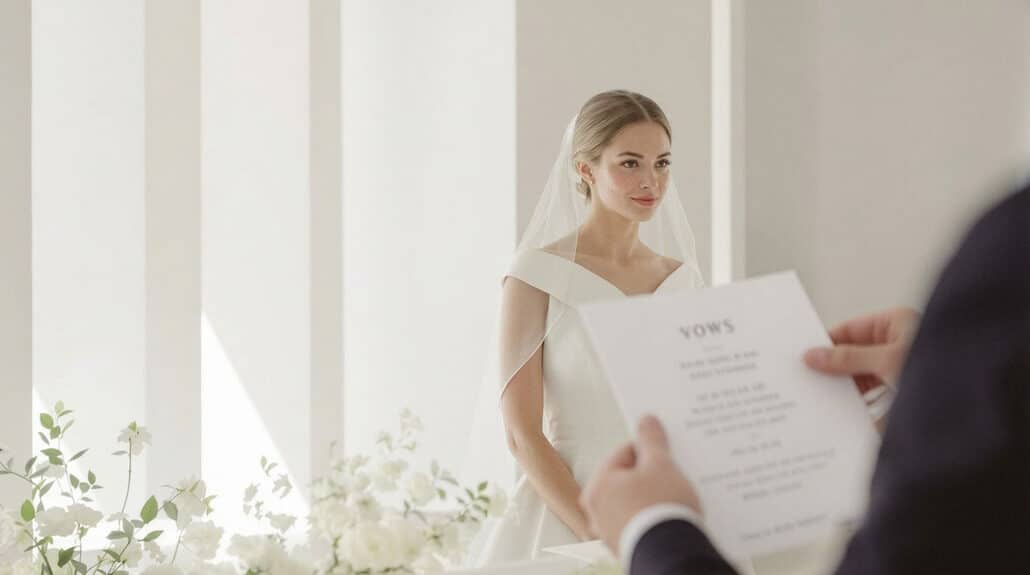
Why has the quest for uniqueness resulted in a paradoxical sameness? As self-written vows have transformed from bold choice to standard expectation, you’ve likely witnessed the emergence of what wedding professionals quietly call “the generic vow problem.” Couples flee traditional vows seeking personal expression, yet end up reciting nearly identical platitudes about best friends, soulmates, and forever promises.
You’re rejecting centuries-old ceremonial language—language steeped in cultural meaning and structural purpose—only to replace it with Instagram-ready clichés that could apply to literally any couple in America. This trend ignores how traditional vows once operated as formal social contracts with binding significance beyond the romantic feelings of the day. And yet, this phenomenon isn’t merely aesthetic failure; it represents something deeper. The 49% of Americans who prefer dropping traditional elements like bride’s obedience are rightfully questioning patriarchal remnants, but they’re simultaneously discarding the reciprocal promises and public declarations that gave personalized wedding vows their power in the first place. You’re left with beautiful sentiment that says absolutely nothing specific about your actual relationship. Much like wedding vendors who blur professional boundaries to manufacture intimacy, generic vows prioritize the performance of emotion over the substance of commitment.
Structure Options: Narrative Promise-Based Hybrid
Moving beyond the generic vow trap requires serious structural consideration for your personalized promises. Three distinct frameworks emerge for personal vow creation: narrative (telling your love story), promise-based (concrete commitments), and hybrid (combining both). The narrative approach anchors vows in specific memories—that first date where you spilled wine, the moment you knew they were “the one”—creating vows that sound like you, not Pinterest. Promise-based structures, on the other hand, offer three to six specific commitments spanning emotional support to playful pledges. For maximum impact, focus on promises that will stand the test of time rather than temporary circumstances.
The hybrid method, though, that’s where magic happens. Begin with personalized written expressions, then switch to “repeat after me” traditional promises—maintaining coherence through both. Your vow writing guide: practice delivery timing, balance length across both partners’ vows, and make certain each promise aligns with your narrative. This collaborative approach mirrors how successful couples work with wedding vendors—viewing the process as co-creative rather than transactional. Structure paradoxically creates freedom; the scaffolding actually allows authenticity rather than constraining it.
Avoiding Clichés: Overused Phrases to Skip

While earnestly pouring your heart onto paper, you’ll inevitably encounter the wedding vow graveyard—that collection of phrases so overused they’ve lost all meaning. Your wedding vow writing deserves better than calling your partner your “best friend” or “partner in crime.” Eyes roll, guests tune out, and your precious words dissolve into background noise.
Relational descriptor clichés like “my person” or “the one” have become equally predictable substitutes. And those repetitive structures—”I love your smile, I love your laugh, I love your…”? They create a monotonous rhythm that puts audiences on autopilot.
Every all-encompassing vow writing guide will warn you against religious standbys too: 1 Corinthians 13 (“Love is patient…”) and “till death do us part” have been diluted through overuse. Your vows should sound like you—specific, concrete, personal—not like the last twelve weddings your guests attended. Promise something only you could promise. Just as museum designers use elegant restraint to let artwork become the focal point, your vows need space to breathe without decorative language that competes for attention.
Appropriate Length: 1-2 Minutes Maximum
How long should your heartfelt declarations actually be before they transform from moving proof to endurance test? The sweet spot for wedding vow writing: two to three minutes, maximum. That’s roughly 250-300 words when spoken aloud—yes, count them.
When you write wedding vows, remember that standing before sixty-plus witnesses makes every second feel magnified. Your carefully crafted five-minute masterpiece will feel like a Shakespearean monologue to guests whose attention spans cap at 180 seconds. And yet, this constraint breeds creativity. The most memorable vow ideas personal enough to matter require ruthless editing.
Speaking at 125-150 words per minute means your precious promises need boundaries. Consider this: would you rather maintain eye contact with your beloved or spend your ceremony reading from notecards? Private letters exchanged before the ceremony can house your lengthier sentiments—keep what’s public punchy and profound. Emily Post Institute guidance reinforces that brevity in ceremony elements maintains guest engagement and keeps the focus on the emotional significance of the moment.
Writing for Spoken Delivery Not Reading
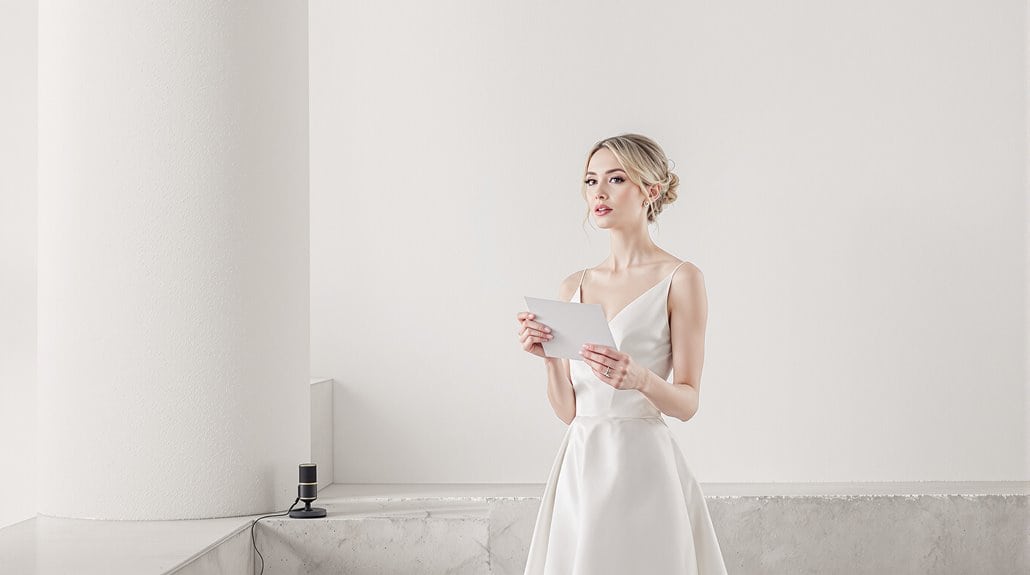
Words crafted for the ear differ fundamentally from those intended for the eye. Your vows will be heard, not read—a distinction that should guide every word choice in your vow writing guide. Write as you speak, not as you write. Record yourself speaking your draft vows aloud; you’ll immediately spot the phrases that trip your tongue or sound unnatural coming from your mouth.
Speak your vows before you write them. The ear catches what the eye misses in matters of the heart.
- Avoid complex sentence structures that leave you breathless
- Choose words you naturally use, not ones you’d only write
- Build in natural pauses where your emotion might overwhelm you
- Include concrete promises rather than poetic abstractions
- Insert personal references that only your partner will fully understand
The emotional resonance of vows comes from authenticity in spoken delivery. Your written draft might look unimpressive on paper—and yet when spoken with genuine feeling, these same words can stop hearts. Simple, heartfelt promises outshine literary flourishes every time. Just as collaborative, transparent dialogue strengthens family relationships during wedding planning, vows that reflect your genuine communication style will resonate more powerfully than carefully constructed prose that sounds foreign coming from your lips.
Creating Specificity: Concrete vs Abstract
The magic of unforgettable wedding vows lies not in grand declarations, but in vivid specificity. When you proclaim “you’re my everything,” you’ve effectively said nothing—you’ve chosen abstract language that could apply to any couple in any ceremony on any day. Your vows deserve better, and so does your partner.
Concrete language transforms generic sentiment into memorable promise. Instead of “I’ll always be there,” try “I’ll bring you coffee on Sunday mornings and hold your hand through every doctor’s appointment.” This vow personalization creates an emotional fingerprint unique to your relationship.
The difference is striking: “You make me happy” floats away like smoke, while “Your terrible puns at family dinners make even my mother laugh” anchors your commitment in shared reality. Replace sweeping statements with precise moments—the 2am airport pickup, the way they fold your laundry, the specific kindnesses that define your love—and watch your vows become unmistakably yours. Just as pairing two decorative fonts creates visual chaos that detracts from elegance, stacking multiple abstract declarations in your vows dilutes their emotional impact and leaves nothing memorable behind.
Testing Vows Aloud Before Ceremony
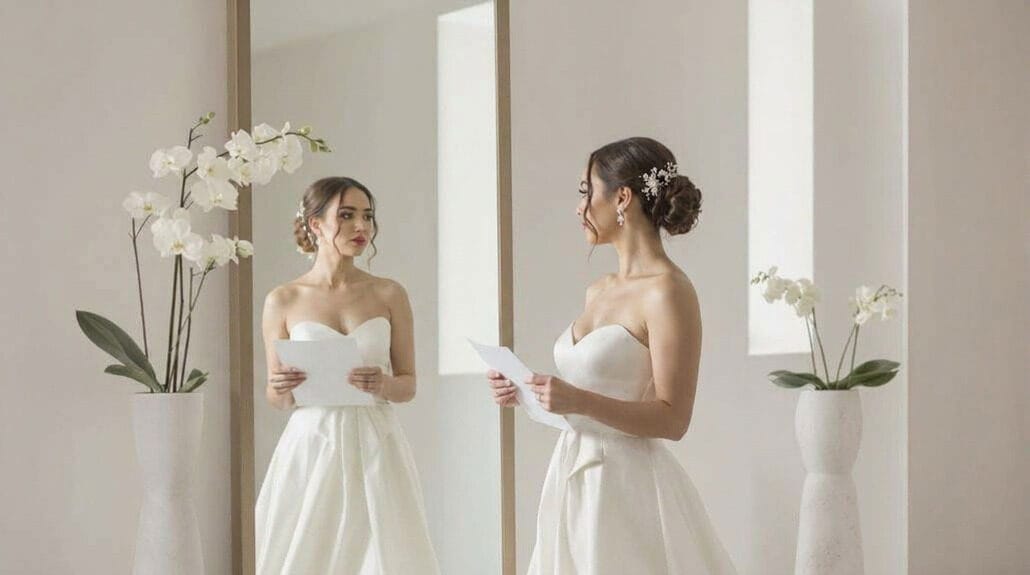
Many couples dedicate hours to perfecting every syllable of their vows, yet neglect the crucial step of speaking those carefully crafted words aloud before their wedding day. This wedding vow practice isn’t just about memorization—it’s about inhabiting your promises physically, testing how they feel in your mouth, how they land in the air.
The rehearsal offers your perfect chance for vow delivery experimentation:
- Record yourself reading aloud—the cadence you imagine often differs radically from your actual speaking rhythm
- Practice with ambient noise (music, chatter) to simulate ceremony conditions
- Time yourself: vows over two minutes risk losing guests’ attention
- Identify tongue-twisters or awkward phrasings that read beautifully but trip your speech
- Find natural pauses for breath and emotional moments
- Test during evening hours when fatigue might affect your delivery, mirroring the actual conditions of a late-day ceremony
Your written vows may be poetry on the page, but wedding vows exist fundamentally as spoken commitments—and deserve to be tested as such.
Conclusion
Once you’ve practiced your vows aloud, landing each syllable with intention, your final task awaits: crafting an ending that echoes long after you’ve spoken it. The conclusion of your unique wedding vows deserves as much attention as your opening—perhaps more. While traditional endings often default to generic “forever” promises, your finale should crystallize what makes your commitment singular.
| Conclusion Approach | Example |
|---|---|
| Circular Reference | Revisit your opening line, now transformed by everything shared between |
| Commitment Statement | “I promise these things not just today, but through every sunrise we share” |
| Future Vision | “I can already see us, gray-haired and holding hands, still choosing each other” |
| Shared Mantra | Use your private relationship motto as your powerful final words |
| Simple Truth | Sometimes three honest words—”I choose you”—outshine flowery prose |
When you write wedding vows that conclude with specificity rather than sentiment alone, you’ve created something unrepeatable—just like your love. Much like how elegance and glamour define a carefully curated aesthetic, your vows should reflect the distinctive beauty of your particular bond.