

Wedding media conceals four uncomfortable truths: you’ll exceed your budget by 45%, family dysfunction will intensify (96% find planning stressful due to family issues), cultural appropriation runs rampant, and the authenticity-performance tension is real. Your 468 hours of planning will expose class divides, narrow beauty standards, and the expectation to create Instagram-perfect moments while maintaining “authentic” connection. Confronting these contradictions—the $35,000 average cost, the 79% of brides planning alone—creates space for a more honest celebration.
What Wedding Media Avoids – Essay opening
Why does wedding media feel so sanitized, so carefully curated, so aggressively pleasant? Because honest conversations about weddings would force us to confront uncomfortable truths: that marriage isn’t just about romance but power interplays, that celebrations expose class divides, that traditions can exclude entire communities.
You’ve probably noticed the uniform perfection across Pinterest boards and bridal magazines—thin, able-bodied, heteronormative couples smiling against picturesque backdrops. Yet what’s happening in those carefully cropped margins? The non-binary individual struggling to find representation, the disabled bride fighting for accessible venues, the aromantic person questioning why partnership requires such performative spectacle. Meanwhile, the same industry packages luxury beauty products as wedding essentials, reinforcing narrow aesthetic standards that few can naturally achieve.
Wedding media honesty remains elusive precisely because authentic discussions would reveal five major blind spots: gender diversity erasure, asexual/aromantic exclusion, marginalized community underrepresentation, toxic body expectations, and structural power inequities. These restrictive representations reinforce rigid gender norms that historically control reproductive choices and relationship dynamics. And these aren’t just oversight—they’re carefully maintained silences.
Class and Budget Anxiety Silence
Perhaps the most profound omission from wedding media’s spotlight falls at the intersection of bank accounts and social standing. You’ve probably seen those $29,195 “average wedding cost” headlines without realizing they’re drastically skewed by extreme outliers—the truth? Three-quarters of couples spend under $20,000, with the median hovering around $10,000. This class disparity creates unbearable tension when your Pinterest board suggests champagne taste but your wedding budget screams beer pocketbook.
The financial stress isn’t just hypothetical—it’s measurable. Seventy percent of engaged couples report significant anxiety over costs, with 84% of brides experiencing stress before and during their wedding day. And yet, we pretend this isn’t happening. We smile through decision fatigue while costs spiral 30-40% beyond our estimates. This budget-blowing tendency is confirmed by research showing 74% of brides admit to exceeding their initial wedding budget. The reality is even more stark: only 32% of couples actually stay within their budgets, with 56% exceeding their guardrails entirely. What’s most troubling? Higher spending ($20,000+) actually predicts increased divorce risk—a statistical reality buried beneath tulle and letterpress invitations that nobody’s brave enough to mention.
Family Dysfunction Navigation Absent
While glossy bridal magazines showcase picture-perfect families beaming with joy, they conveniently omit the messy reality that 96% of couples find wedding planning intensely stressful—largely because of family interactions you’re expected to navigate without a map. You’re thrust into a pressure cooker where long-buried tensions resurface with vengeance.
| Family Dysfunction Reality | Wedding Media Fantasy |
|---|---|
| 40% of couples experience “extreme” planning stress | Effortless family cooperation scenes |
| 71% find wedding planning worse than house-hunting | Multi-generational harmony portraits |
| Transition guest placement required for feuding relatives | Everyone magically gets along |
| Professional mediation often necessary but rarely used | DIY planning presented as joyful |
| Post-wedding “Reckoning” exposes relationship cracks | Happily-ever-after narratives only |
Your wedding becomes a crucible exposing generational patterns you’ve never fully understood. Life shift crystallize family dysfunction in high definition, yet the wedding industry remains conspicuously silent about providing actual tools for this inevitable minefield. Instead, bridal collections focus exclusively on glamorous wedding dresses while completely ignoring the emotional labor required to unite fractured family systems.
Cultural Appropriation Questions Dodged
When you encounter imagery of white couples donning Indigenous headdresses or incorporating “exotic” cultural elements into their ceremony, you’re witnessing the wedding industry’s most uncomfortable blind spot. The honest discussion about cultural appropriation remains conspicuously absent from wedding magazines and Pinterest boards, yet the problem persists in real ceremonies worldwide.
Wedding professionals struggle with where to draw the line, operating on a sliding scale where appreciation blurs into appropriation. You deserve clarity on what constitutes respectful incorporation versus harmful borrowing.
Consider these critical factors determining appropriation:
- Connection – Do you have genuine heritage ties to the tradition?
- Permission – Were you explicitly invited to participate in these cultural practices?
- Intent – Are you honoring significance or treating elements as decorative props?
- Power – Does your use reinforce or challenge historical marginalization?
Understanding the origins and meanings behind wedding traditions can help couples make more informed and respectful decisions about which cultural elements truly belong in their celebrations.
The wedding industry craves your dollars—not your discomfort with difficult conversations about cultural respect.
Performance vs Authenticity Tension
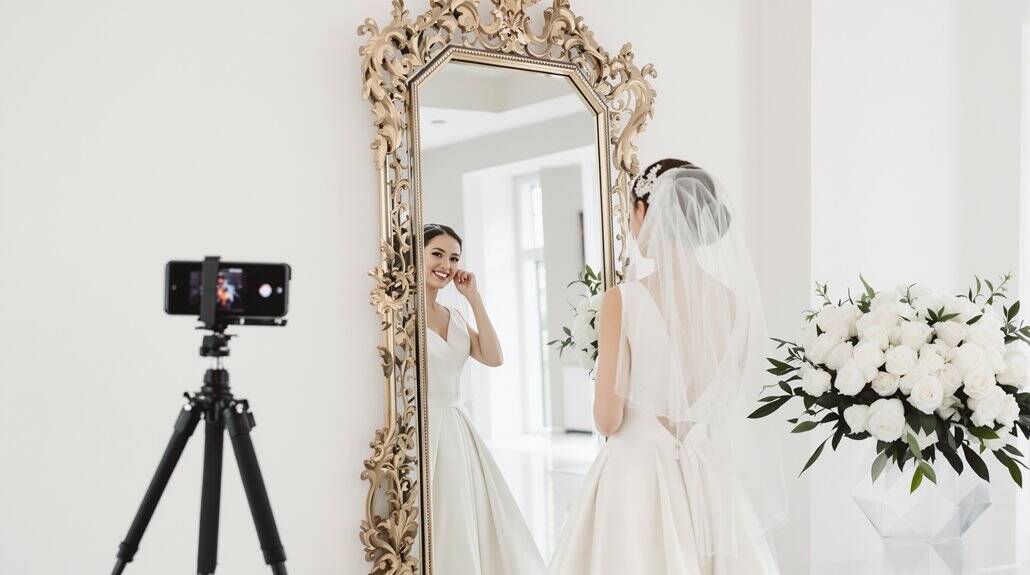
As soon as you announce your commitment, you’re thrust onto a stage you never auditioned for. The honest wedding conversation no one’s having? You’re caught between documentation obsession (83% of Gen Z prioritizes photos/videos as essential) and claims of authenticity—a paradox reflected in the 45% rise of “unplugged ceremonies” since 2017.
You’ll spend six hours weekly curating your digital wedding persona while simultaneously insisting your celebration is “totally you.” And yet, you’re statistically likely to embrace traditional performances—77% still cut cake, 85% take a spouse’s surname—while rebelling in selective ways, like abandoning identical bridesmaids’ dresses (down from 51% to 15%).
The truth? Your wedding exists in impossible tension—a performance you must document exhaustively while pretending it’s effortlessly authentic. This performance anxiety extends even to your venue aesthetics, where luxury rental furniture becomes another tool for crafting the perfect Instagram backdrop while maintaining the illusion of personal style. This tension isn’t incidental; it’s the defining characteristic of the contemporary wedding experience.
Creating Space for Complexity
Behind the Pinterest-perfect filters lies a messier reality you’re rarely permitted to acknowledge—your wedding simultaneously represents profound joy and crushing stress for 84% of couples. This paradox demands an honest wedding conversation about complexity that transcends simplistic narratives.
Your celebration exists in a multi-dimensional reality where:
- Financial pressures create genuine anxiety—74% of couples exceed their budget, with most underestimating costs by a staggering 45%
- Time investment consumes approximately 468 hours of planning (6 weekly hours across 15 months)
- Social dynamics introduce friction—45% find guest lists most stressful
- Support systems often falter—79% of brides plan everything without assistance
- Vendor relationships require navigation—57% of ultra-luxury clients negotiate scope modifications rather than simply accepting first quotes, revealing that thoughtful discussion is both common and expected
Creating space for complexity means rejecting the binary framing that weddings must be either magical or meaningless. Your experience can—and will—contain contradictions: exhilarating yet exhausting, meaningful yet manufactured, personal yet performative. The most authentic celebration acknowledges these tensions rather than erasing them.
Conclusion
Throughout this exploration of wedding discourse, we’ve peeled back layers of carefully maintained illusions to reveal what truly matters—the conversations we’re not having but desperately need.
An honest wedding conversation acknowledges financial realities without shame—yes, average celebrations cost $35,000, and no, that’s not reasonable for most. It confronts family dynamics head-on, recognizing that 68% of couples experience significant tension with relatives during planning. It examines cultural appropriation beyond surface aesthetics, questioning our entitlement to traditions we admire but don’t understand. It acknowledges the 40% divorce rate without pessimism, but with clear-eyed preparation.
Most importantly, it prioritizes authentic connection over performance. Your wedding represents a single day; your marriage, thousands. For couples navigating complex circumstances, understanding Canadian marriage and citizenship requirements adds another layer of practical consideration to the emotional journey. And yet, the industry’s $300 billion apparatus works tirelessly to reverse this equation. By demanding space for complexity and contradiction, you reclaim what matters—not a perfect wedding, but a meaningful beginning.