
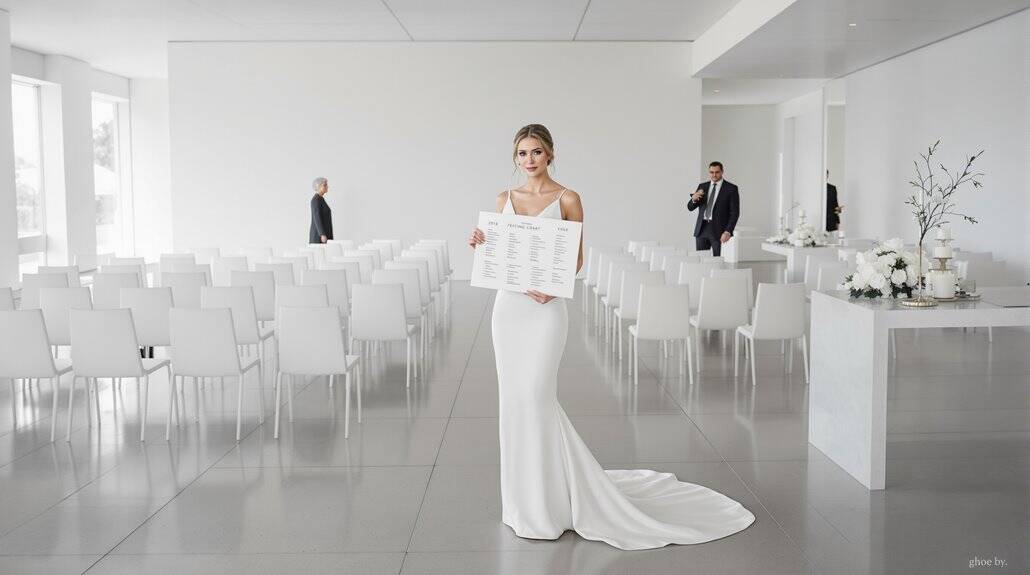
Wedding traditions aren’t self-indulgent pageantry—they’re navigational tools for your guests. When you ditch familiar signposts (processionals, cake-cutting, structured toasts), 72% of attendees feel disoriented and anxious. Your “uniqueness” often translates to their confusion. Traditional elements create predictable emotional arcs and clear social cues, transforming strangers into community through shared rituals. You can innovate thoughtfully, yes, but remember: your perfect day falls flat if everyone’s wondering what happens next.
Traditions as Guest Orientation – Essay opening
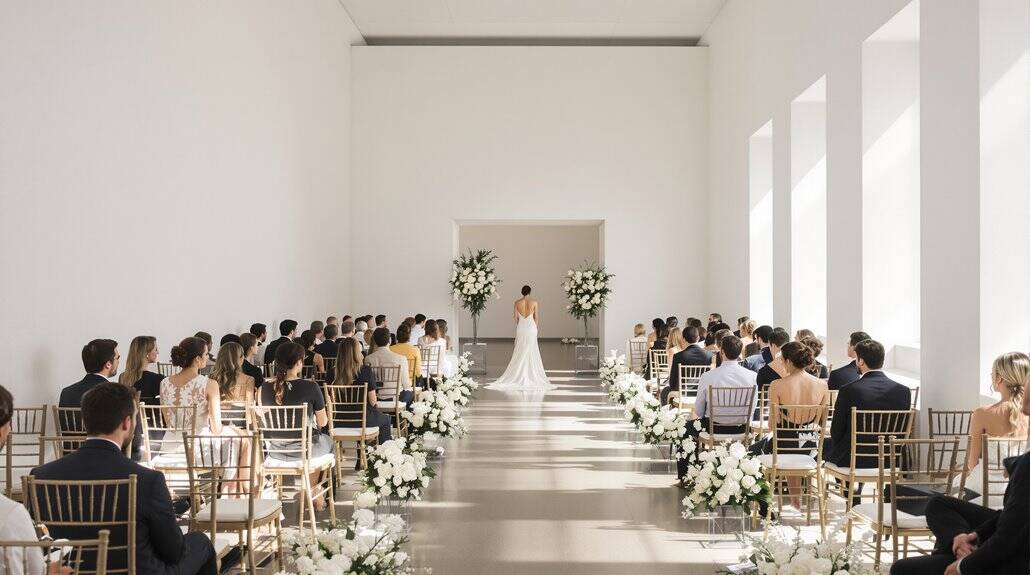
While you might think wedding traditions exist primarily to satisfy the couple’s fairy-tale fantasies, they’re actually refined social engineering tools that keep your guests from wandering around like lost puppies.
Consider this: 72% of couples rank guest comfort as their absolute top priority—above cost, above aesthetics, above personal preference. Why? Because a roomful of confused attendees makes for a tense celebration. Traditional elements—processionals, receiving lines, cake-cutting (still embraced by 77% of Gen Z couples)—aren’t just Instagram moments. They’re sophisticated waypoints that orient your guests through unfamiliar social territory.
Your processional signals who’s important. Your table assignments prevent awkward musical chairs. Your first dance (evolved from aristocratic balls where guests of honor initiated dancing) gives everyone permission to join the celebration. And yet, these traditions deliver something deeper: predictability in an emotionally charged environment where 116 strangers (the national average guest count) are navigating complex social dynamics. Much like how minimalist design eliminates visual confusion by focusing on essential elements, wedding traditions strip away social ambiguity by providing clear behavioral cues. This is particularly significant as 96% of couples feel grateful to celebrate in person with loved ones after years of pandemic restrictions.
How Rituals Orient Audience
Those orientation markers that guide your guests don’t happen by accident—they’re the product of centuries-refined social choreography. When 79% of married adults approve of ring exchanges and 73% support the first dance, they’re embracing traditions for guests that create a cognitive map of the celebration. Your receiving line? It establishes hierarchy. The bouquet toss? It signals the reception’s approaching conclusion.
Consider what happens without these signposts: guests wander aimlessly between activities, unsure when to sit, stand, or expect food. They feel disoriented, even anxious. The formal dress code (preferred by 14%) isn’t mere superficial pageantry but creates visual coherence and behavioral expectations. Throughout history, wedding customs have evolved alongside broader cultural shifts, adapting to serve both couples and their communities. Weddings function primarily as social performances emphasizing spectacle and visual appeal rather than reflecting the couple’s intimate relationship.
And yet, these same traditions causing some brides “extreme pressure to perform” are being reimagined. Celebrant-led ceremonies (showing a 49% search increase) offer couple-centered alternatives without abandoning the orienting function guests need. The ritual remains, but its performance pressure diminishes.
Completely Non-Traditional: Guest Confusion
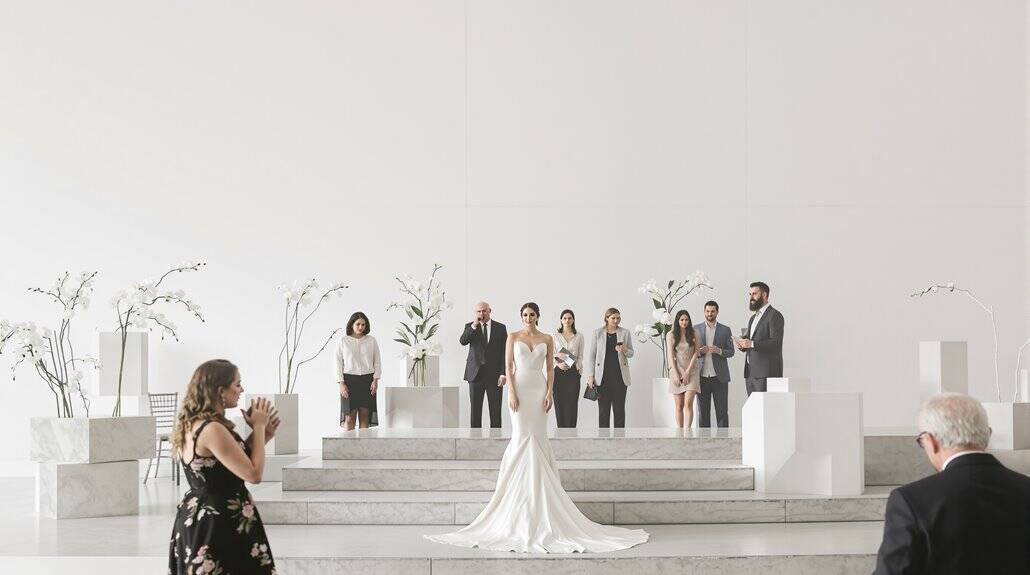
Despite the allure of throwing convention to the wind, completely non-traditional weddings often leave guests adrift in a sea of uncertainty. You’ve imagined this gloriously unique celebration, but your attendees—those people you’ve specifically invited to witness your commitment—are frantically searching for familiar contact points that simply aren’t there.
Consider the facts: 75% of guests prioritize food yet feel bewildered when uncertain about dinner timing. They’ve invested effort finding your wedding website, only to arrive at a venue lacking directional signage or programs explaining unfamiliar elements. Without assigned seating, they awkwardly hover between tables, unsure where they belong. That gap between your ceremony and reception? It’s not “free time”—it’s confusion.
Wedding traditions—processionals, receiving lines, announced first dances—aren’t arbitrary constraints but rather navigational tools that orient your guests. They’re silent instructions that transform strangers into a cohesive community celebrating your union. Strategic luxury rental furniture placement can help establish those familiar spatial cues that guide guests naturally through your event, even when you’re reimagining other traditional elements.
Balancing Innovation with Orientation
Striking the perfect balance between innovation and familiarity represents the central challenge for modern couples steering today’s sped-up wedding trend terrain. Your guests crave both: the thrill of something fresh and the comfort of knowing what comes next. This ritual-innovation tension defines successful celebrations.
| Element | Traditional Function | Modern Adaptation |
|---|---|---|
| Processional | Signals ceremony start | Personalized music, varied entry order |
| Receiving Line | Ensures guest acknowledgment | Interactive photo stations, rotating host tables |
| Meal Service | Provides structure | Food stations, timed courses with announcements |
You’ll find the sweet spot when you update traditions rather than abandoning them completely. Remember: 87% of guests report feeling more comfortable when key orientation moments remain intact, even if reinvented. Your TikTok-inspired floral installation creates memorable photos, but without clear signaling for meal service or first dance timing, guests experience disorientation rather than delight. Innovation thrives within structures guests understand. Just as luxury beauty products require both quality ingredients and elegant presentation, your wedding needs substance beneath the style.
Tradition as Hospitality Not Obligation
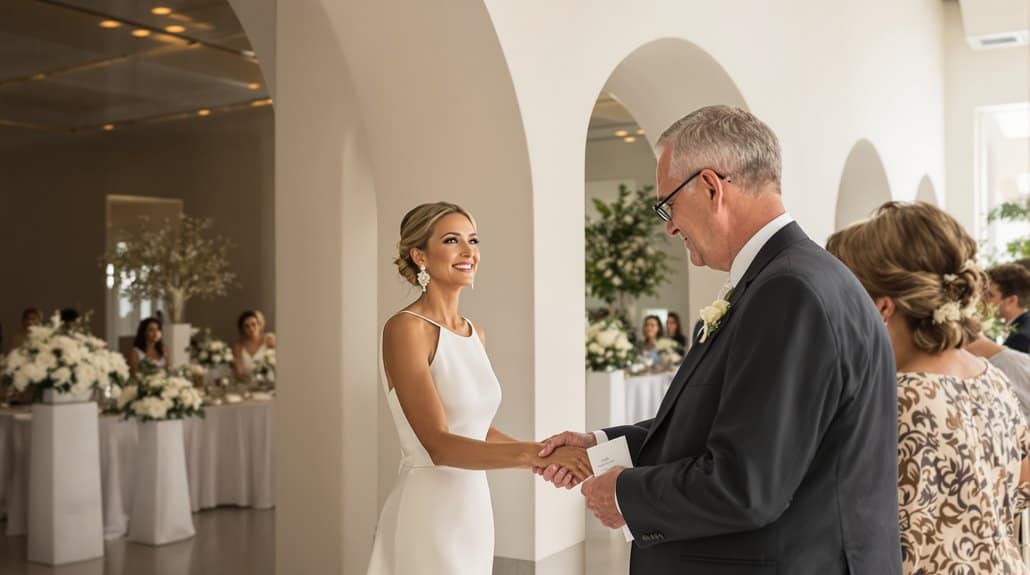
While balancing tradition and innovation sets the structure for your celebration, reframing traditions as hospitality tools—not obligatory checkboxes—transforms how you’ll approach your wedding day entirely. Your guests aren’t keeping score of which traditions you include; they’re seeking connection and comfort. Every tradition serves audience needs first, your aesthetic vision second.
Consider what your information discloses:
- 63% of guests prioritize catching up with family—traditions creating social spaces aren’t frivolous, they’re essential
- Single guests report 15% less joy than coupled ones—inclusive traditions matter profoundly
- Food quality (64%) trumps decor in guest satisfaction—practical hospitality outweighs visual perfection
- 25% of guests stress about not knowing others—introduction-facilitating traditions directly serve their experience
Those regional Southern traditions emphasizing extended family aren’t archaic—they’re hospitality incarnate. And yet, obligation-driven traditions that don’t actually serve anyone? Those deserve reconsideration, replaced with intentional hospitality that puts guest comfort first. Oscar de la Renta’s bridal philosophy demonstrates how honoring tradition through elevated design creates comfort without sacrificing sophistication.
Which Traditions Actually Serve Guests
When we examine which wedding traditions truly improve the guest experience, a critical pattern emerges: the most worthwhile traditions aren’t necessarily the most photogenic or Pinterest-worthy—they’re the ones creating structure, meaning, and connection.
Consider the interactive rituals that transform strangers into community: the Hora lifting newlyweds while guests dance in protective circles, or the money dance creating one-on-one moments with the couple. These aren’t empty performances but acts of hospitality that orient your guests in unfamiliar spaces.
Interactive wedding rituals aren’t mere performances—they’re profound moments of connection that transform scattered attendees into a meaningful community.
The sequenced toasts from best man to family members offer predictable emotional arcs. Shared food traditions—whether Italian multi-course feasts or symbolic Chinese dishes representing longevity—create common ground through collective experience.
Remember: guests crave context. When including cultural elements like the Kiddush cup or Tallit ceremony, provide brief explanations in programs. Your wedding traditions aren’t performative obligations but rather thoughtful structures that help guests feel included, informed, and emotionally invested. The core function of these rituals is transforming individuals into a united partnership witnessed by your community, making everyone present feel they’ve participated in something historically significant.
Conclusion
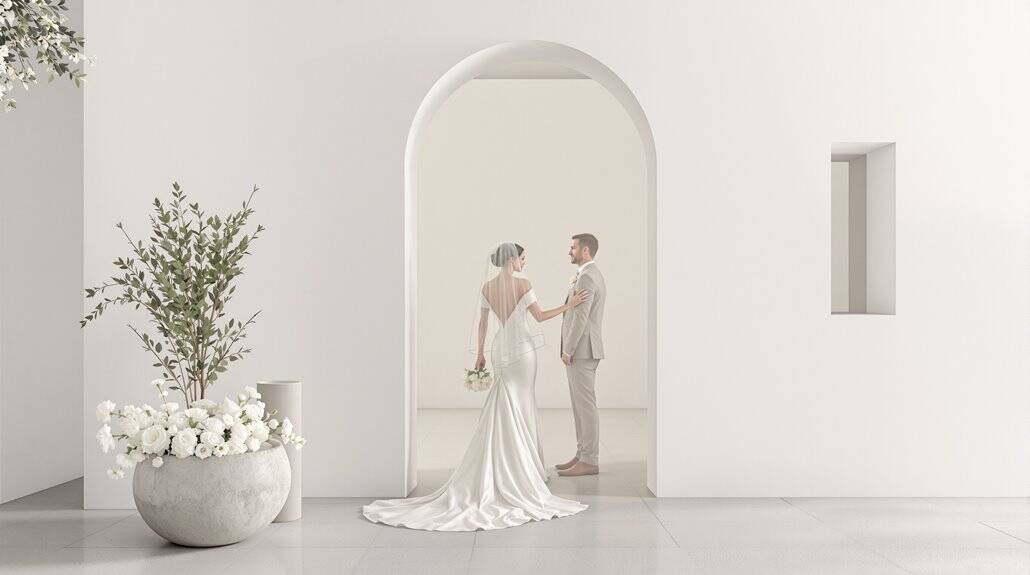
Throughout this exploration of wedding traditions, you’ve likely noticed a fundamental truth about celebrations that truly *strike a chord*: they’re designed with guests in mind, not just the couple. The processional, receiving line, and bouquet toss aren’t arbitrary rituals—they’re navigational tools, orienting your loved ones through an emotionally charged day.
When planning your wedding, remember these guest-centric principles:
- Structure creates comfort—traditions provide a roadmap when emotions run high
- Signposting matters—clear cues help guests know when to stand, sit, or celebrate
- Context builds connection—introducing important people helps everyone feel included
- Timing expectations reduce anxiety—sequential traditions pace the experience naturally
You can absolutely craft a wedding that reflects your unique relationship. And yet, abandoning all traditions often leaves guests adrift in a sea of uncertainty. The most memorable celebrations balance personal expression with thoughtful structure—honoring both your story and your guests’ experience.
Just as advanced skincare requires thoughtful formulation to achieve optimal results, a well-designed wedding ceremony needs careful consideration of each element to create a comfortable experience for everyone present.