

Creating meaningful secular ceremonies requires crafting a deliberate arc—processional, welcome, readings, vows, exchange, pronouncement—that guides emotional flow. You’ll need tangible rituals (sand pouring, candle lighting, tree planting) to transform abstract promises into visceral experiences. Choose readings that reflect authentic relationship values, not prepackaged sentiment. Poetry, literature, and nature metaphors work beautifully. Combine declarative finality with forward-looking optimism in your conclusion. Your ceremony’s power lies in intentional symbolism and shared human values, not divine authority.
The Secular Ceremony Challenge
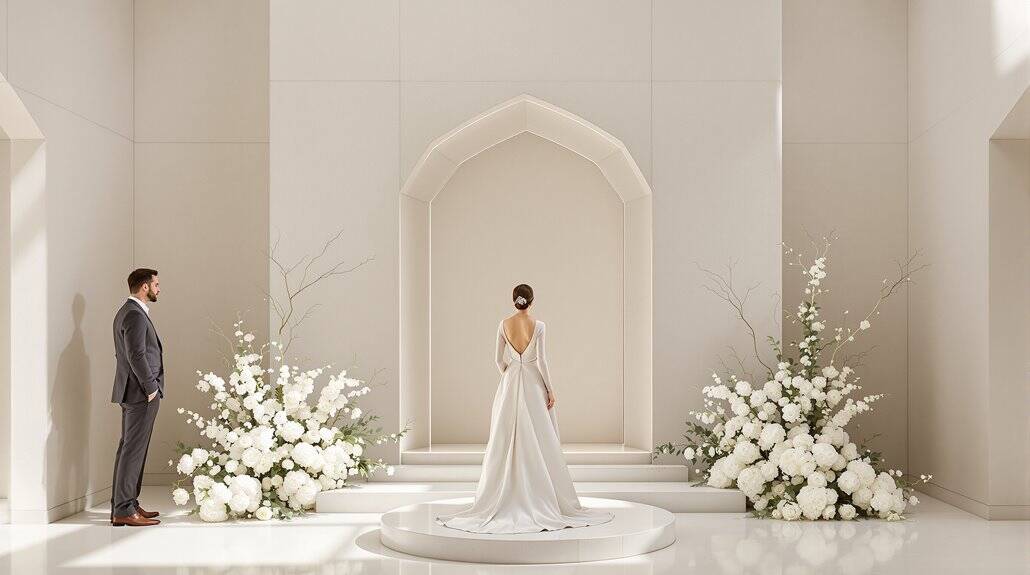
Increasingly, contemporary couples find themselves steering uncharted ceremonial waters. With religious ceremonies plummeting by 48% in Anglican churches and 49% of weddings now entirely secular, you’re part of a massive cultural shift—and yet, this freedom comes with significant challenges. Secular ceremony planning requires building meaning without inherited structures, a task both liberating and formidable.
Consider the numbers: only 30% of Americans married this decade had religious ceremonies, down from what was once the overwhelming majority. You’re creating from scratch what generations before received intact. This explains why personalization has become paramount—not merely aesthetic preference but existential necessity.
The 291% explosion in civil marriages at alternative venues reflects your cohort’s determination to craft ceremonies with authentic significance. The preference for venues like the Bodleian Library, which conducts 50-60 weddings annually, demonstrates the growing appeal of locations with historical gravitas but without religious requirements. But authenticity demands work. Without religious scaffolding, you must deliberately construct ritual architecture that honors your values while still delivering the gravitas a life transition demands. Just as brands like Chanel have mastered the art of creating elegance and glamour through deliberate curation, couples now face the challenge of crafting ceremonial moments that feel both beautiful and meaningful without traditional frameworks.
Building Ceremony Arc Without Religious Structure
Five essential components form the backbone of every successful secular ceremony, whether you’re planning a wedding in a converted warehouse or a commitment ceremony atop a mountain. These pillars—processional, welcome remarks, vow exchange, ring exchange, and pronouncement—create structure without religious scaffolding. They’re non-negotiable elements in secular ceremony planning, your framework for everything else.
Between these foundations, weave your unique narrative. Share your love story during welcome remarks—how you met, why you fell in love, what you value. This storytelling creates meaning where religious doctrine might otherwise serve. Then, strategically place 2-3 readings performed by loved ones before vows to build emotional momentum.
Pacing matters tremendously, yet remains overlooked. Arrange unity ceremonies (sand pouring, love locks) after vows but before pronouncement, creating a natural crescendo effect. Consider adding musical performances or meaningful songs that reflect your relationship to further enhance the emotional journey. Your ceremony should feel like an emotional journey—building, peaking, and resolving—without relying on scripture for its architecture. The ceremony arc you create functions similarly to how architectural style shapes atmosphere in venue selection, providing structure that guides guest experience from beginning to pronouncement.
Non-Religious Ritual Options
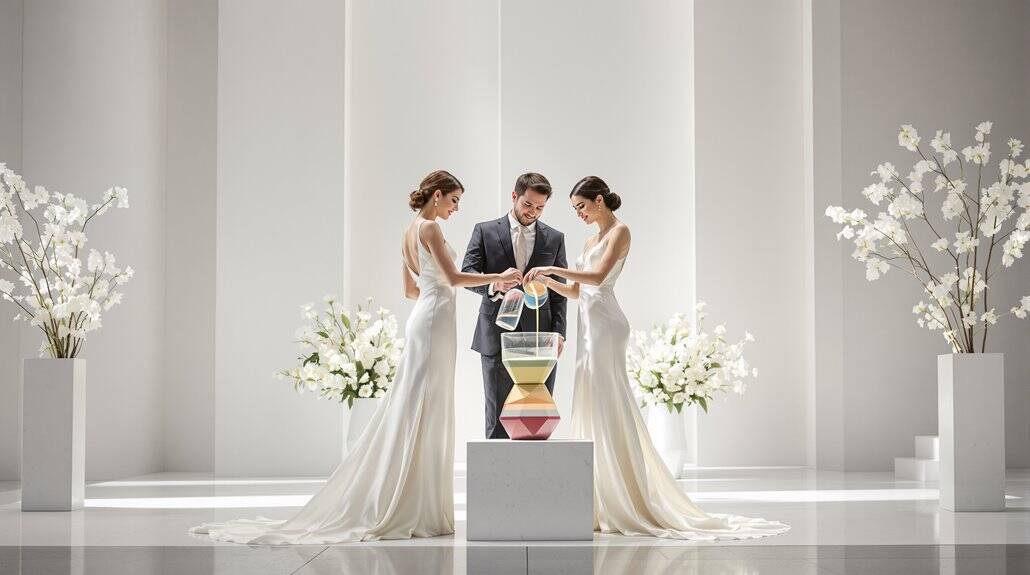
With structure established, your attention now turns to what will make your ceremony distinctly yours—meaningful, non-religious rituals that speak to your shared values.
The most powerful non-religious wedding moments arise from symbolic actions that transcend the need for deity-focused traditions. Consider unity rituals: pouring two colored sands into one vessel (perfect for blended families), lighting a central candle from your individual flames, or planting a sapling together—physical metaphors for your union that guests witness in real time.
Meaning emerges through shared action—create your love story through rituals that show, not tell, the commitment you’re making.
For honoring absent loved ones, create a remembrance table with photos, observe a moment of silence, or have names read aloud during the ceremony itself, not relegated to reception mentions.
And yet, the most distinctive rituals look forward. Time capsules and anniversary boxes—containing letters to your future selves, sealed during your ceremony—create a bridge between this day and the relationship you’re building, ritual that transforms into tradition with each passing year. Once you’ve finalized these ceremonial elements, consider how letterpress printing on high-quality paper can elevate your invitations to reflect the intentionality you’re bringing to every aspect of your celebration.
Readings That Resonate Without Scripture
Selecting readings that echo your authentic voice represents perhaps the most intellectually rewarding challenge in ceremony design—finding texts that speak universal truths without invoking divine authority. When crafting secular ceremony ideas, you’re building meaning from scratch—a formidable freedom.
| Source Category | Example Text | Emotional Register |
|---|---|---|
| Poetry Classics | Shakespeare’s “Sonnet 116” | Steadfast, enduring |
| Contemporary Lit | Coelho’s *The Alchemist* | Aspirational growth |
| Nature Metaphor | Shelley’s “Love’s Philosophy” | Cosmic inevitability |
| Modern Accessible | “I Choose You” by Bareilles | Active commitment |
You’ll find certain threads running through secular readings that work—celestial imagery connecting you to something larger, water metaphors suggesting continuity, botanical references implying growth. But the most resonant selections aren’t just beautiful—they’re true to your actual relationship, reflecting the specific gravity of your connection rather than pre-packaged sentiment. These readings serve as intentional acts of bonding, transforming the moment from simple declaration into witnessed partnership rooted in shared values rather than doctrine.
Creating Gravitas Through Intention
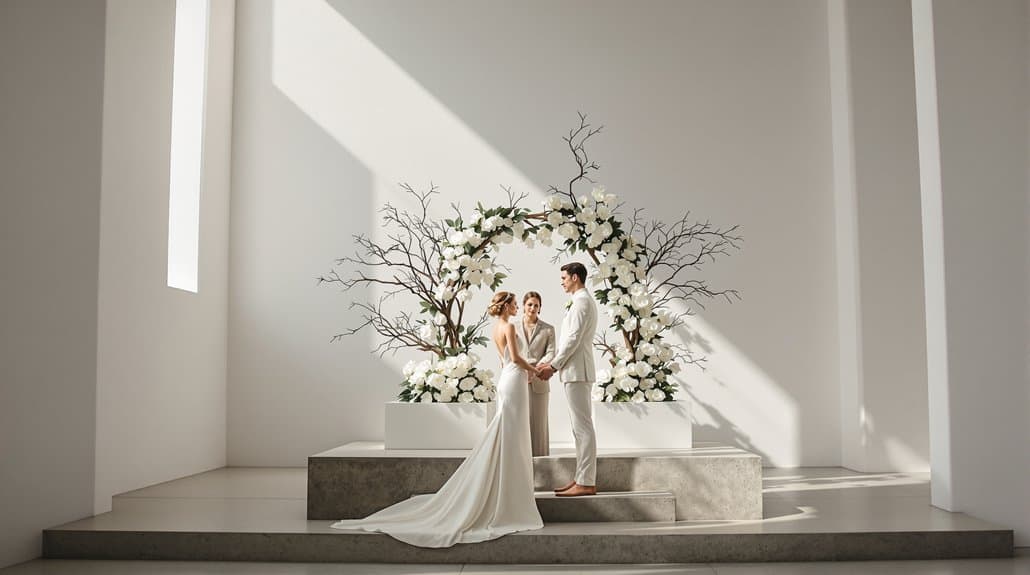
While finding the perfect readings establishes your intellectual foundation, gravitas emerges from something far more elemental—intentionality. A secular wedding ceremony gains its weight not from divine authority but from deliberate human choice: yours.
Begin by crafting a declaration of intent that speaks raw truth—”I choose you, knowingly and without reservation”—rather than empty platitudes. Structure your ceremony as a narrative arc with distinct movements, building emotional momentum like a well-composed symphony. This isn’t accidental; it’s architectural.
Words spoken without conviction are merely air. The architecture of your vows determines their gravity.
Consider integrating community-affirming rituals—ring warmings where fifty hands bless your bands, moments of collective silence, shared recitations—that transform passive observers into active witnesses. Your officiant should explicitly state their legal authority, anchoring the proceedings in civic tradition rather than religious convention.
The most powerful secular ceremonies don’t apologize for what they lack but celebrate what they possess: authentic human connection, displayed with unapologetic intention. Focus on atmosphere and connection—the elements that 97% of guests actually remember—rather than obsessing over ceremonial minutiae that fade from memory within hours.
Secular Ceremony Examples
How exactly do you infuse meaning into a ceremony stripped of religious scaffolding? Your secular wedding ceremony doesn’t need divine intervention to create profound significance—it needs intentional symbolism that speaks to your unique bond.
| Ritual | Symbolism | Execution | Impact |
|---|---|---|---|
| Sand Blending | Merged lives | Pour colored sand into clear vase | Visually striking, permanent |
| Handfasting | Ancient bonding | Wrap hands with meaningful cords | Tactile, intimate connection |
| Anniversary Box | Future commitment | Lock letters and wine for first anniversary | Creates anticipation, ritual |
| Tree Planting | Growing relationship | Each partner adds soil to sapling | Living emblem of union |
These rituals work because they’re visceral—you’re physically creating something together. They transform abstract commitments into tangible actions. And yet, the power lies not in the ritual itself but in the intention you bring. The most memorable ceremonies often blend multiple elements, creating layers of meaning that resonate with your specific journey together. Just as structural installations transform venue atmospheres through careful planning and specialized execution, these ceremony rituals require thoughtful preparation to create the emotional impact you’re seeking.
Conclusion
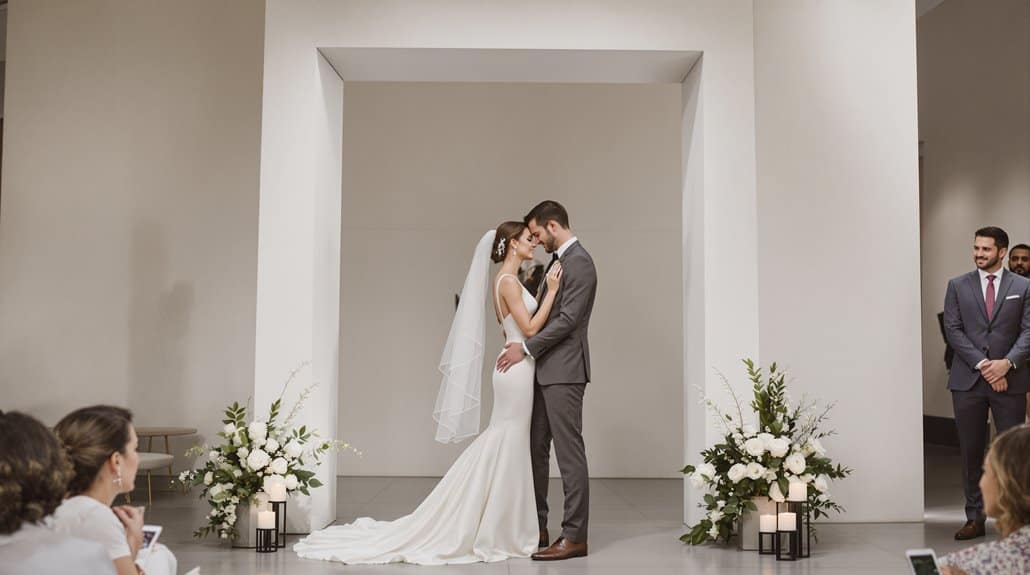
The final moments of a secular ceremony crystallize everything that came before into something greater than the sum of its parts. Your pronouncement, blessing, witness acknowledgment, symbolic act, and community presentation—these five elements transform a legal procedure into an emotionally resonant milestone. They build a scaffold of meaning just as sturdy as any religious structure, but one that’s uniquely yours.
Creating a secular wedding ceremony isn’t about subtracting religious elements, but rather about deliberately constructing meaning through words and actions that reflect your authentic values. The most powerful conclusions combine declarative finality (“you are now joined”) with forward-looking optimism (“may your connection grow exponentially”). And yet, the most memorable element is often the simplest: that moment when you’re presented to your community with new titles, new rings, new promises—a secular transition no less profound than any sacred one. Consider providing wedding programs to help guests understand the significance of each element in your ceremony structure, especially if you’ve incorporated meaningful symbolic acts that deserve context. Your ceremony ends exactly where your partnership begins.