
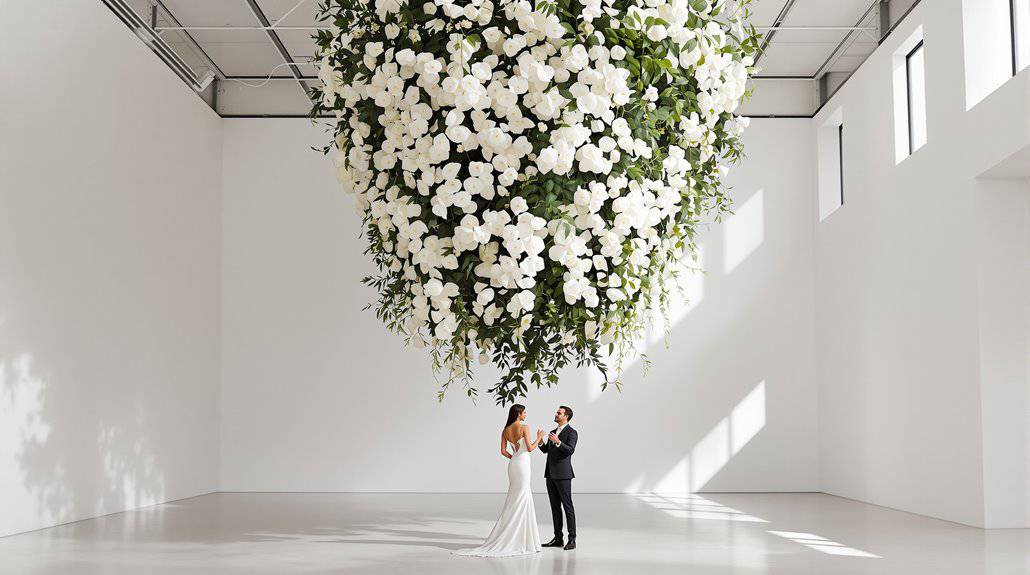
You’ve been making a fundamental category error. Floral installations aren’t “decorations” but spatial architecture that transforms environments—they deserve 15-18% of your budget, not the traditional 8-10%. They’re architectural interventions that reshape perception, create immersive worlds, and define movement patterns—more comparable to lighting design than centerpieces. Your guests experience environments, not just pretty flowers. This shift in perspective demands extended planning timelines, technical expertise, and infrastructure investment. The transformation justifies every penny.
The Budget Category Error – Essay opening
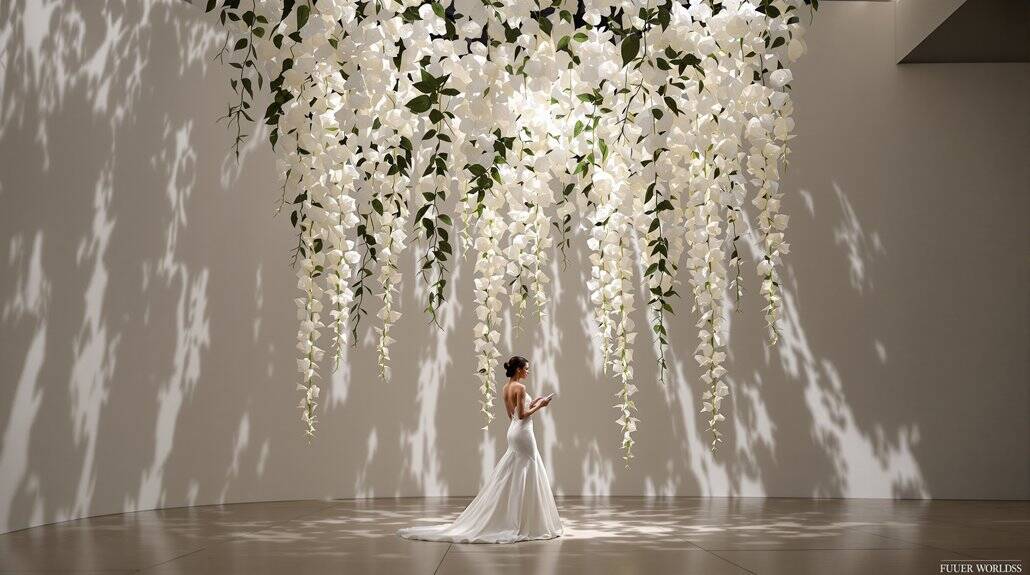
While most couples carefully allocate funds for centerpieces, ceremony arrangements, and bouquets, they’re fundamentally misunderstanding what makes wedding florals transformative. You’ve categorized incorrectly from the start—thinking of flowers as objects rather than architectural elements transforming physical space.
This isn’t merely semantic. Your floral budget strategy should prioritize installations that redefine how guests experience your venue, not just decorate it. When 150 people fill that “perfect” industrial loft, it suddenly feels cavernous, impersonal. The solution? Tactical floral installation investment creating spatial division, focal points, and emotional intimacy.
Consider this: $3,000 spent on bridesmaids’ bouquets impacts seven people holding them, while that same budget directed toward a dramatic ceiling installation affects every single guest’s experience. It’s mathematics, psychology, and spatial design principles at work simultaneously—not just “pretty flowers.” And yet, most couples reflexively allocate based on tradition rather than spatial impact, undermining their own vision while wondering why their venue feels underwhelming. Large-scale installations costing between $800-$1,500 can completely transform outdoor or industrial venues into dramatic, atmospheric environments. Like photography-optimized makeup that must perform under professional camera conditions, floral installations require technical considerations for how they’ll appear in your lasting wedding imagery.
Florals as Decoration vs Spatial Design
Beyond the surface understanding of “pretty flowers,” fundamental differences separate decorative florals from true spatial design—differences that’ll transform your entire wedding environment. When you invest in floral installations rather than mere arrangements, you’re purchasing architectural elements that redefine your venue’s very geometry.
| Aspect | Decoration | Spatial Design |
|---|---|---|
| Function | Enhances existing spaces | Transforms entire environments |
| Scale | Confined to vessels | Occupies three-dimensional planes |
| Impact | Adds beauty to designated spots | Reshapes how guests perceive space |
The installation vs arrangement distinction isn’t semantic—it’s experiential. Your guests won’t remember individual centerpieces, but they’ll never forget walking through a suspended garden of wild meadow flowers overhead, or exchanging vows beneath an architectural structure that seems to defy gravity. Architectural floral installations prioritize strong linear components that establish frameworks similar to buildings, creating purposeful negative space rather than merely filling areas with flowers. Consider sculptural elements like curly willow intertwined with orchids for ceremony frameworks that create elegant vertical interest and redefine the spatial boundaries of your venue. Floral installation value transcends the decorative; it creates immersive worlds where your celebration unfolds.
Installation as Experience Investment
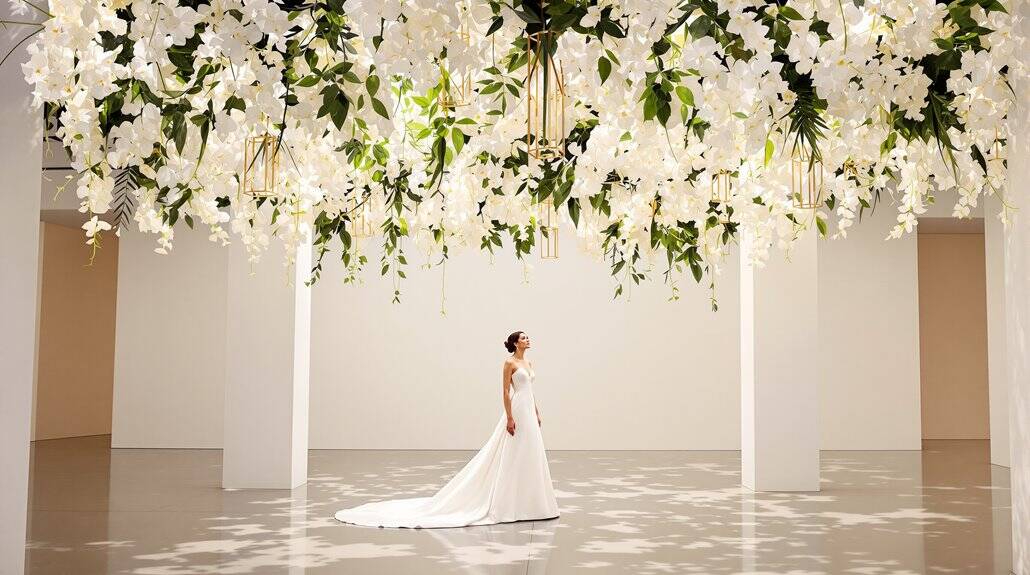
Instead of viewing floral installations as merely expensive decorations, you’re actually funding revolutionary experiences that yield returns far beyond visual appeal. When 78% of attendees report enhanced event experiences through custom floristry, you’re not buying flowers—you’re purchasing memories. This isn’t frivolous; it’s strategic.
Your floral installation value manifests in multi-sensory environments that transform ordinary spaces into extraordinary narratives. Think suspended arrangements creating floating gardens overhead, biophilic designs fostering human-nature connections, or interactive flower bars extending engagement beyond passive observation. And yet, the investment compounds further: these flowers spatial design elements become content engines, generating social media moments that extend your event’s reach exponentially.
The installation design investment pays dividends through brand amplification, attendee satisfaction, and technological innovation. VR previsualization reduces costly mistakes; AR applications ensure perfect spatial integration. These aren’t decorative afterthoughts—they’re experiential foundations worth every penny of their dedicated budget line. Like historic venues where architectural beauty can mask operational challenges, spectacular floral installations require proper infrastructure planning to ensure structural supports can handle suspended arrangements and rigging points.
Comparable to Lighting Not Centerpieces
Comparing floral installations to centerpieces misses their fundamental purpose—they’re actually lighting’s spiritual twin. Both transform entire spaces rather than merely decorating them. When you invest in a suspended meadow installation or a 16-foot-tall tree construct, you’re not buying prettier table décor; you’re engineering a complete spatial intervention that alters how guests experience your venue.
Like lighting design, floral installations demand technical infrastructure—weight calculations, mounting systems, venue assessments—and create immersive atmospheres that define movement patterns and emotional responses throughout your event. They establish visual hierarchies and direct attention, not unlike how a professional lighting designer layers ambient, task, and accent illumination.
The floral installation value derives from this spatial transformation capability. You wouldn’t budget lighting as an afterthought, relegated to “we’ll see what’s left.” And yet most couples treat dramatic floral architecture as optional flourish rather than the foundational spatial design element it truly is.
Repositioning Floral Installation Budget
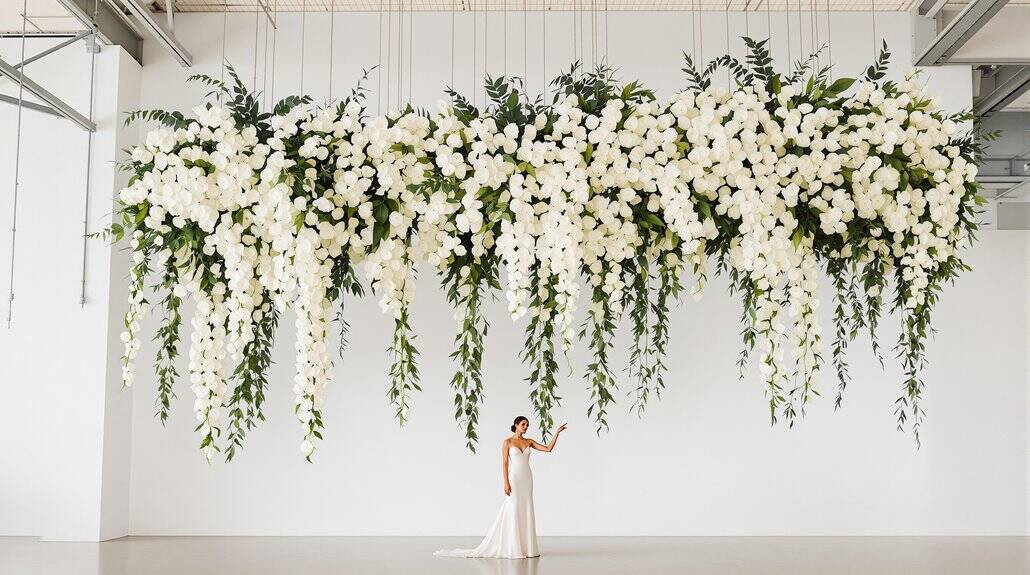
While most couples allocate just 8-10% of their wedding budget to florals, this traditional industry standard fundamentally misunderstands the spatial power of sophisticated installations. You’re not simply buying stems—you’re investing in atmospheric transformation, architectural presence, and immersive guest experience. The floral installation investment should command 15-20% of your total budget when prioritizing spatial impact.
| Installation Type | Cost Range | Venue Size | Guest Impact | Budget % |
|---|---|---|---|---|
| Ceremony Arch | $800-1,500 | All | High | 3-5% |
| Statement Backdrop | $2,000-5,000 | Medium-Large | Very High | 5-10% |
| Hanging Installation | $1,500-3,000 | Any | Remarkable | 4-8% |
| Entry Moment | $800-2,500 | Large | First Impression | 3-6% |
| Full Room Design | $3,000-8,000+ | All | Revolutionary | 8-15% |
Consider this flowers spatial design redistribution: 60% installations, 40% personal florals. In vast spaces hosting 150+ guests, a $2,000 installation delivers more floral installation value than twenty $100 centerpieces—and yet costs the same. The largest budget portions are often allocated to invisible elements like conditioning, structural expertise, and cultivated farm relationships that ensure extended vase life and installation integrity.
Architecture-Level Decision Making
Successful floral installations demand you think beyond individual elements to embrace full spatial composition—not just what flowers you’ll use, but how they’ll fundamentally restructure your venue’s architectural reality. You’re not merely decorating; you’re reshaping how guests perceive and interact with environment. Typical wedding budgets allocate 8-10% to florals, but transformative installations might warrant 15-18%—and deliver exponential impact.
When planning architecture-level decisions, consider:
- Sight lines and flow patterns—how guests will move through and visually experience each installation
- Vertical vs. horizontal emphasis—ceiling installations command attention differently than table designs
- Scale relativity—a 9-foot suspended arrangement reads differently in a warehouse versus a ballroom
- Negative space utilization—sometimes what you don’t fill matters most
Your venue isn’t just a container for design; it’s your primary material. The relationship between existing architectural elements and your floral interventions creates dialogue—tension, even—that elevate ordinary spaces into extraordinary experiences. Destination wedding venues, from elegant ballrooms to tropical gardens, offer diverse architectural canvases that require distinct spatial design approaches for floral installations.
What This Reframing Changes
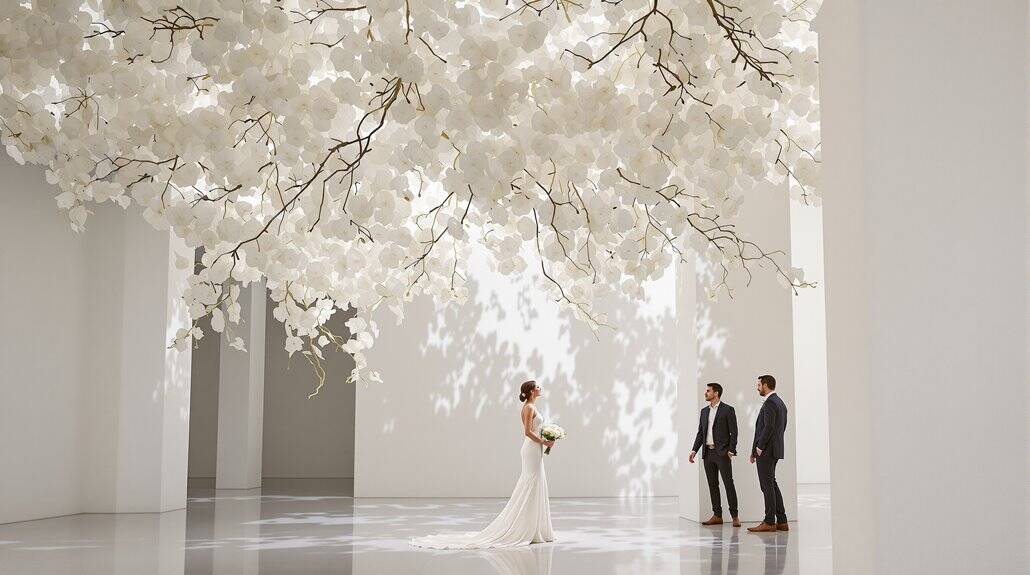
The practical implications ripple through every aspect of planning:
| Planning Dimension | Traditional Approach | Spatial Design Approach |
|---|---|---|
| Budget Allocation | 5-10% of total | 15-25% of total |
| Timeline | 1-2 weeks before | 6-8 months before |
| Team Structure | Single florist | Designer + technical team |
| Material Selection | Based on color palette | Based on spatial interaction |
| Installation Time | Hours | 1-3 days |
This isn’t merely semantic—it’s financial. When you budget for spatial design rather than decoration, you’re investing in immersive experience rather than visual accents. Your installations become architectural elements that define space rather than occupy it, transforming how guests physically move through and emotionally involve with your event. True spatial design begins with architectural context, ensuring your floral installations read the room’s inherent language and respond with botanical poetry rather than imposing decorative elements that compete for attention.
Conclusion
Reframing florals as spatial design fundamentally alters how you’ll create meaningful events—and your conclusion should reflect this conceptual schema. When you position installations as dimensional interventions rather than decorative afterthoughts, you’re not just selling prettier arrangements—you’re selling transformed experiences, emotional resonance, and environmental psychology. This paradigm shift demands a budget allocation that honors spatial design’s true value.
- Budget installations first—not as a luxury add-on after centerpieces are calculated
- Price according to spatial impact metrics, not just stem counts and labor hours
- Document installation transformations with before/during/after photography sequences
- Present proposals that articulate psychological and experiential ROI, not just visual aesthetics
Your clients aren’t buying flowers; they’re buying dimensional worlds that happen to be constructed from botanical materials. And yet, this reframing requires you to become fluent in spatial design principles—balance, scale, proportion—while maintaining your horticultural expertise. Just as luxury French beauty brands like Lancôme understand that wedding day preparation requires intentional investment in transformative results, floral installations demand the same strategic budget allocation to deliver their full experiential impact.