
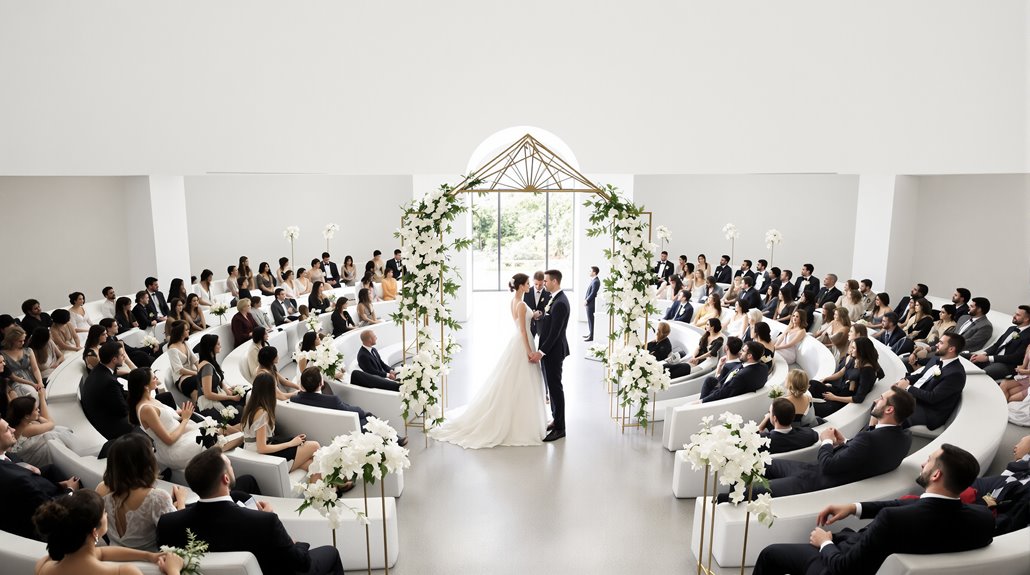
Your ceremony layout choice dramatically transforms the entire wedding experience. Traditional aisles create theatrical drama with a clear processional path, but leave some guests with restricted views. In-the-round arrangements eliminate “bad seats,” surround you with community energy, and symbolize eternal unity—yet demand complex photography logistics and create a raw vulnerability at center stage. Each configuration choreographs emotions differently: dramatic journey versus intimate embrace. The details of each setup reveal how profoundly this decision will shape your day’s emotional resonance.
Two Ceremony Configurations
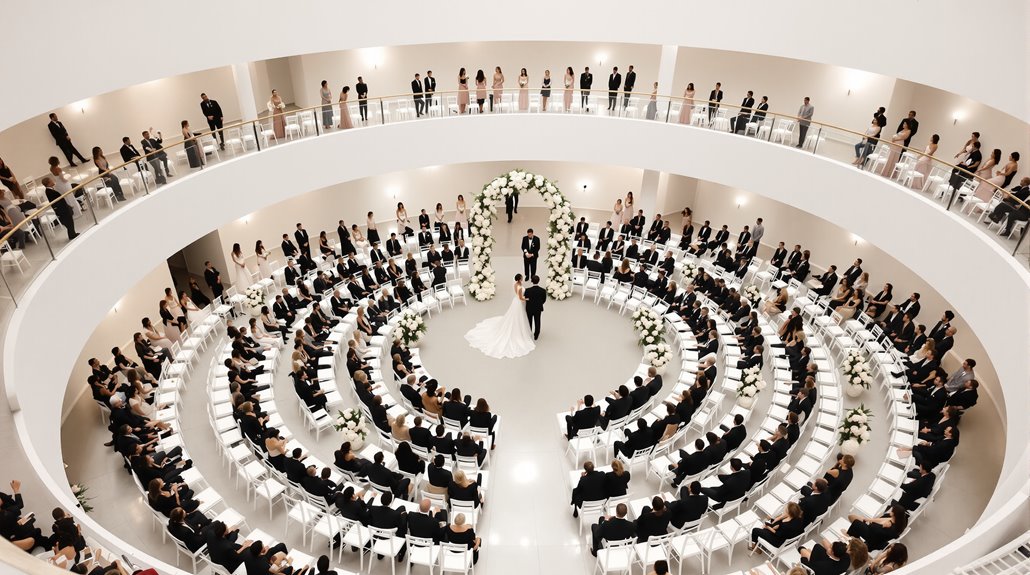
When planning your wedding ceremony, the spatial configuration you choose fundamentally reshapes the entire guest experience—yet most couples default to the traditional option without considering alternatives.
The ceremony seating layout comes down to two distinct approaches: traditional straight-aisle or in-the-round. With traditional configurations, guests observe your back while facing a singular direction, creating a theater-like experience with clear “good” and “bad” seats. And yet, ceremony in the round transforms this energetic entirely—placing you at the center of a 360-degree circle or spiral of loved ones, eliminating the hierarchy of visibility. Circular ceremonies can also represent symbolic significance through the eternal shape of the ring, mirroring your wedding bands and the endless nature of your commitment. This choice reflects a broader philosophy of quality over quantity in guest engagement, enhancing the emotional resonance of the moment.
Your ceremony spatial design choice ripples through every aspect of the day. Traditional aisles create dramatic processional moments but sacrifice visibility for many guests. Circular ceremony configuration, alternatively, ensures every attendee enjoys unobstructed views while symbolically wrapping you in community support—no more back-row guests straining to see your first kiss.
Traditional Aisle: Processional Drama and Guest Sightlines
Though nearly universal at American weddings, the traditional straight-aisle configuration creates a theatrical experience that’s simultaneously magnificent and problematic. You’re orchestrating a 3-5 minute crescendo of emotion—a carefully choreographed processional timing that builds anticipation with each participant’s entrance, culminating in that breathtaking bridal reveal. Additionally, this layout has become a focal point for emerging luxury trends that enhance the overall wedding experience.
And yet, this ceremony seating layout forces half your guests to watch your backs during the most significant moments. Those perfectly reserved front rows ensure wedding party visibility, but create an inherent asymmetry in guest sightlines. Your promenading pace (that deliberately slow, measured walking) builds dramatic tension while allowing music to span the full processional without awkward cuts.
The traditional aisle demands meticulous planning—positioning the lineup out of sight, coordinating walking speeds across participants, and arranging seating for the processional cast. Family members are typically seated with the bride’s family on the left and groom’s family on the right of the aisle. It’s the ultimate theatrical staging that sacrifices intimacy for spectacle, for better or worse.
Ceremony in the Round: Psychological Intensity
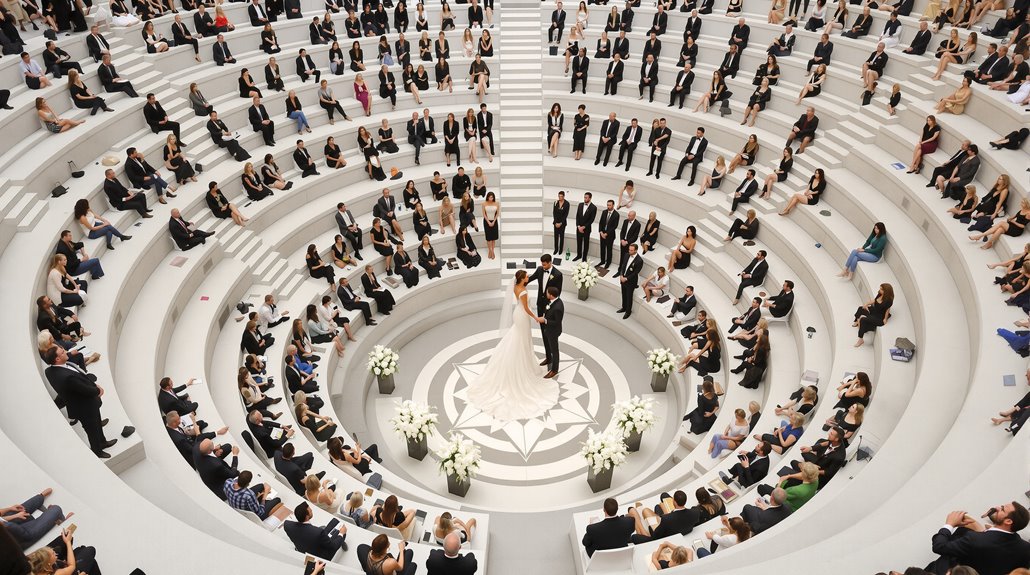
Beyond the dramatic spectacle of a traditional aisle lies a fundamentally different psychological experience—the ceremony in the round. This ceremony seating layout transforms guests from passive observers to active witnesses, eliminating the hierarchical changing where some views are “better” than others. You’re no longer watching backs; you’re part of a living circle.
The psychology shifts dramatically. When surrounded by your community in concentric circles, the emotional connection intensifies—every eye meets yours, every face visible during your vows. There’s nowhere to hide, and yet this vulnerability creates unprecedented intimacy. The spatial democracy—equal distance, equal importance—reinforces community integration through physical positioning.
What you’re creating isn’t just aesthetically distinct but psychologically revolutionary. The circular arrangement symbolizes the marriage joining entire communities, not just two people. It’s physically closer, emotionally rawer. Your witnesses don’t just see your ceremony; they physically surround your commitment with their presence. This approach not only enhances the decision-making quality of your wedding but also elevates the perceived value of the experience for all involved.
Photographer Logistics for Each Configuration
The spatial configuration of your ceremony fundamentally reshapes your photographer’s tactical approach, technical limitations, and creative possibilities. Traditional aisle ceremony seating layouts—those rows of chairs forming a corridor—allow your photographer predictable sight lines, consistent lighting considerations, and the classic processional shots we’ve all internalized. They can position themselves strategically at the front, capturing reactions with telephoto precision from respectful distances.
And yet, ceremony in the round transforms everything. Your photographer must navigate a 360° environment where they’re potentially always in someone’s view (and someone’s photo). They’ll need multiple camera bodies, ultra-wide lenses for intimate circular compositions, and a nimble, almost choreographed movement strategy to capture moments without becoming the show themselves. Lighting considerations become exponentially complex—shadows cast differently, reflections multiply, exposure settings require constant adjustment.
The difference isn’t merely aesthetic but operational: one ceremony format lets photographers disappear; the other demands they become interpretive dancers, constantly calculating their next position.
Guest Experience Comparison
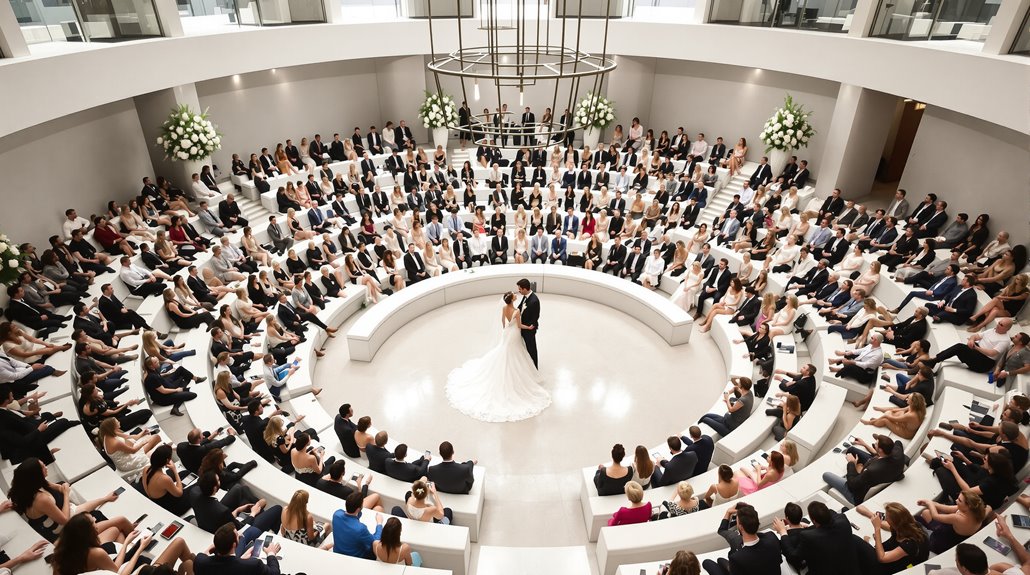
While couples often fixate on their own ceremony viewpoint, your guests’ experience fundamentally shifts based on whether they’re arranged in traditional rows or encircling you in the round. Traditional ceremony seating layout creates a clear distinction—spectators and participants, front row VIPs and back-of-house cousins twice removed. And yet, this familiar format provides comfortable navigation cues that prevent guest confusion.
Round ceremonies demolish this hierarchy, positioning every guest equidistant from your vows—all 87 witnesses experiencing identical proximity to your “I do.” They’ll remain at dining tables throughout, eliminating the dreaded 45-minute shift or changeover period between ceremony and reception. But this intimacy comes with exposure—there’s nowhere to discreetly check phones or subtly stretch cramped legs.
Your ceremony seating choice isn’t merely logistical—it’s philosophical. Traditional vs round ceremony configurations fundamentally reshape guest experience from passive observation to communal participation, from watching your back to surrounding you with support.
When Round Configuration Works Best
Round ceremonies shine brightest when your priorities align with their inherent strengths rather than forcing this configuration into incompatible scenarios. Your circular ceremony layout creates unmatched intimacy for small gatherings—guests see not just you, but each other’s emotional reactions, creating a shared experience impossible with traditional arrangements.
Consider this alternative ceremony arrangement when symbolism matters deeply: circles represent eternity and unity, perfect for ceremonies emphasizing spiritual wholeness. They’re also ideal when you’re blessed with 360-degree natural beauty—why choose a single backdrop when panoramic views await?
Surprisingly, circular ceremony seating layout works brilliantly for large guest lists, eliminating the “bad seat” problem of traditional rows. Everyone maintains direct sightlines to you, regardless of their position. And yet, this configuration demands thoughtful execution—the center becomes intensely vulnerable, with all eyes converging from every direction, creating pressure that’s simultaneously beautiful and intimidating.
When Traditional Aisle Is Superior
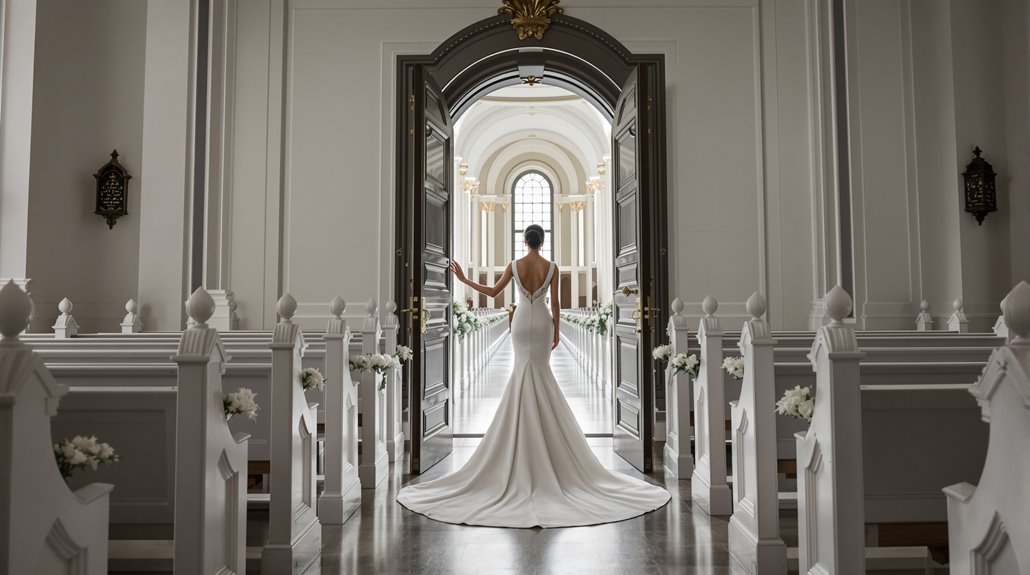
Despite the allure of ceremony-in-the-round configurations, traditional aisle setups reign supreme in several essential scenarios that shouldn’t be overlooked. Heritage venues—those magnificent, 200-year-old churches with impossibly high ceilings and predetermined seating—practically demand the classic processional format. And yet, even in blank-slate spaces, traditional aisles create a psychological runway that builds anticipation in ways circular ceremony layouts cannot.
You’ll appreciate the traditional aisle when videography matters deeply. Your cinematographer can position strategically at aisle’s end, capturing that tear-jerking moment when parents see you—impossible to replicate with 360-degree ceremony seating layouts. Acoustics, too—traditional setups ensure 92% of guests hear vows clearly without complex sound equipment.
For couples with mobility-challenged relatives or elaborate processional choreography (think: 7+ attendants), the defined traffic pattern of traditional aisles eliminates confusion. The ceremony in the round may surround you with love, but sometimes, that classic straight shot delivers exactly what matters most.
The Hybrid: Modified Arrangements
For couples who find themselves torn between tradition and innovation, a hybrid ceremony layout offers the perfect compromise—and the design possibilities extend far beyond simply angling a few chairs. Consider the horseshoe configuration: traditional rows curve gently at the front, creating a semi-circle that partially surrounds you while maintaining that iconic aisle moment. The intimacy is palpable, the sightlines improved—and yet, you don’t sacrifice the dramatic entrance.
Or perhaps try offset seating—traditional rows deliberately angled inward at 15 degrees—which subtly reorients guests toward the couple rather than forcing a straight-ahead gaze. Some couples opt for the “partial round,” where the first four rows follow traditional arrangement while remaining guests encircle in concentric arcs behind them.
These hybrids deliver the best of both worlds: the ceremonial gravitas of processing down an aisle, but with the communal energy that comes from guests witnessing your vows from multiple perspectives.
Conclusion
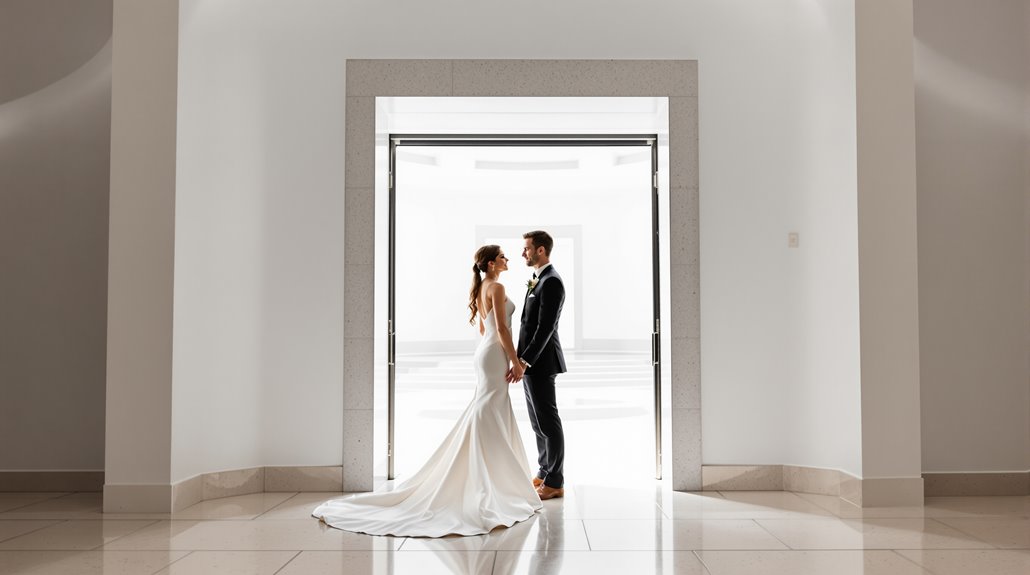
When it comes to your wedding ceremony layout, the stakes couldn’t be higher—this architectural decision shapes every emotional beat of those vital thirty minutes. The traditional aisle creates a dramatic processional with guests witnessing your journey from behind, while ceremony-in-the-round envelops you in communal energy, visible from all angles.
This isn’t merely aesthetic preference; it’s about emotional architecture. Traditional layouts honor centuries of ceremonial progression—the symbolic journey toward partnership witnessed by an audience. And yet, circular arrangements democratize the experience, eliminating hierarchical positioning and creating what many describe as a more inclusive atmosphere.
Your choice ultimately reveals your ceremonial values: Do you prize the dramatic reveal and symbolic journey of the traditional aisle? Or do you prioritize the intimate cocoon of being surrounded by your community? Both create powerful memories—just different ones. The layout you choose becomes the invisible choreographer of your ceremony’s emotional impact.