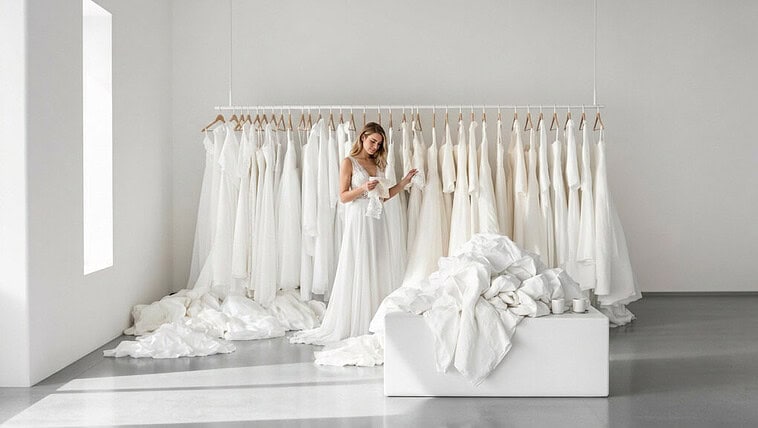
You’ll save thousands on a sample wedding gown—up to 75% on luxury designers—but factor in the hidden math. Sample dresses come with wear, limited sizing (8-12), and potential repair costs ($300-800+) that can devour your savings. Full-price offers pristine condition, customization, and peace of mind. Your best bet? Budget brides benefit at luxury price points where even post-alteration value remains substantial, while mid-range shoppers face a more complex equation.
The $5000 Savings Promise
While the promise of five-figure savings at a sample sale sounds like bridal industry hyperbole, the math checks out when you’re dealing with luxury designer territory. Consider the raw dress cost comparison: that $8,000 Vera Wang or Monique Lhuillier suddenly available for $3,000 represents exactly the $5,000 markdown that makes sample sales legendary in wedding planning circles.
The highest savings potential exists specifically in the premium category—where original price points hover between $6,000-$10,000. Your typical sample sale wedding gown delivers maximum value when it’s from last season’s runway collection, marked down 60-80% from astronomical starting prices. Such opportunities exemplify the essence of quiet luxury, where the emphasis is placed on elegant restraint rather than ostentatious displays. And yet, this isn’t universal; mid-range designers rarely offer such dramatic dollar savings. Sample sales are particularly advantageous for brides with quick wedding timelines, as these dresses are immediately available off the rack.
Is the dress sale worth it? Absolutely, if you’re targeting designers previously outside your budget. The formula works: higher original price plus aggressive percentage discount equals that coveted $5,000 savings—turning impossible dream gowns into sudden, thrilling possibilities.
Sample Sale Realities: Condition and Limitations
Those dazzling $5,000 savings come with fine print. Your sample sale wedding gown has likely been tried on by dozens—perhaps hundreds—of brides before you. Loose beading, makeup stains, frayed hems, and compromised zippers are common battle scars. You’re purchasing history, not perfection. Additionally, it’s crucial to consider your overall budget and how effective tier allocation can help you optimize your spending.
The illusion of designer savings masks reality: worn fabric, missing rhinestones, and history woven into every compromised seam.
Size options? Drastically limited. Most samples hover in street sizes 8-12, with precious few extending beyond. Most bridal shops that carry samples offer dresses that can be altered up to 2 sizes without sacrificing the gown’s structural integrity or design elements. You’ll compete with other bargain-hunters for that one dress, in that one size, in that one condition—and you cannot order modifications.
Final sale terms are brutally straightforward: what you see is precisely what you get. No returns, no exchanges, no recourse for post-purchase regret. Your “as-is” commitment requires clear-eyed acceptance of every loose thread and missing button.
The captivating discount demands trade-offs—wear and tear from multiple tryings, size constraints, and zero flexibility after purchase. Your budget must account for potentially significant alterations to address these limitations.
Alteration Costs That Reduce Savings
Behind every sample sale victory lurks a sobering financial reality—your $5,000 discount may shrink dramatically once alteration costs enter the equation. That sample sale wedding gown might require substantial work, especially when you can’t choose your size.
| Alteration Type | Regular Gown | Sample Sale Gown |
|---|---|---|
| Basic Hemming | $125-200 | $300-450 |
| Bodice Reshaping | $100-200 | $200-400+ |
| Bustle Addition | $75-150 | $150-200 |
| Beadwork Repair | Minimal | $300-500 |
Wedding dress pricing isn’t just about the tag—it’s about what follows. You’ve saved $5,000 on that $3,000 sample (versus $8,000 retail), but you’re now facing potential alterations exceeding $1,000—possibly double what you’d need for a properly sized gown. Moreover, the psychology of luxury weddings suggests that affluent couples may prioritize quality markers over initial savings. And yet, with tactical budgeting, some sample sales still represent genuine value—if, and only if, you factor these hidden costs into your initial calculations.
Full Price Advantages: Condition Sizing Customization
Sample sale savings can evaporate quickly under the reality of alteration costs, but purchasing at full price offers substantive advantages that extend far beyond the initial sticker shock. When you invest in a full price wedding dress, you’re securing pristine, unworn fabric—no mysterious stains, no stretched seams, no compromised structure from dozens of previous try-ons. Worth every penny? Absolutely.
Sizing becomes your ally, not your nemesis. Unlike the sample sale’s “take it or leave it” proposition where you’re limited to whatever sizes survived the retail gauntlet, full-price retailers stock extended ranges from 00-32, ensuring you won’t settle for “close enough.” And yet, it’s customization that truly distinguishes the full-price experience—neckline adjustments, sleeve modifications, even fabric substitutions remain gloriously available options. Those $3,000-4,000 designer gowns? They arrive with consultation services and bespoke construction possibilities that transform your dress from mass-produced to meaningfully yours.
Risk Assessment: Sample Sale Variables
While breathtaking price tags draw hopeful brides into the sample sale ecosystem, your willingness to embrace risk becomes the actual currency of exchange. That $3,000 sample sale wedding gown (versus $8,000 retail) comes with significant quality control concerns—broken stitches, loose beading, and weakened seams from countless try-ons—yet these imperfections remain invisible until thorough inspection. The final sale and return policy transforms minor oversights into permanent decisions; your signature on that receipt means accepting every hidden flaw, regardless of discovery timing.
- Condition roulette: No standardized grading system exists, leaving you dependent on retailer transparency about a dress’s journey
- Alteration uncertainty: Budgeting becomes precarious when repairs may add $500-1,000 beyond anticipated costs
- Size limitations: Your dream dress might exist only in sizes that require substantial reconstruction
Your greatest protection? A meticulous pre-purchase inspection protocol, unwavering budget discipline, and emotional preparedness to walk away when the math—financial or psychological—stops making sense.
When Sample Sales Make Financial Sense
Despite the inherent risks, sample sales transform financial impossibilities into bridal realities when the circumstances align perfectly. You’ll access designer wedding dress sample sales where $8,000 gowns suddenly cost $3,000—an indisputable mathematical victory—but only when you’ve factored every variable into your equation.
| Scenario | Sample Sale | Full Price |
|---|---|---|
| Timeline | Immediate availability | 4-6 month wait |
| Budget | 50-70% savings | Full retail + rush fees |
| Alterations | Higher potential costs | Standard adjustments |
You’re making the right call when your wedding date looms under three months away (avoiding those $500 rush fees), when you’ve found a sample that needs minimal alterations (crucial), or when that couture label you’ve obsessed over finally falls within reach. And yet—this isn’t universal math. Your body type, timeline flexibility, and alteration budget ultimately determine whether this discount represents actual savings or merely different spending.
When Full Price Is Smarter Investment
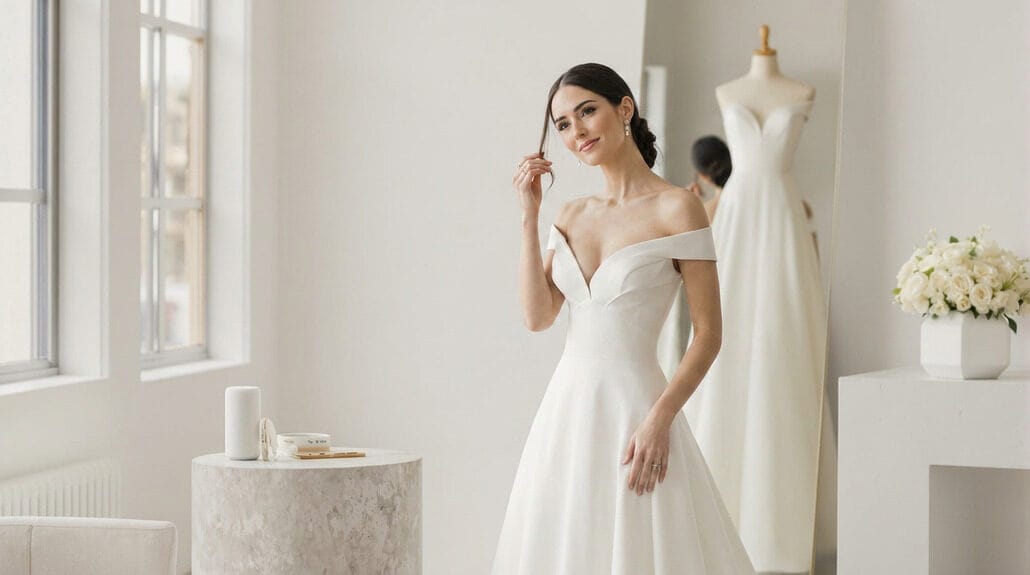
Even the most tantalizing discount finally costs more when it compromises the dress’s structure, fit, and visual impact. That sample sale wedding gown might save $5,000 upfront, but consider what you’re sacrificing: made-to-order construction that eliminates expensive bodice reconstruction, custom sizing that ensures premium fabrics drape exactly as designed, and structured details that photograph beautifully throughout your ceremony.
A bargain wedding gown often becomes the most expensive dress you’ll never want to wear again.
- Full-price gowns utilize luxury natural fibers (silk charmeuse, duchess satin) that maintain elegance throughout extended wear—something synthetic alternatives simply cannot replicate
- Made-to-order construction means avoiding the $800+ alteration nightmare typical with sample sale wedding dresses
- Designer names maintain approximately 60% resale value, compared to sample sale counterparts that, frankly, show their wear
The sample sale vs full price debate isn’t really about the initial price tag—it’s about investing in fabric quality, proper fit, and preservation potential that transforms your dress from expense to heirloom.
The Math by Dress Price Tier
Breaking down the numbers reveals why sample sales aren’t universally beneficial across all price points—they’re mathematically advantageous for specific tiers only. That sample sale wedding gown priced at $3,000 instead of $8,000 sounds irresistible, and yet, the calculations demand scrutiny beyond the sticker shock.
| Price Tier | Sample Sale Savings | Hidden Costs | Final Value |
|---|---|---|---|
| Budget (<$1,500) | 30-40% ($450-600) | Alterations: $300-500 | Minimal |
| Mid-range ($1,500-4,000) | 50-60% ($750-2,400) | Condition issues: $200-400 | Strong |
| Luxury ($4,000-10,000) | 60-75% ($2,400-7,500) | Size limitations: $600-1,200 | Excellent |
When comparing sample sale vs full price, the mid-to-luxury tiers typically yield the most substantial financial advantage. Your budget dress sample savings might evaporate entirely after necessary alterations, but that $8,000 designer creation at 65% off? Worth every compromise—even with a substantial alteration budget.
Conclusion
While the allure of sample sales promises dramatic discounts and designer names at fraction-of-retail prices, your perfect dress decision demands consideration beyond mere percentage points off the tag. The wedding dress sample sale ecosystem—chaotic, final, and restrictive—requires you to weigh condition against cost, availability against alterations, immediacy against options.
- Financial transparency – Calculate total investment (dress + alterations + cleaning) rather than focusing solely on the initial price reduction
- Personal priorities – Determine what matters most: designer label, pristine condition, perfect fit, or bottom-line savings
- Timeline realities – Consider whether your wedding date accommodates the sample sale vs full-price ordering window
You’re not simply choosing between paying $3,000 versus $8,000—you’re deciding what kind of bridal shopping experience you need. Some brides thrive in the sample sale hunt, while others require the comprehensive service journey. Trust yourself to know which bride you are.