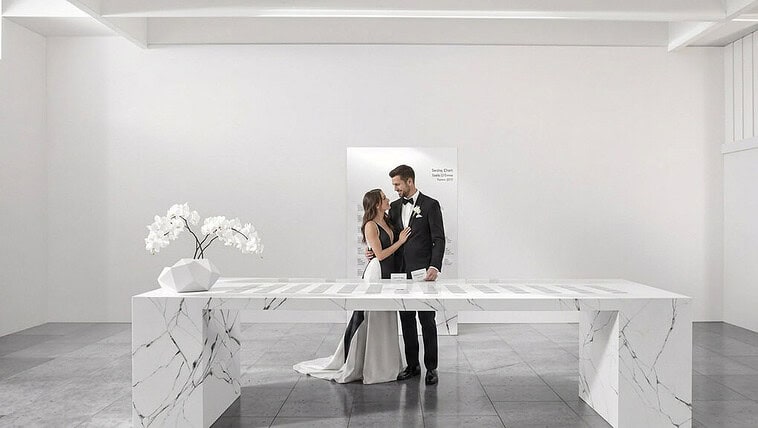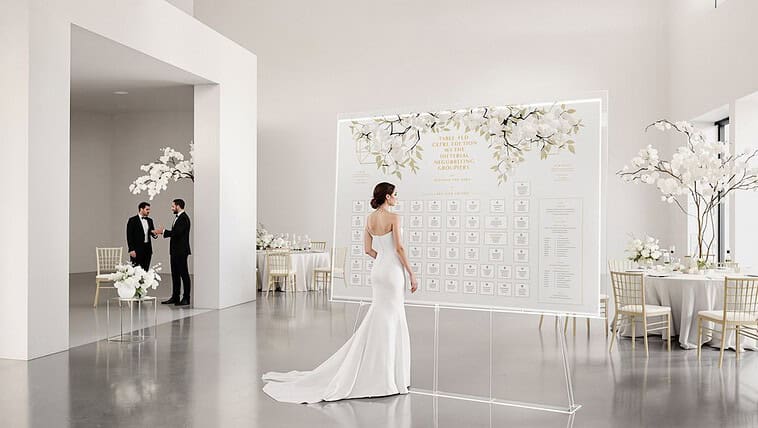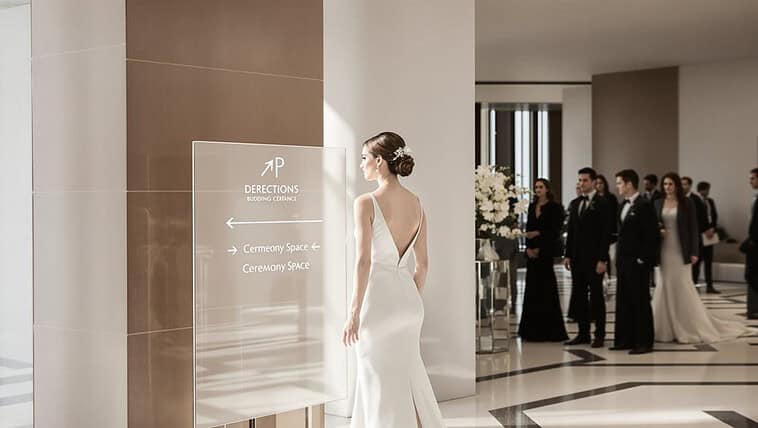
Your wedding isn’t just decorated rooms—it’s choreographed human migration through space and time. You’re not simply arranging tables; you’re orchestrating an emotional journey as guests flow from ceremony to cocktails to dinner to dancing. Each shift carries psychological weight. The best spatial designs anticipate movement patterns, create invisible pathways, and transform mechanical logistics into meaningful procession. Dance floors need proper dimensions; entrances require psychological staging; exits demand climactic framing. The physical architecture of your day shapes every memory it contains.
Static vs Temporal Design – Essay opening
When you imagine your wedding, you’re likely visualizing a photograph—a perfect, frozen moment capturing your ceremony or reception setup. But your wedding isn’t a photograph. It’s six hours of human movement through spaces: arrival, passage, congregation, migration, dispersal.
Most venue layouts treat your celebration as static art—fixed, unchanging, permanent. And yet, wedding flow design demands thinking in four dimensions, not just three. Your guests won’t stand motionless; they’ll navigate, cluster, disperse, return. Space and time wedding considerations transform your planning from decorating to choreographing. The most successful celebrations acknowledge this temporal nature, anticipating how 120 bodies will interact with your environment throughout a day that unfolds in phases, not snapshots. This approach aligns with a philosophy of quality over quantity, emphasizing meaningful interactions over mere aesthetics.
Wedding movement planning isn’t just logistics—it’s emotional architecture. How spaces transition from ceremony to cocktails to dancing shapes the entire emotional arc of your day. Truly effective wedding design incorporates adaptable environments that respond to the natural rhythms of your celebration as it progresses from intimate ceremony to energetic reception.
Wedding as Six-Hour Movement Sequence
Wedding flow design demands attention to transition points: the moment 150 bodies pivot from ceremony to cocktail hour, the spatial shift when your grand entrance transforms a static dining setup into a dynamic dance floor. Every guest journey design decision—from processional pacing to dance floor activation—shapes how people physically experience your celebration.
How effectively have you mapped the living choreography of your wedding day? Your wedding isn’t a still-life—it’s a continuous six-hour sequence of human bodies in motion: 5-10 minutes of processional, 30 minutes of ritualized exchanges, 60-90 minutes of seated dining, followed by hours of celebratory movement. Consider scheduling moments of privacy between these transitions to give yourselves time to breathe and fully experience your special day.
Temporal wedding design means recognizing those pivotal momentum shifts: the collective rise of guests before your entrance, the acoustic surge of applause after your kiss, the circular formation around your first dance. These aren’t just emotional touchpoints, but physical choreography—the living, breathing reality of bodies moving through wedding space.
Arrival and Entry Choreography
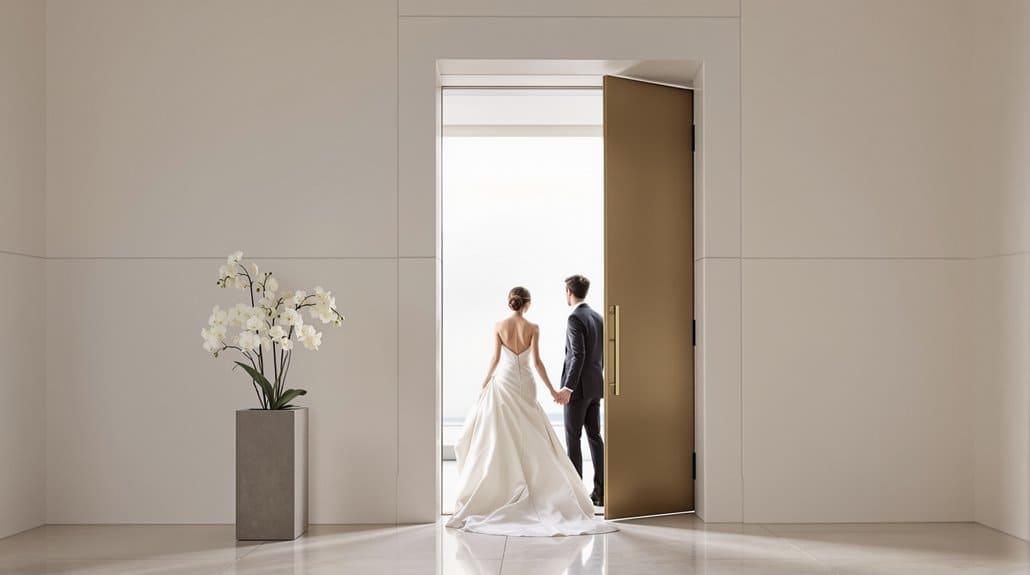
Though often reduced to a mere “grand entrance,” your arrival sequence constitutes the most psychologically potent five minutes of your entire wedding day. It’s where wedding spatial choreography transforms abstract plans into physical reality—your first embodied experience as a married couple. The venue layout dictates your movement, yet you dictate the emotional impact through intentional design.
Your entry creates these emotional reverberations:
- Anticipatory tension that breaks into collective release when you appear
- Spatial transformation from separate individuals to united partnership
- Visual manifestation of your relationship journey through physical movement
- Emotional contagion as guests mirror your visible joy and confidence
- Sensory convergence where music, lighting, and movement fuse into memory
Wedding flow design isn’t frivolous aestheticism—it’s psychological architecture. The way you navigate space literally reshapes how everyone experiences the day. Your entrance choreography doesn’t just look good in photos; it fundamentally alters the wedding experience design by setting the emotional baseline for everything that follows. Additionally, emerging design movements continue to influence how couples approach these unforgettable moments, blending tradition with contemporary aesthetics.
Ceremony to Cocktail Migration
The masterful entrance you’ve choreographed immediately confronts a new spatial challenge: the ceremony-to-cocktail migration. This isn’t merely a functional passage—it’s the emotional bridge between solemnity and celebration. Your guests, still processing the ceremony’s weight, must be effortlessly guided through physical space without jarring their experience.
To ensure a smooth transition, consider implementing effective tier allocation strategies that can optimize your budget and enhance the overall experience.
| Migration Element | Common Pitfall | Strategic Solution |
|---|---|---|
| Timing | Awkward waiting periods | 60-90 minute cocktail window |
| Wayfinding | Confused wandering | Strategic signage + staff positioning |
| Energy Flow | Post-ceremony lull | Musicians along transition pathways |
The most elegant migrations operate invisibly—guests float from ceremony to cocktails without consciously registering direction. Dim the lights gradually, not abruptly. Position your signature cocktail station immediately visible upon exit. And yet, don’t underestimate environmental resistance; outdoor ceremonies require clear pathways (preferably covered) and interior transitions benefit from subtle architectural cues that guide without commanding.
Cocktail to Dinner Transition

Once cocktails have properly lubricated your celebration’s social mechanics, transforming strangers into conversationalists, you’ll face the evening’s most underestimated spatial challenge: guiding 150+ wine-warmed, conversation-deep guests toward dinner service. This migration requires choreography, not chance. Time it perfectly—60-90 minutes after cocktail hour begins—when energy peaks but before hunger turns festive into famished.
Your transition toolkit should include:
- Dimmed lighting in cocktail areas creating a subtle “time to move” message
- Tactical door openings revealing your reception space with theatrical timing
- Music shifts from ambient background to rhythmic invitation
- Staff positioned as unobtrusive shepherds, not drill sergeants
- Food continuity ensuring appetizer themes elegantly foreshadow dinner courses
Remember: these aren’t just logistical transitions but emotional ones. The perfectly orchestrated flow—eight appetizer varieties properly timed, two per guest—transforms mechanical movement into meaningful procession. Your guests won’t notice perfect planning, but they’ll feel it.
Reception Flow and Dance Floor Migration
Designing your reception’s spatial choreography requires understanding both physics and psychology, as guest bodies migrate between dining tables and dance floor like social particles seeking equilibrium. You’re not just planning a party—you’re orchestrating mass movement patterns across six vital hours.
| Space Dynamics | Strategic Implications |
|---|---|
| Peak dancing: 35-40% of guests | Allocate 9-12 sq ft per dancer |
| First dance: now 1.5-2 minutes | Brief focal moment creates momentum |
| DJ booth near bar, not corners | Reduces navigation friction, increases engagement |
| Multiple venue zones | Enables natural circulation, prevents bottlenecking |
Your dance floor isn’t static—it’s a pulsating ecosystem requiring about 520 sq ft for a 150-person wedding. Today’s successful receptions feature shorter, varied dance sets rather than marathon sessions, creating natural breaks for bar visits and circulation. Position entertainment strategically; your DJ booth functions as a traffic control hub, not merely a music station.
Departure Choreography

Your exit strategy should evoke these visceral reactions:
Departures must speak to primal emotional architecture: create wonder, rhythm, anticipation, nostalgia, and purposeful movement.
- Wonder—as when guests become living architecture through sparkler tunnels or lantern releases
- Rhythm—found in brass bands leading New Orleans-style parades to reception venues
- Anticipation—built through the nine-minute dance medley that delays your actual departure
- Nostalgia—triggered by the church bells marking ceremonial completion
- Movement—like the deliberate tempo change when you shift from slow ceremony to lively motorcycle escape
Traditional exits work because they understand crowd flow patterns. Vehicle departures establish directional focus. Participatory elements transform guests from observers into environment creators. This isn’t just aesthetics—it’s human migration design.
Designing for Movement Not Just Moments
While many couples fixate on creating perfect photo opportunities, the most memorable weddings unfold as kinetic experiences—living choreographies that guide 150+ bodies through space with intentional rhythm. This isn’t abstract theory; it’s practical architecture.
Your venue’s shape directly dictates energy flow. Circular dance floors create magnetic centrality that pulls guests inward from all angles, while rectangular layouts establish clearer traffic patterns for 8-count structured movements. And yet, the most refined designs anticipate transitions—those 3-5 minute migrations between ceremony and cocktails, dinner and dancing.
Consider choreographing not just your first dance but the entire guest experience. Simple spatial awareness prevents the awkward bottlenecking that happens when 137 people simultaneously exit ceremony rows. Build in 90-second buffers between major moments. Create 12-foot clearance paths. Remember: your wedding isn’t a photograph. It’s six hours of human movement through spaces: arrival, transition, congregation, migration, dispersal.
Conclusion

Spatial choreography transcends aesthetics, becoming wedding architecture that shapes everyone’s lived experience. Your decisions about layouts, transitions, and focal points aren’t just design choices—they’re directing a six-hour human performance with 100+ participants who’ve never rehearsed. You’re crafting an embodied narrative that guides how people move, interact, and remember.
Your venue isn’t just a backdrop—it’s the invisible script guiding how your wedding story unfolds for every guest.
- The invisible pull between ceremony and cocktail hour—that pathway shapes 87% of initial guest conversations
- Strategic seating clusters that transform strangers into confidants through proximity and sightlines
- Dance floor dimensions that invite participation or accidentally create spectators
- Lighting progressions that signal time’s passage and permission to shift behavior
- Service station positioning that prevents congestion while maintaining energy flow
Your wedding design isn’t static imagery but temporal architecture. It’s living choreography that breathes alongside your guests, guiding their bodies through space while appearing entirely natural. Deliberate yet invisible—the mark of brilliant spatial design.