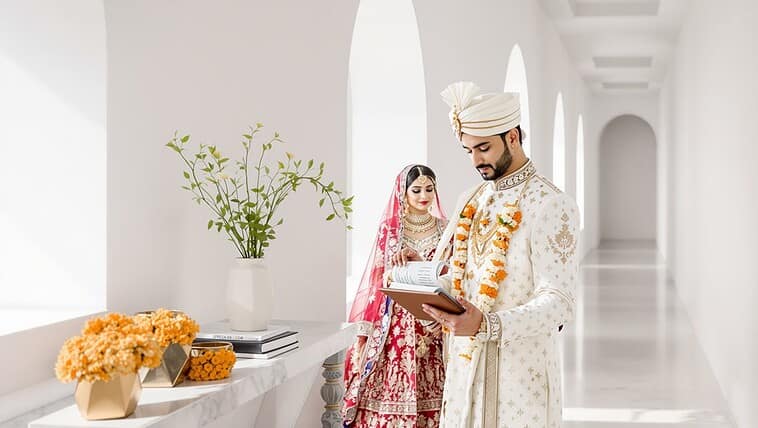
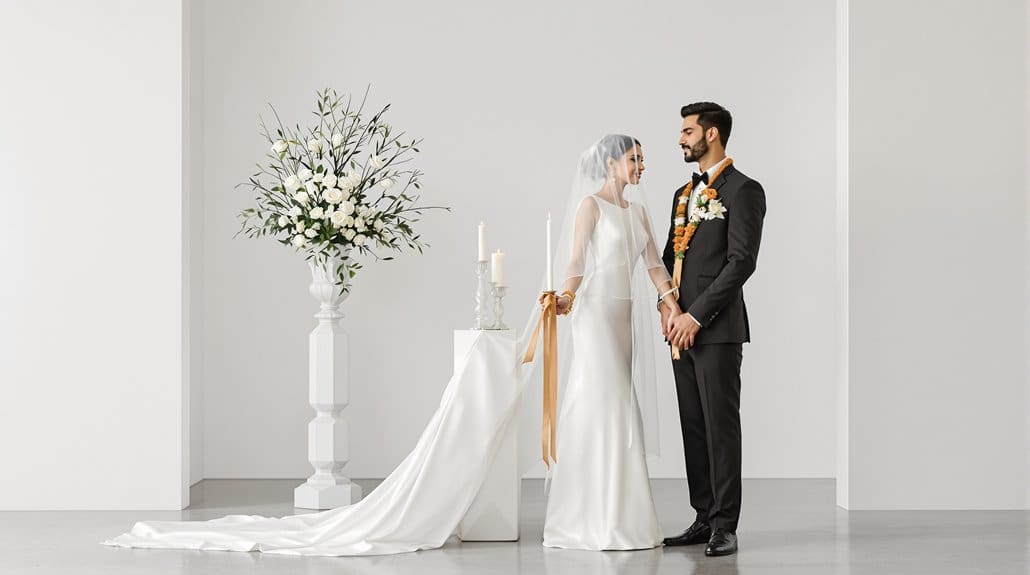
You’ll successfully honor two cultures in your ceremony by weaving traditions rather than compromising—focus on 1-2 meaningful elements from each heritage that resonate deeply with both of you. Consider a fusion structure: perhaps a chuppah decorated with family textiles alongside a tea ceremony, or co-officiants representing both faiths. The most authentic celebrations embrace tension, create thoughtful programs explaining rituals, and involve family members actively. Your ceremony becomes not just a blend but the foundation of your unique third culture.
The Two-Culture Challenge

When two people from different cultural backgrounds decide to marry, they’re not just joining lives—they’re attempting to bridge entire worldviews. Your interfaith wedding becomes a microcosm of larger cultural forces—a delicate dance between honoring tradition and forging something new.
You’ll face fundamental values collisions. One family expects hierarchical deference; the other prizes individualistic expression. And yet, these differences create the very opportunity for a meaningful multicultural ceremony. Your Catholic mother-in-law may bristle at the absence of communion, while your Jewish grandmother wonders aloud about the crucifix displayed. In some cases, security measures on wedding websites can block access when attempting to merge different cultural elements online.
The religious blending wedding requires orchestrating not just obvious symbols but invisible expectations—communication styles, time orientation, even concepts of respect. 78% of intercultural couples report family tension during wedding planning. The challenge isn’t merely aesthetic but existential: how to honor two complete cultural systems without diminishing either’s integrity or alienating those who hold them dear. Proper engagement with traditions involves respectful understanding and correct execution, strengthening community bonds while preserving cultural integrity.
Ceremony Fusion Approach
Rather than forcing awkward compromises between faith traditions, successful multicultural ceremonies embrace full integration at every level. You’ll find the magic happens not in alternating separate rituals but in weaving them together—creating an interfaith ceremony that feels cohesive rather than cobbled together. Consider combining structural elements like the Jewish chuppah with Hindu mandap traditions, creating a single canopy that serves both purposes simultaneously. Emily and Sri demonstrated this seamless integration by using a beautifully designed dual-purpose canopy for their vow exchange.
Symbolic representation works best when overlapping meaningfully: the breaking glass paired with paste application, both acknowledging life’s fragility and permanence. The number seven, sacred in both traditions, provides natural connective tissue. These rituals succeed because they connect to existing emotional significance rather than borrowed aesthetics, creating authentic meaning for both families.
Your fusion approach should include co-officiants working as a team rather than taking turns. Have them collaborate on a ceremony flow that makes narrative sense, explaining each element’s significance in programs. This isn’t compromise—it’s creation of something entirely new, yet deeply respectful of both heritages.
Chuppah with Catholic Readings Integration
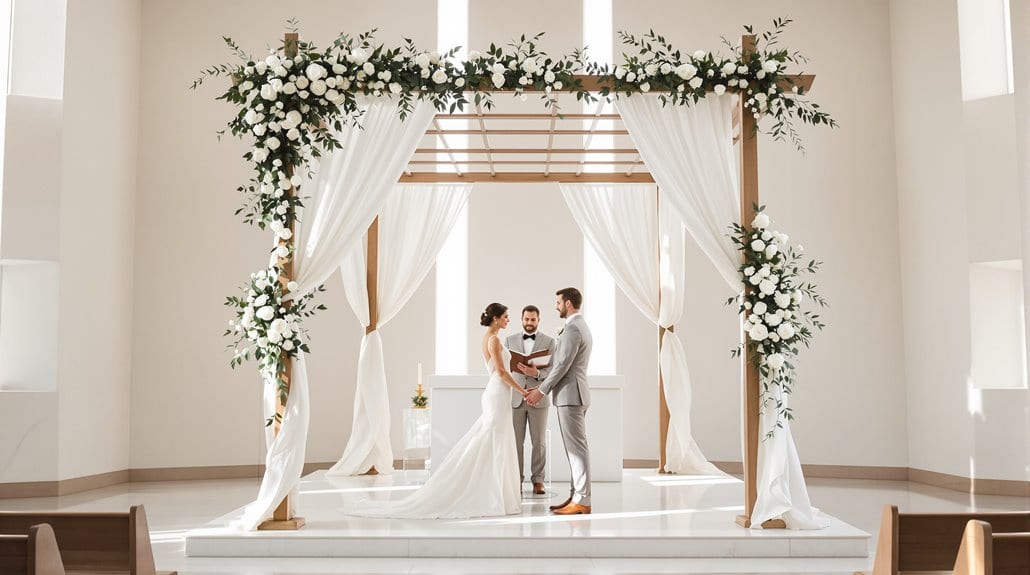
The chuppah emerges as a central element in interfaith wedding ceremonies, offering a physical structure where Jewish and Catholic traditions can coexist with profound symbolic resonance. You’ll find its four-sided canopy—representing your new shared home—creates a sacred space that honors both lineages while remaining distinctly personal. The openness of its sides isn’t just aesthetically pleasing; it’s a declaration that your marriage welcomes community while maintaining its own boundaries.
For a truly multicultural ceremony, incorporate Catholic readings beneath this Jewish structure—perhaps Ephesians 4:4-6 on unity or Colossians 3:15-17 on gratitude. These texts transform any venue into hallowed ground. Your chuppah’s covering might incorporate family textiles from both traditions, while the Catholic readings provide spiritual anchoring. This juxtaposition isn’t contradictory but complementary—the visual symbolism of the chuppah paired with the auditory power of Catholic scripture creates a sensory experience that honors both worlds without diminishing either. In Jewish wedding tradition, the chuppah symbolizes the home the couple will build together, making it an ideal focal point where families from different faiths can witness the union of their children.
Priest and Rabbi Co-Officiating
Sharing sacred space at the altar, a priest and rabbi co-officiating your ceremony creates perhaps the most powerful visual embodiment of interfaith marriage possible. This religious collaboration—once rare at just 13% in 1995—now represents 25% of interfaith ceremonies, with an additional 20% of rabbis allowing Catholic clergy to participate without theological references.
Your multicultural ceremony options expand considerably when you understand the nuances of co-officiation practices:
- Male rabbis (27%) are slightly more likely than female rabbis (20%) to co-officiate
- Rabbis ordained before 2000 collaborate more readily (27%) than their younger colleagues
- 59% require a commitment to establishing a Jewish home
- Late Saturday ceremonies improve your chances profoundly
- Clear communication about theological references dramatically affects clergy participation
The delicate choreography between traditions demands precision, yet yields profound importance. You’re not merely planning a ceremony—you’re trailblazing interfaith dialogue within your most intimate celebration. For couples seeking a museum backdrop with architectural grandeur, the Metropolitan Museum of Art offers private event and wedding venue rental options.
Guest Education Through Programs
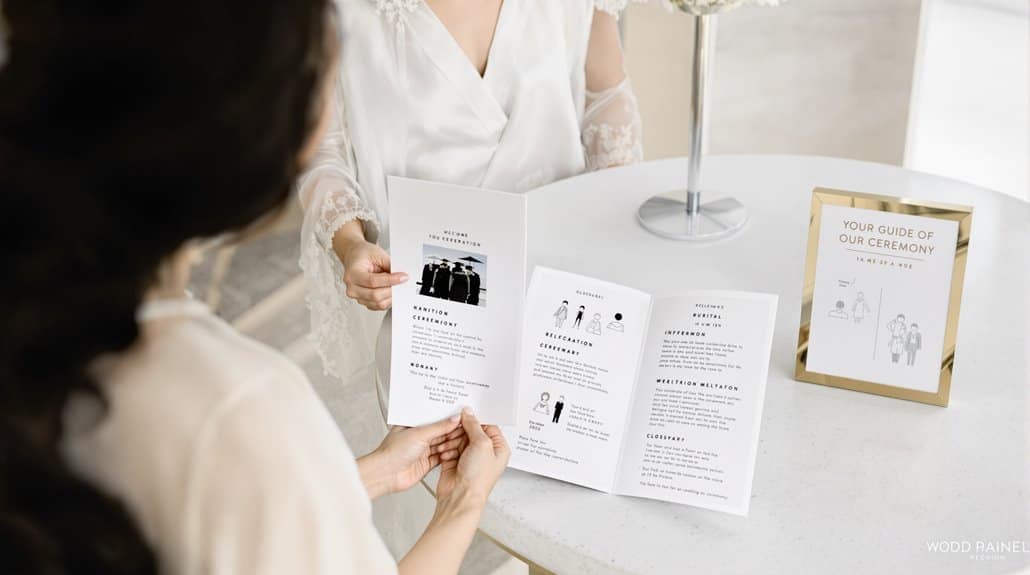
Carefully designed wedding programs function as your guests’ cultural compass, transforming potential confusion into meaningful connection during your interfaith ceremony. Your program isn’t merely an agenda—it’s a powerful multicultural ceremony education tool that bridges understanding gaps.
Consider including a glossary defining unfamiliar ritual terms (chuppah, communion, ketubah), transliterations of prayers for participation, and brief explanations linking each tradition to its deeper meaning. Interfaith wedding programs work hardest when they anticipate questions before they form in guests’ minds. You’re creating not just a reference but an invitation to witness something profound.
The most effective programs balance thoroughness with accessibility—comprehensive enough to honor both traditions authentically, yet simplified enough not to overwhelm. Just as your program guides guests through ritual elements, the invitation wording itself sets expectations by matching your ceremony’s authentic tone rather than relying on impersonal traditional templates. Your guests arrive with varying degrees of familiarity with each faith’s practices, and yet, with thoughtful program guidance, they’ll experience not two separate traditions but one beautifully unified celebration.
Family Diplomacy and Expectation Navigation
Successfully maneuvering family expectations in an interfaith marriage demands diplomatic finesse rivaling international peace talks—because that’s fundamentally what you’re conducting between your respective family traditions. Cultural integration isn’t simply combining rituals—it’s a delicate negotiation of deeply held beliefs where you’ll need to listen before explaining, acknowledge differences before recommending solutions.
When navigating expectations with families, consider these approaches:
- Map stakeholders thoroughly—identify who holds ceremonial influence beyond just parents (grandparents often wield surprising veto power)
- Translate conversations not just linguistically but culturally—what sounds like objection may be concern for appearance
- Present unified decisions as a couple first—family diplomacy works best when you’re not divided
- Create physical representations of both traditions—visual symbols speak when words fail
- Schedule separate family meetings before joint ones—air concerns privately before public negotiations
For couples seeking neutral territory that honors both traditions equally, California wine country venues offer naturally beautiful settings that don’t inherently favor one cultural aesthetic over another.
Creating Meaningful Fusion vs Box-Checking

How do you transform two distinct cultural traditions into one cohesive ceremony without reducing either to mere decoration? The difference lies in intention. Authentic integration weaves traditions into the narrative of your relationship—not as separate elements, but as intertwined expressions of your shared future.
In a truly multicultural ceremony, you’re selecting 1–2 traditions from each heritage that genuinely resonate, not frantically including everything. Those German beer unity ceremonies paired with Thai string rituals? They work when you understand their significance, not just their aesthetic appeal. Cultural respect demands more than visibility—it requires genuine connection.
The most successful couples approach fusion by asking, “What traditions speak to us?” rather than “What’s expected?” And yet, the most meaningful ceremonies often abandon formulaic approaches entirely, creating something entirely new: a third culture that honors both families while establishing your unique identity as partners. Multicultural practices like Jewish blessings or jumping the broom add layered meanings that reflect the diverse backgrounds couples bring together, transforming rituals into authentic expressions of their shared commitment.
What Made It Work
When Jewish and Catholic families stood under the same ceremonial chuppah, what truly transformed this potentially fraught situation into a harmonious celebration? The success hinged on intentional ritual integration—not merely checking boxes of tradition, but weaving meaningful practices that honored both lineages. You’ll notice that multicultural weddings work when couples prioritize substance over performance, creating ceremonies that feel authentic rather than theatrical.
Family participation became the cornerstone. Parents and grandparents weren’t just witnesses but active participants in the ceremonial edifice—tying threads of generational wisdom into each ritual moment.
- The priest and rabbi co-officiating as equals, neither tradition subordinate
- Custom ceremony scripts reflecting the couple’s unique heritage blend
- Symbolic elements carrying dual meanings across traditions
- Extended family members serving active roles in core rituals
- Sequential cultural phases giving each tradition its sacred space to breathe
Dedicated wedding specialists at Four Seasons collaborate closely with couples to ensure every multicultural detail aligns with both families’ expectations and visions.
Conclusion
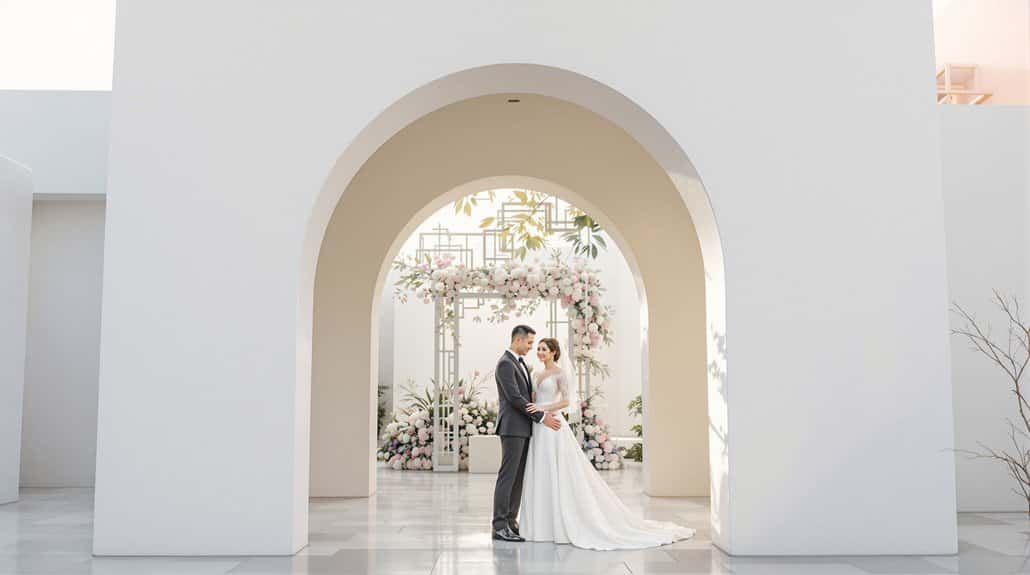
Throughout the convergence of diverse faiths and cultural traditions, what emerges isn’t merely a ceremony but a living demonstration to possibility. Your multicultural ceremony becomes the blueprint for your marriage—honoring both histories while crafting something entirely new. The beauty lies in the intentional weaving, not the perfect execution.
| Cultural Element | Symbolic Meaning | Modern Adaptation |
|---|---|---|
| Glass Breaking | Permanence of change | Bubble wrap for Chinese sensibilities |
| Chair Lifting | Community support | Combined with cross-cultural music |
| Tea Ceremony | Elder respect | Integrated between legal and religious rites |
When planning your dual-ceremony closure, remember that the most successful fusions acknowledge tension rather than erasing it. The Nigerian money spray alongside Armenian prayers, the Bollywood finale after a traditional log cutting—these juxtapositions create magic, not confusion. Just as Greece’s diverse cultural traditions have woven together influences from ancient civilizations to create a rich tapestry of customs, your cultural traditions aren’t burdens to manage but assets to celebrate, and your ceremony becomes the first chapter in a marriage that honors both where you’re from and where you’re going.