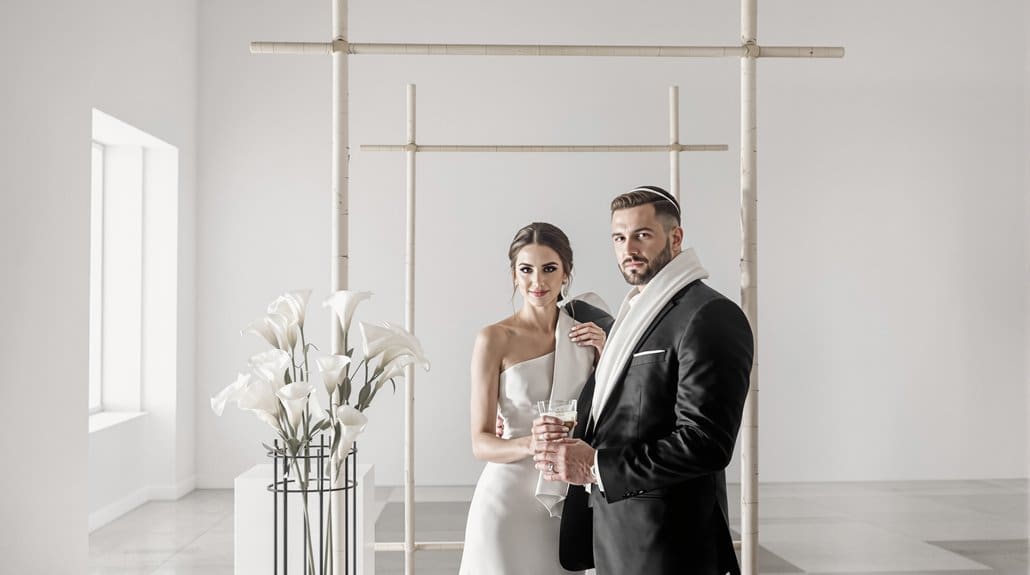
Jewish wedding traditions—chuppah, ketubah, circling, glass-breaking—carry rich symbolism you can respectfully adapt. Your chuppah represents divine shelter; customize with meaningful fabrics. The ketubah, once women’s protection, now reflects modern partnerships. Breaking glass commemorates Jerusalem’s Temples while symbolizing life’s fragility. Before personalizing, understand origins: modifications should dialogue with tradition, not reject it. Consult your officiant early for guidance on which elements allow flexibility and which maintain sacred integrity.
Understanding Jewish Wedding Elements
What makes a Jewish wedding so deeply meaningful? It’s the rich tapestry of jewish ceremony elements that transform a legal union into a spiritual covenant. The chuppah—that four-poled canopy open on all sides—isn’t just decoration; it’s the physical embodiment of Abraham and Sarah’s hospitable tent, signaling your commitment to an accessible, welcoming home.
Your processional tells a story: parents escorting children, locked elbows, symbolic candles. Then there’s the ketubah chuppah guide—the ceremonial heart where betrothal blessings over wine consecrate your union. The circling ritual—whether traditional seven circles by the bride or the modern three-and-three with a final shared circle—creates an invisible sacred boundary around your relationship. The ceremony concludes when the groom, or sometimes both partners, shatters a glass to commemorate the destruction of the Temples in Jerusalem.
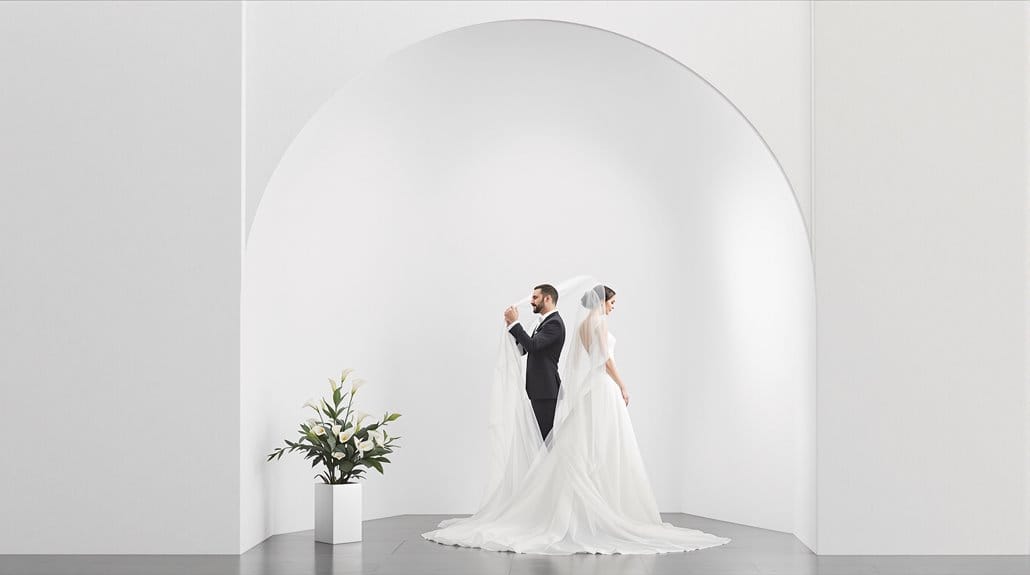
And yet, each element carries flexibility. The badeken veiling ceremony, the ring placement on the right index finger—these jewish wedding customs bear witness to thousands of years of tradition while allowing your personal interpretation. For couples seeking an extraordinary setting, the Metropolitan Museum of Art offers private event and wedding venue rentals that can honor these sacred traditions within a culturally rich environment.
Ketubah: Marriage Contract Artistic vs Traditional
While you may think of it merely as that beautifully framed artwork hanging in Jewish homes, the ketubah represents one of Judaism’s most groundbreaking legal innovations. Dating back nearly 2,000 years, this Aramaic document (not Hebrew) established revolutionary protections for wives—and yet today’s couples often focus more on its aesthetic qualities than its legal significance.
The ketubah stands as Judaism’s overlooked legal masterpiece—protecting wives millennia before modern marriage equality emerged.
Traditional ketubah composition follows exacting standards:
- Signed by two male witnesses in the groom’s presence
- Details three obligations: food, clothing, and conjugal relations
- Establishes financial security through the mohar (bride price)
- Functions as binding civil contract, not religious document
You’ll find modern couples reimagining this tradition with egalitarian language and artistic flourishes, but the ketubah’s essence remains unchanged: a public declaration that marriage brings serious obligations. What began as Simeon ben Shetach’s protection against casual divorce has evolved into both legal contract and meaningful artwork—practical and symbolic simultaneously. Like many wedding traditions across cultures, the ketubah reflects how communities formalize and celebrate the transition to married life. In Israel today, the ketubah maintains its status as a legally binding document under both civil and religious law.
Chuppah: Symbolism Who Builds Meaning

When Jewish couples stand beneath the chuppah—that fabric canopy held aloft by four poles—they’re participating in a tradition far richer than mere decorative backdrop. This cornerstone of Jewish wedding traditions represents the couple’s first shared home, with its four open sides echoing Abraham and Sarah’s tent, welcoming guests from all directions.
The chuppah’s evolution tells a story—from biblical references to the bridegroom’s chamber to its current form codified in the sixteenth century. You’ll find it crafted from silk, velvet, or even family tallitot, each material choice adding layers of meaning.
Who stands beneath matters, yet varies widely. The couple must be present, but parents, rabbis, and witnesses? Optional. This flexibility exemplifies how jewish ceremony elements balance tradition with personal expression—the chuppah simultaneously a legal instrument (kinyan) and a canvas for jewish ritual meanings that you’ll make uniquely yours. Much like how national anthem lyrics carry deep cultural significance across different traditions, the words spoken beneath the chuppah—from ancient blessings to personal vows—anchor the ceremony in meaningful expression.
Breaking Glass: Tradition Origins and Interpretations
Moving from the shelter of the chuppah to the sharp crack that follows, the breaking of glass stands as one of Judaism’s most recognizable wedding rituals. Dating to Talmudic times—specifically Berakhot 5:2, fourth century CE—the tradition began when Rabbi Mar shattered a 400-zouzim cup to temper excessive celebration. What started as a solemn reminder has evolved across centuries, accumulating layers of meaning while retaining its visceral power.
When you incorporate this Jewish ceremony element, you’re tapping into interpretations both ancient and evolving:
- Commemoration of Jerusalem’s Temple destruction—a bittersweet reminder amid joy
- Symbol of life’s fragility and relationships requiring constant care
- Representation of irreversible transformation marking your married status
- Connection to covenant-making traditions (breaking seals agreements)
The glass-breaking ritual varies notably across Jewish wedding traditions. Sephardic communities break glass before ceremonies begin, while Ashkenazi customs place it at the conclusion—followed by that cathartic, collective “Mazel Tov!” that launches your celebration. Many brides today choose to pair this ancient tradition with Oscar de la Renta bridal couture, merging timeless ceremony with contemporary elegance.
Hora: When It Works When It Overwhelms
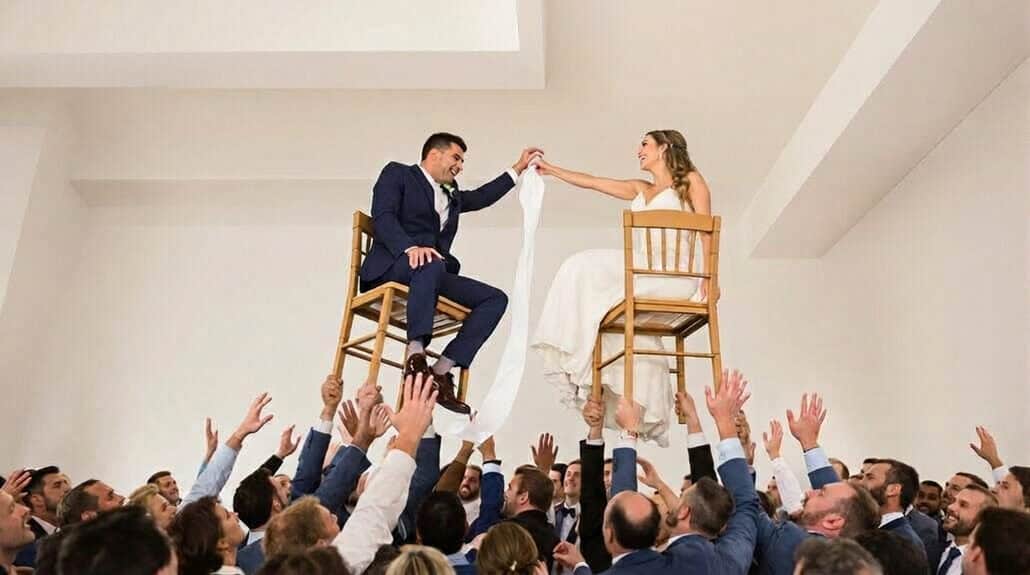
Few Jewish wedding traditions energize a celebration quite like the hora—that swirling, pulsating circle of joy that transforms even the most reserved guests into enthusiastic participants. This Romanian-rooted dance, introduced to Palestine in 1924, has become a cornerstone of jewish wedding traditions worldwide.
You’ll need to decide when to schedule it—most couples opt for immediately post-dinner or after the first dance. And yet, timing isn’t prescribed; coordinate with your DJ to read the room’s energy. The dance’s duration? Completely flexible—one song or several hours of Hava Nagila renditions.
The chair-lifting centerpiece of this jewish ritual meaning transcends mere entertainment. It symbolizes spiritual elevation, bringing you closer to God amidst community celebration. But beware: choose sturdy wooden chairs, not flimsy folding ones. Some jewish ceremony elements overwhelm with intensity—Orthodox celebrations separate genders while progressive weddings blend circles—adapt accordingly to balance tradition with your guests’ comfort.
Modern Adaptations and Flexibility
While tradition provides the foundation of Jewish weddings, the beauty of these ancient practices lies in their remarkable adaptability to modern sensibilities. Today’s couples are reimagining Jewish ceremony elements through the lens of personal values—particularly gender equality—without sacrificing meaning.
- Both partners breaking glass together, replacing the traditionally male-only ritual—a powerful statement of shared commitment
- Ketubahs rewritten to reflect contemporary partnerships, with 61% of American Jews since 2010 marrying non-Jewish spouses
- Chuppahs constructed from culturally significant textiles that honor both partners’ heritages
- Community blessing formats where guests offer one-word wishes aloud, nurturing deeper connection
Your wedding should reflect who you are. The statistics don’t lie: 41% of couples with formal ceremonies report high-quality marriages versus just 28% without. Modern wedding adaptations aren’t about rejection of tradition, but rather its thoughtful evolution—honoring the past while embracing your future together. These adaptations maintain the seven blessings tradition, which remains a cornerstone of Jewish wedding ceremonies even as couples personalize other elements.
Understanding Before Adapting

Before you can thoughtfully adapt Jewish wedding traditions for your own ceremony, you’ll need a deep understanding of their historical context and significance—a foundation that anchors personalization in something authentic rather than arbitrary.
Consider that Jewish ceremony elements evolved over millennia—from the ancient two-stage process (erusin and nissuin) to today’s unified ceremony. Knowing that the ketubah originated as a financial protection for women, not merely decorative art, transforms how you approach its modern adaptation. The chuppah’s simplicity represents divine shelter, while the breaking glass carries seven centuries of layered meanings.
Every jewish ritual meaning contains historical DNA worth preserving. You might reject certain patriarchal elements of traditional Jewish wedding traditions—and you should—but first understand exactly what you’re modifying. There’s profound difference between thoughtful evolution and uninformed elimination, between honoring 3,000 years of tradition and merely using it as aesthetic backdrop. For interfaith couples seeking to navigate these traditions, specialized resources can help build confidence in understanding Jewish customs while respecting both partners’ backgrounds.
Conclusion
Understanding tradition’s depth grants you permission for its thoughtful reinvention. Jewish wedding traditions aren’t static relics—they’re living, breathing expressions that have evolved through generations, across continents, between denominations. Your ceremony exists within this magnificent continuum, allowing for ritual adaptations that honor both ancestry and authenticity. When considering modern customization, remember: thoughtfulness trumps obligation.
- Approach adaptation as conversation, not rebellion—engage with tradition rather than simply discard it
- Research historical variations before assuming something is “required”—what seems universal may actually be regional
- Consult with officiants early about potential modifications—many are more flexible than you might expect
- Document your choices and their meanings—future generations will appreciate understanding your intentions
The most meaningful ceremonies balance reverence with relevance, tradition with truth. Beyond the ceremonial elements, ensure you’ve addressed the legal requirements for your marriage, including obtaining your marriage license according to your state’s regulations. Your Jewish wedding becomes not merely a performance of customs but their continuation—adding your voice to an ancient, ongoing dialogue.