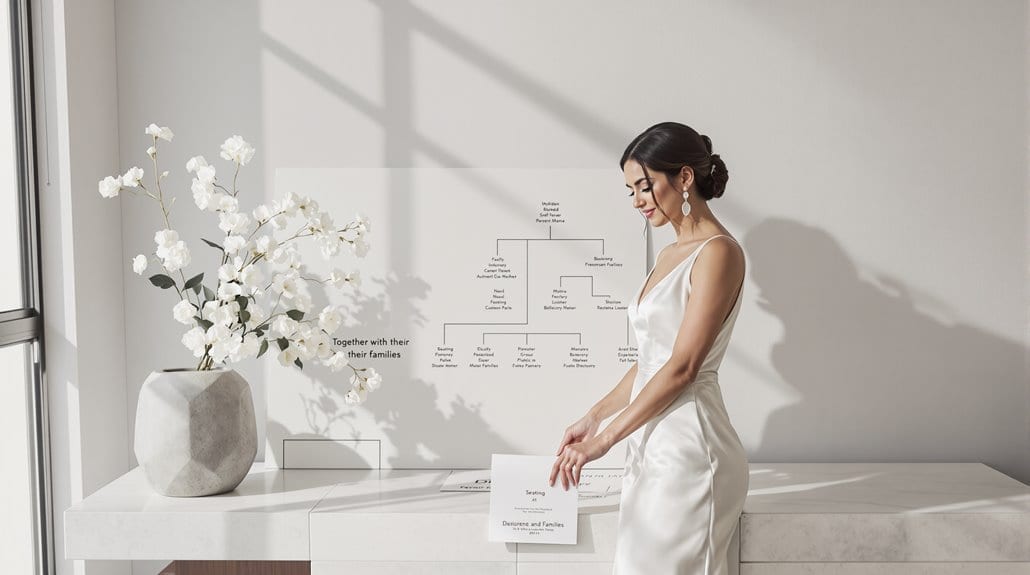
When wording invitations for non-traditional families, ditch outdated templates that assume nuclear structures. Instead, opt for inclusive phrases like “together with their families” or specifically name all hosting parties. For divorced parents, list names separately. Include step-parents thoughtfully, honor same-sex couples without heteronormative language, and use gender-neutral terms for non-binary individuals. Remember: 40% of children don’t live with married biological parents—your wording should reflect this reality. The right invitation signals genuine belonging to everyone involved.
Beyond Traditional Template Assumptions
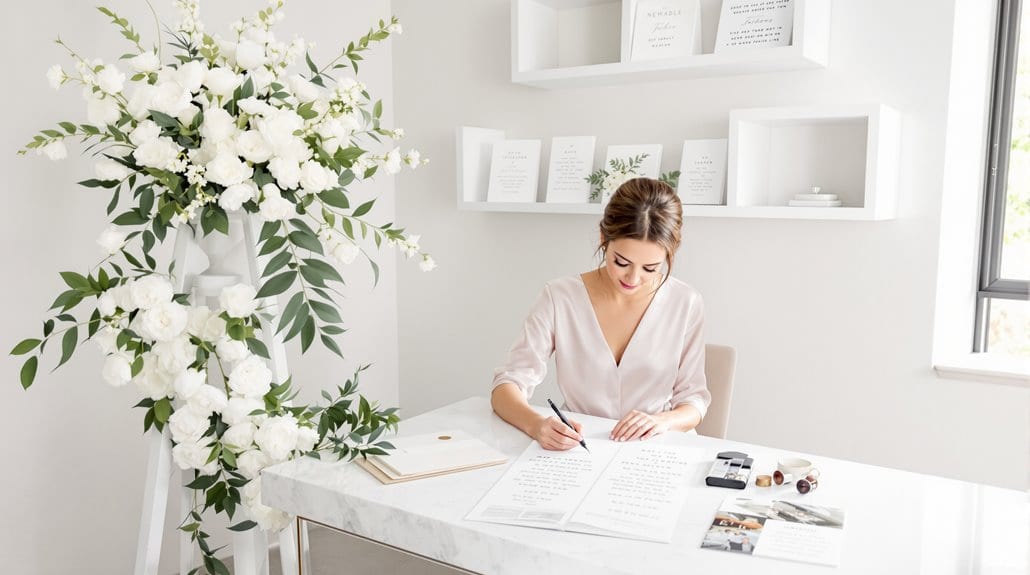
While those classic wedding invitation templates have served generations of brides and fathers-of-the-bride admirably, they’re woefully inadequate for today’s kaleidoscope of family structures. You’ve got stepparents, same-sex couples, non-binary individuals, single parents, adoptive families—and absolutely zero guidance from those traditional etiquette books gathering dust.
Modern family invitation wording requires thinking beyond prescribed formulas. Start by asking: Who’s actually hosting? What relationships matter most? Inclusive invitation language doesn’t mean compromising formality—it means acknowledging reality. Try phrases like “Together with their families” or directly name all important parties without hierarchical implications. Remember that there is no single “right” way to word your wedding invitations—what matters most is honoring your relationships authentically.
Non-traditional invitation wording works best when it reflects your authentic voice—formal yet contemporary, playful yet respectful. Just as Japanese beauty rituals emphasize intentionality and personal meaning in each gesture, your invitation should carry deliberate significance. The goal isn’t perfection but representation. Your invitation serves as the first glimpse into your celebration, and yet, it’s also a declaration of your family’s truth. Choose wording that honors both.
Divorced Parent Wording Options
Navigating divorced parent dynamics on invitations often proves more anxiety-producing than selecting the perfect cardstock—and understandably so. The typography of separation demands thoughtful precision, with mother’s name first, separate lines mandatory, and never—I repeat, never—an “and” between their names.
For divorced parents invitation formats, remember this: structure mirrors reality. Mother-only hosting uses “Ms.” followed by “invites you to the marriage of her daughter,” while father-only hosting requires similar autonomy in language. When both contribute financially, “together with” becomes your salvation phrase—acknowledging joint investment without implying reunification.
Modern family invitation wording gets exponentially complex with remarriages. The bride’s full name becomes your anchor amid the surname sea. Invitation inclusive language means acknowledging each parent’s current reality—new spouses, changed surnames—while maintaining clarity about who belongs to whom. For Catholic couples, understanding the marriage sacrament adds another layer of consideration to invitation wording, particularly when navigating family relationships across different faith traditions. If you encounter a block while accessing wedding sites like annsbridalbargains.com, be aware that their security measures may temporarily restrict access to protect website integrity. The elegant solution? Meticulous spacing and strategic line breaks that honor every relationship without pretending complications don’t exist.
Step-Parent Inclusion Strategies
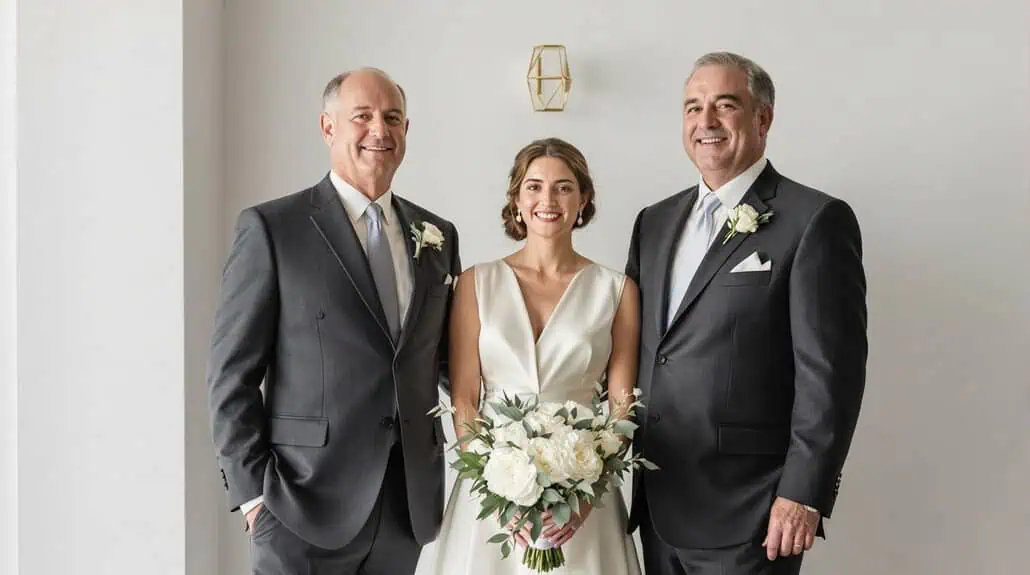
Successfully integrating step-parents onto wedding invitations requires surgical precision—a delicate balance between honoring actual relationships and avoiding the chaos of overcrowded cardstock. Consider three proven approaches: hierarchical listing (“Mr. and Mrs. Johnson and Mr. and Mrs. Taylor request the honor…”), separate line formatting (each parental unit on its own line), or the elegant sidestep of collective language (“Together with their families”).
Your modern family invitation might benefit from distinguishing between hosts and honorees—step-parents who contribute financially deserve prominent placement, while those with meaningful but non-financial roles might appear in supplementary positions. For LGBTQ invitation wording, the traditional templates collapse entirely; instead, prioritize accuracy over convention.
Remember: invitation language reveals family dynamics to every recipient. Your wording choices telegraph relationships—so when including step-parents, ensure the text reflects lived reality, not aspirational family fictions. People notice these distinctions, even if nobody discusses them openly. When navigating these sensitive decisions with your stationer or invitation designer, maintain clear, structured communication rather than relying on assumptions—explicit instructions about family relationships prevent miscommunications that could result in costly reprints or family tensions.
Same-Sex Couple Language
The traditional language of wedding invitations—steeped in patriarchal assumptions and heteronormative phrasing—utterly collapses when applied to same-sex couples. You’ll need to reimagine these conventions entirely, embracing non-traditional invitation wording that honors your authentic relationship.
| Scenario | Traditional Format | Modern Same-Sex Alternative |
|---|---|---|
| Couple-Hosted | “Mr. & Mrs. request…” | “Julian and Marcus joyfully request…” |
| Divorced Parents | Father listed first | Alphabetical or meaningful order |
| Parent-Hosted | “Mr. & Mrs. announce their daughter…” | “The Wongs celebrate their son’s marriage to…” |
| Religious Elements | “Holy Matrimony” | “Celebration of Love and Commitment” |
| Reception Line | “Bride and Groom” | “Newlyweds” or specific names |
When crafting same-sex invitation wording, abandon hierarchy—alphabetize names when unsure, skip unnecessary titles, and embrace phrases like “together with their families.” Your invitation isn’t just paper and ink, but a declaration: love transcends outdated formulas. For comprehensive guidance on navigating these choices alongside other ceremonial considerations, consult Martha Stewart Weddings etiquette guides which address both traditional and modern wedding scenarios.
Non-Binary Pronouns and Gender-Neutral Wording
While traditional invitation formats crumble under the weight of binary assumptions, crafting language for non-binary individuals requires both precision and care—not just linguistic gymnastics, but genuine respect embodied through words.
When designing non-traditional invitation wording, consider titles like “Mx.” (pronounced em-ex) rather than Mr./Mrs., or terms like “marrier” and “celebrant” instead of bride/groom. Your phrasing matters profoundly: “[Names] joyfully invite you to celebrate their marriage” creates space where binary language once constricted. And yet, even modern families with divorced parents face invitation challenges—acknowledge both households without awkwardness by using “Together with their families” formulations.
Always ask about preferences before addressing non-binary guests. Never assume. Never deadname. The most elegant invitations aren’t those with perfect calligraphy but those reflecting genuine understanding of each guest’s identity—treating language not as a battleground, but as sacred ground where every person stands recognized. For couples drawing from cultural traditions, understanding the ceremony customs specific to their heritage can inform how they adapt traditional invitation language while honoring their roots.
Complex Family Structure Acknowledgment
Beyond pronouns and neutrality lies a terrain of family configurations that shatter conventional invitation templates. Consider: only 60% of children live with married biological parents, while 22% reside in single-parent households, 9% in step-families, and 4% with grandparents or others. Your invitation language must navigate this reality.
The statistics demand attention—43% of children born to unmarried parents, 44% of cohabiting households with children including at least one adult with children from other relationships. And yet, these numbers represent real people, not just demographic shifts. You’ll need flexible phrasing that acknowledges multi-generational households (higher in Black and Hispanic families at 8% compared to White households at 4%) and household transitions (7% of adolescents experience these annually).
When crafting invitations, recognize that family complexity varies dramatically across racial and socioeconomic lines—half of children with non-college-educated parents live in complex families, versus one-fifth of those with college-educated parents. Approach this challenge as a partnership with your stationer or designer, using transparent conversations to develop wording that respects each family member’s role without rigid adherence to outdated templates.
Chosen Family Recognition
Across America’s changing social terrain, chosen families have emerged as essential support networks deserving explicit acknowledgment in your event invitations. Nearly one-third of Americans report taking time off work to care for chosen family members—those intimate connections formed through choice rather than biology or law. Seven states now legally recognize these bonds, impacting over 10 million Americans’ access to care leave since 2016.
When crafting inclusive invitations for chosen families, consider:
- Use “and guest(s)” with an open number rather than limiting plus-ones
- Include phrases like “and your chosen family members” alongside traditional family mentions
- Avoid assumptions about household composition in address lines
- Offer explicit RSVP options for non-traditional family units
- Consider open language like “we welcome those who make your life complete”
The nuclear family represents fewer than 20% of American households, yet invitation etiquette often lags behind this reality. Your wording choices matter—they signal belonging for LGBTQ+ individuals, immigrants, and countless others who find family beyond blood. For smaller celebrations that honor these diverse family structures, consider unique venue rentals that can accommodate intimate gatherings where every guest feels genuinely welcomed.
Conclusion
How can something as simple as an invitation become a profound statement about who belongs in your celebration? The answer lies in the deliberate choices you make with every line of text—choices that either reinforce outdated assumptions or create space for the beautiful complexity of modern families.
Traditional invitation templates were designed for a world that no longer exists—one of binary genders, heterosexual marriages, and 2.5 kids. And yet, the families gathering around your holiday tables, wedding receptions, and graduation ceremonies reflect a immensely different reality: blended households, chosen families, non-binary loved ones, single parents raising remarkable children, polyamorous partnerships.
Your invitation is the first signal of what guests can expect. Will they need to contort themselves to fit into your event, or will they find a celebration that acknowledges them exactly as they are? The words you choose aren’t just formalities—they’re declarations of belonging.
Just as you carefully consider each word on your invitation, your bridal beauty preparations deserve the same thoughtful attention to ensure you look and feel authentically yourself on your special day.