
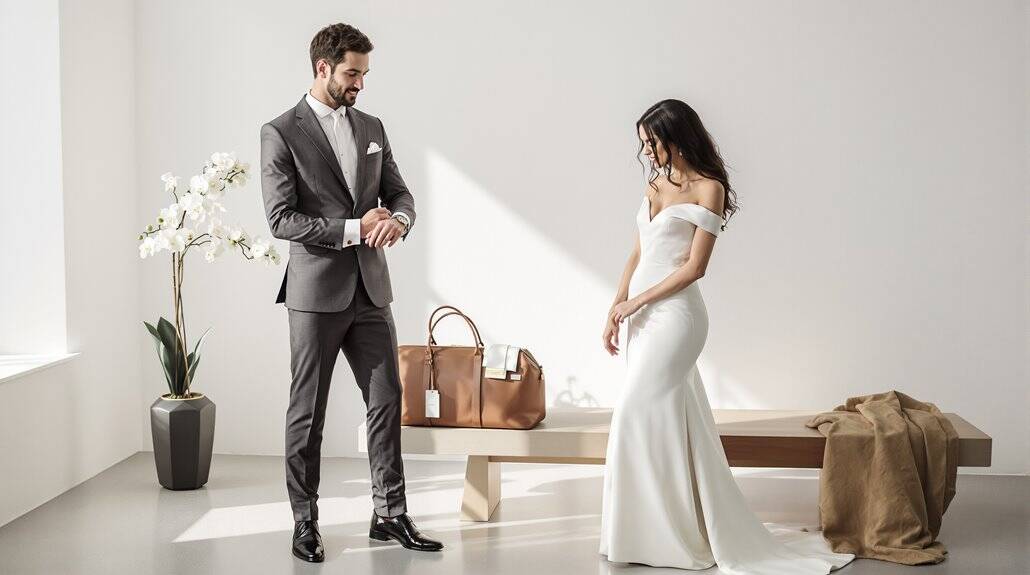
When done right, wedding suiting isn’t just an expense—it’s a tactical investment. You’ll break even against rentals by your third formal event, with quality suits providing both psychological confidence and practical versatility for years beyond your wedding day. Classic navy or charcoal options outperform trendy choices, offering decades of wearability at progressively lower cost-per-wear. That $3,000 bespoke suit amortizes to mere double digits per use while adapting to your evolving physique. The deeper economics reveal themselves through long-term calculations.
Investment vs Expense Mindset – Essay opening
When you stand at the crossroads of a wedding suit purchase, you’re not just making a fashion choice—you’re revealing your fundamental economic worldview. That $3,000 price tag triggers either immediate anxiety or calculated consideration, depending entirely on whether you’re operating from survival or thriving mentality.
Most men approach wedding wardrobe investment as pure expense—something to minimize, endure, then forget. And yet, this cost-cutting reflex sabotages long-term value creation in spectacular fashion. The navy bespoke suit that serves you impeccably for a decade versus the trendy slim-fit that photographs poorly by next season? Not remotely comparable assets. This failure to analyze your wedding suit as a strategic investment rather than a one-time expense mirrors the common pitfalls that prevent business growth.
Your timeless suit choice represents the psychological shift from expense-thinking to investment-mindset—seeing beyond the immediate outflow to recognize deliberate asset building. This isn’t merely clothing; it’s capital allocation with measurable returns through durability, versatility, and psychological confidence. Just as luxury French beauty elevates wedding day presentation through premium formulations, your suit selection communicates refinement and attention to detail. The truth is embarrassingly simple: quality procurement in wedding attire outperforms fast-fashion alternatives through maintenance economics alone.
Classic Suiting That Serves for Years
Unlike fleeting fashion choices that fade with each passing season, classic wedding suiting represents one of menswear’s last bastions of genuine multi-decade value creation. That bespoke navy suit you invest in today—the one with hand-stitched canvas construction requiring 40+ hours of skilled labor—will still be serving you at weddings, funerals, and board meetings fifteen years from now.
Your wedding suit investment translates to tangible economics: a £1,500 full-canvas garment worn twice weekly over fifteen years delivers a cost-per-wear that decimates the three-year lifespan of its fused counterpart. Classic wedding suit selections in Super-120s worsted won’t just last—they’ll age gracefully, conforming to your body while maintaining structural integrity. With generous seam allowances, your wedding suit can accommodate natural body changes through alterations over time.
The suit beyond wedding strategy demands rotation, though. Give each garment 24 hours between wears, store in climate-controlled environments, and you’ll possess something increasingly rare: clothing engineered to outlive trends rather than succumb to them. Just as proper skincare preparation transforms complexion for wedding day photography, meticulous garment care preserves your investment’s appearance across countless future occasions.
Trendy Choices You’ll Regret in Photos
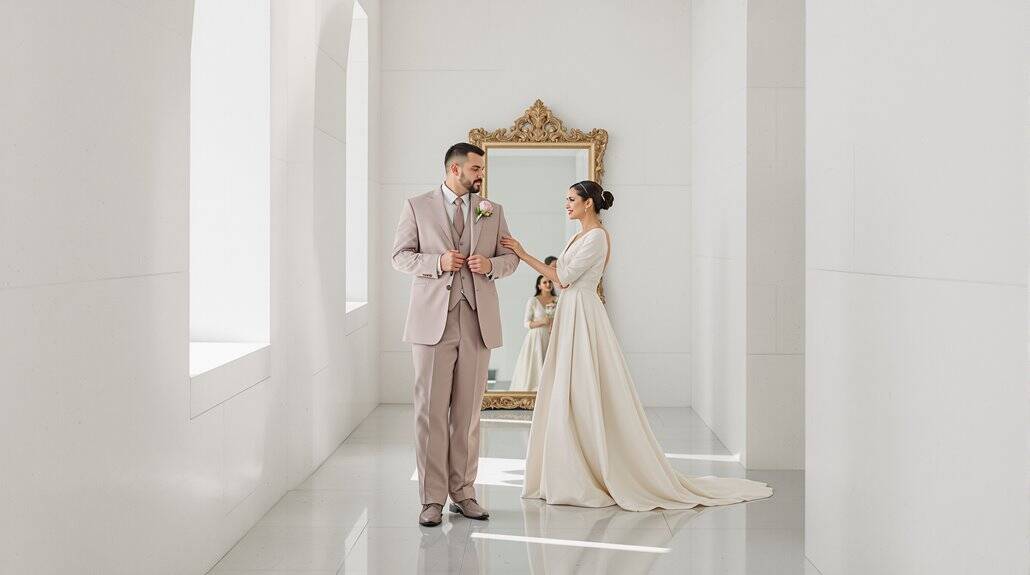
While investing in a timeless wedding suit creates long-term value, trendy choices virtually guarantee future photo regret. That ultra-slim fit with aggressive tapering—the one that feels so “of the moment”—will date your wedding album faster than dial-up internet. Your wedding suit investment should transcend fleeting trends; those exaggerated peak lapels or lively patterned linings won’t serve you at future formal occasions.
You’ll cringe at photos showing overly tight trousers that restricted movement during your first dance, or that fashionable shorter jacket length that looked dated within eighteen months. A versatile groom suit withstands scrutiny years later, but trend-chasing creates permanent visual records of temporary infatuations.
The most painful regrets come from external influence—letting groomsmen, salespeople, or Instagram dictate choices contradicting your personal style. Interestingly, personality conflicts around wedding decisions run deep—2 in 10 couples would actually consider different guest lists if they were to remarry, suggesting that wedding-day choices influenced by others create lasting regret. Your suit beyond wedding use becomes impossible when it’s imprisoned by its moment—a costly costume rather than an investment piece.
The Versatility Calculation
The true value of a wedding suit emerges not at the ceremony, but across the hundred occasions that follow. Your wedding suit investment becomes exponentially more valuable when you select for maximum cross-functionality. That navy or charcoal suit—seemingly conventional choices—will smoothly transition from boardrooms to formal dinners for a decade, while that trendy slim-fit option grows embarrassingly dated by next season.
Invest in a wedding suit’s afterlife—conventional choices unlock a decade of elegance while trends fade embarrassingly fast.
When calculating versatility, consider:
- Tan and grey suits offer unparalleled seasonal adaptability, working equally well at summer destination weddings or winter formal events
- Wool blends provide year-round comfort while photographing beautifully across varied lighting conditions
- Classic fits outlast trends, ensuring your investment wedding clothing remains relevant no matter how fashion’s pendulum swings
And yet, versatility isn’t just about color—it’s about construction. A properly tailored suit adapts to your evolving physique, creating a suit beyond wedding functionality that serves you through countless life milestones. When discussing your vision with your tailor, shift from price haggling to cooperative partnership—viewing them as a collaborator who understands both your budget constraints and long-term wardrobe goals.
Quality Investment in Tailoring
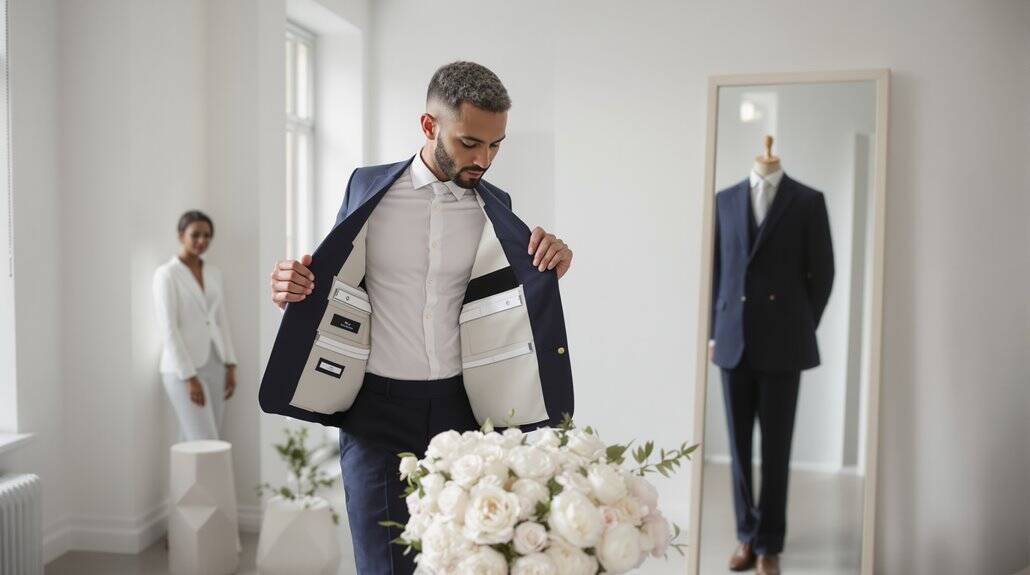
Investing in superior tailoring represents perhaps the most consequential financial decision in your wedding wardrobe journey—one that pays dividends far beyond your ceremony. The math is brutally simple. That $3,000 bespoke navy suit will serve you for a decade—through professional milestones, travel, and countless celebrations—while the trendy slim-fit alternative becomes obsolete within months.
The numbers tell a convincing story: men wear tailored garments 3.5 times more frequently than off-the-rack options, and bespoke construction ensures consistency across varying body positions. Worth noting: the high-end customization market is projected to hit $2.8 billion by 2032, growing at 7.2% annually. Not just vanity metrics.
Your investment transcends financial calculus, though. Premium fabrics selected specifically for durability, superior stitching techniques, reinforced seams—these elements compound to create a garment that withstands both scrutiny and time. The same principle applies to bridal jewelry collections, where craftsmanship and timeless design ensure pieces remain elegant across generations. The truth? Quality tailoring isn’t expensive; it’s worthwhile.
Building Wardrobe Foundations Through Wedding
Few decisions create a more tactical platform for your entire style evolution than wedding attire acquisition—particularly when approached as the cornerstone of a decade-spanning wardrobe system. Your $3,000 investment in a bespoke navy suit isn’t merely wedding day plumage—it’s infrastructure. With 45% of grooms now increasing their wedding attire budget, you’re joining a cohort of men who understand: foundations matter.
Tactical wardrobe architecture begins with your wedding suit—a calculated investment that returns dividends across decades of wear.
- That suit you’ll love in photos now and fifteen years from now—unlike the 70% of trend-chasing purchases doomed to visual obsolescence
- The psychological armor of knowing you’ve built something with staying power, not just consumed fashion
- The financial mathematics: amortized over a decade of professional occasions, travel dinners, and others’ weddings, your cost-per-wear plummets to double digits
Men’s formal investment isn’t vanity—it’s strategy. While the wedding industry churns through $82.42 billion annually, your tailoring choice stands apart: considered, permanent, and working for you long after the honeymoon ends.
When Rental Makes Sense vs When to Invest
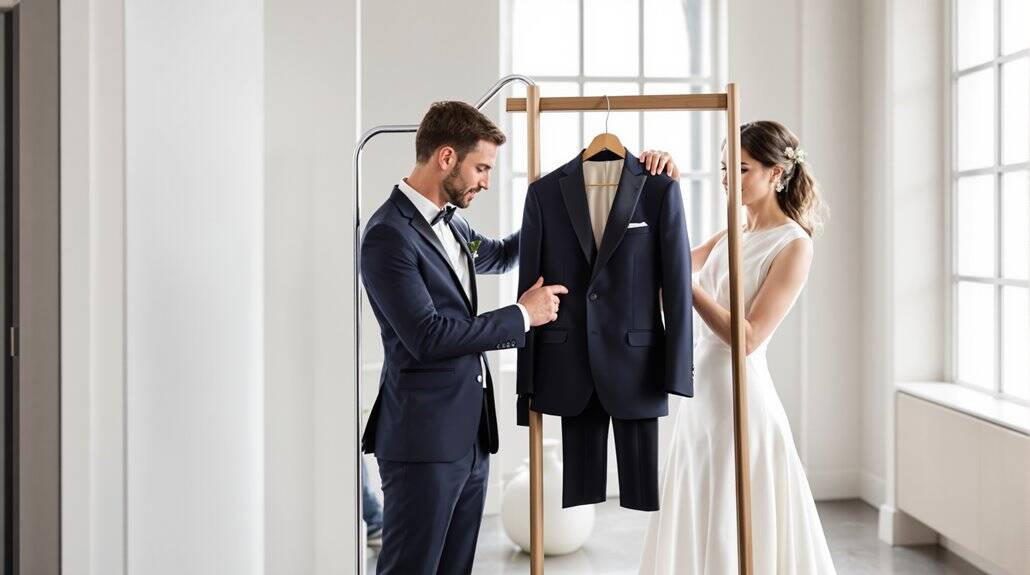
While most men instinctively dismiss rentals as false economy, distinguishing when to borrow versus when to buy demands more financial sophistication than wedding guides typically acknowledge. The math isn’t mysterious: at approximately $150 per rental versus $300+ for ownership, the break-even point arrives quickly—specifically, your third formal occasion. And yet, single-use scenarios still favor rentals, particularly when coordination across wedding parties requires matching fabrics unavailable at retail.
The hidden calculus extends beyond dollar figures. Purchased garments provide tailor-perfect comfort in breathable, modern fabrics that rental inventories simply can’t match. Six formal events cost $1,140 in rental fees versus just $438 for ownership and maintenance—a 62% savings that compounds annually. But here’s the uncomfortable truth: many men’s “investment” purchases fail precisely where they should succeed—versatility. That $3,000 trendy light gray suit you’ll cringe at in photos next year? False economy incarnate compared to a timeless navy option with decade-long wearability. This mirrors the broader wedding vendor principle: spending beyond certain thresholds yields diminishing returns—where the first $5,000 significantly improves quality, but additional upgrades offer only subtle benefits.
Conclusion
As we’ve examined throughout this guide, the true economics of wedding suiting transcend the simplistic purchase-versus-rental binary that dominates conventional wisdom. Quality tailoring represents the rarest of consumer opportunities: aesthetics and practicality in perfect alignment. Your wedding suit becomes the foundation of a functional wardrobe—not a one-off expense.
Consider these investment truths that transcend passing trends:
- That $3,000 bespoke navy suit serves you for a decade: weddings, professional occasions, international travel—while the trendy slim-fit light gray becomes something you’ll wince at in photos by next year.
- Quality tailoring ages with dignity, developing character through wear rather than deteriorating into shabbiness.
- The psychological power of owning “your suit” creates confidence that rental approximations can never match.
This investment mindset aligns with the broader principle that budgets should reflect personal priorities rather than arbitrary spending conventions—allowing you to allocate resources where they generate lasting value.
The economics ultimately become self-evident: amortized across years of wear, investment pieces aren’t extravagances—they’re the fiscally responsible choice for the discerning gentleman.