
Your wedding isn’t just a celebration—it’s a $50,000-$200,000 project requiring serious management skills. Applying project principles transforms overwhelming emotional decisions (affecting 59% of couples) into structured processes with clear timelines, budgets, and stakeholder boundaries. You’ll make 127+ decisions more effectively using structures like Decision Rights Matrices and Gantt charts, reducing the anxiety and insomnia plaguing 86% of planning couples. The right operational approach eliminates 70% of stressors while preserving what truly matters.
The Emotional Overwhelm Industry Wants – Essay opening

While you set out on the whirlwind journey of planning your wedding, something insidious is happening behind those pristine Pinterest boards and glossy bridal magazines—the wedding industry is actively courting your emotional overwhelm. They’ve perfected this strategy: 59% of couples describe wedding planning as overwhelming, manifesting in physical symptoms from headaches to reduced sex drive. This pressure often leads to a fixation on quality over quantity, pushing couples to prioritize lavishness over the deeper emotional connections they should be nurturing.
The mechanism? Perfectionism. That inner critic activates each time you browse Instagram’s flawless ceremonies, convincing you that your special day must match these unrealistic standards. And yet, these are temporary emotional promises made in unworn clothing while guests consume overpriced chicken.
Decision fatigue becomes your constant companion—45% of brides find guest lists alone paralyzing. Every choice feels monumental, every potential misstep catastrophic. The industry thrives when you’re emotionally compromised; it’s simply easier to upsell services to someone overwhelmed than someone thinking rationally about a $50,000+ project. A staggering 86% of couples experience stress symptoms like anxiety, insomnia, and mood swings during this period, with many failing to build the foundational relationship systems necessary for long-term marital success.
Wedding as $50K-$200K Project
Despite what bridal magazines portray as a dreamy love-filled adventure, your wedding represents a serious financial undertaking—a $50,000 to $200,000 project that deserves proper management rigor. Location determines your bottom line more than anything else: a New York celebration costs nearly double a southern wedding, while adding just 50 guests can push your budget into six figures. The data shows that planning during peak season months can significantly impact your total costs, as July through September typically sees the highest wedding expenses. Additionally, emerging luxury trends influence the choices you make, often leading to unexpected expenses.
| Market | Average Cost | Cost Drivers |
|---|---|---|
| NYC | $87,700 | Venue scarcity, vendor premiums |
| San Francisco | $51,500 | Real estate costs, luxury expectations |
| Chicago | $54,190 | Urban venue competition, service costs |
| Destination | $41,000 | Travel logistics, coordination fees |
Strategic wedding planning means confronting these numbers head-on. You wouldn’t start a home renovation without a budget spreadsheet—yet couples plunge into wedding project management emotionally overwhelmed. The wedding industry thrives on this vulnerability, but your wedding planning system should treat this milestone like the substantial investment it is.
Project Management Principles – Scope stakeholders budget timeline

Now that we’ve established the substantial financial investment your wedding represents, let’s examine the project management structure that’ll save your sanity—and possibly your relationship.
Every successful wedding hinges on three core principles. First, define your scope—what’s in, what’s out, what matters most—because without boundaries, your wedding becomes an endless money pit. Second, identify and manage your stakeholders—from vendors to in-laws—because they’ll need clear communication channels, defined expectations, and appropriate levels of input. Third, develop a living budget document that tracks every expense against estimates, because those $200 “small decisions” compound into $10,000 overruns faster than you can say “just one more appetizer.”
Additionally, create a detailed guidance timeline to ensure all tasks are completed on schedule, allowing you to manage complexity effectively.
You’re not just planning a party; you’re executing a complex, time-constrained project with multiple dependencies and stakeholders. And yet, with proper scope definition, stakeholder management, and budget control, you’ll transform overwhelming emotion into tactical execution.
Applying PM Methodology to Weddings
Let’s translate project management theory into wedding reality through a structured five-phase approach that’ll transform your planning from chaotic to controlled. When you adopt systematic wedding planning, you’re not just organizing a party—you’re executing a complex $50K+ project with dozens of moving parts.
Your engagement launches the initiation phase, where you’ll define scope and priorities with stakeholders (yes, including your mother-in-law). The planning phase develops your aesthetic vision alongside brutal timeline realities. During execution, you’re coordinating vendors, securing contracts, and tracking deposits—all while maintaining your sanity.
Professional wedding planning isn’t just checklists; it’s continuous monitoring against your budget and timeline. Small overages compound quickly, yet vigilant tracking prevents disaster. Finally, the completion phase delivers your actual wedding day—the culmination of hundreds of decisions, thousands of details, and one all-encompassing project management approach that actually works.
The Gantt Chart You Actually Need
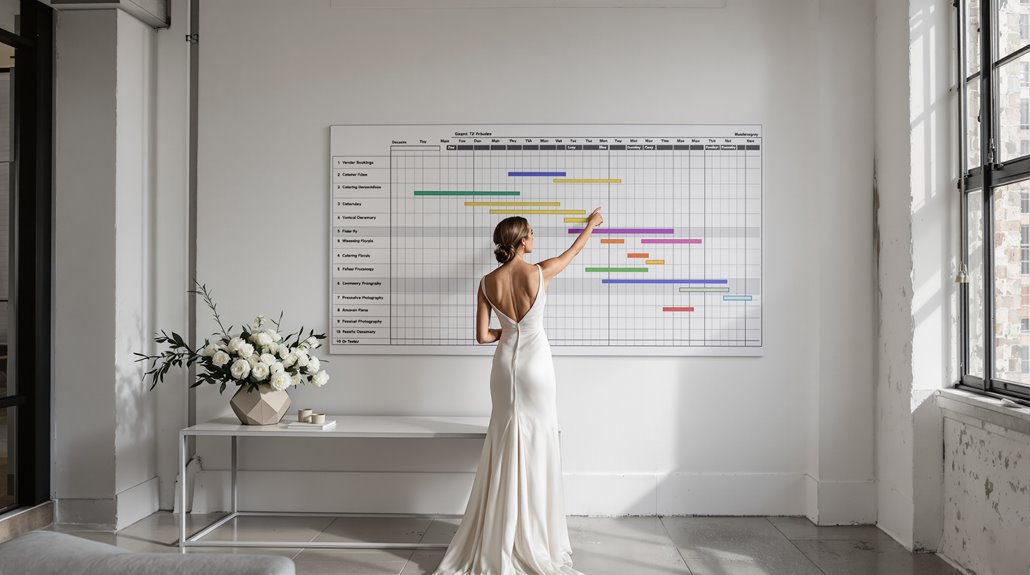
While most wedding planning tools offer superficial checklists, a proper wedding Gantt chart transforms your $50K+ investment from chaos into controlled execution. You need visual organization that matches the complexity of your celebration—not some cutesy app with heart icons and insufficient functionality.
Serious investments deserve serious tools, not emoji-filled nonsense masquerading as wedding planning solutions.
Your wedding timeline management demands professional-grade tools that:
- Allow color-coding for priority levels (red for “book venue now” versus yellow for “confirm floral arrangements”)
- Facilitate drag-and-drop functionality so you’re not wasting hours reformatting when vendors change dates
- Combine budget tracking directly alongside tasks, linking that $3,200 catering deposit to its timeline position
- Visualize dependencies—because you can’t finalize centerpieces until you’ve confirmed table count and layout
The right Gantt chart isn’t just pretty—it’s wedding project management that prevents the midnight panic attacks when you realize you’ve forgotten to coordinate transportation timing with your photographer’s schedule.
Decision Frameworks Over Feelings
When you allow raw emotions to drive your wedding planning process, you’ve already lost control of your $50K+ investment. You’re playing directly into the industry’s hands—they want you overwhelmed because emotional decisions lead to impulsive spending, not tactical outcomes.
Look at the numbers: 43% of couples experience relationship-threatening strain, with decision bottlenecks creating the perfect conditions for conflict. Yet implementing a Decision Rights Matrix transforms this interplay completely. By explicitly assigning who drives each of your 150+ decisions, who approves, who’s consulted, and who’s informed, you create a systematic planning structure that prevents the “I thought we agreed” conversations destroying budgets and weekends.
Wedding project management isn’t cold or unromantic—it’s protective. Couples using decision frameworks achieve near-equal planning contributions (52/48% splits versus the typical 80/20), stay 3% under budget, and report peak stress levels of 6/10 instead of the crushing 8-9/10 endured by everyone else.
Stakeholder Management
The same organizational discipline that brings order to your decision-making must extend to the complex web of humans orbiting your wedding—your stakeholder ecosystem. You’re not just planning an event; you’re orchestrating relationships. Effective stakeholder management transforms your wedding from a chaotic emotional minefield into a structured project with clear communication channels.
Your wedding’s success hinges on four critical stakeholder practices:
- Identify and map all players—parents, vendors, wedding party—by interest level and influence
- Establish communication plans tailored to each stakeholder’s preferences and needed involvement
- Set expectations early—ideally three months before major decisions—to align everyone’s vision
- Practice active listening to uncover stakeholders’ underlying needs beneath stated positions
You’ll need extensive communication planning that documents decisions and centralizes information flow. And yet, the technical aspects of wedding project management must balance with relationship maintenance—recognizing vendor efforts while maintaining boundaries that protect your vision and budget.
Why Operational Thinking Reduces Stress
Beyond the emotional significance of your wedding day lies a complex operational edifice that requires rigorous management—and this matters far more than the wedding industry wants you to recognize. When you pivot to project-based thinking, your wedding transforms from an anxiety-inducing emotional gauntlet into a series of manageable processes with clear outcomes.
| Operational Component | Stress Source | Management Solution |
|---|---|---|
| Timeline Management | Decision paralysis | Establish firm deadlines with buffer zones |
| Vendor Coordination | Communication chaos | Centralized contact system with clear accountability |
| Contingency Planning | Fear of disaster | Prioritized risk assessment with action protocols |
You’ll face 127 distinct decisions during wedding planning—each with emotional landmines attached. Yet operational structures provide guardrails that prevent decision fatigue. Your feelings matter, but they shouldn’t dictate your process. The structured approach doesn’t diminish the day’s magic; rather, it creates space for genuine emotion by handling logistics through systems, not stress.
Conclusion

Throughout the wedding planning journey you’ve now witnessed, project management emerges not merely as a useful approach but as the fundamental structure that distinguishes joyful celebrations from logistical nightmares. Tactical wedding planning transforms the overwhelming into the achievable—it’s the difference between drowning in tulle samples and commanding your vision with confidence.
When you embrace wedding project management principles, you gain:
- Financial control – tracking a $50K investment with the precision it deserves
- Emotional boundaries – keeping vendors’ upselling tactics at bay
- Time efficiency – eliminating 70% of common planning stressors through proper sequencing
- Decision clarity – making choices from strategy, not panic
Wedding planning organization isn’t about spreadsheets replacing romance—and yet, it’s precisely this structure that creates space for genuine moments to unfold. Your celebration deserves both your heart and your head, working in concert rather than opposition.