

You’ll blow your budget by 23% and create physically impossible timelines without professional help. Planners watch couples underestimate setup times (6-8 hours, not 2), mismanage beauty schedules (bride needs 90 minutes, not 30), and foolishly believe Pinterest determination equals expertise. DIY coordination of 14 vendors typically hemorrhages money through missed contract details and rush fees. Add a 15% buffer to your budget, trust vetted professionals, and build 15-minute cushions between events—physics demands it.
Common Mistakes Planners See Repeatedly

While planning your dream wedding might feel like a straightforward endeavor, most couples unknowingly step into a minefield of logistical pitfalls that veteran wedding planners have witnessed hundreds of times.
You’re likely underestimating setup time—drastically. That Pinterest-worthy reception you’ve envisioned? It requires 6-8 hours of scrupulous arrangement, not the breezy two-hour window you’ve allocated. And your DIY ambitions? Noble, yet potentially disastrous when you’re simultaneously juggling family arrivals and pre-ceremony jitters. Common wedding errors stem from timeline compression: booking venues before establishing budgets, selecting dates before securing locations, and—perhaps most damaging—failing to create exhaustive line-item spreadsheets that prevent financial hemorrhaging. Many couples fall into the trap of not reading contracts thoroughly, missing critical details about payment schedules, cancellation policies, and vendor responsibilities. Watch for vendors who exhibit communication delays exceeding 72 hours or lack clear contact protocols in the weeks leading up to your event, as these warning signs often predict mishandling on the wedding day itself.
Wedding planner advice consistently emphasizes one fundamental truth: professionals have orchestrated hundreds of celebrations while you’re planning your first. Trust their experience. They’ve witnessed every wedding planning mistake imaginable and, more importantly, know precisely how to avoid them.
Budget Misconceptions: Save Money Not Hiring Planner
Many couples believe the supreme budget hack is avoiding professional planning services altogether—a dangerous financial miscalculation that experienced planners watch unfold with painful regularity.
You’ll confidently calculate “saving” $3,000-5,000 on coordinator fees, and yet this economic sleight-of-hand typically backfires spectacularly. Budget misconceptions crystallize when you’re negotiating vendor contracts alone, missing industry-standard discounts that planners routinely secure—often covering their entire fee through these savings alone.
The mathematics is brutal, unforgiving. Without professional oversight, couples exceed budgets by 23% on average, hemorrhaging funds through rookie mistakes: rush fees from timeline miscalculations, emergency day-of rentals at premium rates, and costly vendor communication breakdowns. Premium planners manage vendor relationships and budgets while providing personalized experiences that prevent these expensive missteps. Couples tend to underestimate costs significantly, as evidenced by the $7,500 gap between what they initially budget and what they actually spend.
Your spreadsheet won’t capture these hidden financial landmines. The cruelest wedding planning mistake? Believing DIY coordination demonstrates fiscal responsibility when it often represents its precise opposite—a expensive experiment in wishful thinking.
Timeline Failures: Underestimating Setup Time
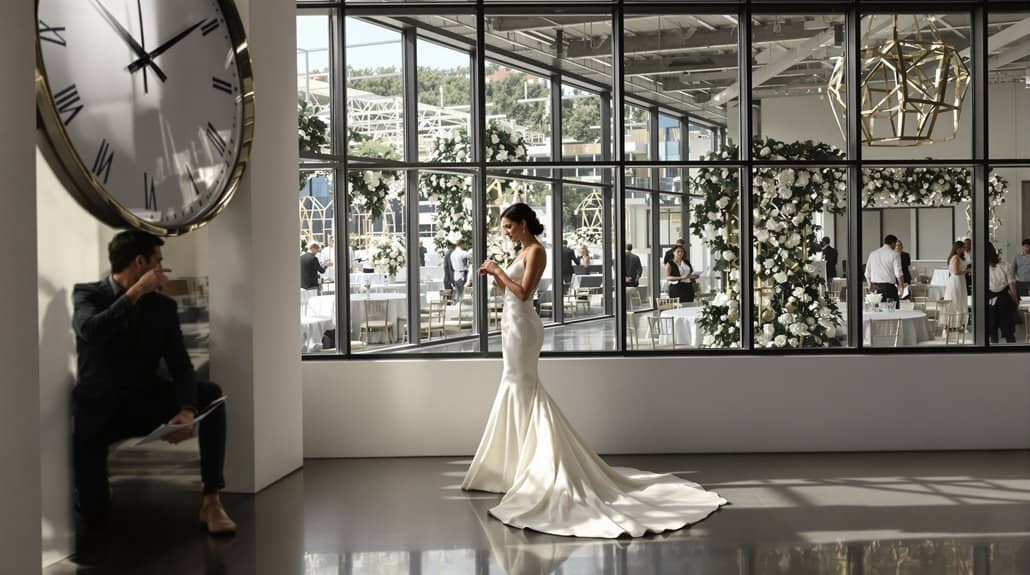
Despite thorough Pinterest boards and optimistic vendor contracts, couples consistently underestimate setup requirements—a timeline miscalculation that cascades into your entire wedding day with ruthless mathematical precision.
Your three-hour setup window evaporates when vendors arrive simultaneously at the loading dock. Consider this: experienced teams need 2-3 hours for a 250-guest reception, yet most couples allocate half that time. Professional timeline planning accounts for electricity access, generator placement, and ADA requirements—details you’ve likely overlooked.
The mathematics are unforgiving. With 70% of wedding delays stemming from logistics rather than design failures, your backward-scheduled timeline must begin with service realities, not aesthetic aspirations. Your vendor timing coordination affects everything: when guests eat, dance, and finally, whether they remember your celebration fondly or as a disjointed sequence of waiting periods. Just as your color palette shapes the emotional atmosphere and long-term memories guests form, your timeline architecture determines whether those memories capture seamless celebration or fragmented chaos. And yet, proper setup coordination remains the most overlooked aspect of wedding production—the invisible infrastructure upon which your visible moments depend.
Overestimating DIY Capacity
As you sketch out ambitious floral arrangements on graph paper at midnight, professional planners are logging their 100th hour on weddings half the size of yours—yet you’ve convinced yourself that Pinterest tutorials and determination will close this expertise gap.
The statistics crush these DIY wedding dreams: 49% of couples exceed their budget despite self-management, with unexpected expenses adding $5,000-$10,000 beyond planned amounts. You’re facing a 45% underestimation of ceremony and reception costs, while attempting to recreate $300,000 aesthetics on a $30,000 budget.
This ranks among the top wedding planning fails: couples consistently overestimate their capacity to manage 14 vendors while learning specialized skills. The couples get wrong the fundamental math—150-200 hours of planning work that professionals condense to 100-120 through expertise. Your DIY wedding mistakes accumulate as social media fuels unrealistic expectations, leaving 60% of couples stressed when Pinterest perfection collides with practical limitations. When negotiations do become necessary, couples often resort to car-dealership tactics that vendors view negatively, further damaging the collaborative relationships essential to pulling off a successful wedding.
Poor Vendor Communication Patterns

When vendors operate in isolation from each other, your wedding transforms into a chaotic mess of missed connections and costly misunderstandings. Vendor communication breakdowns create information silos where critical details fall through cracks. Your role shouldn’t include playing telephone between professionals who should be coordinating directly.
Three communication failures that devastate weddings:
- Delayed response times – 91% of couples expect same-day responses, yet vendors routinely miss weekend inquiries, costing them 35% of potential leads
- Inadequate information collection – Without coordinated gathering systems, you’ll face surprise overtime fees and unexpected transportation charges
- Contact method misalignment – 67% of callers hang up without leaving voicemail, treating it as a failed attempt rather than an invitation to callback
Professional planners establish communication protocols weeks before your wedding, converting 45% of inquiries compared to the industry’s 25% average. This coordination becomes especially critical when managing the complex scheduling puzzle of venues and vendors who often require deposits 12+ months in advance. Your vendors need structure—not chance encounters—to deliver your vision effortlessly.
Simultaneous Services: Hair Makeup Mathematics Wrong
Couples routinely botch the mathematics of wedding-day beauty services, creating timeline disasters that ripple through their entire celebration. You’re budgeting 2-3 hours for your entire bridal party? Think again. A bride plus four bridesmaids requires a minimum five-hour runway—not the abbreviated timeline you’ve sketched on that optimistic Excel sheet.
Among the most devastating wedding planning fails: underestimating that each bridesmaid needs 30-45 minutes per service, not 15-20, while you’ll require 60-90 minutes for each of yours. And yet, there’s a solution hiding in plain sight. Your common wedding errors involve insufficient stylist allocation; with six or more bridesmaids, you need at least two hair stylists working simultaneously to avoid ceremony delays.
Wedding planning mistakes compound when you position yourself last in the timeline. Schedule yourself mid-sequence instead, finishing 1.5-2 hours before ceremony start—creating that vital buffer for inevitable delays and essential touch-ups. Build 15-minute buffers between each service block to accommodate the delays that derail even the most meticulously planned beauty schedules.
Prevention Strategies from Professionals

While beauty timelines create ripples of stress on your wedding day, smart prevention tactics can calm the waters before they churn. The most devastating wedding planning mistakes occur when couples forget to see their celebration through the eyes of their guests—an oversight professionals witness with alarming frequency. Trust the vendors you’ve vetted, then release the reins. Wedding planning failures multiply when micromanagement replaces delegation, and your joy evaporates amid spreadsheet cells.
Beauty stress dissolves when you plan smartly, prioritize guest experience, trust your vendors, and resist micromanagement’s joy-killing grip.
- Budget first, dreams second – Create a thorough spreadsheet tracking every expense before booking a single vendor, saving yourself the gut-punch of realizing you’ve spent 80% of your budget with 70% of your needs still uncovered.
- Decide quickly, but thoroughly – Common wedding errors stem from prolonged indecision that forces last-minute, premium-priced compromises, including delays in securing your marriage license requirements which vary significantly by state.
- Schedule breathing room – Build 15-minute buffers between events and carve out 20 sacred minutes post-ceremony just for you two.
Conclusion
Throughout this exploration of wedding planning pitfalls, one truth emerges with unmistakable clarity: your perfect day exists in the balance between thorough preparation and graceful surrender. Wedding planning mistakes aren’t failures—they’re inevitabilities you’ll navigate with varying degrees of grace.
From the planner perspective, couples who thrive aren’t those avoiding errors but those approaching the process with flexibility, realistic expectations, and willingness to delegate.
| Area | Common Wedding Errors | Reality Check |
|---|---|---|
| Time | Underestimating setup | Double your estimates |
| DIY | Overcommitting | Choose one signature element |
| Vendors | Poor communication | Schedule monthly check-ins |
| Budget | Surprise costs | Add 15% buffer minimum |
The most successful celebrations aren’t necessarily the most expensive or elaborate—they’re the ones where couples preserved their joy throughout the planning process. When it comes to achieving that polished look for your big day, investing in luxury beauty products can elevate your bridal aesthetic and ensure you feel confident from ceremony to reception. And yet, the struggle itself creates something meaningful: a first test of your partnership’s resilience, communication, and ability to create beauty amid chaos.