
Effective wedding guest flow requires architectural thinking—not just aesthetics. Your floor plan should enable seamless transitions: ceremony to cocktail hour within 15 minutes, cocktail space with 1 table per 10 guests, and reception pathways at least 36 inches wide. Position bars away from entrances (1 bartender per 75 guests), create “invisible highways” between stations, and anticipate bottlenecks at restrooms and thresholds. The difference between chaotic collisions and effortless mingling lies in these seemingly minor spatial decisions.
Why Guest Flow Matters More Than You Think
Although breathtaking centerpieces and showstopping gowns grab attention, it’s the invisible architecture of guest movement that transforms a wedding from merely pretty to profoundly memorable. The data doesn’t lie: 68% of guests primarily attend to celebrate you, yet their ability to do so hinges entirely on your wedding venue layout decisions. To ensure a seamless experience, consider implementing effective tier allocation strategies in your planning process.
Consider this reality: your carefully selected catering (noticed by 64% of attendees) becomes irrelevant if guests stand trapped in bottlenecked serving areas. Your wedding floor plan isn’t merely logistics—it’s emotional architecture. And yet, the most successful guest circulation wedding patterns remain invisible, felt rather than seen.
Medium-sized celebrations (51-150 guests) offer that golden balance—enough energy for dancing (important to 41% of guests) without the logistical nightmares of larger gatherings. Your reception represents the highlight for over half your attendees. With 53.13% of guests favoring the reception as the top part of the wedding day, plan its flow scrupulously, and everything else—from décor to dessert—falls perfectly into place.
Ceremony Exit to Cocktail Hour: The Critical Transition
While your ceremony provides the emotional peak, it’s the immediate shift afterward that determines whether your wedding maintains momentum or fractures into awkward waiting periods. Your wedding guest flow hinges on timing—cocktail hour should begin within 15 minutes of ceremony conclusion, lasting 60-90 minutes maximum. Any longer creates restlessness; any shorter feels rushed. This critical transition contributes significantly to creating a memorable wedding experience for all attendees. Emphasizing quality over quantity in your planning will enhance the overall flow and atmosphere.
Your wedding layout design should incorporate strategic visual cues. Dim lights in the cocktail area, open reception space doors, and position staff at transition points to subtly shepherd guests without making them feel herded. The reception layout benefits from engagement elements that maintain energy—photo booths near entrances or acoustic musicians performing conversation-friendly Motown classics at precisely calibrated volumes.
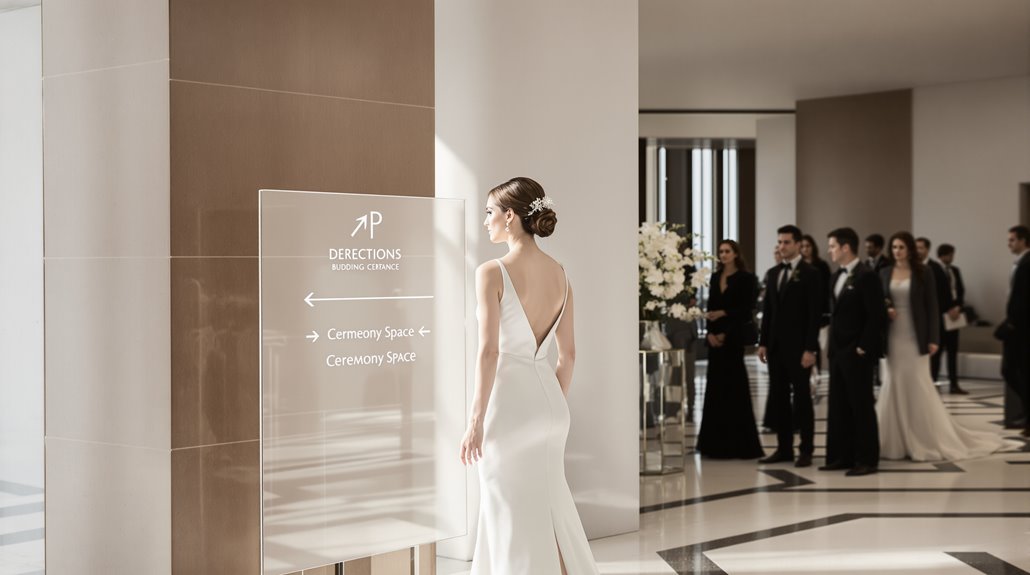
Communication remains paramount. Clear signage prevents the dreaded guest wandering syndrome. And yet, the most effective transitions feel invisible—guests flow naturally from ceremony to cocktails to reception, never sensing the architectural precision beneath their experience.
Cocktail Hour Spatial Requirements
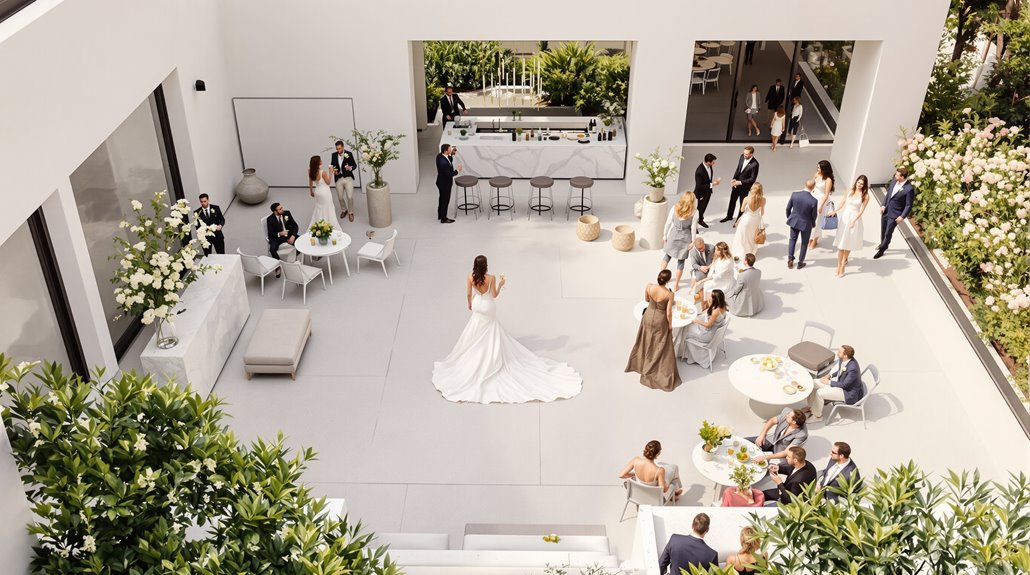
Because even the most heartfelt ceremony becomes meaningless if guests spend the next hour trapped in an overcrowded hallway, your cocktail space requires precise mathematical consideration. Wedding guest flow demands rigorous calculations: 1 cocktail table per 10 attendees with dinner service, but double that without formal dining options. That standard-issue 100-person wedding? You’ll need 10 high-tops—non-negotiable.
Your wedding venue layout must allocate 25-30% of surfaces for seating, particularly for older guests who’ll quietly resent you otherwise. But here’s where most couples miscalculate: the negative space between stations creates the experience. Wedding layout design isn’t about cramming maximum furniture into minimum square footage; it’s about creating invisible highways for movement.
Distribute bars tactically to prevent bottlenecks, position food stations with ample approach space, and—critically—leave the majority of floor space gloriously, intentionally empty. Counterintuitive? Yes. Essential? Absolutely. In fact, understanding emerging design movements can enhance guest experience by promoting a seamless flow throughout the event.
Reception Entry and Seating Discovery
The moment your guests step from cocktail hour into your reception space represents a psychological reset—their final destination for the evening, where memories crystallize and your celebration finds its fullest expression. Your wedding venue layout must transform this transition from functional to transcendent.
Consider dramatic lighting as your silent usher—monogram projections establish identity while uplighting pathways subtly guide movement without feeling prescriptive. Draped architectural framing with strategic spotlighting creates an entrance that feels both grand and intimate, a contradiction that perfectly captures wedding energy.
For guest flow that feels intentional but never rigid, invest in seating arrangements that invite discovery. Serpentine tables (rather than predictable rounds) create visual interest and conversation flow, while maintaining crucial 36-inch pathways for server access. Your reception entry should feel like revelation—98% of couples now customize their space rather than accepting standard configurations, and yet the most memorable designs maintain balance between dramatic statement and intuitive navigation.
Bar Positioning and Line Prevention
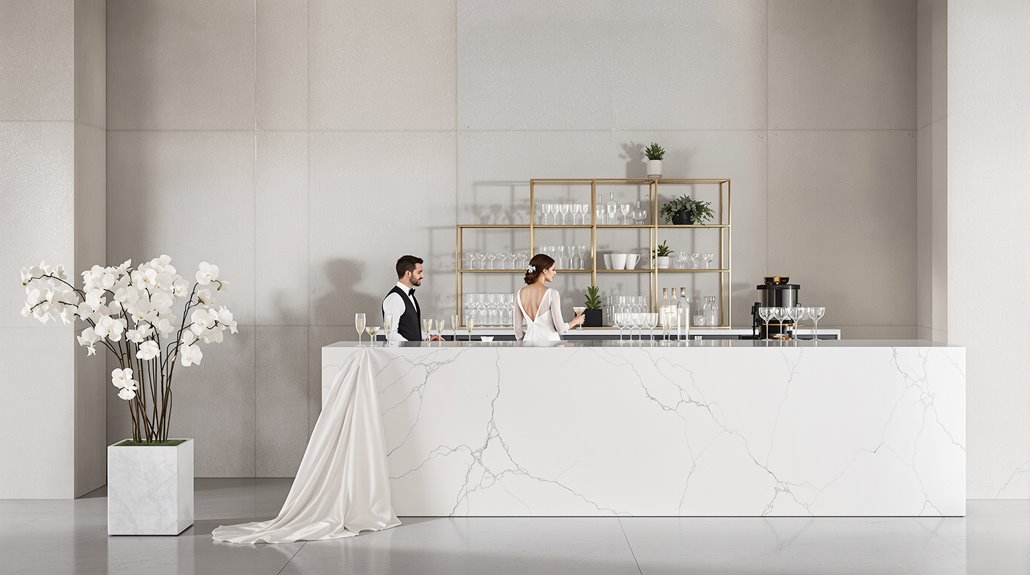
Few wedding elements derail guest experience more swiftly than the dreaded bar line—a phenomenon that transforms enthusiastic celebrants into impatient clock-watchers within minutes of arrival. Your wedding venue layout demands calculated thinking: position your main bar away from entrances and dance floors, while creating satellite stations near natural gathering spots to disperse crowds.
For ideal wedding space planning, follow proven bartender ratios: one per 75 guests for basic service, increasing to one per 50 for craft cocktails. And yet, even perfect staffing collapses without consumption planning—expect two drinks per guest that first hour, then one drink hourly thereafter.
Wedding guest flow hinges on anticipating pressure points. Deploy multiple service stations—a central cocktail hub, dedicated wine station near dining, beer taps for outdoor access—rather than funneling everyone through a single bottleneck. Monitor consumption patterns with hourly counts, adjusting your 50-30-20 ratio (wine-spirits-beer) based on real-time demand.
Dance Floor Accessibility
Masterful dance floor accessibility functions as your wedding reception’s central nervous system, connecting guests to celebration while preventing dangerous crowding patterns during peak moments. Your wedding layout design must include a minimum 36-inch clearance on all sides—non-negotiable for safety and flow. You’ll need alternation positioning that balances visibility for seated guests with proper traffic patterns, ensuring your wedding guest flow remains intuitive throughout the evening.
- Create at least two clear access paths to prevent bottlenecks when the dance floor fills during those inevitable Taylor Swift moments
- Install non-slip progression areas between different flooring surfaces—they’ll prevent embarrassing (and potentially litigious) guest falls
- Position your dance floor to optimize sightlines from all tables, keeping non-dancing guests connected to the celebration
Your venue layout coordination should account for physical obstacles that can reduce usable space by 25%. The perfect wedding flow embraces accessibility without calling attention to it—inclusive yet invisible.
Lounge Area Placement
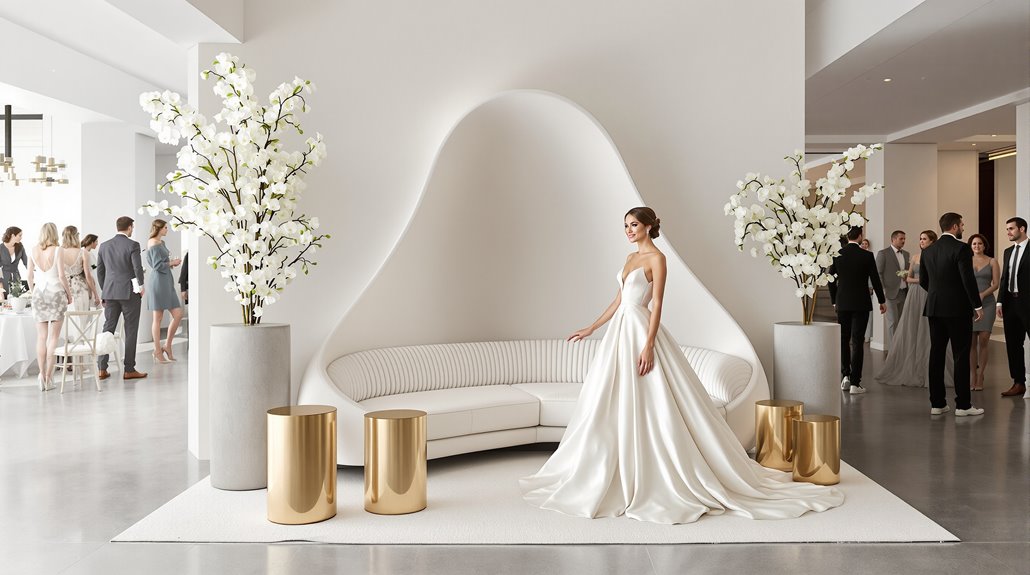
Tactical lounge area placement serves as the social gravitational center of your reception, drawing guests away from congestion while nurturing intimate conversation zones that never feel divorced from the celebration’s energy. Position these sanctuaries deliberately—close enough to maintain event engagement but far enough from your dance floor to allow actual conversation.
You’ll need to accommodate 10-15% of your guest count within these areas, balancing proximity to bars and restrooms without creating bottlenecks. And yet, the math alone won’t save you; venue-specific elements—those cursed columns, awkward alcoves, and structural quirks—demand in-person walkthroughs before finalizing positions.
Your anchor piece (that statement sofa or tête-à-tête) establishes both aesthetic foundation and functional purpose. Supporting furniture should radiate outward, creating symmetrical configurations that look intentional rather than scattered. Remember: when guests can’t immediately intuit how to use a space, they simply won’t.
Common Bottleneck Zones to Avoid
While designing your perfect celebration tableau, bottlenecks lurk in predictable zones—those frustratingly obvious problems you’ll only notice once 150 well-dressed bodies are simultaneously attempting to navigate them. Your venue’s spatial poetry transforms into prosaic congestion when guests collide at these critical junctures, yet most are entirely preventable with deliberate foresight.
- Bar stations – position multiple service points with 1 bartender per 50 guests and consider satellite bars for larger events; that magnificent central bar becomes a social black hole otherwise
- Restroom corridors – narrow hallways leading to facilities become painfully apparent during post-dinner rushes; ensure 28-36 inches minimum width per expected traffic volume
- Transition thresholds – those ceremony-to-cocktail hour bottlenecks require timing buffers of 20-30 minutes and spatial pathways that accommodate 60% of your guest count moving simultaneously
Counterintuitively, the most beautiful architectural features—grand staircases, ornate doorways—often become your most problematic flow interrupters. Beauty and function must coexist.
Testing Your Flow Plan
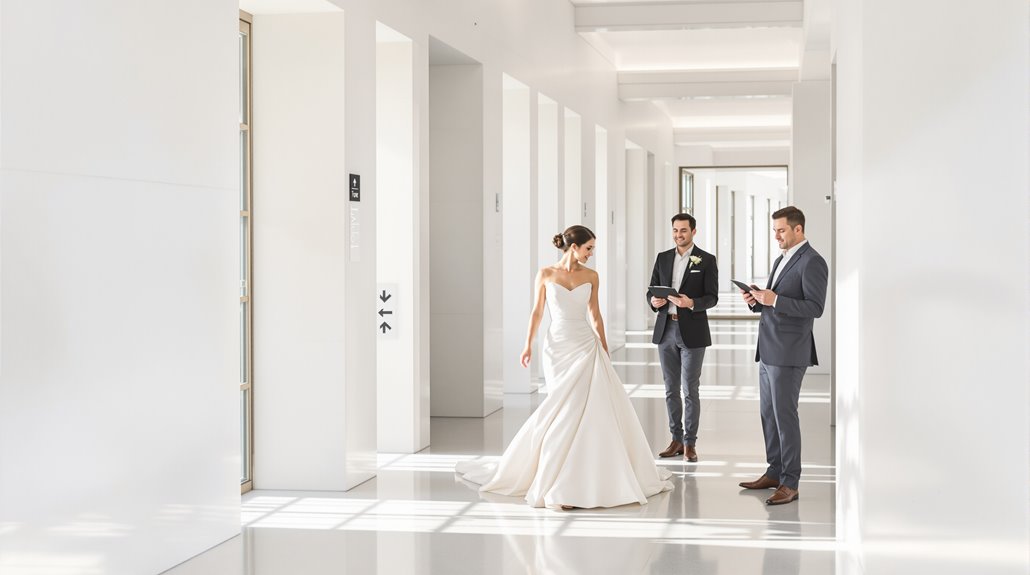
Before committing to your event design, you’ll need to ruthlessly test every aspect of your guest flow—because theoretical plans collapse spectacularly when confronted with real human behavior. Try these validation approaches:
Track your energy arc by mapping emotional peaks and valleys. A condensed 4-5 hour reception often maintains momentum better than the traditional 6-hour marathon, which risks mid-reception energy slumps.
Apply the unforgiving 30/5 rule: that 5-minute hair adjustment will absolutely consume half an hour. Build buffers accordingly.
Distribute toasts throughout dinner in 3-5 minute segments rather than consecutive speech blocks that drain the room’s energy before dancing begins.
Create multi-sensory engagement stations—sommelier-guided tastings, interactive food displays, looping family photos—to increase mingling by 60%.
And test your technical environment rigorously. The wrong generator vibration frequency will physically exhaust guests, while proper amber-to-pink lighting progression subconsciously sustains their comfort throughout the night.
Conclusion
The architecture of your wedding’s guest flow forms the invisible foundation upon which every memorable moment rests. When executed with intention, your celebration unfolds not as a series of disconnected events but as a seamless narrative—one that guides guests through an experience that feels both effortless and extraordinary. What appears spontaneous to attendees actually stems from meticulous planning, flexibility, and communication.
- Prioritize comfort over convention – create multiple zones that allow for natural mingling, ensure accessibility for all mobility levels, and position amenities strategically
- Think choreographically – imagine your guests as dancers moving through space; eliminate bottlenecks, bundle similar activities, and intersperse high-energy moments with quieter ones
- Remain adaptable until the end – develop backup plans for guest count fluctuations, weather contingencies, and timing shifts
Your wedding flow design isn’t merely logistical—it’s the invisible hand that transforms disparate elements into a cohesive celebration that feels both inevitable and magical.