
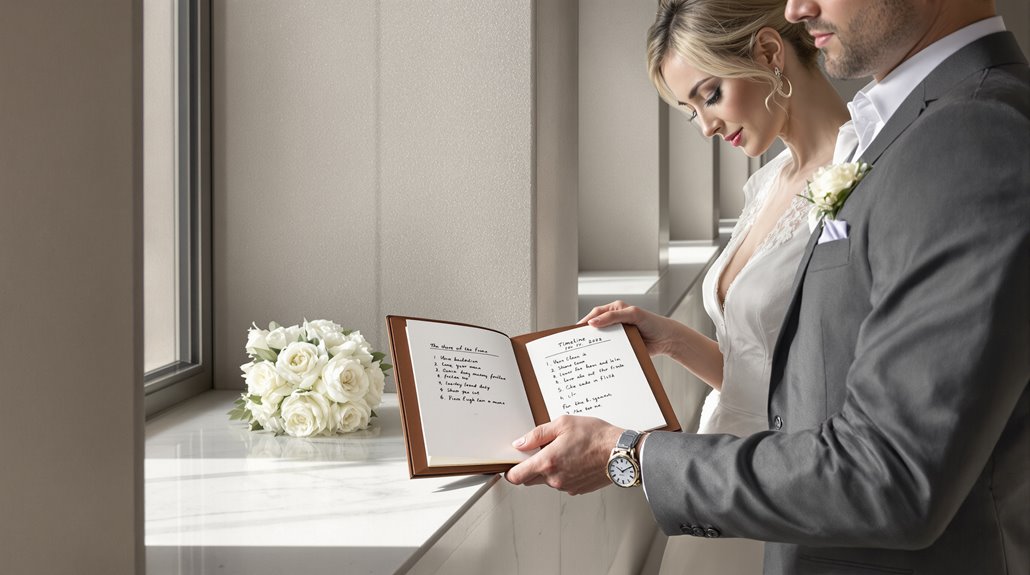
Your wedding timeline isn’t just logistical paperwork—it’s the backbone that prevents your celebration from unraveling. You’ll need precision for 11 critical moments: getting ready (start 6-7 hours pre-ceremony), first look (30 minutes), ceremony timing, cocktail hour flow, meal service, toasts (20 minutes total), cake cutting, golden hour photos (45 minutes pre-sunset), dance sequence, and a tactical final hour. Thoughtful planning distributes decision-making, allowing you to actually enjoy being the center of attention.
Introduction: Why Timeline Matters
Why do so many seemingly perfect weddings unravel in the final hours? Because the wedding day schedule—that detailed choreography of moments—fails at the worst possible time. Your carefully planned celebration depends on a strong wedding day itinerary that coordinates everyone from your photographer to your in-laws.
Your timeline isn’t just paper—it’s your defense against chaos. It prevents your photographer from missing critical shots, your guests from wandering aimlessly between events, and you from forgetting to eat. With couples spending an average of 15 months engaged, establishing a comprehensive timeline becomes essential to making the most of this significant planning period. A thorough wedding timeline template distributes decision-making burden away from you, creating space to actually experience your day. In the realm of weddings, quality over quantity becomes a guiding principle, emphasizing the importance of thoughtful planning over mere extravagance.
Without proper scheduling, even minor delays cascade. Hair running fifteen minutes late means rushed photos, which means late ceremony start, which means cold dinner, which means—you get it. The timeline serves as both backbone and safety net, transforming potential disasters into manageable hiccups through anticipation rather than reaction.
Moment 1: Getting Ready Start Time
Though you might be tempted to sleep in on your wedding day, your getting ready timeline actually begins far earlier than most couples anticipate. The mathematics are unforgiving: each bridesmaid requires 90 minutes for hair and makeup, while you’ll need 2-3 hours. And yet, these numbers aren’t merely about beauty—they’re about emotional breathing room.
For a 5 PM ceremony, hair and makeup should start by 9-10 AM. Earlier ceremonies demand proportionally earlier starts—a 10 AM ceremony might require that alarm clock at dawn’s first light. Brutal, yes, but necessary.
Your wedding day schedule hinges on this first domino. Add buffers—30 minutes between completion and dressing, time for eating actual food (not just mimosa breakfast), photographer arrival before the final hairspray cloud settles. Multiple stylists can compress the hair and makeup duration, but you’ll still need those margins. Plan for 5-10 minutes more than you expect each activity will take to prevent stress when something unexpected occurs. Timeline tension is inevitable; anticipate it.
Moment 2: First Look Timing
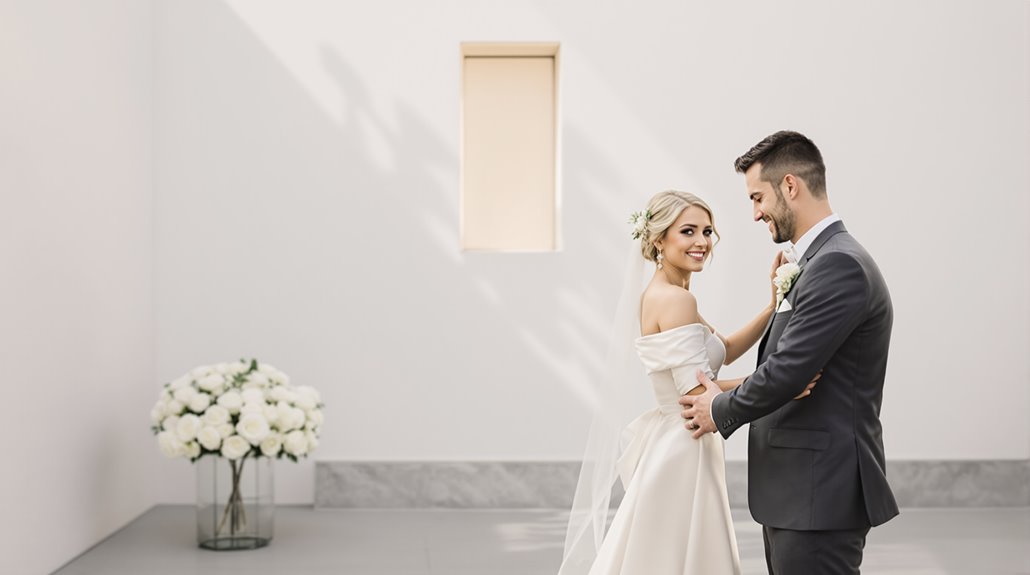
While your dress gets zipped and boutonnieres pinned, the clock marches relentlessly toward your first look—that pivotal 30-minute window where private emotion meets photographic documentation. This sacred moment requires precise wedding day timing, yet rushing it guarantees regret. Your ceremony timeline bends around this decision: opt for a first look, and you’ll gain an hour of flexibility; skip it, and you’ll need to pad your wedding day schedule with an additional hour for post-ceremony portraits.
- Location scouting and setup must be completed before the scheduled time
- Photographer and videographer require positioning before the groom arrives
- Winter weddings typically start at 1:30 PM, spring ceremonies might push to 2:30 PM
- Bride transportation to the location needs seamless coordination
- The 30-minute window allows for emotional recovery before portraits
Your first look offers breathing room—a tranquil island amid the day’s relentless current of expectations and timetables. Additionally, this moment can reflect the old money aesthetic, emphasizing an elegance that resonates with timeless luxury.
Moment 3: Ceremony Start
As your ceremony processional begins, those 3-6 minutes represent the culmination of months of planning yet serve merely as prelude to the emotional centerpiece of your day. Your wedding day schedule hinges on this passage being seamless—precise coordination between officiant (who enters first), groom (either with parents or solo), wedding party pairs, then finally you, typically escorted by family.
Your wedding day itinerary should allocate specific timeframes: 2-3 minutes for opening remarks, 5-10 minutes for readings, 3 minutes for ring exchange, and potentially 5 minutes for unity ceremonies. But timing isn’t merely mechanical—it’s emotional architecture.
Start ceremony planning 30 days out, finalize details within the final two weeks. Assign responsibilities deliberately: ushers directing guests, someone safeguarding rings, your officiant keeping time. Reserve front rows for immediate family—grandparents, parents, siblings—creating the intimate tableau against which you’ll exchange vows and become, officially, married. Additionally, consider how spending optimization can enhance the overall experience and ensure every moment is memorable without exceeding your budget.
Moment 4: Cocktail Hour Logistics
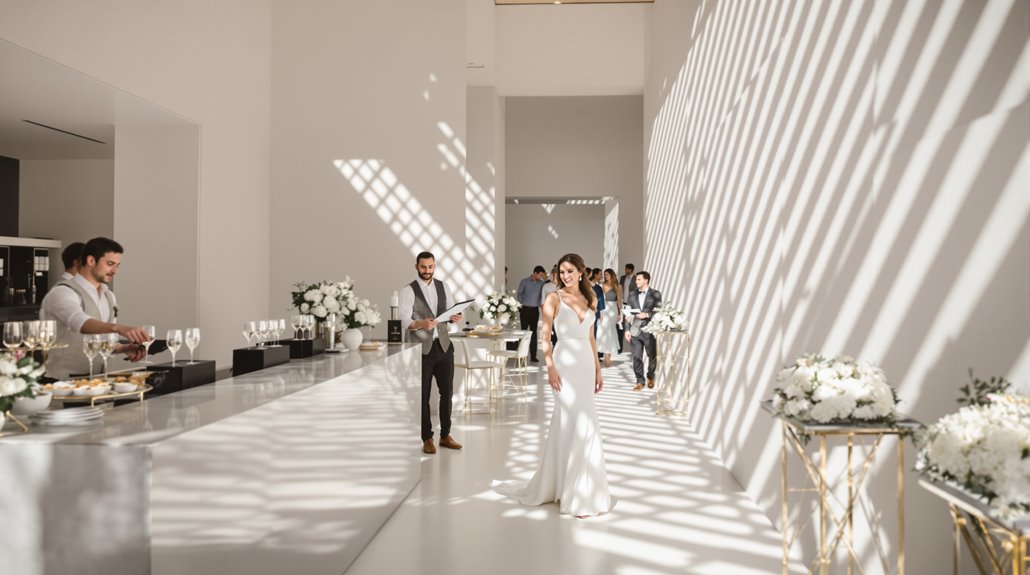
Once your ceremony concludes, you’ll enter the deceptively complex domain of cocktail hour—that critical buffer between “I do” and dinner that determines whether guests leave raving about your hospitality or grumbling about empty stomachs. The standard 60-minute window demands precision wedding day scheduling, yet stretching to 90 minutes might be necessary if venue handoffs are involved.
Your wedding reception timeline must account for:
- One bartender per 35-40 guests (non-negotiable)
- 2-3 appetizer pieces per guest of each variety
- Setup beginning 30 minutes after ceremony’s end
- Transition coordination between catering and bar staff
- Entertainment elements that don’t compete with conversation
Moment 5: Grand Entrance
Your cocktail hour sets the mood, but the grand entrance defines it. This critical moment in your wedding day timeline demands precision—occurring exactly 1.5-2 hours after your ceremony and immediately following that essential 15-minute guest seating period.
The mechanics are deceptively complex. Your MC announces family and wedding party sequentially while your DJ shifts to entrance music that captures your essence. And yet, the emotional impact hinges on minute details: the exact wording of your introduction, the 5-10 second pause before you appear, the positioning of guests’ chairs for ideal visibility.
Your wedding day schedule should allot 5-10 minutes for this moment, with buffer time built in. Increasingly, couples incorporate choreographed entrances—adding personality but requiring rehearsal time in your wedding day itinerary. Your photographer needs advance notice of exact timing and movement patterns. First dance typically follows immediately, creating a seamless narrative flow that guests intuitively understand.
Moment 6: First Dance Placement
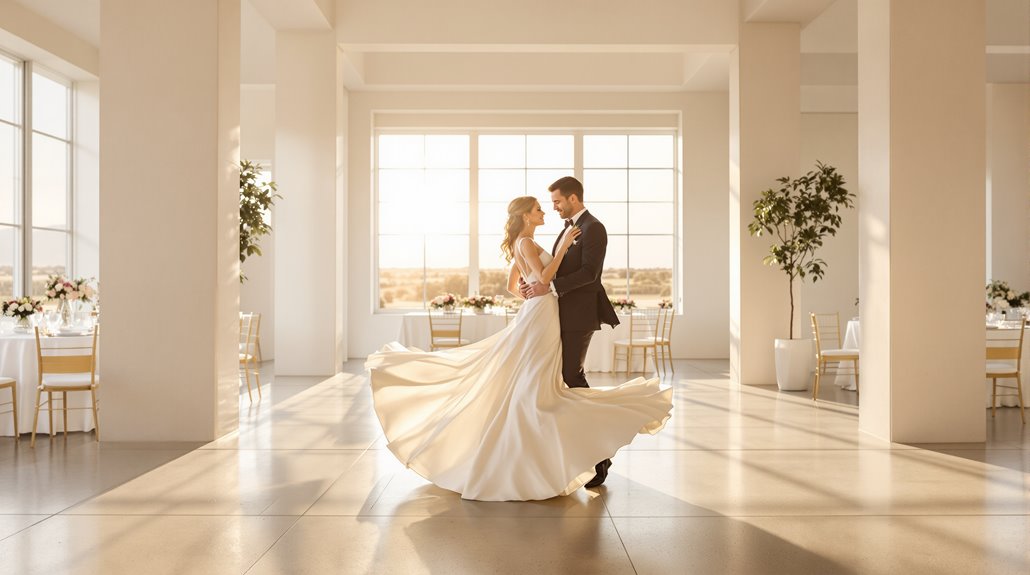
The first dance placement decision creates ripples throughout your entire reception flow. You’ve got two prime options: the traditional post-dinner slot when guests are full and relaxed, typically between 7:45-8:30 PM, or the momentum-building early placement immediately following your grand entrance. The latter frontloads emotion while guests are fresh—and yet, the traditional approach utilizes that magical post-meal glow when everyone’s settled in.
Your dance should last between 2.5-3 minutes—enough time for photographers to capture the moment, not so long that guests lose interest. The sequence matters profoundly:
- First dance (newlyweds)
- Father-daughter dance (approximately 2 minutes)
- Mother-son dance (slightly shorter)
- Best man and maid of honor dance (optional)
- Opening the dance floor to all guests
Start planning 3-6 months ahead for choreographed routines, 2 months minimum for simpler approaches. Time invested now prevents day-of panic.
Moment 7: Dinner Service
While couples often focus exclusively on the emotional peaks of their wedding day, dinner service constitutes the essential backbone that determines your reception’s overall success. You’re balancing guest comfort against timeline constraints—a high-wire act requiring precision.
| Service Style | Timing | Best For | Guest Flow | Kitchen Coordination |
|---|---|---|---|---|
| Plated | 60-90 min | Formal weddings | Synchronized | Complex, requires rehearsal |
| Buffet | 45-75 min | Casual celebrations | Table rotation | Simpler, station setup |
| Family-Style | 50-80 min | Intimate gatherings | Natural progression | Moderate complexity |
| Stations | 60-90 min | Interactive events | Continuous | High staff requirements |
| Cocktail-Style | 75-120 min | Modern receptions | Fluid movement | Requires timing precision |
Schedule dinner between 6:00-7:45pm for standard receptions. You’ll need 15-45 minutes post-seating before first course arrives, then another 30-40 for mains. And yet, these windows compress or expand based on your kitchen’s capabilities—confirming timing with catering staff isn’t just helpful, it’s essential.
Moment 8: Toasts Sequence
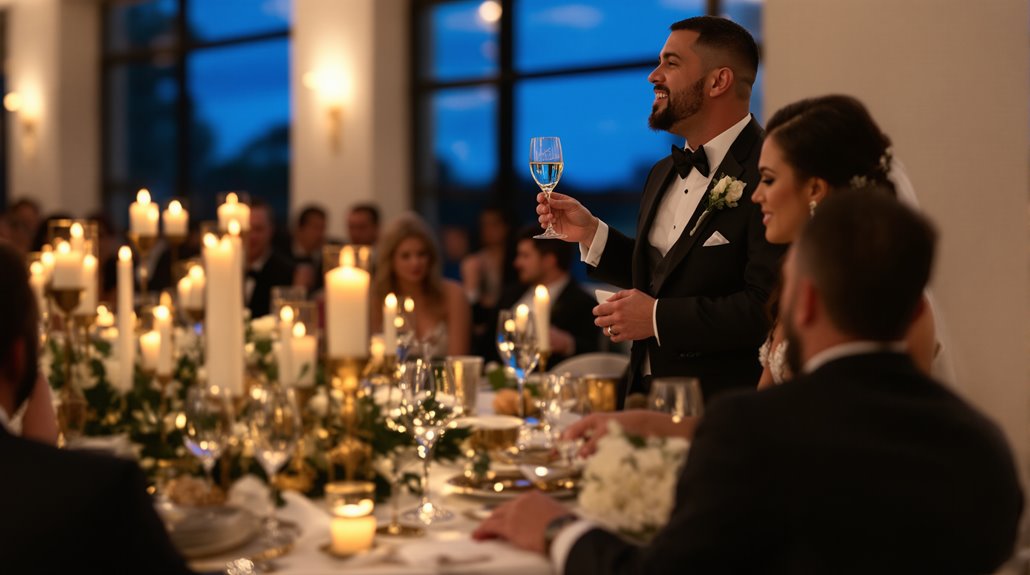
Beyond mere formality, wedding toasts serve as emotional tentpoles that transform your reception from dinner party to meaningful ceremony. You’ll need to decide not just who speaks, but when—a seemingly minor detail that profoundly impacts your entire evening flow. The traditional order (best man first, followed by maid of honor, then parents, finally you) creates a natural emotional arc, building from levity toward heartfelt gratitude.
- Post-main course timing allows uninterrupted presentations and sets the evening’s tone
- Allocate exactly 20 minutes total to prevent schedule derailment
- Formally assign speakers—assuming someone will toast spontaneously is reception suicide
- Position all speakers tactically near the microphone to maintain momentum
- Remind each speaker to hold champagne ready but drink only after concluding
The best toasts feel effortless, and yet they’re precisely choreographed—a microcosm of your entire wedding day, where invisible structure creates space for authentic moments.
Moment 9: Cake Cutting
Seemingly simple yet rich with symbolic weight, cake cutting represents your first unified task as a married couple—a moment guests instinctively recognize as meaningful despite its brevity. Position yourselves properly: groom’s right hand over bride’s while gripping the knife, inserting it cleanly into the bottom tier for structural integrity.
Traditional timing places this ritual post-dinner, pre-dancing—signaling to guests that departures won’t offend. And yet, modern couples increasingly cut earlier, especially with mixed-age guest lists. Grandparents and toddler parents appreciate not feeling obligated to linger until midnight.
Prepare carefully: ensure your caterer places two forks, napkins and a plate beside a stable (never too tall) cake stand. Notify your photographer minutes before to capture this Victorian-era tradition that once symbolized fertility but now represents mutual support.
After your ceremonial slice and feeding, the professionals take over, whisking the cake away for proper service to everyone else.
Moment 10: Golden Hour Photos
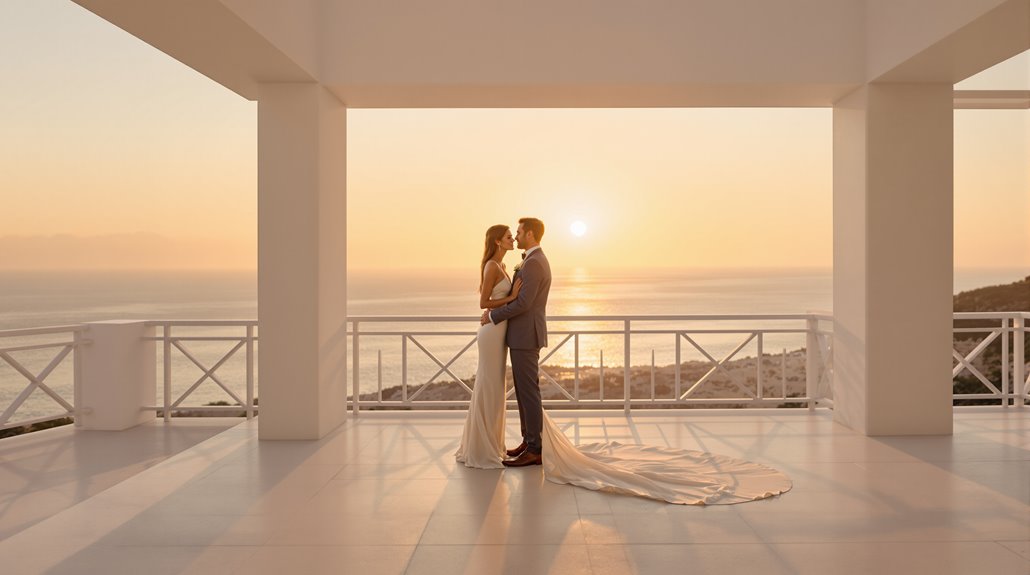
With the cake cut, you’re now racing against the sun’s inevitable descent. This fleeting window—typically 45 minutes before sunset—delivers the most cinematic, flattering light you’ll encounter all day. It’s non-negotiable photography gold that transforms ordinary portraits into ethereal keepsakes. Schedule backward from sunset, not forward from your ceremony.
- Winter golden hours compress to 30-40 minutes; summer stretches generously longer
- Coastal venues with clean horizon lines maximize your glow window
- Steal just 20 minutes from reception festivities—guests won’t notice amid cocktail chatter
- Schedule your ceremony 1.5-2 hours before sunset to guarantee adequate transition time
- Photographers need minimal equipment during this magic hour—nature does the heavy lifting
The timeline mathematics feel clinical, calculated—and yet, this precise planning creates your most spontaneous-looking images. Golden hour transforms even the most camera-shy couples into luminous, relaxed versions of themselves, skin bathed in forgiving amber that artificial lighting simply cannot replicate.
Moment 11: Final Hour Strategy
As your reception reaches its final stretch, planning the last sixty minutes with military precision determines whether your wedding concludes with triumphant perfection or awkward uncertainty. The 10:00-11:00 PM window requires tactical orchestration—not haphazard winding down.
Your last dance (ideally at 10:50 PM) must be pre-selected, creating that final intimate moment between you two while guests gather for your exit. Whether you’ve chosen sparklers, bubbles, or laser lights, communicate this plan clearly in your program. And yet, the most elegant send-offs collapse when transportation timing misaligns with guest departure.
Contract end-times matter enormously here. Vendors typically need 45-60 minutes for load-out, and every minute past 11:15 PM might trigger premium charges. Keep total reception length under 5 hours to maintain energy—anything longer and you’ll watch guests drift away, deflating your grand finale before it happens.
Putting It Together
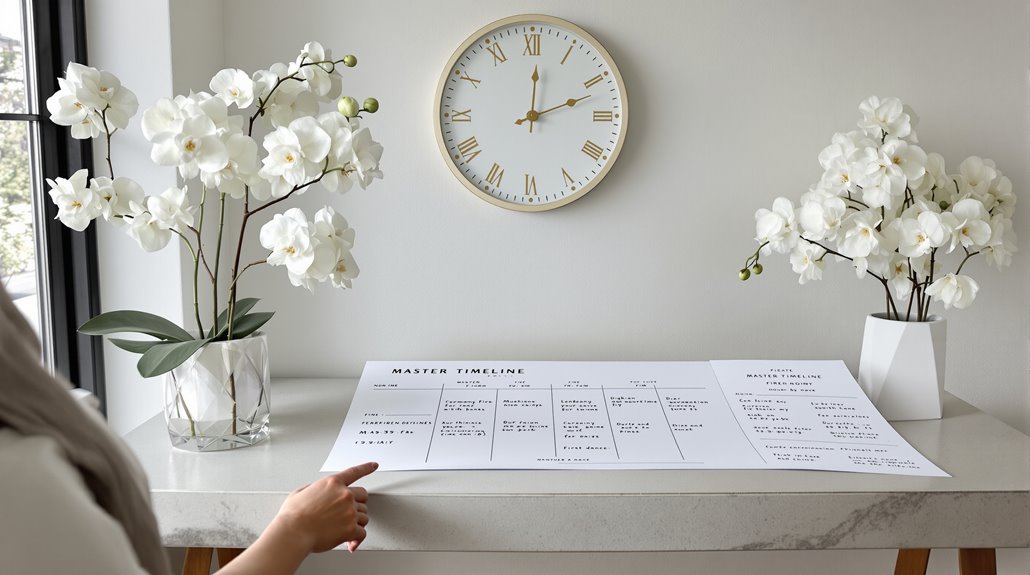
The perfect wedding timeline emerges not from guesswork but from tactical architectural planning where every moment becomes load-bearing. You’re crafting a precision instrument—one that accommodates both predictable rhythms and inevitable surprises. Working backward from your ceremony time creates the scaffold upon which everything else hangs, and yet flexibility remains your greatest ally.
- Anchor points first: Ceremony, dinner service, first dance, cake cutting, exit
- Buffer zones matter: Add 15-minute cushions between major progressions
- Vendor coordination sheet: Create a master document with all arrival/setup times
- Hour-by-hour breakdown: Include both public events and behind-the-scenes prep
- Priority protection: Identify 2-3 non-negotiable moments that cannot be rushed
Remember—your timeline should breathe. The most successful schedules maintain a paradoxical quality: carefully detailed yet responsive to the day’s natural evolution. Perfect planning creates the illusion of effortlessness, masking the architectural precision holding everything together.
Conclusion
Why do perfectly planned weddings still feel natural instead of robotic? Because the best timelines create structure while allowing for spontaneity—a framework, not a prison. And yet, as your celebration winds down, those final moments demand their own careful consideration.
Your exit strategy matters. Whether you’re planning a sparkler send-off (allocate 20 minutes minimum), a vintage car departure (schedule 15 minutes before for photos), or simply slipping away quietly (tell your photographer and three key people), the conclusion shapes how everyone remembers the day. But this isn’t just about dramatic exits—it’s about intentional closings.
Consider timing: most receptions end between 10pm-midnight, with your vendor contracts dictating precise cutoffs. The final hour should feel crescendo-like, not abruptly truncated. Your DJ’s last four songs matter enormously—they should build momentum, culminate in your chosen finale, and leave everyone satisfied, not stranded mid-celebration.