
Your ceremony should start 90-120 minutes before sunset, not the standard 5pm. In summer, aim for 6-7pm; fall and spring, 4:30-5:30pm; winter, as early as 3pm. Location matters too—mountains need an extra 30-minute buffer for earlier shadows. This timing optimizes golden hour portraits, prevents guest discomfort from midday heat, and creates natural flow into cocktail hour and reception. The perfect formula balances light quality, temperature curves, and logistical breathing room for your day’s seamless unfolding.
The 5pm Default Problem
While the 5pm ceremony start time has become the gold standard in American wedding planning, it creates a cascade of logistical nightmares that most couples don’t anticipate until they’re drowning in timeline math. You’re thinking sunset glow and ideal ceremony time—yet you’re actually signing up for harsh shadows, squinting guests, and compressed vendor chaos. Embracing quiet luxury in your planning can lead to a more seamless and enjoyable day for everyone involved.
Consider this: your makeup artist arrives at noon, photographer at 2pm, florist scrambling to finish by 4:30pm—all while your timeline offers zero buffer. That dreamy wedding timing golden hour portrait session? It’s now a rushed 15-minute sprint between dinner and dusk. Many wedding planners actually recommend 5:30 p.m. as the ideal ceremony start time for better flow and lighting conditions.
The truth is uncomfortably mathematical: a 5pm ceremony means your day began at dawn, your guests stand hungry through cocktail hour, and your carefully planned reception gets compressed into a rushed evening. Smart couples are questioning this default—and discovering ceremony start times should be calculated backward from sunset, not forward from noon.
Golden Hour by Season and Latitude
That 5pm default we’ve been dissecting? It’s woefully inadequate when you consider how golden hour timing shifts dramatically throughout the year. Your ceremony scheduling must align with seasonal sunset patterns, not arbitrary tradition. Summer ceremonies can start as late as 6:30pm and still capture that luminous light, while winter weddings might need a 3:00pm kickoff to avoid total darkness during portraits. Affluent couples often prioritize quality markers such as perfect lighting to enhance the overall experience and outcome of their wedding.
Ditch the 5pm default. Golden hour shifts with seasons, and your ceremony timing must follow nature’s rhythm, not tradition.
Your geographic location compounds this complexity—mountains create earlier shadows; coastal venues extend light. The math isn’t optional, it’s essential. Researching specific sunset times for your exact wedding date and location will ensure you don’t miss nature’s most flattering lighting opportunity.
- Summer (June-August): Golden hour begins around 7:30pm; schedule ceremony 1.5-2 hours pre-sunset
- Fall/Spring: Aim for 4:30-5:30pm starts as golden hour shifts earlier (typically 6:00pm)
- Winter: Plan for dramatically earlier timing—sometimes 2:00-3:00pm ceremonies
- Mountain/Valley Venues: Add 30 minutes to account for geographical light obstruction
Work backward from sunset, not forward from arbitrary convention. Your photos depend on it.
Temperature Curves Throughout Day
Beyond the perfect light for photos, your ceremony timing battles an equally formidable opponent: thermal reality. That dreamy 3pm summer ceremony? A sweat-soaked ordeal where guests silently curse your ideal ceremony time aspirations through squinted eyes.
Morning ceremonies (before 11am) offer merciful coolness and gentle light—ideal for spring and summer weddings when temperatures climb relentlessly toward that mid-80s threshold where discomfort becomes unavoidable. And yet, midday ceremonies persist despite peak solar radiation creating a thermal pressure cooker for your impeccably dressed guests.
The afternoon barely improves, with heat lingering stubbornly until 5-6pm when temperatures finally begin their meaningful descent. Your ceremony time planning should acknowledge this reality: evening ceremonies (post-6pm) provide reliable comfort as the day’s accumulated heat dissipates. The sweet spot exists where thermal comfort meets photographic potential—a window that shifts seasonally but remains discoverable for the determined planner. Additionally, understanding old money aesthetic can help you create a timeless and elegant ambiance that complements your ceremony’s timing.
Guest Comfort Considerations
Guest comfort transcends mere temperature considerations—it encompasses the entire experiential ecosystem you’re creating. Your ceremony timing decision affects whether attendees squint painfully through your vows or witness them in perfect visual clarity. The 5pm ceremony you’ve dreamed about might actually create a miserable experience—harsh July sun beating down, guests fanning themselves frantically, makeup melting before photos.
Consider these critical factors when determining start time:
- Travel logistics – Late afternoon ceremonies accommodate work schedules and distant travelers without forcing 5am departures
- Visual comfort – Position seating to avoid direct sunlight in guests’ eyes (ceremony math: sun angle + seating direction)
- Environmental exposure – Uncovered venues intensify temperature extremes and wind effects
- Seasonal appropriateness – October demands different timing than July; fall events require buffer for unpredictable weather patterns
You’re not just selecting a time—you’re engineering an experience that respects your guests’ physical comfort while honoring your vision. And yet, compromises here often augment rather than diminish.
How Ceremony Timing Affects Reception Flow
While you might imagine ceremony and reception as separate events, in reality they form two halves of a single synchronized dance whose success depends entirely on precise timing. Your optimal ceremony time creates the foundation for everything that follows—from cocktail hour to last dance.
Here’s the brutal truth: ceremony delays happen in half of all weddings, creating a domino effect that ripples through your entire timeline. A single 30-minute photography delay compresses everything downstream. Your cocktail hour—ideally 60-75 minutes—functions as your reception’s safety valve, absorbing these inevitable hiccups.
Grand entrances should happen within 5-10 minutes of dinner invitation, never exceeding 20 minutes after seating. Too late? You’ll spend the night fighting an uphill energy battle. Your wedding ceremony timing isn’t just about pretty photos—it’s mathematical precision determining whether your reception flows effortlessly or becomes a rushed, disjointed affair.
Photographer Optimal Timing Windows
Photographers don’t just capture moments—they orchestrate them within finite windows of perfect light. Your wedding ceremony timing creates or destroys these opportunities. That perfect 5pm ceremony sounds dreamy until you realize it means harsh July sun beating down on squinting guests and unflattering shadows across your face during vows.
The ideal ceremony time aligns with your photographer’s golden hour needs—typically 1-2 hours before sunset. This varies dramatically by season:
- Summer weddings – Start after 3pm to avoid midday harshness
- Winter celebrations – Early afternoon (2-3pm) optimizes limited daylight
- Spring/fall ceremonies – Schedule 2-3 hours pre-sunset for ideal portrait conditions
- Post-ceremony sequence – Allow 45 minutes for family portraits immediately following
What time wedding ceremony should begin? It’s mathematics, not preference—calculated backward from sunset on your specific date and location. Your photos will thank you.
The Formula for Your Ceremony Time
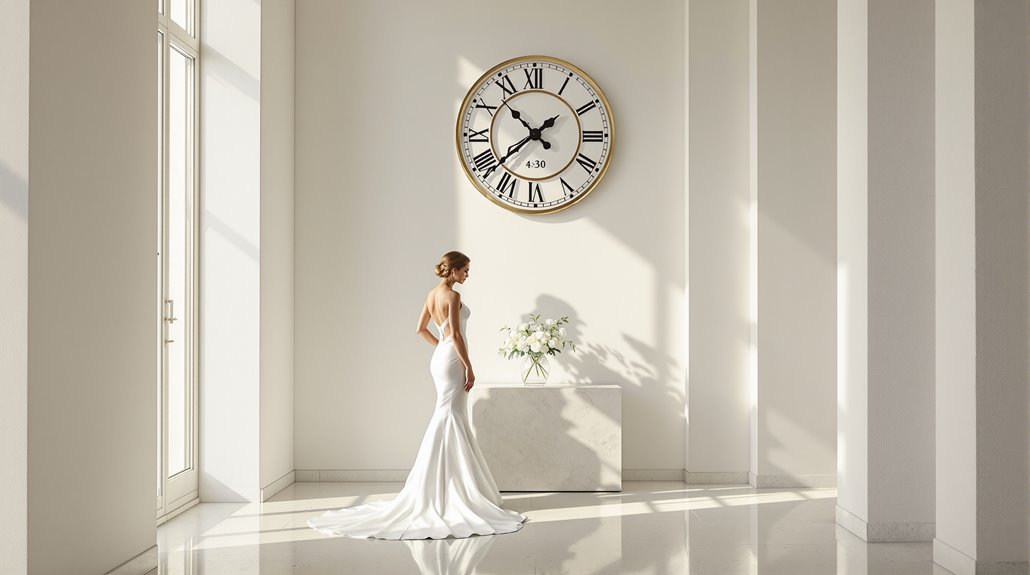
How do you transform a perfect-on-paper ceremony time into a real-world success? Finding your ideal ceremony time requires working backward from sunset—not forward from your hair appointment. Start with sunset, subtract 90 minutes, then adjust based on your specific variables. The mathematics of magical moments, distilled.
| Season | Sunset Buffer | Best Time for Ceremony | Considerations |
|---|---|---|---|
| Winter | 90 minutes | 3:30-4:30 PM | Early darkness, chilly evenings |
| Spring | 90-120 minutes | 5:00-6:30 PM | Rapidly changing sunset times |
| Summer | 60-90 minutes | 6:30-7:00 PM | Harsh midday sun, later golden hour |
| Fall | 90 minutes | 4:00-6:00 PM | Earlier sunsets, cooling temps |
| Holidays | 120 minutes | Varies seasonally | Guest travel considerations |
Your wedding ceremony timing isn’t arbitrary—it’s calculated precision. That 5 PM ceremony sounds romantic and yet creates harsh shadows across your photos. The best time wedding ceremony experts recommend accounts for light quality, guest comfort, and dinner timing—science supporting sentiment.
Indoor vs Outdoor Timing Differences
Despite sharing the same fundamental purpose, indoor and outdoor ceremonies demand radically different timing strategies—and yet many couples apply identical scheduling logic to both. Your ideal ceremony time hinges primarily on venue type. Outdoor weddings remain enslaved to sunset’s whims, requiring mathematical precision around golden hour—while indoor celebrations liberate you from these constraints entirely.
What determines your wedding ceremony timing:
- Light quality – Outdoor ceremonies must conclude 90 minutes pre-sunset for portraits; indoor venues provide controlled lighting regardless of time
- Seasonal variations – Summer outdoor ceremonies start 6:30-7:00PM; winter ceremonies need 4:00-5:30PM scheduling
- Ceremony duration – Religious ceremonies (45-60 minutes) work better indoors; brief ceremonies (15-30 minutes) suit outdoor settings
- Guest comfort – Outdoor timing must account for temperature extremes; indoor venues eliminate weather considerations
Remember: the 5PM ceremony that photographs beautifully indoors becomes a squint-inducing nightmare outdoors in July—timing isn’t arbitrary, it’s tactical.
Conclusion
The perfect ceremony start time represents wedding planning’s most consequential mathematical equation—a calculus of light, logistics, and lived experience that determines every photograph’s quality and each guest’s comfort. That idyllic 5pm ceremony quickly transforms into a squint-inducing ordeal under July’s harsh shadows, with guests shielding eyes rather than dabbing tears.
Remember: timing calculations require brutal honesty. Factor actual travel distances (not optimistic GPS estimates), account for elderly relatives’ needs, and build in that critical 30-minute cushion that acknowledges humanity’s relationship with punctuality. Consider sunset’s golden hour (minus 90 minutes for safety), assess seasonal temperature patterns at your venue, and ruthlessly examine shadow patterns across your space.
Your start time isn’t merely a clock position—it’s the foundational domino that triggers every subsequent moment. Get this right, and everything else stands a fighting chance. Get it wrong, and even perfect vows wilt under unforgiving circumstances.