
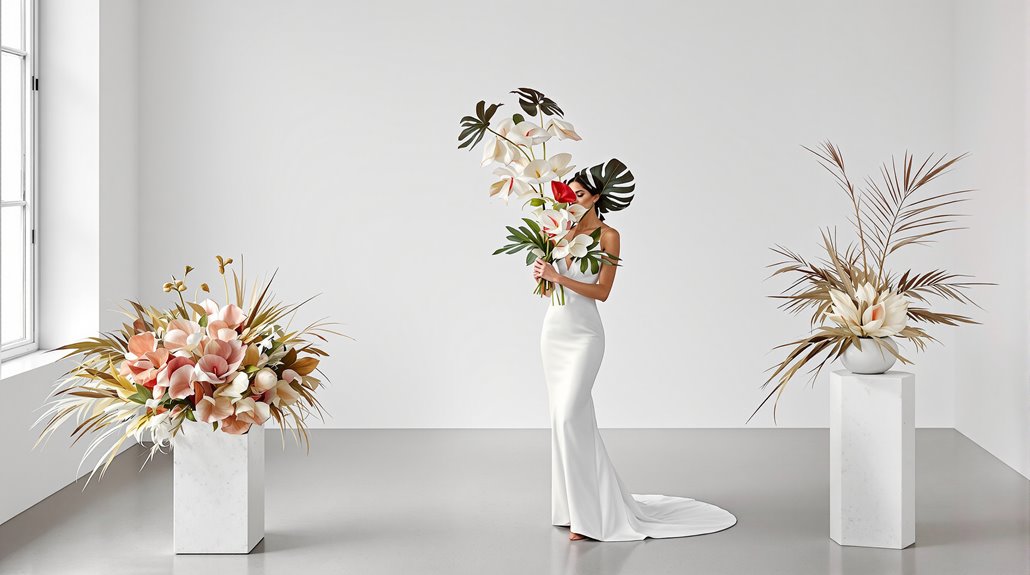
Sculptural bouquets transform florals from decoration to art through deliberate architectural principles. You’ll find nine standout designs—from the precision-bound Vertical Calla Column to the gravity-defying Cascading Amaranthus Drama—that command space rather than merely filling it. Each arrangement balances tension between natural forms and structural intention, incorporating negative space, unexpected asymmetry, and monochromatic palettes for maximum impact. These aren’t just pretty flowers; they’re provocations, statements that challenge conventional arrangements while honoring botanical elegance.
Introduction: Bouquet as Sculpture
When was the last time a floral arrangement actually stopped you in your tracks? Not the pleasant, predictable garden bunches that populate Pinterest boards—I mean arrangements that command space like sculpture, that force you to reconsider what flowers can do.
The architectural floral design movement transforms stems and blooms into statements of artistic intent, not mere decoration. You’ll find negative space doing as much work as the King Protea, see vessels that aren’t hiding behind blooms but standing in conversation with them. The artistic wedding bouquet has evolved from bridal afterthought to centerpiece of aesthetic vision—asymmetrical, unexpected, and unapologetically bold.
We’re witnessing floristry’s evolution into contemporary art, speaking the language of architects and sculptors rather than Victorian sentimentalists. And yet, this movement isn’t about coldness or abstraction—it’s about finding new ways for nature’s forms to arrest us, to make us look twice. Incorporating natural sculptural elements like branches, seed pods, and dramatic foliage creates depth and transforms ordinary bouquets into artistic masterpieces that tell a story beyond traditional floral design. For brides seeking this elevated aesthetic, luxury French beauty houses like Lancôme offer complementary sophistication that matches the artistry of sculptural arrangements.
Design 1: Vertical Calla Column
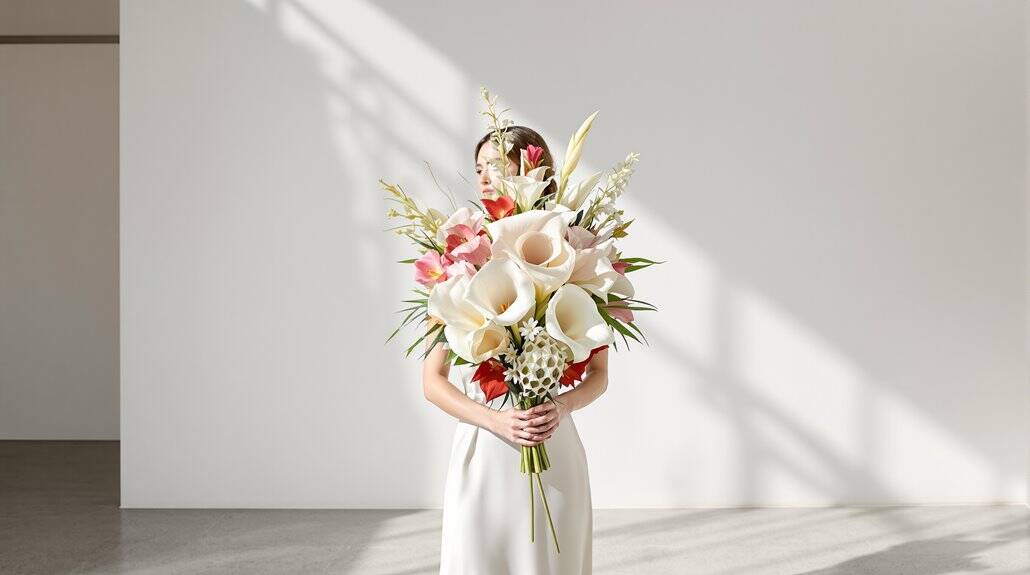
Unlike garden arrangements that drift amorphously, the vertical calla column demands your attention through its architectural precision. This sculptural wedding bouquet creates impact through disciplined simplicity—7 to 12 stems, tightly bound with aluminum wire at three points, stems visible and clean-cut at identical lengths. You’re creating an intentional negative space, not merely filling a vessel.
Arrange the calla lilies in perfect vertical alignment, their trumpet heads slightly staggered in height to create rhythm. The fleshy stems become integral to your statement wedding bouquet, not something to hide. And yet, this architectural bouquet requires careful handling; the chunky stems contain natural movement that will assert itself unless properly secured. The bouquet’s beauty is enhanced when you maintain the straightness of stems throughout the arranging process.
The column’s power lies in its unapologetic verticality—a declaration rather than a suggestion. No supplementary greenery needed. The column reads as sculpture first, flowers second, turning botanical materials into a geometric statement of controlled elegance. This approach mirrors the philosophy behind MoMA’s private spaces, where clean lines and artistic intention transform functional elements into unforgettable experiences.
Design 2: Single Anthurium Statement
| Display Context | Vase Style | Color Pairing |
|---|---|---|
| Japandi Minimal | Matte Ceramic | White/Soft Pink |
| Glam Statement | Black Glass | Deep Red/Purple |
| Modern Focal | Clear Cylinder | Green/Black |
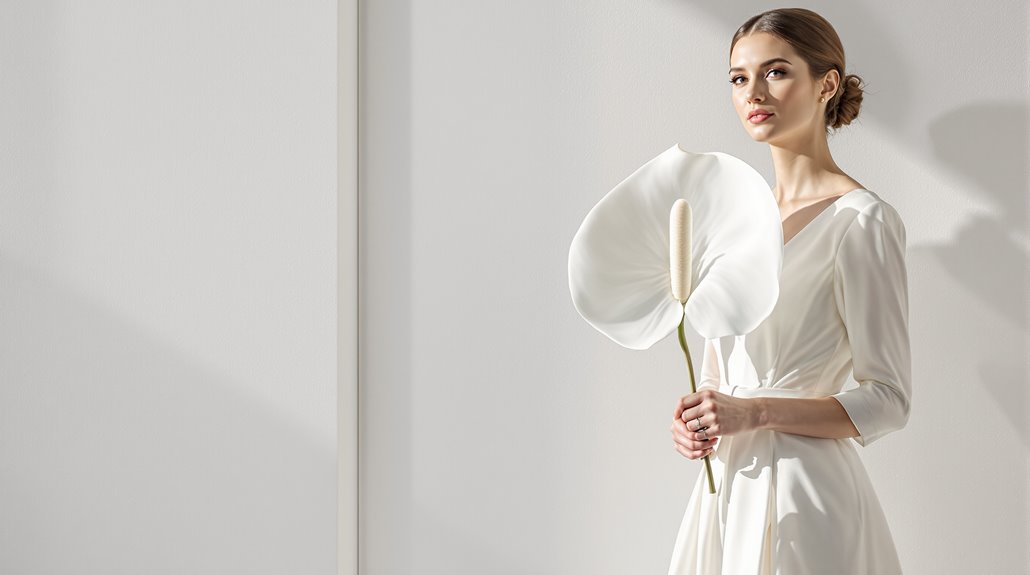
The artistic wedding bouquet thrives on emptiness—the negative space becomes as essential as the anthurium itself. Select a specimen with a flawless spathe, 4-8″ across, and position it so the dramatic stem creates a deliberate line through space. Modern bouquet design principles apply here: one exceptional element will always outperform a dozen mediocre components. It’s architectural, not decorative—and that’s precisely why it works. If incorporating candles nearby for ambiance, ensure your vessel is borosilicate glass or microwave-safe ceramic to withstand heat exposure safely.
Design 3: Cascading Amaranthus Drama
The cascading amaranthus transforms ordinary bouquets into gravitational poetry—defying both floral convention and physics simultaneously. You’re looking at nature’s perfect sculptural wedding bouquet material: those velvet rope-like strands naturally plunge 2-3 feet downward without complex engineering or floral foam contraptions.
Unlike garden-variety arrangements that disappear from memory, an architectural bouquet featuring amaranthus commands attention. It’s ridiculously simple to execute—the stems do the dramatic work for you—yet photographs like liquid movement captured in time. Available primarily in green and red (though white requires special ordering), amaranthus creates that elusive “just-foraged” quality that defines artistic wedding bouquets.
Pair with structured calla lilies at the base for tension between rigid and flowing elements. The imperfection is precisely the point: amaranthus cascades asymmetrically, creating visual interest that’s impossible to achieve with traditional rounded bouquets. And yet, despite its drama, it remains surprisingly accessible for DIY projects. Consider monochromatic variations using green amaranthus with sage foliage and white callas, allowing textural variety to create depth without competing colors.
Design 4: Orchid Arm Sheaf
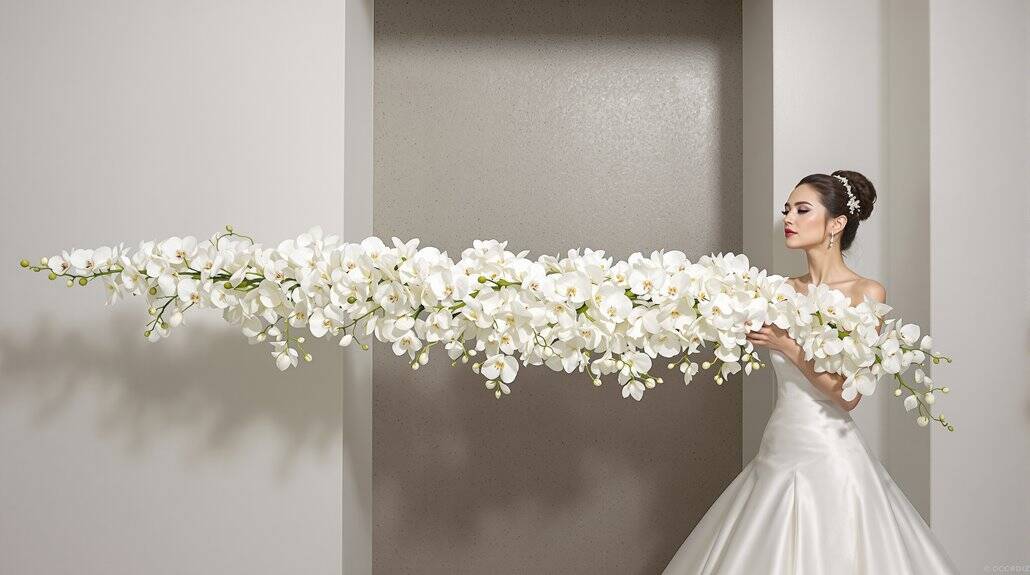
When refined brides demand something beyond the predictable roundness of traditional bouquets, orchestrating an orchid arm sheaf delivers sculptural drama without sacrificing elegance. The architectural foundation demands precision—three phalaenopsis stems woven together by two sets of hands, secured with bind wire at critical junctures. You’ll need patience here; those translucent petal spots require concealment with flat white paint.
The composition builds from this foundation: 2 hydrangea clusters for substance, 7 white Eskimo roses distributed throughout, 5 ruscus stems concealing mechanics. Add 3 fatsia leaves for weight, 7 galax for that essential collar effect. And yet, despite this technical complexity, the final effect reads as effortless.
Position is everything. The bouquet shouldn’t obstruct the dress—it’s cradled in the arm’s crook, stems cascading naturally. Garden arrangements fade from memory; this sculptural statement becomes part of her silhouette, photographed from every angle. Like contemporary museum spaces that serve as sleek, adaptable backdrops, this minimal design transforms the bouquet into a modern exhibition piece against the bride’s form.
Design 5: Monochromatic Plum Sphere
Creating a monochromatic plum sphere demands a fundamental shift in your design thinking—you’ll abandon the instinct for color contrast and instead plunge into the rich depths of a single hue’s possibilities. You’re working with structure as your primary language now, not palette variation.
| Shade Type | Flower Options | Percentage |
|---|---|---|
| Light Plum | Lilac, Lisianthus, Sweet Pea | 80% |
| Medium Purple | Butterfly Bush, Lavender Roses | 10% |
| Deep Violet | Hellebore, Purple Hydrangea | 10% |
| Textural Elements | Seeded Eucalyptus, Baby’s Breath | As needed |
The brilliance of the monochromatic sphere lies in its apparent simplicity—and yet, it’s deceptively complex. Place stems at consistent angles to achieve that perfect dome shape. Wrap with chenille stems for structural integrity, then finish with satin ribbon if you’re feeling indulgent. Your success hinges on textural variation: hydrangeas provide volume, delphiniums offer height, stock flowers add fragrance—all while maintaining the refined plum narrative that reads as intentional art, not accidental arrangement. Like circular ceremony arrangements that democratize the experience by eliminating visual hierarchy, a monochromatic sphere removes the dominance of any single bloom, creating equality through unified color where texture becomes the sole differentiator.
Design 6: Picasso Calla Artistic
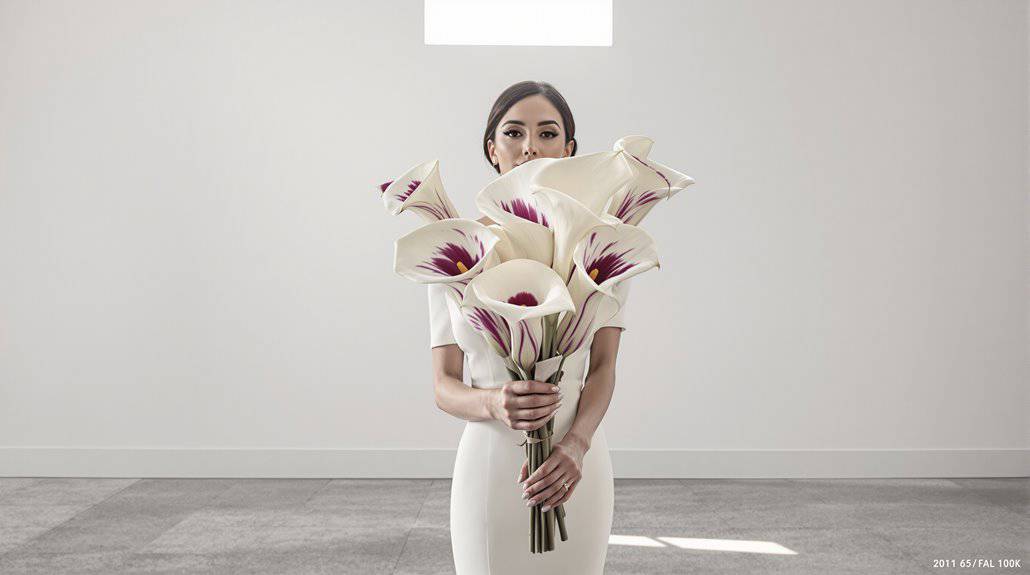
Mastering the Picasso Calla arrangement demands both reverence and rebellion—you’ll simultaneously honor the flower’s natural elegance while pushing against conventional compositional boundaries. These bicolor blooms—deep purple centers shifting to buttery edges—create immediate visual tension without effort. Their 5-inch trumpet-shaped inflorescences command attention, particularly when isolated against negative space.
The Picasso Calla demands artistic contradiction—honor its elegance while boldly rejecting floral convention to achieve striking visual dissonance.
Your approach should create intellectual dissonance through structural contrast:
- Position 3-5 Picasso Callas at varying heights (18-30 inches) with stems visible and intentionally asymmetrical
- Incorporate the arrow-shaped foliage as sculptural elements, not mere fillers
- Allow 2-3 blooms to face unexpected directions, defying the urge for uniformity
The arrangement works because it’s simultaneously formal and subversive. The sturdy stems support architectural positioning that would collapse lesser flowers, and yet there’s vulnerability in the trumpet’s open face. Let the spotted foliage create secondary rhythm—it’s not decoration but counterpoint to the dramatic blooms.
Design 7: Tropical Architectural Fusion
Unlike traditional tropical arrangements that rely on predictable tourist aesthetics, the Tropical Architectural Fusion design transforms exotic blooms into statements of sculptural authority. You’re creating dramatic vertical gestures with red ginger and anthurium that command attention—not politely requesting it.
| Element | Technique | Impact | Application |
|---|---|---|---|
| Green anthurium | Single stem isolation | Architectural purity | Focal point drama |
| Red ti leaves | Structural framing | Geometric tension | Vertical backdrop |
| Trailing angel vine | 3-foot cascades | Controlled chaos | Movement element |
| Safari sunset | Angled placement | Directional force | Eye-path creation |
The formula is devastatingly simple, yet execution demands precision: build a strong foundational structure with horsetail and galax, then position bold tropical blooms as punctuation marks, not paragraph fillers. Your goal? Hidden uplighting that transforms a seemingly simple arrangement into a shadow-casting art installation that guests circle rather than simply admire. While florals create these concentrated focal points during ceremonial spaces and reception zones, strategic lighting influences every photograph throughout your event—from the first glimpse of your sculptural centerpiece to the final dance floor moment.
Design 8-9: Additional Sculptural Designs
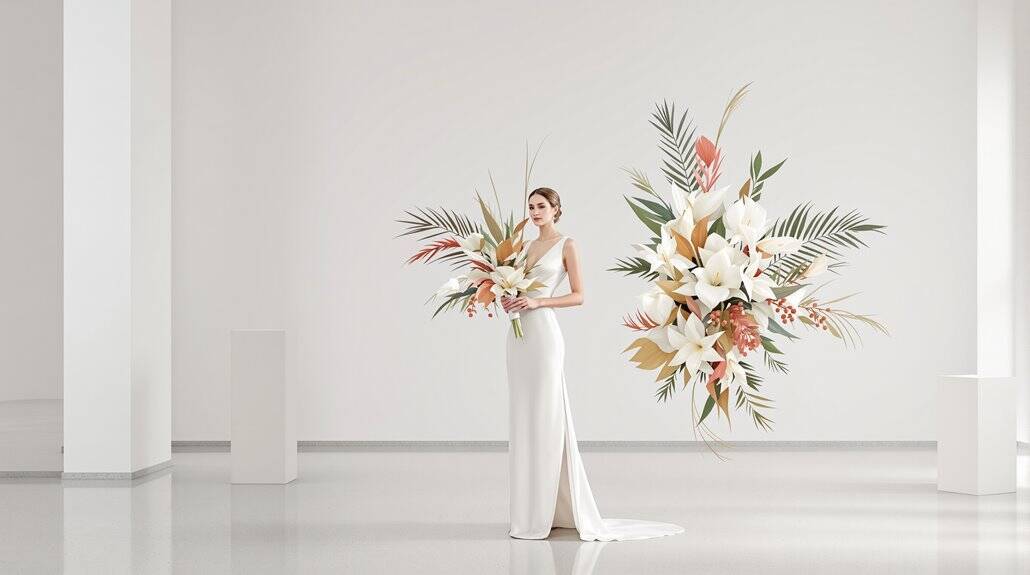
When you venture beyond traditional arrangements into designs eight and nine, you’ll discover the groundbreaking power of sculptural minimalism and tropical drama. The ikebana-inspired minimal (design eight) demands respect through deliberate restraint—a single anthurium or calla lily placed at precisely 60 degrees creates more impact than fifty roses could ever hope to achieve. And yet, the genius lies in the negative space, that emptiness which frames and raise the solitary bloom into living sculpture.
Design nine, the heliconia torch arrangement, ventures into tropical audacity with architectural presence that commands attention:
- Vertical drama – torch heliconia positioned as a 3-foot flame-like spire rising from contemporary vessels
- Textural contrast – rope-like amaranthus cascading alongside rigid structural elements
- Monochromatic intensity – single-color palettes in unexpected hues (burnt orange, midnight purple) magnifying form over rainbow distraction
These aren’t mere flowers—they’re statements, conversations, provocations. Like successful weddings in rainy cities such as Miami and New Orleans, these sculptural designs prove that effective planning transforms potential challenges into opportunities for unexpected beauty.
Architectural Form Principles
Sculptural bouquets draw from architectural principles that transform flowers from mere decoration into spatial statements. You’re creating visual weight and balance—whether through symmetrical mirroring of matching blooms or the more refined asymmetrical balance where different elements achieve equilibrium through their visual gravity. Think: three substantial protea on one side balanced by a cascading amaranth on the other.
Scale becomes your secret weapon. When you place a single oversized king protea against delicate ferns, you’re manipulating proportion deliberately, not accidentally. Rhythm emerges through repetitive elements—perhaps three identical calla lilies at precisely graduated heights—while movement directs the eye through the composition via directional stems.
And yes, human dimensions matter. A bouquet that towers three feet above the table creates monumental impact, but the finest sculptural arrangements acknowledge human scale while deliberately transgressing it—familiar enough to read as flowers, unusual enough to register as art. Just as historic venues must balance authentic classical proportions with modern functionality, your floral architecture navigates the tension between organic growth patterns and deliberate structural design.
Conclusion
As you’ve journeyed through the principles and techniques of sculptural floristry, the distinction between mere arrangements and true botanical art has likely crystallized in your mind. The transformation—from garden bouquets that fade from memory to sculptural statements that command attention—isn’t merely aesthetic but philosophical, redefining what flowers can communicate in spatial terms.
Your next experiments might include:
- A single calla lily, angled precisely at 75 degrees, suspended by nearly invisible wire
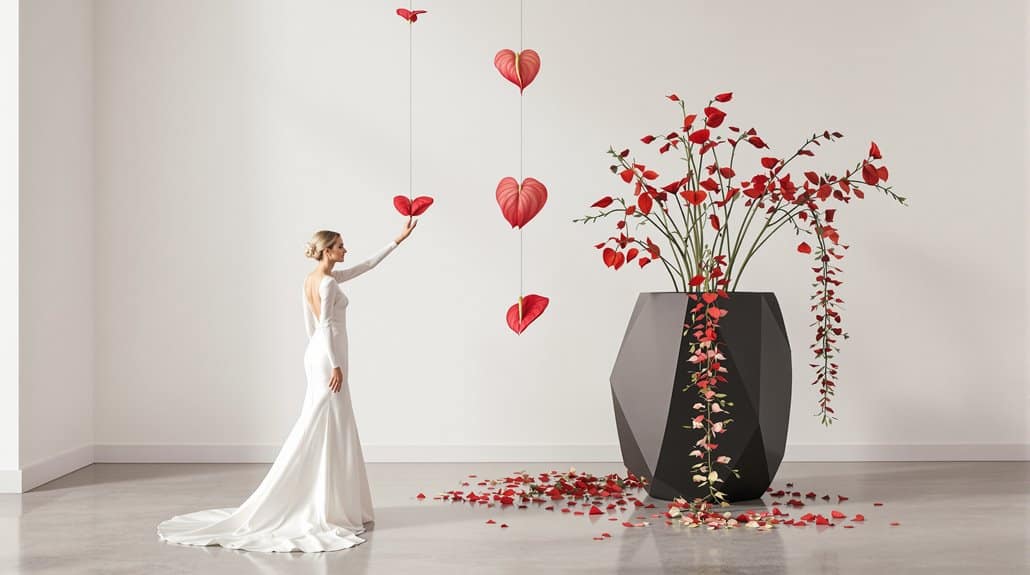
- Three stems of amaranth cascading exactly 36 inches from a matte black vessel, creating a waterfall effect
- Floating anthurium hearts, spaced 4 inches apart vertically, creating negative space that’s as powerful as the blooms themselves
You’ve entered a domain where floristry transcends decoration and becomes legitimate contemporary art. The techniques are exacting, and yet the emotional impact remains profoundly organic—intellectual in conception but visceral in experience, technical in execution but deeply intuitive in reception. When commissioning sculptural floral work from vendors, remember that scope modifications regarding material selection and stem count often yield better artistic outcomes than simply demanding lower prices, preserving both the integrity of the design and your collaborative relationship with the florist.