
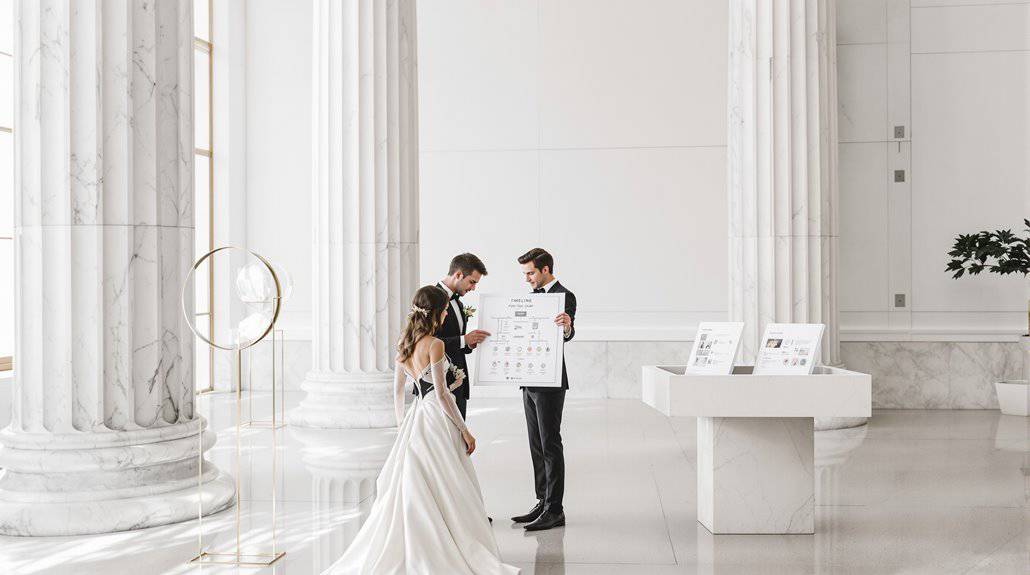
Planning a museum wedding for 120 guests requires an 8-month lead time and thorough coordination. You’ll face strict restrictions—no open flames, wall adhesives, or red wine near artwork—while managing a $45,000+ budget. Expect tight timelines (typically just 6 hours) and limited access windows. Success hinges on booking experienced vendors from the approved list and creating detailed schedules with buffer time between key moments. The resulting backdrop of priceless art makes these logistical gymnastics worthwhile.
Behind the Effortless Photos
While those dreamy museum wedding photos flooding your Pinterest board appear effortlessly magical, they’re actually the product of careful planning and technical expertise that begins months before anyone says “I do.” Professional photographers must navigate a labyrinth of venue-specific challenges—from notoriously dim gallery lighting to strict flash restrictions near priceless artwork—requiring approaches that go far beyond simply showing up with a camera.
When you plan an art museum wedding, expect to scout multiple lighting opportunities—golden hour on terraces for warm backlighting, tactical off-camera flash setups for dark galleries, reflectors to combat midday glare from those stunning glass walls. The Sculpture Barn requires supplemental lighting solutions, especially for creating an intimate atmosphere during evening events. The museum wedding process demands photographer coordination months ahead, identifying which architectural features will serve as backdrops. Museum venue logistics restrict when and where lighting equipment can be placed—and you’ll need dedicated portrait time blocks separate from general coverage to capture those signature shots that make museum spaces worth the $45,000 investment. Successful planning also requires restraint in scale when positioning decorative elements, ensuring that floral arrangements and ceremony structures don’t compete with the artwork or interfere with photography sightlines.
Booking Process: 8-Month Lead Time
Those breathtaking gallery wedding photos don’t materialize without months of careful groundwork—specifically, eight months’ worth. The museum wedding process demands foresight that borders on clairvoyance, with venue and logistics coordination beginning the moment you’ve set your heart on those marble halls. You’ll need to secure your date early—museums book quickly, particularly for those coveted Saturday evenings—and immediately tackle transportation arrangements for all 120 guests.
Your venue secures more than walls and floors; it dictates your entire timeline. Within your first 60 days of museum wedding planning, you’ll need to source rental companies for anything the venue doesn’t provide, book your photographer and videographer, and send those save-the-dates. The eight-month window isn’t arbitrary—it’s calculated based on vendor availability, rental item lead times, and invitation protocols. Delay even slightly, and you’ll find yourself scrambling rather than savoring each planning milestone. Along with venue selection, this early phase requires establishing a clear overall wedding budget to guide all your subsequent vendor decisions and prevent financial stress. During this initial planning period, you’ll also want to research Oregon’s marriage certificate requirements to ensure you have adequate time to complete the necessary legal documentation before your wedding day.
Navigating Museum Restrictions
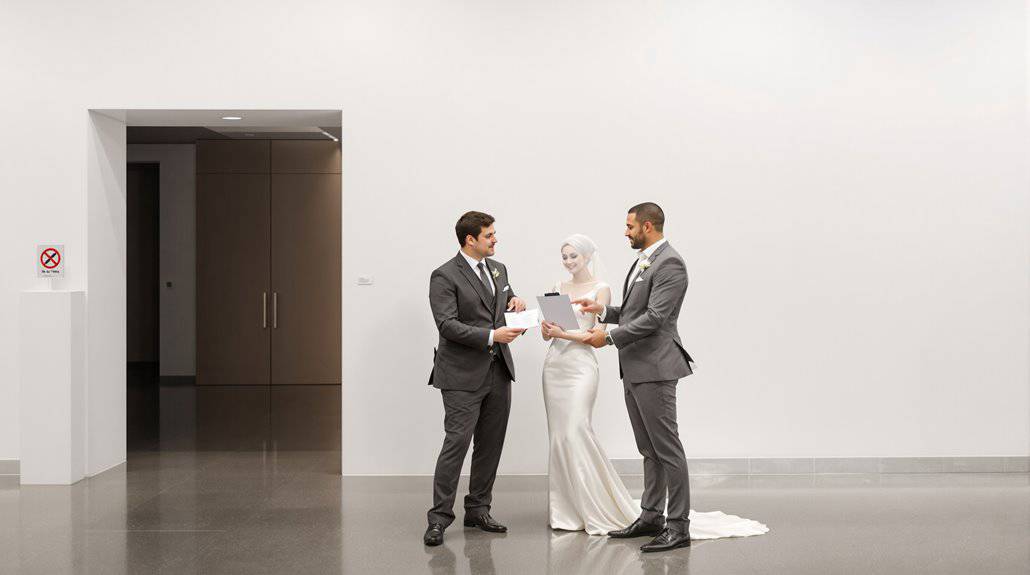
Despite their alluring grandeur, museums impose restrictions that’ll make your average venue contract look like a permission slip for recess. Your museum wedding planning journey requires navigating a labyrinth of rules protecting priceless collections—no confetti, no open flames, no adhesives on walls, and certainly no red wine near that 19th-century tapestry.
| Restriction Type | Common Limitations | Workarounds |
|---|---|---|
| Decorations | No nails, tape, open flames | Freestanding structures, LED candles |
| Food & Beverage | Designated areas only, no red wine | Creative mocktails, strategic station placement |
| Capacity | Often capped at 25-100 guests | Multiple connected spaces, staggered arrivals |
You’ll face capacity limitations that sound arbitrary—”120 guests maximum, including your photographer”—and yet, they’re calculated precisely for preservation. Exhibition schedules might force venue changes weeks before your date. Beyond decorative restrictions, preservation requirements may also impose additional restoration contributions or fees on top of your standard rental costs. But these restrictions paradoxically create the very exclusivity you’re seeking—a wedding where history itself becomes your most distinguished guest.
Insurance and Approved Vendor List
How quickly your museum wedding dreams can evaporate when faced with the insurance requirements—a labyrinth of liability limits and legal language that’ll make your eyes cross. The museum wedding process demands certificates of insurance at least 30 days before your event, with $1-2 million in liability coverage non-negotiable. Some prestigious spaces even push this to $5 million.
You’ll need multiple coverage types: property damage protection, event liability, and—if serving alcohol—liquor liability. Expect to pay $100-$500 total, with museum venues commanding 25-50% higher premiums than standard venues. And yet, insurance represents just the beginning of your museum wedding planning odyssey.
Your vendors face identical scrutiny. Each photographer, caterer, and coordinator must submit their own liability documentation. The museum wedding guide you received likely specifies approved vendors who already understand these requirements—use them. They’ve navigated this bureaucratic maze before, sparing you countless headaches. These venue-approved lists connect you with professionals who maintain the proper credentials and have established trusted peer networks with other reputable vendors at your location.
6-Hour Access Window Strategy
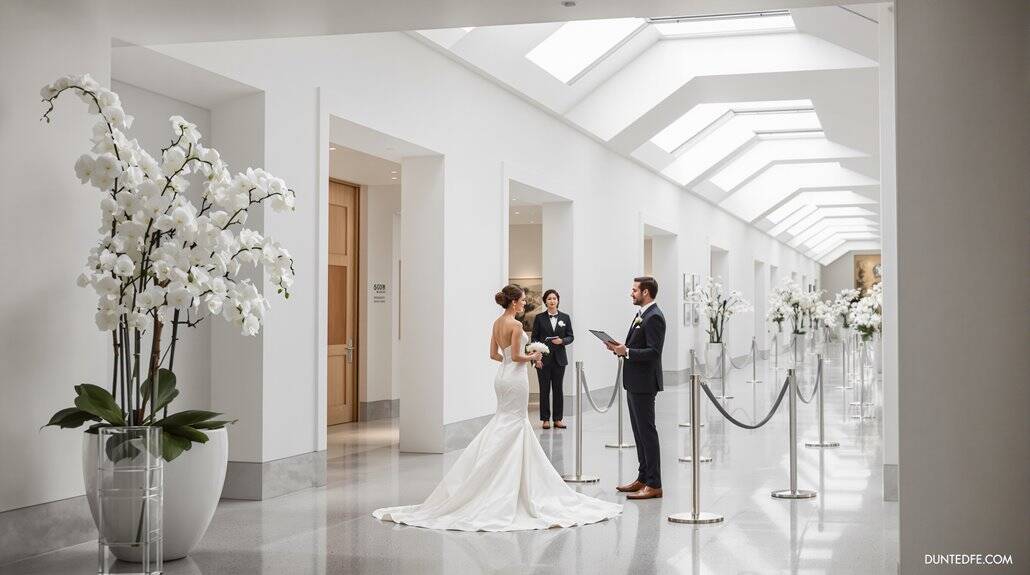
When reality collides with museum wedding fantasy, the strict six-hour access window might shock you—it’s not the leisurely all-day affair most venues offer. You’re working against public hours coordination constraints, with museums typically open until 4-5 p.m., leaving your setup window timing painfully compressed.
Your vendors must execute a military-precision plan: early access at 1 p.m. for indoor spaces, the exhibition floor available only after 5 p.m. closing, and teardown schedule management that demands complete evacuation by 11:59 p.m. Sharp. No exceptions.
But here’s your lifeline: extended options exist if your budget stretches. Four-hour packages with dedicated indoor facilities give breathing room, and nine-hour access packages, while premium-priced, eliminate the panic. The secret? Build your timeline backward from that non-negotiable exit deadline, and hire vendors who’ve navigated these constraints before—they’re worth their weight in exhibition-hall gold. If you’re planning a destination museum wedding in Canada with international guests, research Canadian marriage requirements early, as documentation needs vary by province and can add weeks to your planning timeline.
Vendor Team Assembly
Building your museum wedding vendor dream team requires surgical precision, not casual browsing—your entire event hinges on professionals who understand institutional constraints most vendors never encounter. You’ll need a thorough vendor vetting approach that starts with the museum’s approved list—that non-negotiable document that might initially feel restrictive but actually saves you from catastrophic mishaps.
Your planner becomes command central, interfacing between museum protocol officers and your creative vision. Select vendors with proven museum wedding planning experience; they’ll navigate the labyrinthine approval processes and compressed 6-hour timeline without breaking stride. Create a master vendor schedule with military-grade precision—delivery windows, setup zones, teardown protocols.
When interviewing potential team members, ask pointed questions: “How many museum weddings have you executed?” “What’s your contingency for delayed access?” Their responses will reveal whether they truly understand the high-stakes choreography of institutional events versus standard ballroom affairs. Your caterer must also coordinate with the venue regarding ready rooms for vendors, which serve as essential staging areas throughout your event day.
Timeline Optimization
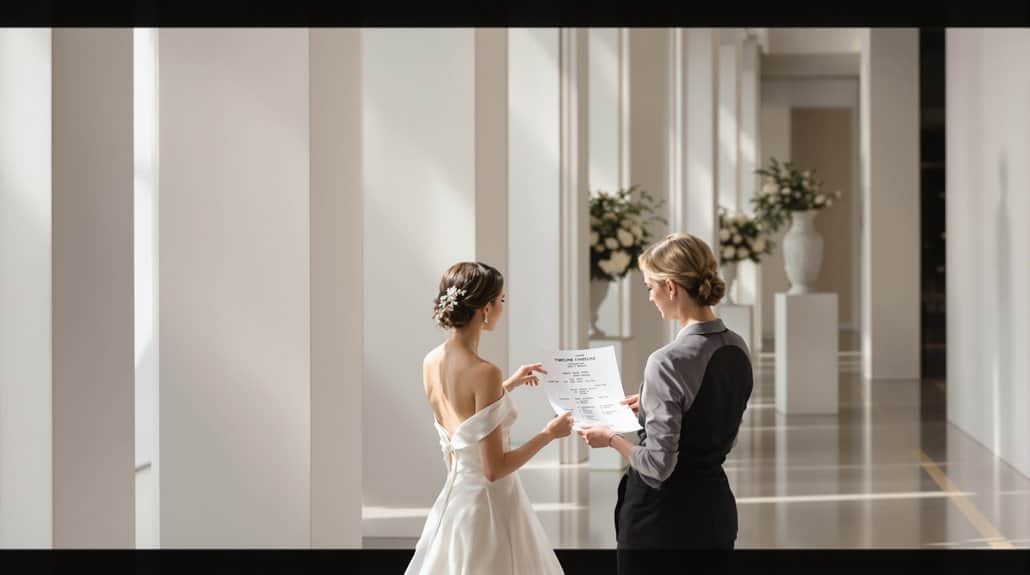
Unlike traditional venues where time flows generously, museum wedding timelines function as precision instruments where every minute carries both opportunity and constraint. You’ll face the reality of compressed load-in and load-out management—typically just 6 hours total for a venue that costs north of $45,000 all-in. This isn’t negotiable.
Your ceremony time becomes the anchor around which everything orbits. Position it tactically, then work backward to map preparation and forward to plot reception flow. Vendor-specific schedule development isn’t optional; it’s survival. Create separate visual timelines for each provider—photographer, caterer, DJ—with military-grade precision about where they should be, when, and doing what.
Build buffer time ruthlessly. Thirty minutes between ceremony and cocktail hour isn’t luxurious; it’s necessary insurance against the inevitable delays that museums, with their institutional rhythms and security protocols, practically guarantee. Wedding math works differently here: anticipate, don’t assume. Keep your reception under 5 hours to maintain energy and prevent guest drift, especially critical when venue access windows are non-negotiable.
Budget Transparency: $45000 All-In
The $45,000 figure you’ve seen floated as the “all-in” cost for museum weddings isn’t a marketing ploy—it’s the bare minimum threshold for entry, and it dissipates with alarming speed once you begin allocating it across required line items. The museum wedding process demands brutal budget transparency: venue rental fees alone devour significant portions, with Rodin Museum charging $10,250 for five hours plus a mandatory $3,250 for a rain plan space.
Your remaining $31,500 must cover catering—easily the largest expense at $360 per person for 120 guests at Rodin ($43,200 total), already exceeding your full budget. And yet, some smaller art galleries offer viable alternatives with $800 venue fees and $5,000 catering packages. The math becomes inescapable: museum weddings below $45,000 require ruthless prioritization, vendor negotiation, and guest list pruning—or finding those rare institutional gems with less restrictive vendor requirements and lower overhead costs. When working within these constraints, monochromatic palettes enhance budget efficiency by focusing on fewer color variations, allowing you to allocate more resources toward venue and catering essentials rather than complex décor schemes.
Conclusion
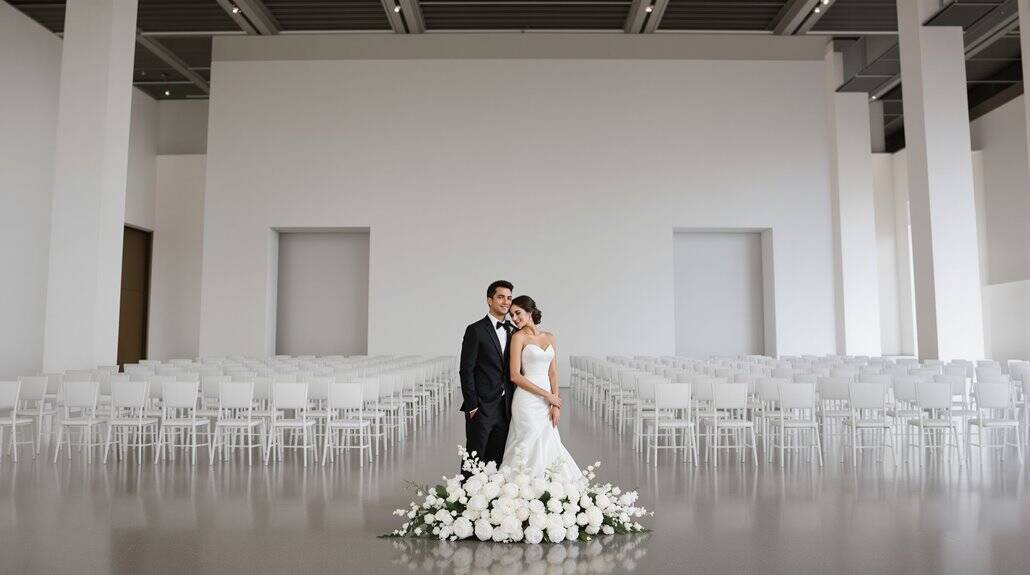
Museum weddings demand both resilience and flexibility, yet they reward your efforts with unequaled aesthetic dividends. Your journey through museum wedding planning requires navigating institutional protocols while maintaining your vision—an intricate dance worth every pirouette. The event execution phase will test your mettle, but proper preparation transforms potential chaos into orchestrated elegance.
The most valuable lessons learned come from embracing the venue’s inherent character rather than fighting against it:
- Work with—not against—the museum’s aesthetic; let Renaissance paintings or modern installations inform your color palette
- Calculate your true timeline by subtracting 90 minutes from your rental window for setup and breakdown
- Prioritize guest experience over perfection; they’ll remember the artwork and atmosphere, not whether your napkins perfectly matched your invitations
Understanding that museums operate with 4-6 month planning horizons rather than spontaneous booking capabilities helps set realistic expectations from the start. The $45,000 investment buys more than a reception—it purchases an evening surrounded by humanity’s creative legacy, a beginning appropriately framed by beauty that has endured.