

When you choose paper stock over digital printing, you’re paying for tactile experience, not just visual impact. Digital costs $0.48/unit with no setup fees—efficient below 2,000 pieces. Letterpress creates physical impressions that fingers register as premium, especially on 110-130lb stock (260-350 GSM). It’s a psychological investment: recipients unconsciously equate physical weight with message importance. And yet, advances in digital technology are narrowing these gaps, shifting the calculus of perceived value beyond mere production methods.
The $2000 Invitation Question
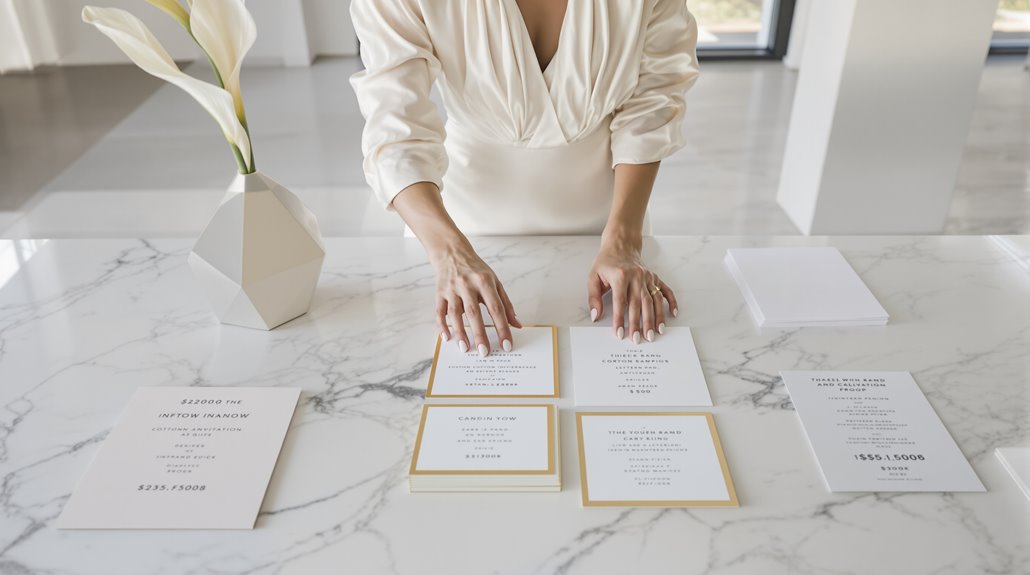
When you’re faced with a $2,000 price tag for wedding invitations featuring thick cotton stock, hand-torn edges, and letterpress printing, you’re standing at the precise threshold between semi-custom and truly bespoke stationery. This isn’t arbitrary—it’s the industry’s dividing line.
Consider what you’re actually purchasing: professional design expertise ($500-$2,000) separate from production costs. The invitation paper weight dramatically affects pricing—basic cardstock runs $1-$2 per invite, while premium 110-lb cotton commands $7-$10 each. And letterpress vs digital? That choice alone adds $400-$2,000 to your bottom line. Multiple design changes may increase your costs even further as each revision requires additional time and skill. Additionally, understanding your spending optimization strategy can help you make the most informed decisions about your stationery budget.
Your design service tier tells the real story. Below $2,000, you’re selecting semi-custom templates with color and text modifications. Cross that threshold, and you’ve entered the realm of hand-illustrated venue sketches, bespoke watercolor elements, and artisanal printing techniques that transform paper into keepsake art. Expensive? Yes. But you’re paying for craftsmanship that can’t be digitally replicated.
Paper Weight and Hand Feel: 80lb vs 110lb vs 130lb
That $2,000 sticker shock for premium invitations makes more sense once you understand what you’re actually holding in your hands. Invitation paper quality isn’t just subjective luxury—it’s measurable substance.
When you’re comparing paper weight options, you’re steering through a spectrum of tactile experiences. The 80lb cover (215-235 GSM) provides respectable sturdiness without overwhelming, perfect for simpler invitations. Yet it’s the 110lb stock (260-300 GSM) that hits the sweet spot most couples choose—substantial enough to communicate significance while remaining practically foldable and mailably elegant. This balance reflects the elegant restraint that characterizes quiet luxury.
The premium 130lb cover (300-350 GSM) transforms an invitation into an artifact, commanding attention through sheer physical presence. Each weight category represents not just thickness but structural integrity, with higher GSM numbers directly translating to increased resistance against folding, wrinkling, and time itself—qualities particularly evident when letterpress printing presses its message into the fibers rather than merely onto them. Understanding the paper’s density and finish also influences the perceived thickness and luxuriousness, regardless of the actual GSM measurement.
Printing Methods Compared: Digital Letterpress Engraving
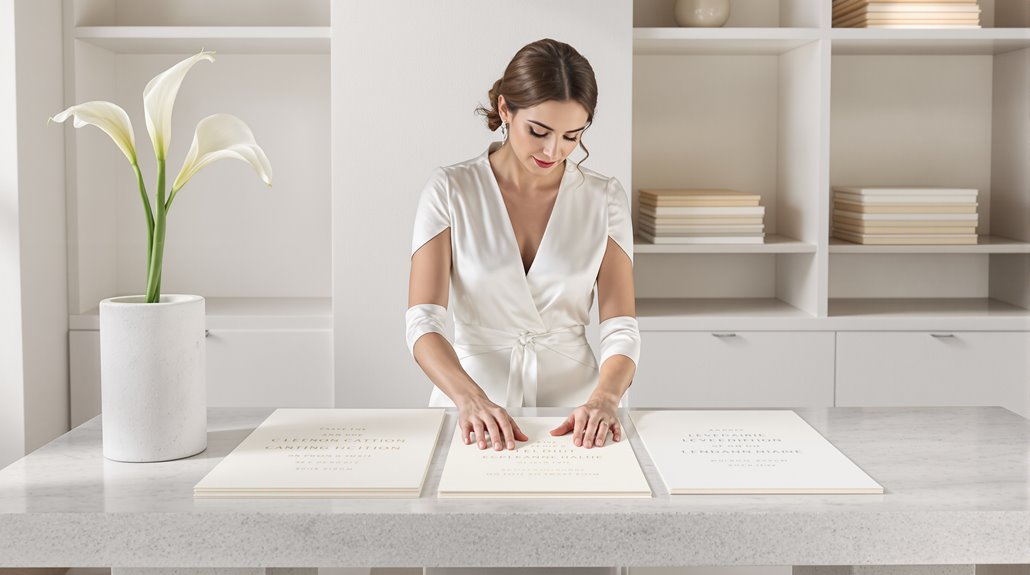
Beyond the weight of paper lies the essential distinction of how ink meets surface—a decision that transforms your invitation from mere information vehicle to sensory experience. Digital printing offers affordability and speed—perfect for complex designs—but sacrifices the tactile dimension that defines premium wedding invitation quality. Letterpress, by contrast, creates that coveted impression you can feel beneath your fingertips, though at considerably higher production cost.
- Letterpress creates physical impressions that interact with invitation paper weight, adding dimension impossible with digital methods.
- Digital printing handles elaborate designs but lacks the textural authority of traditional techniques.
- Each letterpress piece exhibits subtle variations, making your invitations artisanal rather than mass-produced.
- Engraving vs printing isn’t merely aesthetic—it signals your event’s gravitas.
- The $2,000 price tag for letterpress on 110-lb cotton stock isn’t just paper cost—it’s craftsmanship materialized.
Moreover, affluent couples often seek quality markers that reflect their unique taste and the significance of their celebration. You’re not just choosing printing methods; you’re selecting how your announcement announces itself.
What Each Method Actually Shows
The physical evidence of your printing choice speaks volumes before a single word is read. Letterpress creates actual depth—tiny impressions you feel beneath your fingertips when running across that 110-lb cotton stock with hand-torn edges. Digital printing, while precise, sits flat on the surface, revealing itself immediately as machine-perfect rather than human-touched.
Your invitation paper weight directly correlates with perceived value. A 32-lb sheet feels substantive, commanding respect that flimsy alternatives cannot, yet even premium digital prints lack the sensory richness of letterpress. The print quality characteristics differ fundamentally: letterpress bleeds slightly into fibers, creating soft edges against the textural background, while digital printing delivers pixel-perfect reproduction that—though technically flawless—can appear synthetic.
Invitation printing methods aren’t merely production techniques but statements of intent. Letterpress announces care, tradition, and deliberate choice. Digital whispers efficiency. Both communicate, but through entirely different vocabularies.
Cost Breakdown by Method and Quantity
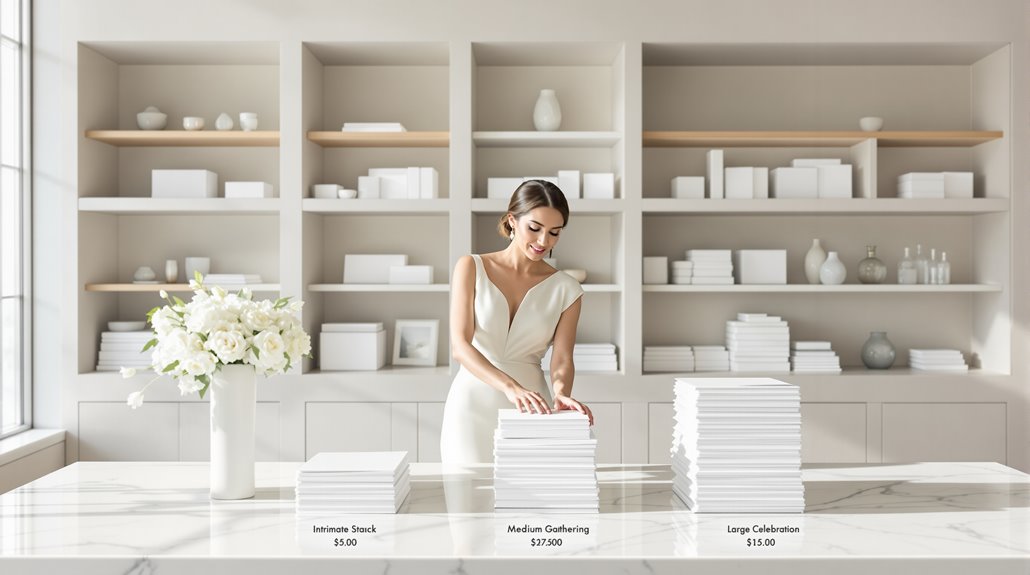
When comparing printing methods purely on financial terms, you’ll quickly discover a mathematical inflection point that determines which approach makes economic sense for your project. Digital printing maintains consistent per-unit pricing ($0.48) regardless of quantity, while offset requires substantial setup fees ($400+) but delivers cheaper per-piece costs ($0.28) once running.
- 2,000 pieces marks the pivotal break-even point where methods converge at identical costs
- Digital shines below 2,000 units—no setup fees means lower total project expense
- Offset becomes increasingly economical as volume grows beyond 2,000 units
- Invitation paper weight critically impacts pricing—110-lb cotton stock with letterpress printing can justify $2,000 price tags
- Invitation printing methods determine both aesthetic value and economic efficiency
Your paper stock comparison should factor both volume and presentation goals. Digital offers budget-friendly small runs, but offset delivers that premium tactile experience high-end invitations demand—and yet the quality gap narrows yearly as digital technology advances.
When Premium Paper Stock Matters
Choosing premium paper stock transforms mundane printing projects into memorable tactile experiences that recipients won’t discard—a vital consideration as you weigh cost against impact. That 110-lb cotton stock with hand-torn edges for wedding invitation paper types isn’t mere extravagance; it’s strategic investment in physical presence that digital alternatives simply can’t replicate.
Your invitation paper weight directly signals event significance—300+ gsm stock communicates reverence before a single word is read. Letterpress and foil stamping invitation printing methods demand heavier, quality substrates to perform properly, creating dimensional impressions impossible on flimsy alternatives.
Premium stock matters most when:
- Creating heirloom-quality wedding suites
- Establishing executive brand positioning
- Producing fine art reproductions
- Developing tangible marketing materials in digital-saturated environments
And yet, premium paper’s true value lies not in its price tag but in its psychological impact—recipients unconsciously associate your message’s importance with its physical vessel.
When It’s Performative Luxury
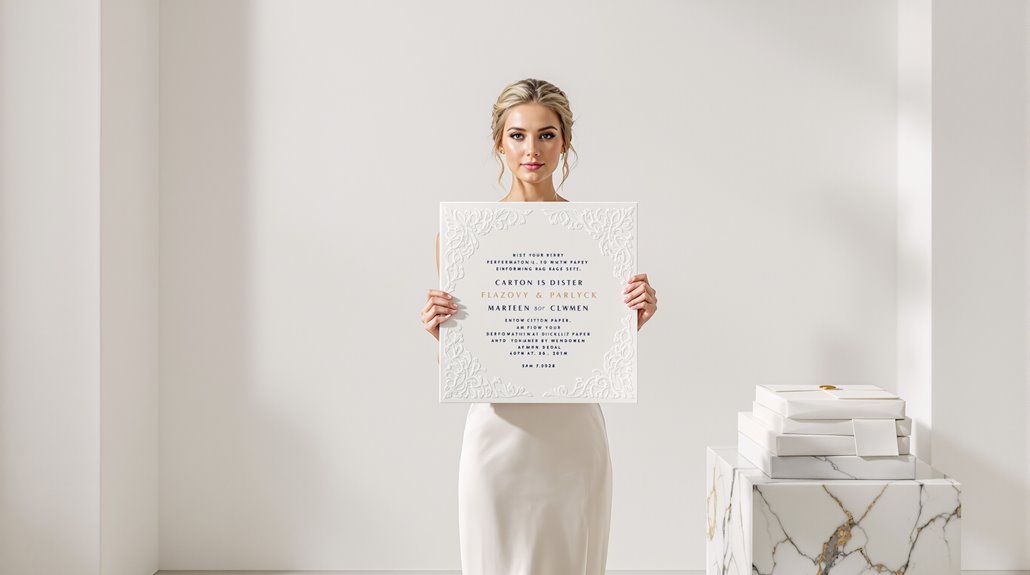
Despite all the luxury signifiers adorning high-end print materials, sometimes you’re paying for performative opulence rather than functional superiority. That embossed logo with gold foil stamping? It’s tactically designed to trigger status associations without necessarily improving durability. You’re investing in perception—which, frankly, might be exactly what you need for certain contexts. And yet, recognizing when luxury becomes theatrical rather than substantive helps you make smarter allocation decisions.
- UV coating creates dimensional effects while obscuring mediocre underlying stock
- 55% of luxury brand ad spend goes to print magazines—not for readability but brand positioning
- Metallic finishes (particularly at 100% density) signal premium quality independent of actual material composition
- “Soft-touch” film lamination transforms ordinary paper into a tactile experience worth 30-50% more
- Pearlescent textures create a luxury marker through visual-haptic illusion rather than material excellence
- Paper selection remains the great equalizer—constituting a substantial portion of costs regardless of printing method
- Digital eliminates the $100-$500 per-color setup fees that create initial financial barriers for small runs
- Personalization needs automatically disqualify offset, no matter the quantity
- Environmental impact reduction through digital alternatives yields 26-45% savings on traditional business expenses
- The break-even crossover point has quintupled from 2,000 to 10,000 impressions in recent years
The question isn’t whether these finishes matter—they absolutely do—but whether they serve your specific communication objectives or merely your vanity.
Decision Framework by Budget and Aesthetic
Moving beyond theater and perception, real-world print decisions inevitably collide with budget constraints—which is why you need a systematic approach rather than vague handwaving about “quality.” The financial reality of print production creates natural decision points that determine whether digital or traditional methods serve your needs.
Your decision structure should align quantity, timeline, and aesthetic requirements:
| Volume | Digital Printing | Offset Printing | Primary Decision Driver |
|---|---|---|---|
| <500 pieces | $0.34-0.48/unit | Cost-prohibitive | Digital’s lower setup costs |
| 500-2,000 | $0.30-0.40/unit | $0.28-0.35/unit | Timeline requirements |
| 2,000-10,000 | Diminishing returns | $0.20-0.28/unit | Paper stock options |
| 10,000+ | Not recommended | <$0.20/unit | Budget efficiency |
You’ll notice the break-even threshold hovers around 2,000 pieces—that’s your decision inflection point. Below this, digital printing delivers superior economics; above it, offset’s economies of scale become incontrovertible. And yet, this structure collapses when variable data enters the equation.
Conclusion
When does the tension between tradition and technology truly resolve in the printing world? Never completely—and that’s precisely the point. Your decision between luxurious letterpress on cotton stock versus rapid digital production isn’t just financial, but philosophical. At volumes below 2,000 pieces, digital printing saves both money and time. Beyond 10,000 impressions, offset becomes undeniably cost-effective—a 30% post-pandemic price increase notwithstanding.
Your perfect solution exists at the intersection of budget constraints, aesthetic requirements, and timeline demands.