
Lighting design isn’t merely decorative—it’s transformative. You’ll need strategic illumination (one uplight per 150 sq. ft. minimum) to preserve your carefully curated details after sunset. Time your ceremony 2-3 hours before sunset to capture golden hour’s magic, then layer with 3-5 candles per table and thoughtfully placed string lights. Professional designers bring both technical expertise and emotional intelligence to the table, turning ordinary spaces extraordinary. The difference between remembering your wedding and feeling it lies in those carefully calculated beams.
Why Light Is Everything
How often have you walked into a space and felt something shift in your emotional register without quite knowing why? It’s the light—that invisible conductor orchestrating your emotional response. Wedding venue lighting isn’t merely decorative; it’s transformational. A mediocre hall becomes remarkable under deliberate illumination, while an expensive venue falls flat without it.
You’re spending thousands on flowers that will die in hours, yet hesitating on lighting that elevates every photograph you’ll keep forever. Ceremony lighting creates the sacred atmosphere where promises materialize—warm amber tones invoke intimacy; cool blues suggest transcendence. And your reception? Think beyond function. Those wedding lighting ideas you’ve pinned—string lights, chandeliers, projected monograms—they’re not frivolous but fundamental to how guests experience your celebration. Professional lighting designers combine artistic vision with technical expertise to create truly immersive spaces that transform your wedding venue. As luxury trends continue to evolve, lighting design is increasingly recognized as a key element in enhancing the overall aesthetic of your event.
The global wedding lighting market will hit $40.6 billion by 2031, and for good reason: light isn’t everything—and yet, without it, nothing else matters.
Natural Light Timing: Golden Hour Mathematics
When the sun hangs low on the horizon, it transforms from mere illumination into pure wedding gold—a fleeting phenomenon photographers chase religiously. You can’t buy this light, can’t fake it, can’t photoshop it—you can only plan for it with mathematical precision.
Golden hour light occurs twice daily, spanning 45-90 minutes depending on your latitude and season. Your wedding timeline hinges on this narrow window. Position your ceremony 2-3 hours before sunset, and you’ll catch that warm, diffused glow that eliminates harsh shadows and makes everyone—yes, everyone—look airbrushed by nature itself. For optimal results, photographers recommend using a wide aperture to create that dreamy background blur that makes couples stand out beautifully against their surroundings. Effective tier allocation of your budget towards lighting design can also enhance the overall aesthetic of your wedding.
Natural light timing requires brutal honesty about geography. Mountains steal your golden hour 90 minutes early; valleys reshape its parameters entirely. Your venue’s topography matters as much as its architecture. The wedding light planning formula remains ruthlessly simple: subtract 2.5 hours from sunset, add 30 minutes for family photos, reserve 20 minutes exclusively for couple portraits—and protect this window like your marriage depends on it.
When Venues Need Supplemental Lighting
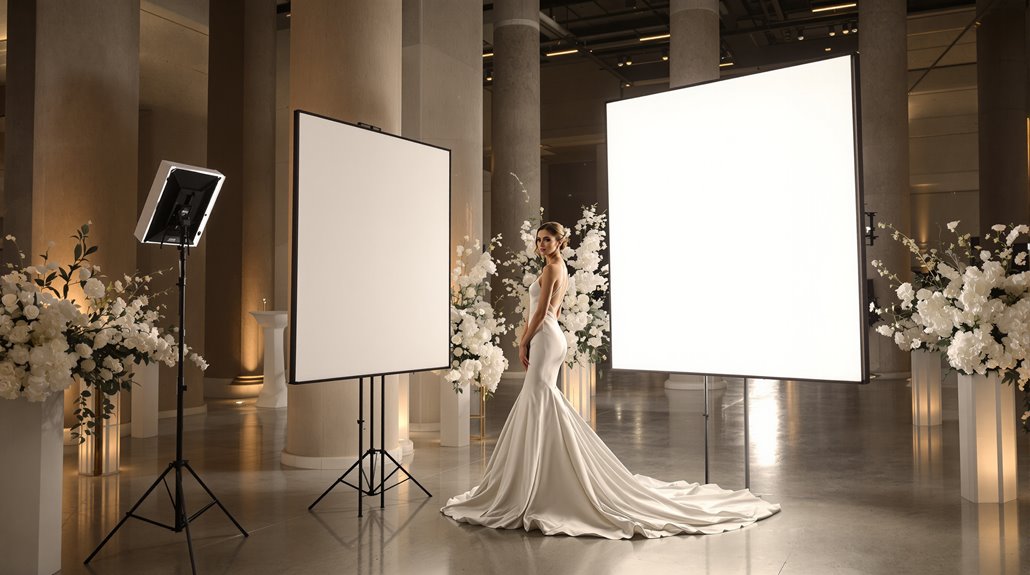
Despite your fairytale venue’s breathtaking appearance during the initial walkthrough, virtually every wedding space requires professional lighting intervention—a truth venue coordinators conveniently omit from their sales pitch. Your reception lighting design strategy begins with square footage math: one uplight per 150 square feet of wall space provides baseline coverage, meaning even a modest 3,000-square-foot venue demands at least 20 fixtures.
Wedding lighting ideas expand dramatically with architectural complexity. Standard spaces need 16-24 uplights, but venues with dramatic pillars or 20+ foot ceilings require tactical placement at every structural junction. Winter weddings demand activation by 4 PM, while outdoor celebrations require selective architectural highlighting rather than uniform coverage.
The most revolutionary wedding light planning acknowledges that professional illumination forms the foundation—not candles. Your perfectly-lit venue demands proper placement based on guest count: 15 fixtures for intimate gatherings under 100, escalating to 35+ for celebrations exceeding 250 guests. Understanding the psychology of luxury weddings can also guide couples in making informed decisions about their lighting investments.
Candlelight Quantities That Matter
The most dramatic lighting transformation happens not with massive fixtures but with the smallest flames—if you’re using the right quantities. Your wedding lighting design hinges on mathematical truths most planners won’t admit: you need far more candles than you initially imagine. Round tables require 3-5 candles for basic ambiance, but 15-25+ for that coveted “wow factor” that photographs like a dream.
For rectangular tables, think in continuous clusters—pillar candles every 8-12 inches create rhythm and warmth. Your ceremony deserves equal attention: minimalist aisles need one candle every three feet, while striking presentations demand 5-8 per section.
The quantity multiplication rule is non-negotiable in wedding light planning: whatever number feels right, double it. And yet, tactful placement matters equally—mixed-height arrangements on staircases, hallways, and architectural features transform ordinary venues into exceptional experiences. This isn’t extravagance; it’s visual mathematics.
String Lights: Saturation Points
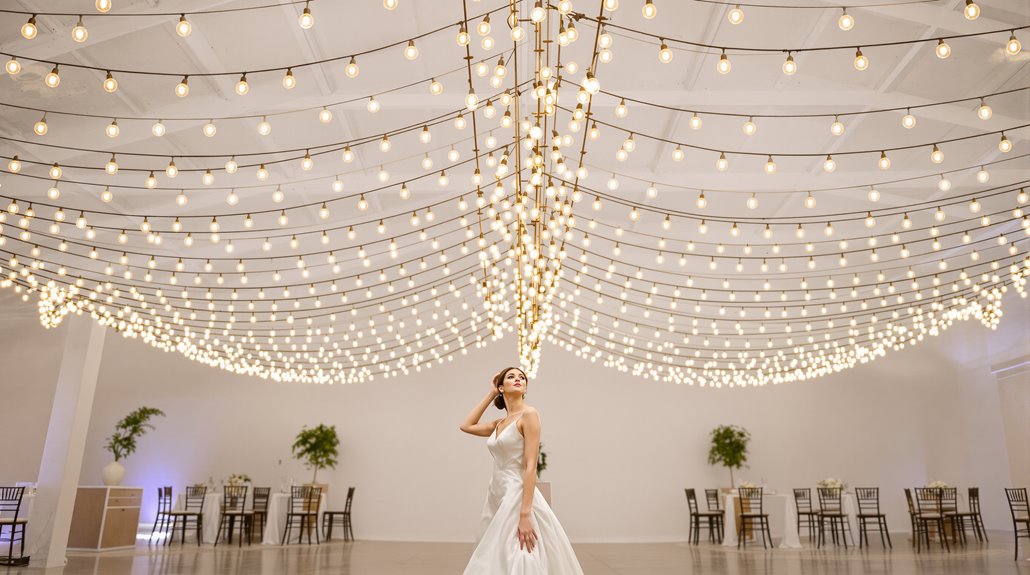
String lights transform spaces with their ethereal glow, yet their magic lives or dies at precise saturation points you won’t find in standard planning guides. You’re looking for that sweet spot—where your venue lighting creates atmosphere without overwhelming the senses.
Here’s what professionals know: perimeter placement plus vertical installation along tent peaks achieves complete saturation in enclosed spaces, while individual bulb spacing determines light distribution. Wider spacing creates intentional mood gaps; narrow spacing delivers continuous luminescence. For small backyard weddings, simple tree-to-tree strands paired with votives work beautifully, but large courtyards demand professional installation.
And yet, more isn’t always better. When lighting saturation exceeds design intent, incorporate sheer fabric panels to soften harsh output. Layering is everything—try pairing overhead string lights with ground-level candles to double ambient glow without over-lighting. The difference between amateur and professional lighting? Knowing exactly when to stop adding more.
Statement Lighting: When to Invest
While string lights create ambience, statement lighting defines entire events—sometimes warranting substantial investment, other times functioning as unnecessary budget-drains. Your wedding light planning should prioritize suspended installations when ceilings soar beyond 12 feet—that emptiness needs filling. A dramatic chandelier (particularly those gold-finished beauties against crisp white tents) transforms dead space into architectural feature.
Statement lighting for weddings delivers highest ROI in otherwise unremarkable venues. That concrete industrial space? Hang 30+ vintage Edison bulbs at staggered heights and suddenly it’s editorial-worthy. The community center reception? Introduce three oversized brass pendants, and guests remember atmosphere instead of folding chairs.
But don’t throw money at already-perfect spaces. That historic library with ornate ceilings? That oceanfront terrace at sunset? They don’t need help. Recognize when venue personality already speaks—and when it requires illuminated punctuation to complete your aesthetic narrative. Some spaces whisper; others need light to find their voice.
Working with Lighting Designers
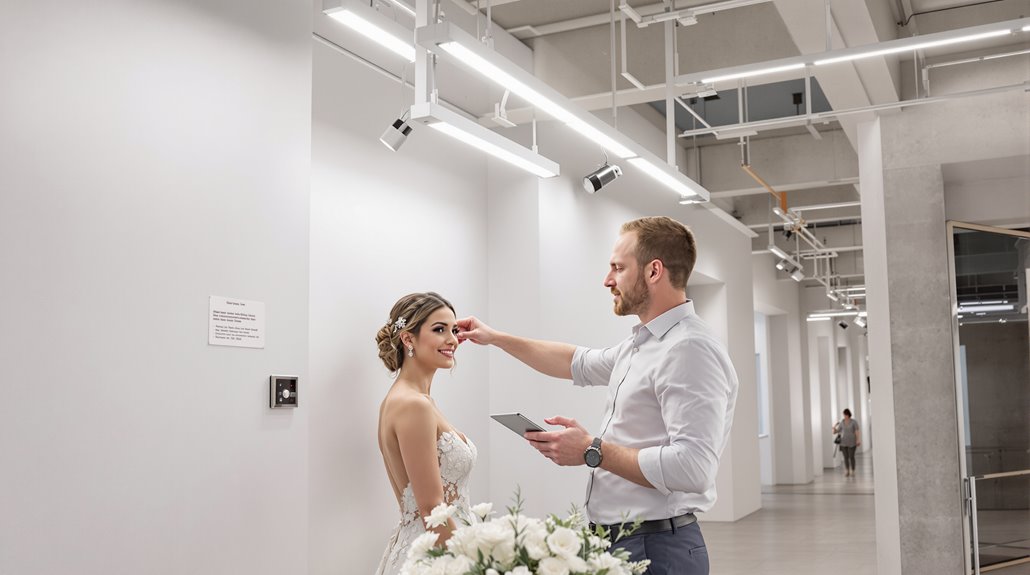
Why entrust lighting to professionals when you’ve planned every other detail yourself? Because wedding lighting design transforms ordinary venues into extraordinary experiences—and that transformation requires technical expertise most couples simply don’t possess. A skilled lighting designer doesn’t just hang fixtures; they orchestrate atmosphere through color theory, fixture selection, and strategic placement.
When selecting your designer, scrutinize portfolios for evidence of wedding lighting ideas that align with your vision. Verify they’ve tackled similar venues and understand the specific challenges of wedding light planning versus concerts or corporate events. You’ll need someone who communicates in both artist’s concepts and engineer’s specifications.
Share your Pinterest boards and inspiration photos, but trust their expertise on execution. The best collaborations happen when you articulate the feeling you want guests to experience, and they translate that emotion into technical solutions—gobos, uplighting, pattern projection—that create your perfect moment.
DIY Lighting: What’s Achievable
Even with a modest budget, you can transform your venue through tactical DIY lighting—if you understand what’s realistically within reach. Floor-mounted uplighting ($152 for a 100-guest reception) delivers instant atmosphere transformation without requiring electrical expertise, while a $99 monogram projection adds that personalized touch guests remember. Battery-powered options eliminate cord management headaches, and most systems take mere minutes to install.
Your DIY lighting arsenal should prioritize:
- Depth creation – Layer fairy lights, pillar candles, and uplighting to create dimension where flat walls once stood
- Focal point enhancement – Direct $25 spotlight packages toward your cake, sweetheart table, or dance floor
- Mood evolution – program uplighting to transition from warm amber during dinner to vibrant blues as dancing begins
String lights remain the DIY champion—versatile, inexpensive, and forgiving. And yet, strategic placement matters more than quantity; twenty thoughtfully arranged Edison bulbs outperform two hundred randomly strung fairy lights.
Conclusion
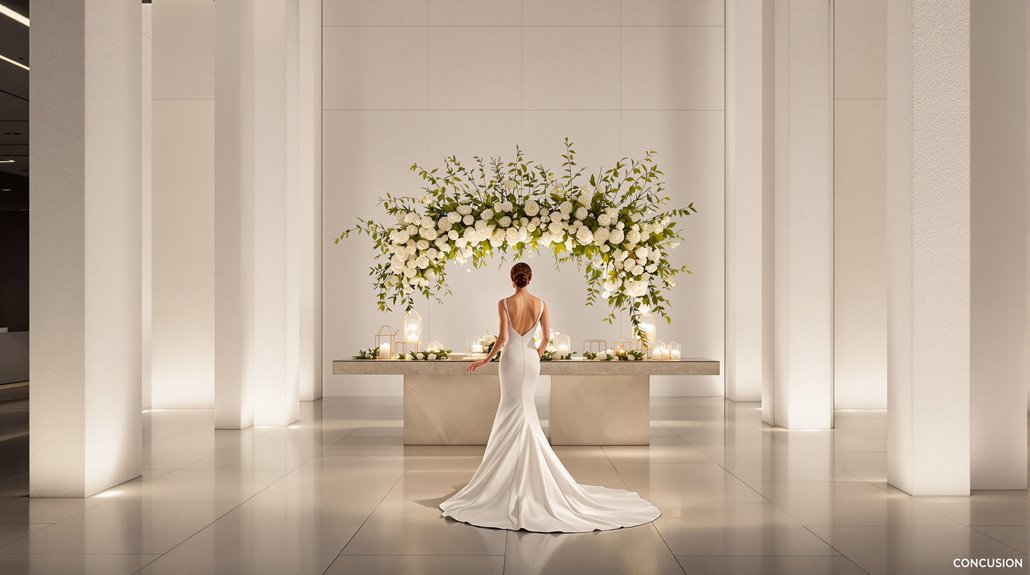
You’re making a $40,620 million industry decision, not merely selecting decorative elements. And yet, this investment yields returns beyond aesthetics—it’s about creating a photographic legacy where images capture the intended emotion rather than technical compensation for poor illumination.
Remember this: 16 tactically placed uplights completely reinvent spaces under 5,000 square feet. Professional lighting designers bring backup systems, crowd-reading expertise, and technical knowledge impossible to replicate through DIY efforts.
Light isn’t everything—but without it, everything else you’ve carefully selected and curated simply disappears into darkness once the sun sets.