
Your invitation wording establishes 90% of guest expectations before they process a single detail. “Request the honor” signals black-tie formality while “Join us” creates casual vibes—choose wrong, and you’ll trigger cognitive dissonance. The language forms a psychological contract with guests, influencing everything from their attire choices to gift selections. This isn’t mere stylistic preference; it’s deliberate psychological engineering. Get it right, and you’ll see 3x higher involvement and dramatically reduced day-of confusion.
Wording as First Tone Communication – Essay opening
The invisible architecture of your invitation wording shapes guest expectations before they’ve processed a single detail about your celebration. That first line—whether “Together with their families” or “Request the honor of your presence”—establishes the psychological contract with your guests, determining how they’ll approach everything from attire to gift selection.
Your invitation’s tone communicates approximately 90% of your intent, functioning as the lens through which all subsequent details are filtered. Formal phrasing signals legitimacy and importance; casual wording creates comfortable accessibility. And yet, misalignment between your chosen tone and your actual celebration creates cognitive dissonance for guests.
Consider how your word choices trigger specific responses: “Request the honor” immediately signals black-tie formality, while “Join us for” suggests relaxed celebration. This isn’t merely stylistic preference—it’s functional communication that determines whether guests arrive prepared, confident, and aligned with your vision. The Emily Post Institute has long emphasized that proper invitation wording serves as the foundation for setting appropriate guest expectations throughout the wedding planning process. Research demonstrates that gender differences in response to formal versus informal communication can significantly impact participation rates, with males typically responding better to more formal invitation tones.
How Language Signals Formality Level
When you select specific language for your invitation, you’re secretly encoding formality level through dozens of subtle linguistic choices your guests intuitively understand. These linguistic cues create an invisible social contract, setting expectations about everything from dress code to event tone without ever directly stating them.
Your invitation language formality emerges through:
The silent architecture of your invitation’s formality lives in its grammar, vocabulary, and punctuation—a linguistic blueprint guests unconsciously decode.
- Grammatical structure — Third-person constructions (“Mr. and Mrs. Smith request”) signal maximum formality, while first-person (“We’re thrilled to invite you”) creates casual intimacy
- Word choice precision — Spelling out all numbers, dates, and addresses (“Two thousand twenty-three” vs. “2023”)
- Punctuation decisions — Formal invitations eschew terminal punctuation at line breaks; casual ones embrace exclamation points
Most couples instinctively know their desired formality level but struggle to translate it linguistically. And yet, mastering these subtle codes allows you to telegraph sophistication or warmth without saying either outright. Traditional phrases like request the pleasure of your company add significant gravitas compared to casual wording, immediately elevating the perceived importance of your event. Similarly, aesthetic choices like luxury cosmetics and haute couture references on beauty-focused event invitations can reinforce an elevated atmosphere and sophisticated tone.
Honor vs Pleasure vs Celebrate: What Each Says
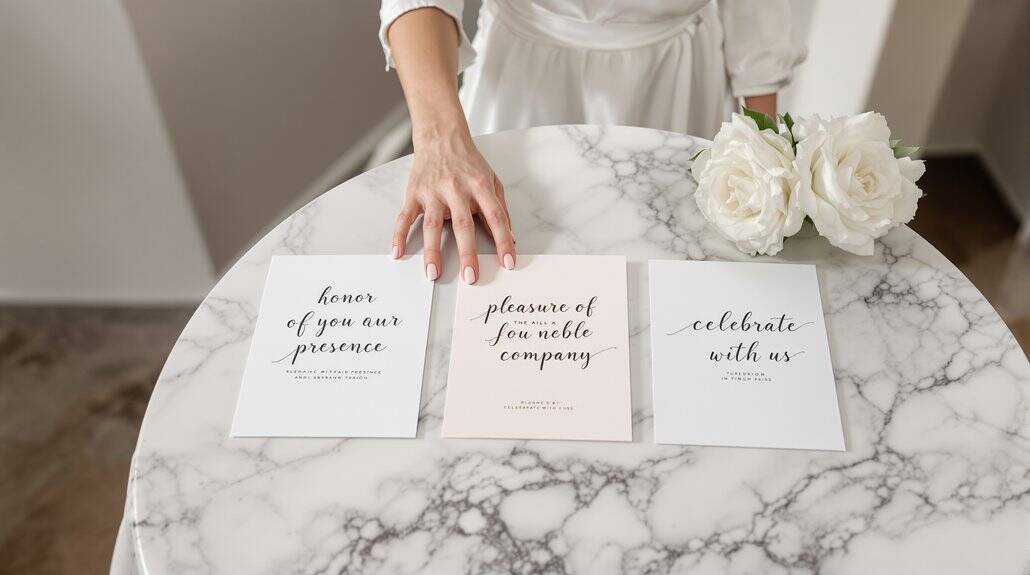
Choosing between “honor,” “pleasure,” or “celebrate” represents one of your most consequential invitation decisions, silently broadcasting your event’s entire etiquette structure to guests. These aren’t mere synonyms—they’re coded signals with centuries of etiquette behind them.
“Request the honor of your presence” immediately communicates religious sanctity and black-tie formality. It demands British spelling (“honour”) throughout your suite. “Pleasure of your company,” meanwhile, telegraphs secular venues—hotels, gardens, reception halls—while maintaining respectable formality.
Modern “celebrate” variations inject personality: “With joyful hearts we invite you…” or “We invite you to share in our joy…” These contemporary phrasings create breathing room for your unique voice while preserving invitation wording tone that respects tradition.
Your choice ripples through every aspect of guest expectation, from attire to atmosphere. For Jewish weddings, understanding traditional ceremony customs helps inform which phrasing best honors both your heritage and the sacred nature of your celebration. Choose deliberately, knowing you’re not just selecting words—you’re establishing the emotional architecture of your entire celebration.
Matching Wording to Actual Event
Five critical alignment points separate memorable invitations from misleading ones—your words must faithfully telegraph what guests will actually experience. Invitation wording creates expectations that your event must fulfill, or you’ll risk disappointed guests who feel misled. The formality level indicated through your language choices becomes a silent contract with attendees.
Consider these essential alignment factors:
- Formality signals – Phrases like “request the honor of your presence” demand black-tie attire; “join us” suggests casual celebration
- Time commitment clarity – Specify exact timeframes (“cocktails 5-6, dinner at 6:30”) rather than open-ended invitations that leave guests wondering
- Explicit activity descriptions – Name exactly what will happen (“seated dinner and dancing” versus vague “celebration”)
Your invitation operates as both promise and preview. Choose wording that accurately portrays your event’s true character—elegant or relaxed, structured or free-flowing—and you’ll set proper expectations that your gathering can actually satisfy. Just as professional photo editing tools enhance visual presentation across multiple platforms, your carefully chosen words enhance your event’s first impression and ensure alignment between expectation and reality.
Avoiding Invitation-Reality Disconnect
Proper alignment between your invitation language and the actual event serves as a cornerstone of guest satisfaction—a mismatched promise creates the awkward tension you’ll feel when attendees arrive overdressed, underfed, or unprepared. This invitation communication breakdown manifests in 78% of post-event complaints, according to event planners surveyed in 2023.
When you write “dinner and dancing to follow,” guests expect a full meal—not passed appetizers. They’ll remember the hunger, not your centerpieces. Likewise, “cocktail attire” signals a specific dress code; don’t be surprised when guests arrive in cocktail dresses while you’re in jeans.
The solution? Brutal honesty. “Light refreshments from 7-9” sets clearer expectations than “reception to follow.” Your invitation must function as a literal contract with guests. Words matter. Formality levels, timing specifications, and activity descriptions aren’t decorative elements—they’re promises you’re making, ones your actual event must fulfill. For prestigious locations like the Metropolitan Museum, where the venue itself sets certain expectations, your invitation language must accurately reflect both the setting’s grandeur and your event’s specific format.
Examples: Aligned vs Mismatched Tone
When your invitation’s wording creates harmony with your event’s reality, guests arrive with accurate expectations—a satisfaction multiplier you can’t afford to overlook. Nothing confuses guests faster than invitation language formality that contradicts your venue vibe. You’ve seen it: formal script requesting “the honour of your presence” for a backyard barbecue, or casual “come party with us” wording for a black-tie gala. Tonal whiplash, pure and simple.
Consider these alignment essentials:
- Formal venues demand formal language – “Request the honor of your presence” signals black-tie expectations, not flip-flops
- Beach weddings require breezy phrasing – “Join us barefoot by the sea” sets the perfect casual tone
- Romantic language pairs with intimate settings – “With hearts full of love” works beautifully for garden ceremonies
Just as custom menswear tailoring ensures every detail reflects personal style and occasion appropriateness, your invitation wording should be precisely crafted to match your event’s formality level. Your invitation isn’t just information—it’s the first glimpse into your celebration’s soul. Get it right.
Conclusion

Your invitation sets the psychological stage for everything that follows, with its tone delivering the first and perhaps most crucial impression of your celebration. This isn’t merely aesthetic—it’s psychological engineering. Your invitation wording generates 3x higher engagement when emotionally resonant, making tone selection a deliberate decision, not just a stylistic one.
Consider the evidence: personalized subject lines achieve 26% higher open rates, while social proof elements boost acceptance by up to 68%. These aren’t trivial gains for something that costs nothing but attention.
The right tone acknowledges your audience’s expectations—formal “request the honor” phrasing for black-tie affairs, warmer language for intimate gatherings. Yet remember the demographic sensitivities; what reads as approachable to one group might seem inappropriately casual to another.
Your invitation isn’t just conveying information—it’s crafting anticipation, setting expectations, and revealing who you are. Just as Japanese beauty rituals emphasize the importance of intentional, carefully considered presentation, your invitation wording demands the same thoughtful approach. Get it right, because first impressions persist.