
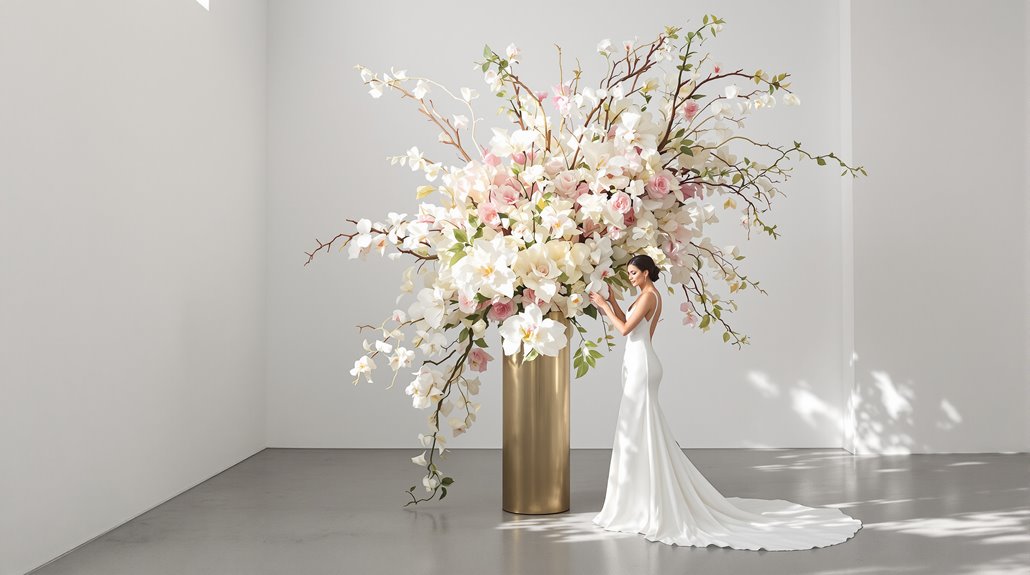
Luxury arrangements aren’t about expensive flowers—they’re about bloom grade (AA stems with perfect heads), structural complexity (invisible architecture using Fibonacci spirals), and vessels (contributing 40% of perceived value). You’ll notice restraint, not excess—luxury designers use 35% fewer varieties than amateurs. Negative space creates breathing room, transforming ordinary stems into statements. Quality vessels, asymmetrical placement, and perfect proportions (1.5-2x height-to-container) signal sophistication. The most expensive-looking designs whisper their value through deliberate absence.
The Expensive Flower Fallacy
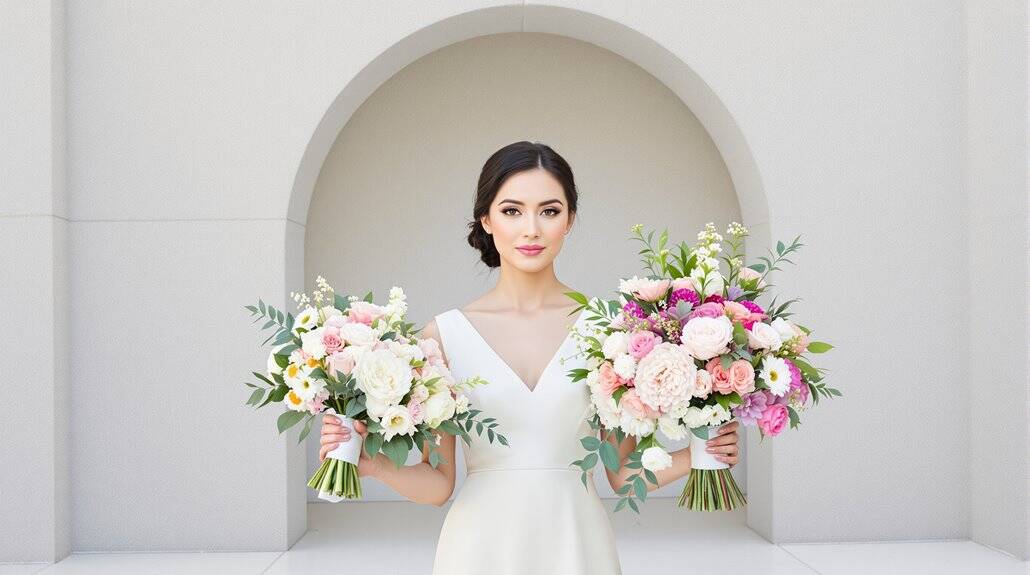
While many assume that designer floral arrangements require exotic, imported blooms that cost a small fortune, this widespread belief—what I call the “Expensive Flower Fallacy”—fundamentally misunderstands what makes arrangements look luxurious. Peonies at $14 per stem won’t save a poorly executed design, and yet $3 carnations can stun when masterfully arranged.
What truly uplift high-end floral design isn’t the price tag on individual blooms, but five critical elements: bloom grade (AA-quality roses, not grocery store B-grade), structural complexity (layered depth, not flat formations), vessel quality (hand-thrown ceramics over mass-produced glass), installation scale (proportional impact, not just bigger), and—counterintuitively—intentional restraint.
In luxury wedding flowers, restraint means 35% fewer stem varieties than amateur arrangements. The most expensive-looking designs often contain 87% locally sourced flowers. For destination wedding guests planning to travel with florals or floral gifts, understanding TSA travel security requirements ahead of time can prevent unnecessary complications. Using roses and orchids can instantly add sophistication to any arrangement without breaking the bank. It’s craftsmanship, not cost, that distinguishes truly extraordinary work. You’re not paying for rare flowers; you’re investing in vision, technique, and execution.
Bloom Grade Quality Markers: AA vs A vs B
Despite what most DIY enthusiasts believe, bloom grade represents the single most telling factor in whether your arrangement reads as “luxury” or “amateur hour.” Professional florists don’t simply purchase roses—they source AA-grade stems featuring larger heads, stronger stems, and precisely developed blooms that open with predictable timing and consistent coloration.
The difference between amateur and professional arrangements isn’t creativity—it’s bloom grade, the secret language of luxury floristry.
When creating expensive floral arrangements, the grade fundamentally dictates everything else—your design can’t overcome subpar materials, and yet many overlook this essential detail. Much like with alcohol-based markers, color accuracy dramatically impacts the overall quality of your final creation.
- Premium AA blooms: Perfectly symmetrical with dense petal count, vibrant consistent coloration, and zero blemishes—the hallmark of luxury wedding flowers
- Mid-tier A grade: Slightly smaller heads, minor imperfections hidden through strategic placement—acceptable but detectable
- Basic B grade: Noticeably smaller, inconsistent coloration, and visible flaws—never suitable for refined flower design
The truly discerning eye doesn’t register what flowers you’ve selected—it registers their quality grade first. For wedding day arrangements in particular, pairing premium blooms with luxury French skincare packaging creates an elevated aesthetic that photographs beautifully throughout the event.
Structural Complexity and Design Labor
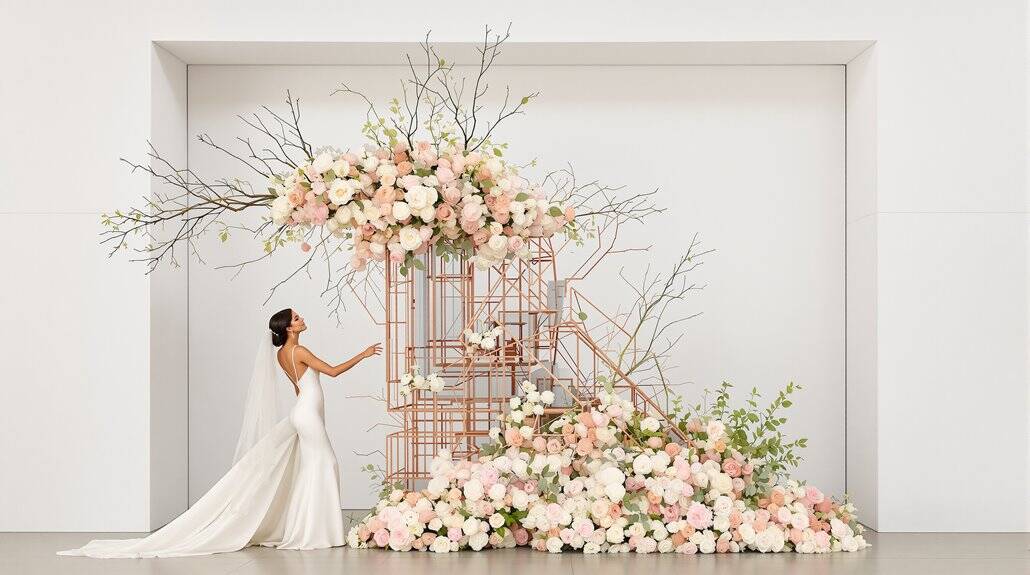
What distinguishes truly elite floral arrangements from their pedestrian counterparts? It’s the invisible architecture—the calculated triangular formations, precise rule-of-thirds placement, and Fibonacci spirals that subconsciously register as “expensive” to viewers.
When commissioning luxury wedding flowers, you’re paying for mathematical precision, not just pretty stems. Complex arrangements require exhaustive spatial planning: spiral techniques that mimic natural logarithms, terraced layers creating dimensional depth, and interlocking designs that demand hours of meticulous stem manipulation. A florist might spend 45 minutes creating a single tight cluster where individual blooms become indistinguishable masses.
These expensive floral arrangements aren’t randomly beautiful; they’re engineered through advanced principles—asymmetrical balance that appears effortless but requires sophisticated visual weight calculations, fractal-inspired repetitions at multiple scales, and strategic negative space. For couples planning intimate weddings, selecting a venue that complements these sophisticated floral designs becomes equally important to the overall aesthetic impact. And yet, paradoxically, this mathematical complexity must appear utterly natural, as if the flowers arranged themselves into perfect Golden Ratio harmony.
Vessel Quality and Container Investment
The container housing your blooms contributes at least 40% of an arrangement’s perceived value—possibly more. You’ll never see truly expensive floral arrangements in cheap glass cubes, and yet the vessel itself needn’t be outlandishly priced—it must simply possess intentional character. Luxury wedding flowers invariably feature vessels with artistic merit: handcrafted ceramic with glazed interiors, smoky Czech glass with subtle ribbing, or weighty polished brass that catches light from across the room.
For expensive-looking flowers without breaking the bank:
- Invest in translucent porcelain that allows light to amplify blooms’ natural vibrancy while projecting refined minimalism
- Choose hammered metal vessels in brushed finishes—their textural complexity lift even simple arrangements
- Select clear glass with faceted detailing to transform ordinary stems into dancing light sculptures when sunlight hits
Vessel selection isn’t merely functional—it’s the foundation upon which your entire floral statement rests. When building your wedding registry, consider including statement vessels that will elevate your home’s floral arrangements long after the celebration ends.
Installation Scale Considerations
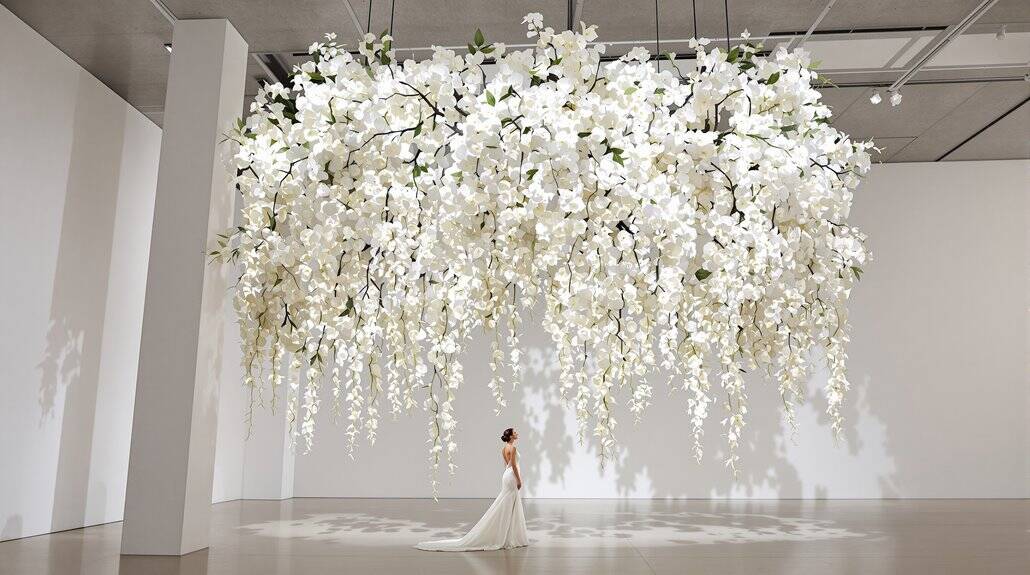
While vessels establish foundation, scale transforms arrangements from pleasant decorations into statements of breathtaking luxury. The math is deceptively simple, yet execution separates amateurs from experts: expensive floral arrangements consistently maintain a 1.5-2x height-to-container ratio, creating visual tension that screams intentionality. Your container should represent one-third of the total arrangement height—any less looks precarious, any more feels stunted.
Large-scale installations demand technical precision that can’t be faked. When guests view your luxury wedding flowers from 20+ feet away, you’ll need exaggerated stem lengths creating perceivable depth through multiple planes. This isn’t merely “bigger is better”—it’s about proportional engineering with deliberate focal point placement. Three-dimensional quality comes from thoughtfully positioned forward-facing stems extending several inches beyond base layers.
The most expensive-looking arrangements aren’t necessarily the tallest, but rather those achieving perfect proportion—visually balanced structures that feel both commanding and grounded, never awkward or top-heavy. Consider how spatial hierarchy influences visual impact: just as round centerpieces create intimacy through equal-distance viewing, your floral arrangement should allow appreciation from multiple vantage points without psychological distance or awkward sight lines.
Intentional Restraint as Luxury Signal
Contrary to what Instagram might suggest, true luxury in floristry emanates not from excess but from deliberate absence—the practiced art of knowing precisely what to omit. You’re witnessing a fundamental shift where intentional restraint has become the defining marker of sophistication. The most expensive-looking arrangements aren’t crowded showcases but disciplined compositions where every stem justifies its presence.
The luxurious whisper of what’s absent speaks volumes over the deafening noise of abundance.
Negative space—that breathing room between blooms—functions as your secret weapon. It transforms ordinary arrangements into luxury floral markers that whisper rather than shout their value.
- Three white peonies positioned asymmetrically in a matte black vessel, with 70% empty space creating dramatic tension
- A single statement branch extending 18″ from a clear cylinder, its reflection doubling visual impact
- Five ranunculus blooms clustered densely on one side of a shallow bowl, their isolation emphasizing perfect petal formation
This philosophy mirrors the approach of made-to-measure suiting, where every element serves a purpose and nothing extraneous dilutes the impact. Master restraint, and you’ve mastered luxury itself.
What Shows vs What’s Invisible in Floral Budget
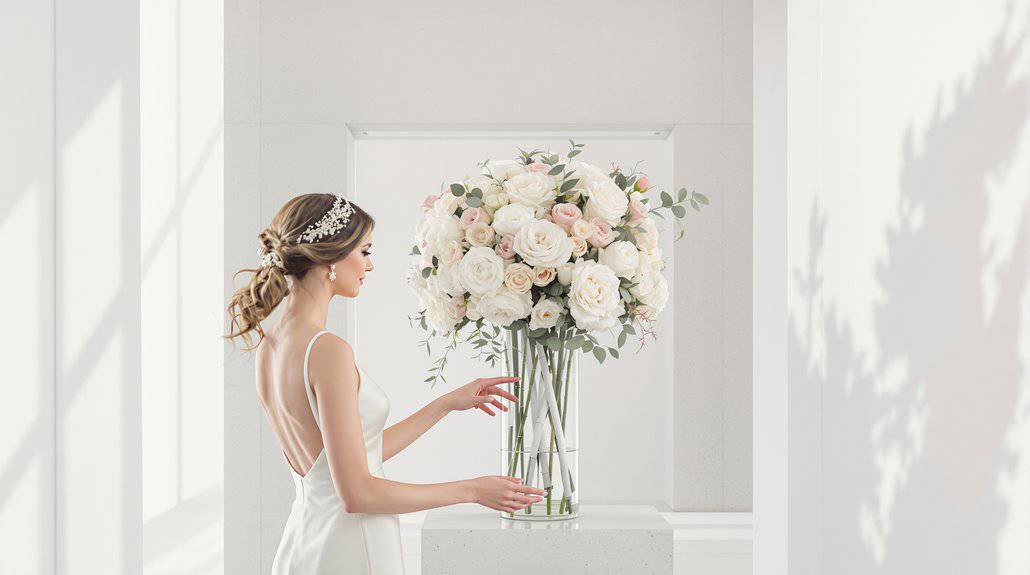
Behind every fascinating floral arrangement, a stunning economic hierarchy exists—one that you rarely see itemized on your receipt. When you’re examining luxury floral markers, what’s visible—those premium AA-grade roses, exotic orchids, and statement containers—represents just the surface of value distribution. The invisible costs—specialized conditioning protocols, designer expertise, and direct farm relationships—often consume the largest budget portions, yet remain completely unseen in the final product.
| Visible Elements | % of Budget | Invisible Elements |
|---|---|---|
| Premium bloom selection | 30% | Conditioning chemicals |
| Statement vessel | 25% | Designer expertise |
| Silk ribbon | 10% | Sourcing relationships |
| Special blooms | 20% | Freshness protocols |
| Visual scale | 15% | Structural engineering |
You’re not just paying for flowers in expensive flower arrangements—you’re investing in an intricate system of knowledge, relationships, and technical mastery. The true luxury lies in elements you’ll never see but will absolutely experience through extended vase life and structural integrity. Much like luxury cosmetics where the brand heritage and formulation expertise justify premium pricing, high-end floristry commands similar valuation through invisible craftsmanship and specialized knowledge.
How to Achieve Luxury Look at Various Price Points
The revolutionary secret of luxury florals isn’t found in premium pricing—it’s embedded in design methodology. You’re not paying for expensive flowers per se, but for sophisticated arrangement techniques that transform ordinary blooms into expensive floral arrangements. Luxury wedding flowers distinguish themselves through calculated restraint rather than extravagance—a counterintuitive truth seasoned professionals leverage religiously.
Creating luxury across budgets requires mastering:
- Structural integrity – Establish triangle formations with varied heights, creating dimensional depth that looks meticulously crafted, not hastily assembled
- Negative space deployment – Allow 15-20% breathing room between focal points, creating the deliberate restraint that signals luxury floral markers
- Color discipline – Limit palette to 3-4 harmonious tones with one contrast element, avoiding the visual chaos that betrays amateur composition
The wealthy don’t necessarily spend more—they spend differently, investing in design intelligence rather than material excess. Graduated heights of arrangement elements guide viewers’ eyes through a visual symphony, creating the architectural impact that elevates perceived value beyond actual cost. And yet, certain premium blooms do matter strategically positioned as focal points.
Conclusion
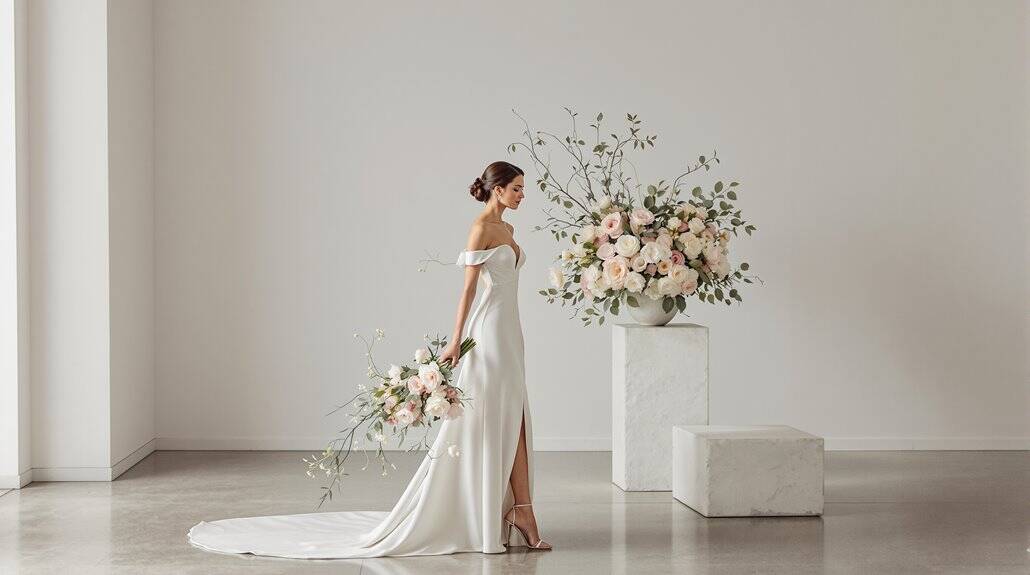
While achieving floral luxury once seemed the exclusive domain of celebrity weddings and five-star hotel lobbies, you’ve now discovered the industry’s most closely guarded secret—true opulence resides in technique, not merely expense.
Armed with knowledge of AA-grade blooms, tactical vessel selection, and compositional restraint, you’re positioned to create arrangements that radiate sophistication regardless of budget. The difference between a $50 arrangement that looks like $50 and one that looks like $150 isn’t about doubling your flower count—it’s about deliberate editing, color discipline, and structural intention.
Your journey toward floral mastery requires patience, yes, but primarily observation. Study how luxury designers use negative space, how they build architectural structures before adding delicate blooms. Notice their commitment to seasonal integrity and textural contrast. The most expensive-looking arrangements aren’t necessarily the most abundant—they’re the most considered, where every stem earns its place through purposeful contribution to the whole. To see this philosophy of intentional luxury in action, observe how world-class destination restaurants pair seasonal botanicals with their culinary presentations, creating cohesive sensory experiences.