
Estate wedding budgets aren’t what they seem. Your $12,000 venue fee? Just the beginning. The full reality hits closer to $44,000 when you factor in mandatory add-ons, infrastructure rentals, scaled-up florals ($15,000+), lighting ($3,000+), and furniture ($3,000-$8,000). You’re actually paying for an experience that demands proportional investment in every element—venue, catering, decor, labor. The true scope emerges when you multiply that initial quote by 3.5-4. Prepare for financial transparency that transforms your planning approach.
The $12000 Venue Fee Illusion
When did “$12,000 for an estate venue” become the most misleading figure in wedding planning? That seemingly manageable number—the one that convinces you an estate wedding cost fits your budget—hides a financial ambush waiting in the fine print.
Your $12,000 venue fee? Merely the foundation of a towering expense. Add the mandatory $8,000 catering minimum, $4,000 for furniture you can’t bring yourself, $3,000 in lighting (because your photographer insists), and $15,000 for florals to transform that empty ballroom. Suddenly, your estate venue actual cost rockets to $44,000—nearly quadruple the initial figure. This reality is even more stark in New Jersey, where venue costs average a staggering $27,710 according to recent data.
What’s particularly crushing about this reality isn’t just the price tag, but the inevitability. Estate weddings are expensive not because you’ve chosen extravagance, but because these venues operate on a business model where the entry fee is merely that—an entry fee. The real costs await inside. Like their industrial counterparts, these spaces present hidden expenses that compound quickly, transforming what appeared to be a reasonable venue fee into a comprehensive investment that rivals or exceeds traditional ballroom packages.
Line-Item Cost Breakdown
So you’ve seen how that deceptive $12,000 venue fee balloons into a $44,000 reality—but what exactly happens to your money, dollar by dollar? Let’s dissect your estate wedding budget breakdown with surgical precision.
That heritage venue cost reality hits hardest in the fundamentals: venue and catering devour 40% of your budget—approximately $20,000 for a typical celebration. Your floral arrangements? Another $6,345, with complexity driving costs skyward. Photography and videography will claim roughly 10-15% of your finances ($8,393 combined), because memories, darling, aren’t cheap. When booking services, you might encounter a message that “the request could not be satisfied” due to high traffic on popular wedding planning platforms.
Planning services—the difference between chaos and choreography—average $4,047, while beauty services seem modest at under $1,000. Your cake, that edible centerpiece, demands another $917. Consider too that hair and makeup require 90 minutes per bridesmaid and 2-3 hours for the bride, meaning your beauty timeline directly impacts vendor scheduling and costs.
The estate wedding cost sticker shock comes from accumulation, not extravagance. Each decision—from seasonal blooms to service style—compounds, transforming your reasonable budget into something that requires a second mortgage. And yet, forewarned is forearmed.
Infrastructure Needs: Furniture Lighting Parking
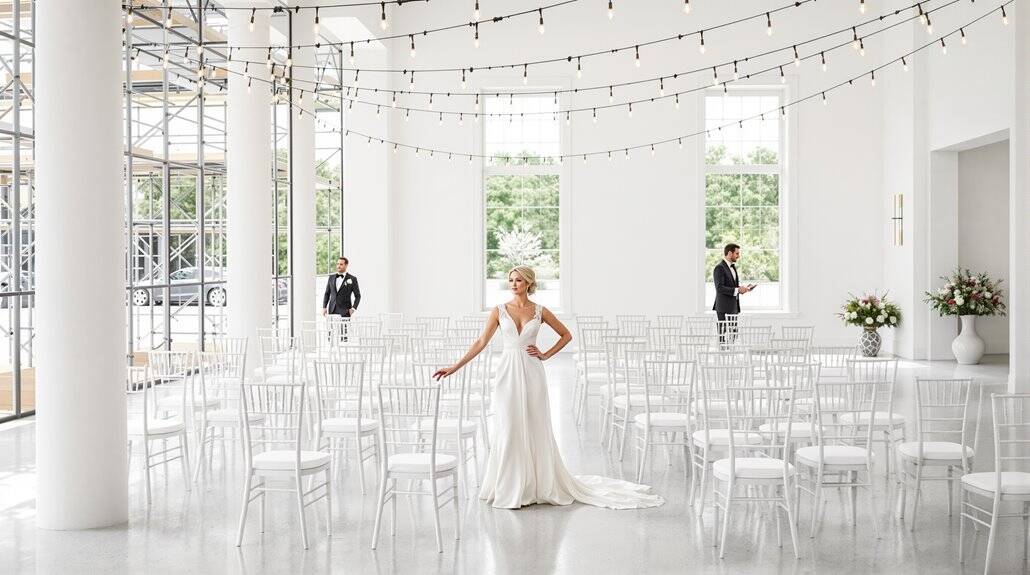
Beyond your venue’s majestic façade lies an uncomfortable truth: those Pinterest-worthy estate receptions require a small fortune in infrastructure rentals that venue coordinators conveniently omit from initial conversations.
You’ll need to budget $3,000-$8,000 for furniture alone—representing roughly 10% of your total estate wedding cost. For a 100-person event, expect lounge seating ($75-$175 per chair), banquet chairs ($4-$40 each), and cocktail tables ($25-$65 each). And that’s before lighting.
Lighting infrastructure for historic estate wedding venues typically runs $3,000+, transforming beautiful-by-day spaces into evening-ready environments. Your $12,000 venue fee? That’s merely the starting line.
Labor comprises 25-40% of rental costs—unavoidable when transforming raw estate spaces. Estate wedding pricing feels deliberately obscured, with venues quoting base fees while knowing full well you’ll need thousands more in essential infrastructure just to make the space functional.
Historic venues often max out at 60% of modern power needs, meaning you may need to budget for generator rentals or accept significant limitations on your lighting and equipment loads.
Floral Scale Requirements for Estate Grounds
Floral installations represent yet another hidden estate expense that quietly balloons your budget while delivering maximum visual drama. Estate venues demand proportionally larger arrangements—what works in a ballroom simply vanishes in expansive estate grounds. Your modest $15,000 floral budget? Barely adequate for the scale required.
Estate florals aren’t luxury—they’re necessity. Standard arrangements disappear against grand backdrops, demanding investment in proportional impact.
When planning estate wedding florals, anticipate these realities:
- Ceremony installations require 150-500 stems per arch—that’s 4-10x standard venue requirements
- Each centerpiece demands 50-100 stems to avoid looking diminutive in grand estate dining spaces
- Estate settings with 100+ guests typically require 15+ substantial centerpieces, not 8-10 modest ones
- Your total stem count will likely exceed 2,000 for even “restrained” estate designs
You’re not just buying flowers; you’re purchasing visual anchors that define your aesthetic against sprawling backgrounds. Floral design for estates isn’t extravagant—it’s proportional, and proportion comes at a premium. Consider complementing your floral aesthetic with coordinated luxury beauty products that match your wedding’s elegance and color palette.
Catering Minimums at Estate Venues
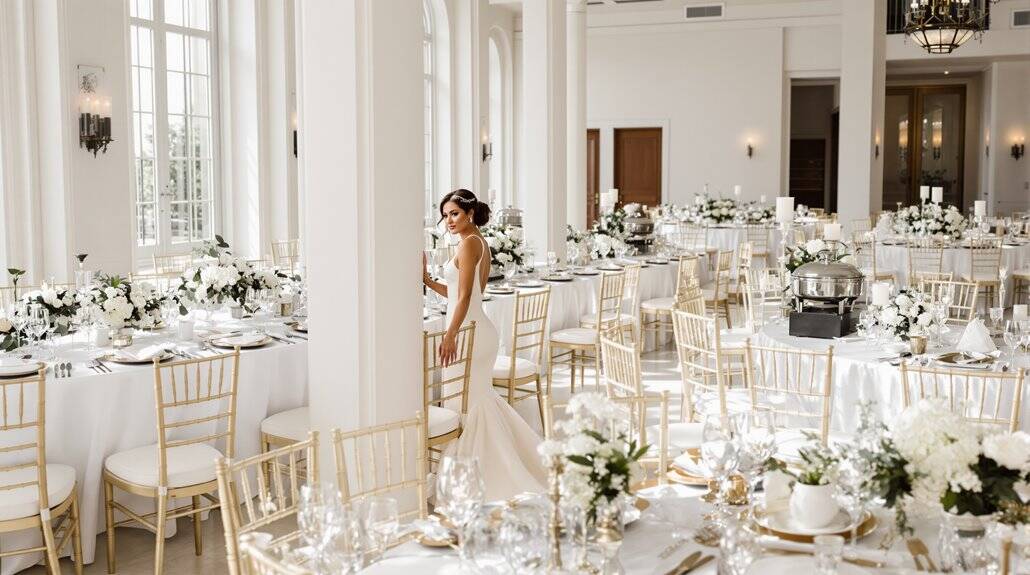
The deceptively innocuous $8,000 “catering minimum” embedded in your estate venue contract hides a financial reality that’s far more consequential than its single-line mention suggests. You’ll surpass this threshold effortlessly—most couples spend $5,500-$8,300 on catering alone, with 100-guest celebrations averaging $80 per person.
But here’s where it gets complicated: that minimum doesn’t include the 18-25% service charge ($1,800+ on a $10,000 bill), separate gratuities ($50-$100 per staff member), or taxes. Your intimate 50-person affair? You’re still paying premium rates since caterers enforce fixed minimums of $2,500-$4,000 regardless of headcount.
The economics are frustrating yet logical—smaller gatherings trigger higher per-person costs (up to $100 each) because baseline staffing requirements remain consistent. Your most cost-efficient approach is 75-100 guests, where minimum thresholds balance nicely against volume considerations, allowing you to optimize value without triggering exponential increases. As you plan these budget considerations, explore registry essentials that complement your venue choices and help guests contribute meaningfully to your new life together.
Final Total Transparency: $44000
When did a $12,000 venue fee transform into a $44,000 budget nightmare? That innocent venue price tag—deceptively manageable at first glance—explodes into a financial behemoth once you factor in the hidden requirements and non-negotiables. You’re not just paying for space; you’re investing in an elaborate ecosystem of services, each with its own price tag that wasn’t prominently displayed in the brochure.
Your actual investment includes:
- $12,000 venue rental (the advertised cost)
- $18,000 catering ($120 per person for 150 guests)
- $5,700 beverage minimum ($38 per person)
- $8,300 in “extras” that aren’t extra at all—furniture, lighting, cleaning fees
This $44,000 reality represents just venue and food—about 27% of your total wedding budget. And yet, you’re still making payments on that figure long after your centerpieces have wilted and your cake has been frozen. What many couples underestimate is how taxes and service charges can silently consume an additional 20-33% of these already substantial costs.
Where Estate Budget Goes
Breaking down your $44,000 estate wedding reveals a sobering anatomy of expenditure—where every dollar finds its predetermined destination. You’ve allocated 27% to the raw venue fee alone—before you’ve served a single canapé or illuminated a single centerpiece. And yet, that $12,000 venue fee represents merely the gateway transaction into a cascade of required expenditures.
| Budget Category | Percentage | Dollar Amount |
|---|---|---|
| Venue & Site | 27% | $12,000 |
| Catering | 18% | $8,000 |
| Décor & Florals | 41% | $18,000 |
Your flower budget, shockingly, exceeds your venue cost—$15,000 for ephemeral blooms that will wilt within hours. The catering minimum ($8,000) feels deceptively reasonable until you realize it covers only the contractual baseline. Northeast couples routinely face venue costs double the national average ($8,573), while Midwest celebrations might require half your current allocation for comparable amenities. Before finalizing any venue contracts, remember that obtaining your California marriage license represents a separate legal requirement with its own processing timeline and fees. The mathematics feel inescapable, yet understanding these proportions *enables* intentional reallocation.
Conclusion
Planning an estate wedding demands confronting financial realities that stretch far beyond that seductive initial venue quote. That seemingly reasonable $12,000 fee morphs into a $44,000 commitment when you factor in the non-negotiables—catering minimums, furniture rentals, lighting packages, and floral installations. You’re not just booking a space; you’re accessing a cascade of required expenses.
What this brutal budgetary awakening teaches:
- The venue fee typically represents just 25-30% of your total venue-related costs
- “Hidden” requirements often exceed the base rental by 2-3 times
- Estate venues demand high-end everything—your $15,000 floral budget isn’t excessive, it’s standard
- The all-in multiplier effect: multiply your venue fee by 3.5-4 for realistic budgeting
That floral investment alone typically covers 700+ premium blooms, structural installations, and a team of 4-6 professionals working 12+ hours to transform your venue into an immersive design experience.
You’re paying for exclusivity, ambiance, and photographic perfection—a premium experience that commands premium pricing. And yet, with proper planning and ruthless prioritization, the estate wedding can still be worth every painful penny.