

To edit 3,000 wedding photos into an 80-page album, start ruthlessly. First, eliminate technical failures—blurry shots, bad exposures, duplicates—immediately cutting 50-70%. Next, apply narrative criteria: does each image advance the story? Create visual flow by varying scale dramatically—full-bleed showstoppers mixed with smaller supporting images. Be brutal about redundancy; five cake-cutting shots aren’t necessary when one perfect frame captures the moment. Remember: professional curation means killing your darlings for the greater emotional impact.
The Curation Challenge: 3000 to 80
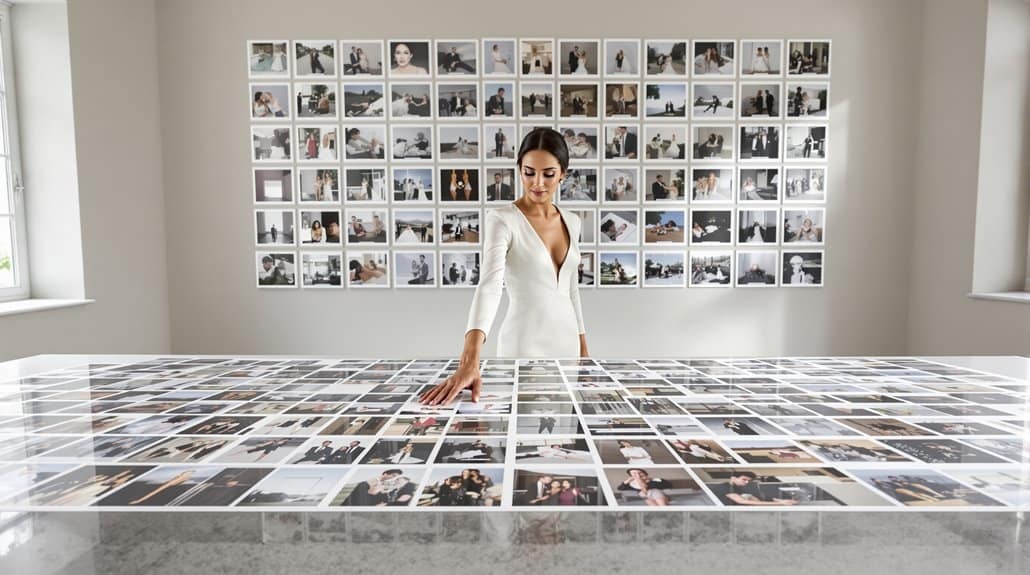
When faced with 3,000 photos and the formidable task of selecting just 80 for your album, you’re not merely choosing images—you’re steering through a psychological minefield of decision fatigue. This album curation process demands discipline most photographers never develop.
You’ll need systematic ruthlessness. Start by eliminating the obvious failures—the blurry, poorly composed shots that somehow survived initial deletion. Next, implement categorical reduction, organizing by theme to identify redundancies. Those twelve nearly identical sunset shots? Choose one—just one.
Ruthless editing isn’t optional—it’s essential. Purge the failures, group by theme, then cull the redundancies without mercy.
The choose album images process works best when broken into manageable batches—perhaps 500 images per session—to maintain consistent judgment. Employ the “pick the keepers” methodology for varied subjects, the “delete the duds” approach for repetitive sequences. Museum photographers prioritize images based on specific needs, typically selecting just 75-100 works for each week of photography.
Remember: professional curators typically retain only 2-5% of available images. Your 80-page photo selection album represents this rigorous math—and yet, this constraint will ultimately produce your most captivating visual narrative. For wedding photographers specifically, investing in Profoto professional lighting during the shoot can dramatically reduce curation time by ensuring more consistently high-quality images from the start.
First Pass: Eliminate Technical Failures and Duplicates
Before you can even consider which images tell your story best, you must ruthlessly purge the technical failures contaminating your collection. Start by examining every frame at 100% magnification—those telltale sensor dust spots appearing in identical positions across multiple shots? Immediate rejects. And yet, batch-processing can salvage dozens of affected images simultaneously if the content warrants rescue. Enabling the Visualize Spots checkbox in Adobe Camera Raw makes identifying these pesky marks significantly easier.
Focus issues represent non-negotiable dealbreakers; no amount of sharpening resurrects a fundamentally blurry image. Check eyes in portraits, key details in scenery—anything soft gets cut. Similarly, extreme color problems signal white balance failures that, while theoretically fixable, drain precious editing time. Think of this initial culling process as satisfying legal requirements—just as every detail matters when obtaining official documentation, every technical standard must be met before an image earns consideration for your album.
Don’t forget duplicates. Those eight nearly identical sunset frames? Choose one, discard seven. Your 3,000-image behemoth shrinks dramatically once you’ve eliminated the technical disasters—perhaps to 1,500 or even 1,000 contenders, bringing that 80-page target within reach.
Second Pass: Good vs Great Ruthlessness
Now that you’ve cleared away the technical debris, you’re facing a far more challenging psychological hurdle—distinguishing between good and truly great images. To curate wedding images effectively, you must adopt a ruthless editor’s mindset. Sentiment is your enemy.
When selecting album photos, ask yourself one merciless question: “What will actually be done with this photograph?” Not what could be done, what will be done. Your editing process should eliminate 75-90% of your remaining images.
| Ruthless Curation Approach | Wedding Photo Editing Reality | Expected Outcome |
|---|---|---|
| Benchmark comparison | Judge against your best, not mediocrity | Top 10% retention |
| Additive selection | Choose only images that “leap off screen” | 80-page excellence |
| “Don’t look back” protocol | No second-guessing deletions | Momentum maintained |
| External accountability | Imagine critical editor over shoulder | Stronger decisions |
Remember: that 2.67% retention rate (80 from 3,000) isn’t just a number—it’s the difference between diluted mediocrity and concentrated brilliance. Just as couples must review 5-10 complete weddings rather than highlight reels to assess a photographer’s consistency, your album should showcase complete narrative excellence, not just a collection of beautiful moments.
Narrative Sequencing Approach
The architectural blueprint of your final 80-page album emerges not just from which photos you select, but essential from how you sequence them. When edit wedding photos album, you’re crafting a visual symphony—the arrangement matters as much as the notes themselves. Your sequencing choice determines whether viewers merely flip pages or experience a journey.
Four distinct approaches to sequencing your carefully selected album photos:
- Chronological narrative – Follow time’s arrow, perfect for wedding day progression from preparation to reception
- Emotional arc sequencing – Arrange by feeling intensity rather than timeline, building toward powerful crescendos
- Visual relationship mapping – Group images by formal qualities: color palettes, composition echoes, repeated motifs
- Intuitive pairing – Place images together that create unexpected dialogue and deeper meaning
Wedding photo editing is fundamentally about storytelling, not just technical correction. Your sequence should feel inevitable—as if these 80 images from 3,000 couldn’t possibly exist in any other arrangement. When grouping by visual relationships, consider how lighting interactions at different times of day—such as golden hour versus midday sun—affect color consistency and emotional continuity throughout your album’s visual flow.
Scale Variation Strategy

While selecting your 80 favorite images establishes what story you’ll tell, varying their scale determines how powerfully they’ll communicate. This isn’t merely aesthetic—it’s psychological warfare against viewer fatigue.
Your strongest shots deserve full-bleed spreads, commanding undivided attention. And yet, clustering too many creates diminishing returns. Instead, establish rhythm by alternating between spreads with single hero images and those containing 3-5 smaller photos. An 8×8 album tolerates 6-8 images per page before legibility suffers; a 12×12 format buys you breathing room.
The disciplined curator plays with scale deliberately—enlarging vital moments while reducing supplementary context. Fast-moving sequences benefit from 6 tightly arranged images; contemplative moments deserve space to breathe. This variation creates visual cadence that propels viewers through your narrative while preventing the dreaded “scrapbook effect” where equal-sized photos flatten emotional impact. Like the bridal accessories that serve as narrative punctuation in wedding albums, your scale choices provide visual emphasis that guides the viewer’s emotional journey through each spread.
Avoiding Redundancy
Examining 3,000 near-identical photos feels like searching for needles in a haystack made of other needles. You’ve captured six versions of the same sunset—slightly different angles, marginally altered exposures—and yet only one deserves album space. Ruthless elimination of redundancy isn’t just good practice; it’s survival.
Implement these redundancy-killing techniques immediately:
- Use duplicate detection software like Peakto to automatically group similar images, saving hours of manual comparison
- Retain only the highest-quality version of each scene—delete the blurry, poorly lit alternatives without remorse
- Establish a coherent filing system based on events or dates to prevent confusion across your collection
- Flag keepers with star ratings while striking through rejects
Your storage space expands dramatically when you eliminate duplicates. The difference between an amateur’s bloated collection and a professional’s curated portfolio isn’t talent—it’s discipline in rejecting the almost-perfect for the genuinely outstanding. Just as elegant table settings rely on deliberate choreography rather than expensive elements, a refined photo album depends on intentional curation over sheer volume.
Every Image Must Earn Its Space

Among professional photographers, a sacred truth reverberates: if a photo can’t justify its existence, it shouldn’t make the cut. You’re not assembling a documentary archive—you’re crafting a concentrated narrative where each frame must pull its weight. Those 3,000 images represent raw material; your 80-page album demands ruthless selectivity.
Consider each candidate against these earning criteria:
| Justification Type | Strong Example | Weak Example | Decision Factor |
|---|---|---|---|
| Emotional Weight | Tears streaming during vows | Generic smile at camera | Genuine vs. performative |
| Technical Excellence | Perfectly exposed silhouette | Slightly blurry action shot | Mastery vs. acceptability |
| Narrative Contribution | Revealing preparation moment | Repetitive guest photos | Advances story vs. redundancy |
| Visual Distinctiveness | Dramatic composition | Standard posed group | Memorability vs. conventionality |
Every inclusion represents dozens of rejections. This discipline—this willingness to discard technically good images that don’t advance your story—separates amateur collections from professional curation. Like the 60-30-10 proportion used in complementary color schemes to prevent visual chaos, your album needs deliberate balance: dominant moments, supporting sequences, and carefully chosen accent images that punctuate without overwhelming. Be merciless, yet thoughtful.
Conclusion
As you journey from the overwhelming abundance of 3,000 photos to the polished elegance of an 80-page album, you’ve performed nothing short of alchemical transformation. The final pages deserve the same rigorous attention as your opening spreads—perhaps more so, as they’ll leave the lasting impression.
Seal your album with these finishing touches:
- Create narrative closure – Echo visual elements from early pages to form a satisfying compositional bookend
- Include one showstopper final image – Select a photo with emotional resonance that encapsulates the entire story
- Consider white space – Allow breathing room in closing pages; visual quietude creates emotional punctuation
- Write minimal, meaningful text – A simple date, quote, or single line can crystallize the experience without overwrought sentimentality
Your discipline throughout this curation marathon has transformed chaos into coherence. The 2,920 images left behind weren’t failures—they were necessary steps toward discovering what truly matters. For wedding albums specifically, understanding the ceremony customs beforehand helps you anticipate which moments will carry the most significance in your final edit.