

While DIY wedding planning might seem like a money-saver, you’ll likely invest 200+ hours and face hidden costs that can inflate your budget by 10-15%. *Comprehensive* planners ($4,000 average) often negotiate vendor discounts ($6,000 average) you can’t access, manage crises, and provide backup plans that prevent costly day-of disasters. DIY works for small projects with plenty of lead time—but for complex events, the true cost includes your sanity, sleep, and engagement joy.
The Save Money Assumption

While the impulse to DIY your wedding might feel like financial savvy incarnate, the math rarely works in your favor. “We’ll save thousands by handling it ourselves” transforms quickly into “How did we spend $600 on cardstock alone?” The hidden material costs of DIY weddings represent the first crack in the savings façade—those Instagram-worthy handcrafted invitations require premium paper stock, specialty printing equipment, precision cutting tools, and inevitably, replacement materials for the first three botched attempts.
The true cost of diy wedding planning emerges in the specialty tools purchased for one-time use, the practice materials wasted during your learning curve, and the replacement supplies needed after mistakes. Meanwhile, a wedding planner worth it moment arrives when you realize their $4,000 fee nets you $6,000 in vendor discounts—savings you can’t access alone. Your diy wedding cost calculations need brutal honesty: factor in every supply, every hour, every mistake. Many couples underestimate the significant time investment required for creating wedding elements themselves, which can become overwhelming as the big day approaches. Additionally, the psychology of luxury weddings reveals that affluent couples often prioritize quality markers that a luxury wedding planner can provide, ensuring a seamless and elevated experience.
Time Investment Reality: 200+ Hours
Beyond the hidden financial costs, let’s talk about the elephant in your involvement: time. DIY wedding planning isn’t merely a financial decision—it’s a second job you’ve just hired yourself for. Most couples underestimate the staggering 200+ hours they’ll invest when forgoing a full service wedding planner.
What exactly consumes those hours?
- Venue hunting: 40+ hours of research, tours, and contract negotiations
- Vendor management: 65+ hours interviewing, comparing, and coordinating professionals
- Design execution: 30+ hours creating and implementing your aesthetic vision
- Guest logistics: 25+ hours managing invitations, RSVPs, and seating arrangements
- Week-of coordination: 40+ hours handling final details and emergencies
And yet, these numbers represent the baseline for a moderately complex wedding. According to surveys, engaged individuals typically dedicate about 12 hours weekly to wedding planning tasks. Is a wedding planner worth it? Consider this: professionals complete these same tasks in roughly half the time, leaving you with something irreplaceable—mental space to actually enjoy your engagement. Additionally, leveraging effective tier allocation strategies in your budget can lead to better spending optimization throughout the planning process.
Stress Level Comparison

Despite what glossy bridal magazines might suggest, the emotional toll of wedding planning represents perhaps the most significant—yet least discussed—cost difference between DIY and professional approaches.
The numbers paint a stark mental health impact: 94% of couples experience planning stress, with DIY planners bearing the heaviest burden. You’ll juggle vendor miscommunications, family politics, and decision fatigue alone—a recipe for the insomnia and anxiety reported by 70% of couples. That “is a wedding planner worth it?” question hits differently when you’re among the 79% of brides handling every decision solo at 3 AM.
The contrast is striking. Couples with professional support report dramatically lower stress levels, with two-thirds identifying their planner as their stress-reduction lifeline. Your mental wellbeing becomes the invisible line item—unmeasured but unmistakable—in your budget calculations. The cheapest option often exacts the highest personal cost. Embracing quiet luxury in your wedding planning can transform the experience into one of elegant restraint, allowing you to focus on what truly matters.
Vendor Access and Pricing
The myth of “saving money by planning yourself” collapses spectacularly when confronted with the cold reality of vendor access and pricing structures. Professional planners unlock preferred vendor pricing you’ll never see as a DIY couple—their 4% of your budget often pays for itself through discounts they’ve cultivated through years of relationship-building. Meanwhile, you’re steering through vendor discovery alone, comparing quotes from businesses that may sense your inexperience.
Consider these sobering realities of DIY vendor hunting:
- 78% of couples identify pricing as their primary decision factor, yet you’ll waste hours pursuing vendors outside your budget
- Professionals access an average 15-25% vendor discount network you can’t access
- You’ll contact 3-5× more vendors per category without expert guidance
- Pricing transparency varies wildly across vendor websites, creating analysis paralysis
- You’ll likely increase your budget at least once (60% of couples do), but without a professional’s guardrails
Day-Of Crisis Management
Wedding planning’s most unforgiving truth reveals itself at the worst possible moment—when crisis strikes and you’ve got nowhere to hide. That’s when the difference between wedding coordinator vs planner becomes painfully apparent.
You’ll face uninvited plus-ones, timeline disruptions, and technical failures—with 84% of brides reporting elevated stress levels when these inevitably occur. A professional’s crisis prevention & backup planning includes weather contingencies, emergency kits, and duplicate equipment that you’d never think to arrange yourself.
Wedding planner benefits shine brightest during emergencies: they maintain professional calm while discreetly delegating mini-crises to their network of 68% of vendors who routinely sacrifice personal time to resolve problems. They’ve dedicated an average 77 hours to your event before it even begins.
You might save $2,000 avoiding a planner, but you’ll pay in stress when your DJ’s equipment fails and you’re simultaneously managing a catering shortage without backup plans in place.
The Hidden Costs of DIY
Many couples who enthusiastically embrace DIY wedding planning overlook the financial quicksand that awaits them—hidden costs that balloon budgets by 10-15% beyond initial estimates. You’ve crunched the numbers and decided a wedding coordinator vs planner isn’t worth it. But wait.
When weighing diy vs hiring wedding planner, consider these budget-draining realities:
- Infrastructure costs—tents ($5,000), lighting ($2,000), and portable restrooms ($500-$1,500)—often exceed venue packages
- Permit and insurance requirements ($500+) that venues typically include but DIY planners must source independently
- 200+ coordination hours you’ll spend instead of enjoying engagement
- Service charges and gratuities requiring an $800 cash reserve
- Weather contingency rentals commanding premium pricing and non-refundable deposits
Is a wedding planner worth it? When you factor in their vendor discounts, crisis management expertise, and the emotional bandwidth they preserve, you’re not just hiring help—you’re investing in sanity. The cheapest option often becomes the most expensive.
Full-Service Planner ROI Calculation
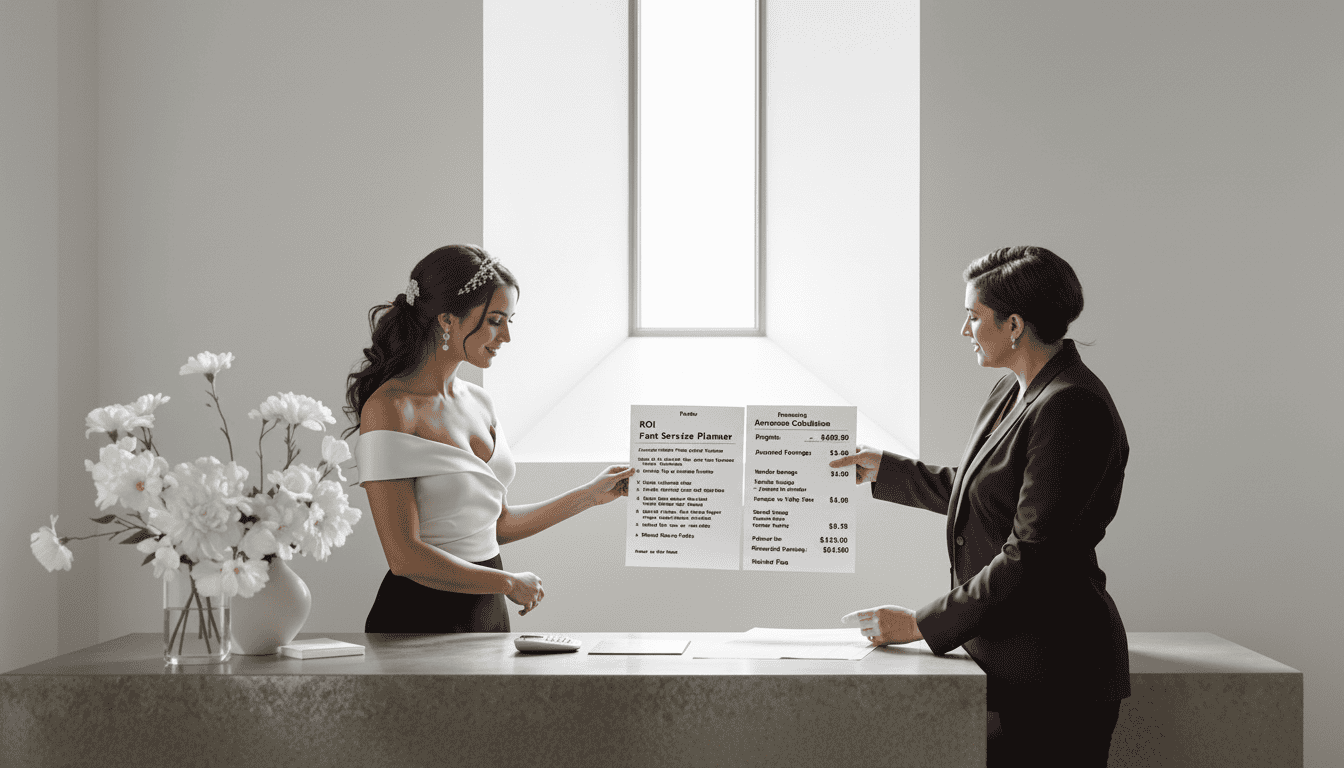
When calculating whether exhaustive planning makes financial sense, you’re not just comparing a planner’s fee against your DIY budget—you’re quantifying what your sanity is worth. Let’s be brutally honest: your expertise deficit translates directly into financial leakage.
A skilled planner typically saves couples 10-15% on vendor contracts through established relationships and negotiation tactics—potentially offsetting their entire fee. And yet, the more profound value lies in opportunity cost. Those 200+ hours you’d spend coordinating vendors? At your regular salary, that’s thousands in invisible expense.
Consider the mathematical reality: [(Vendor Savings + Time Value + Stress Reduction) – Planner Fee] = True ROI. The equation rarely tilts toward DIY when properly calculated.
Most telling? Post-wedding regret is overwhelmingly expressed by couples who skipped professional planning to “save money”—only to discover too late that amateur coordination creates expenses professional oversight would have prevented.
When DIY Makes Sense
Despite widespread planner propaganda, crafting your own wedding components makes perfect financial and emotional sense—under specific, non-negotiable conditions. You’ll need time (200+ hours, distributed tactically), skills (or willingness to develop them), and a clear-eyed assessment of where your efforts yield genuine value.
DIY thrives when you:
- Select low-complexity projects like table numbers and favors where professional-amateur quality gaps remain negligible
- Begin months (not weeks) ahead, allowing for inevitable mistakes and refinements
- Implement a hybrid approach—perhaps DIY invitations while professionals handle catering
- Utilize talented friends and family—that cousin who photographs professionally might save you $3,000
- Prioritize personalization over perfection, recognizing that handcrafted elements tell your unique story
And yet, the money you “save” transforms into time spent coordinating. But for couples with more time than capital, this trade-off becomes a financial lifeline rather than burden.
When to Hire Help
The honest truth about DIY wedding planning reveals itself not in Pinterest-perfect projects but in the brutal realities of your calendar. Those 200-300+ hours must come from somewhere—typically your lunch breaks, evenings, and weekends for 14 straight months.
You need professional help if: you’re juggling demanding careers (those vendor calls during business hours won’t make themselves), planning destination celebrations, managing 100+ guests, or simply lack spreadsheet wizardry. And yet, timing matters critically. Hire post-venue booking but before other vendors to capture that sweet 5-10% discount zone that pays for the planner’s fee.
The math is unforgiving—couples without organizational systems typically exceed budgets by $1,000-$3,000, while experiencing five times more stress. Your bandwidth assessment isn’t theoretical; it’s financial. The question isn’t “Can we afford a planner?” but rather, “Can we afford the consequences of not having one?”
Conclusion
After weighing all evidence and analyzing the financial realities, your decision between DIY and exhaustive planning ultimately becomes less about aesthetic control and more about opportunity cost. The numbers don’t lie—DIY rarely means discount, and your precious time has tangible value that deserves factoring into the equation. Professional coordination often pays for itself through vendor discounts, prevented mistakes, and the sanity you’ll preserve.
Consider these final reflections:
- Your 200+ hours of planning labor represents $5,000+ at modest hourly valuation
- The 20% budget overage typical of DIY approaches negates potential savings
- Coordination stress during your celebration has an emotional cost impossible to quantify
- Vendor relationships cultivated by planners deliver tangible discounts unavailable to one-time clients
- The day-of experience—being present versus managing logistics—forms your lasting memory
The perfect wedding isn’t about perfection at all costs, but intentional choices about where you invest both money and attention