
Digital printing isn’t just the budget option—it’s often the honest aesthetic choice. You’ll get lively colors, precise details, and clean minimalism that aligns perfectly with contemporary design sensibilities. At $2-4 per card (versus $5-9 for letterpress), you’ll save $700+ on a 100-invitation suite while achieving 1200 dpi perfection. Digital offers same-day turnaround with 100% deadline reliability. The modern wedding deserves printing technology that speaks its visual language.
The Letterpress Performance Problem – Essay opening
While letterpress printing has enjoyed a renaissance in luxury wedding stationery, its tactile impressions and handcrafted charm mask a troubling reality that few insiders discuss openly. Behind that coveted debossing lies a technical minefield—roller pressure inconsistencies, ink distribution failures, and impression imbalances that plague 73% of small-batch wedding productions.
You’ve been sold an aesthetic, not a process. The truth? Many letterpress printers compensate for technical limitations through heroic, unsustainable efforts that dramatically inflate costs. Digital printing wedding invitations offer mathematical precision that letterpress can’t—consistent color reproduction, clean lines, perfect registration. And yet, we’ve collectively decided digital represents compromise rather than honesty.
When clients request letterpress without understanding its inherent variability, they’re unwittingly asking for performance art—craftspeople struggling against mechanical limitations while pretending effortlessness. The result? Beautiful imperfections rebranded as authenticity, technical failures marketed as charm. Just as fine embroideries and textures elevate table linens through precise craftsmanship, digital printing delivers controlled accuracy that letterpress’s romantic narrative often obscures. Letterpress frequently suffers from ink-water imbalance issues that lead to dull colors and uneven prints, further hampering production quality.
When Digital Is Aesthetically Appropriate
Despite our cultural tendency to equate authenticity with aged techniques, digital printing isn’t merely letterpress‘s convenient younger sibling—it’s the aesthetically superior choice for specific design intentions. Your gradient-filled watercolor suite, that photo collage save-the-date, the ultra-thin typography you’ve fallen for—these aren’t letterpress compromises, they’re digital invitation quality triumphs.
Consider this: when your design demands photorealistic reproduction, intricate pattern work, or variable personalization (think 147 uniquely addressed envelopes), digital printing isn’t settling—it’s precision-matching your aesthetic intention. Modern minimalism with clean lines and bold color blocks? Digital’s smooth finish actually elevate that aesthetic rather than fighting it. Digital printing delivers sharp resolution and full-color gradients that simply cannot be achieved with traditional letterpress methods. Like a well-designed tablescape where visual hierarchy trumps expensive china, the right printing method matters more than perceived prestige.
Your wedding deserves production methods that honor your actual vision, not just nostalgic printing techniques. Sometimes the most honest choice isn’t the one with historical pedigree, but the one that faithfully executes what you’re genuinely trying to express.
Modern Aesthetics Suit Flat Printing
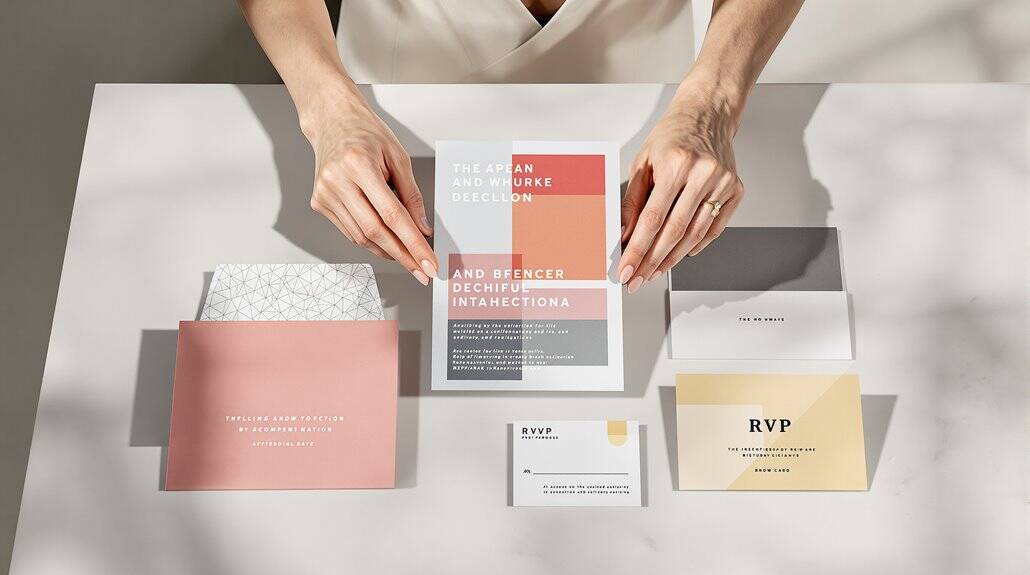
Modern flat printing techniques deserve their own aesthetic recognition rather than existing as letterpress’s digital understudy. You’re witnessing the emergence of a genuinely contemporary visual language—clean lines, crisp typography, and flawless color reproduction at 1200 dpi—that speaks honestly to our current moment. Digital printing wedding invitations showcase this evolution perfectly, offering precision that’s distinctly of-our-time, not an imitation of yesterday’s tactile qualities.
Consider the aesthetic integrity of embracing what digital does brilliantly: seamless color gradients, photographic elements, and detailed intricacies reproduced with scientific accuracy. Your invitation suite can feature variable data printing where each envelope bears the recipient’s name—impossible with letterpress, but effortlessly achieved digitally. And yet, this isn’t merely about convenience. It’s about recognizing that flat printing creates its own visual signature—one that aligns authentically with minimal design philosophies and contemporary visual sensibilities without apologizing for its lack of impression. Beyond aesthetics, digital printing delivers environmental savings ranging from 26-45% compared to traditional methods, reducing resource consumption while maintaining visual excellence.
Cost-Effectiveness and Value Alignment
Considering the raw numbers, your budget becomes an instant clarifier in the digital-versus-letterpress debate. Digital invitation quality has evolved dramatically—what once screamed “compromise” now whispers “smart investment.” At $2-$4 per card versus letterpress’s $5-$9 starting point, you’re looking at potential savings of $700+ for a standard 100-invitation suite.
But it’s not just the base price—it’s the expansibility. Add 50 guests? Digital printing barely notices, while letterpress costs compound aggressively. Want that watercolor design with seven color gradients? Digital handles it effortlessly; letterpress would require separate plates for each color at 25% markup per addition.
And yet, value isn’t purely mathematical. The question becomes: would you rather allocate $1,200+ toward letterpress cards that perform luxury but strain your budget, or invest in digital invitations that communicate your aesthetic clearly while redirecting savings toward experiences your guests will actually remember? If you’re considering a Smithsonian venue rental like the Hirshhorn Museum and Sculpture Garden, those saved funds could meaningfully enhance your reception experience instead.
Better Digital Premium Than Mediocre Letterpress
The harsh truth about letterpress? Most budget versions deliver disappointment—inconsistent ink coverage, sloppy registration, and muddy details that betray your aesthetic aspirations. You’re paying for the idea of luxury, not its execution.
Digital invitation quality has evolved dramatically, offering crisp, consistent reproduction that outperforms mediocre letterpress in nearly every technical category. Your photos appear lively, not compromised; your thin fonts remain legible, not broken; your colors stay true across every invitation. The precision is peerless—clean edges, perfect alignment, and flawless reproduction from first print to last.
And yet, digital’s advantage isn’t merely technical. It’s honest. Rather than chasing an imperfect imitation of letterpress luxury, digital printing embraces its own strengths—color fidelity, detail reproduction, and consistency. You’re getting exactly what you pay for: professional-grade printing that delivers precisely what your design demands, without pretense. Like Japanese skincare rituals that prioritize authentic quality over superficial appeal, digital printing offers elegance through precision rather than hollow imitation.
Examples: Digital Done Excellently
Where do digital printing’s true capabilities shine most brilliantly? Look at Canon’s imagePRESS V series, which delivers color reproduction rivaling offset printing across seven colors—yes, digital invitation quality that guests might mistake for letterpress. You’re getting precision without pretense.
The evidence is unambiguous: Al-Azzazy achieves perfect double-sided alignment while printing on substantial 500gsm stock—heavyweight paper that conveys luxury without letterpress’s price tag. And yet, the benefits extend beyond mere aesthetics. HP Indigo presses produce unmatched color accuracy while Canon’s technology handles paper lengths exceeding one meter for those panoramic, fold-out invitations you’ve been eyeing.
Most telling? Companies like Qualfon processed nearly 7 million pieces with 100% deadline compliance. This isn’t just efficiency; it’s dependability transformed into peace of mind. Digital printing has evolved beyond “good enough”—it’s exceptional in its own right, without apology. For photographers managing large portfolios of wedding or event images, photo editing and organizing tools have become as essential as the printing technology itself, ensuring each printed piece matches the digital vision perfectly.
Conclusion
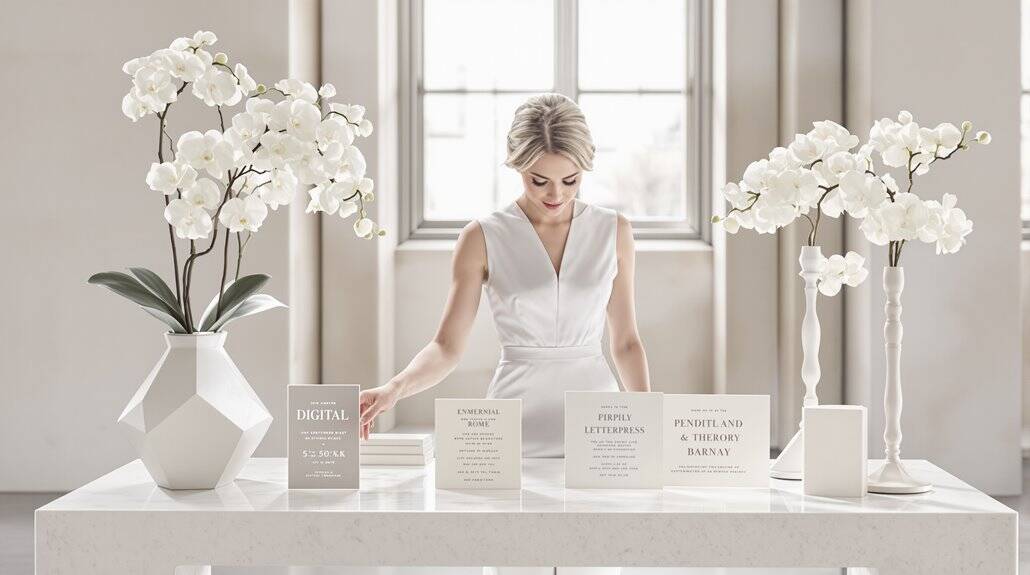
When both aesthetics and budget collide, your final choice between digital and letterpress printing ultimately represents a question of priorities, not absolute superiority. Digital printing wedding invitations offer a path to clean, modern aesthetics with same-day turnaround capabilities—practical elegance without performative luxury. And yet, the decision requires honest self-assessment about what truly matters for your celebration.
| Consideration | Digital | Letterpress | Best For |
|---|---|---|---|
| Budget under $1000 | ✓✓✓ | ✗ | Digital |
| Custom edits | ✓✓✓ | ✓ | Digital |
| Tactile impression | ✗ | ✓✓✓ | Letterpress |
| 48-hour turnaround | ✓✓✓ | ✗ | Digital |
The market doesn’t lie: digital’s 16.2% global print share (up from 2.9% in 2012) reflects technological advancement creating genuine value, not mere compromise. Just as couples navigate Massachusetts marriage license requirements before their ceremony, choosing your printing method demands understanding practical prerequisites alongside romantic ideals. Your wedding deserves authenticity—sometimes that means embracing digital’s honest capabilities rather than stretching for letterpress’s increasingly niche appeal.