

You need both digital galleries and printed albums—it’s not either/or. Digital offers instant sharing and unlimited storage (3,000+ photos versus 80-120 in print), while printed albums evoke 18% more feelings of love and last 100+ years without technological obsolescence. Digital collections face hardware failure risks; physical prints provide tangible remembrance without decision fatigue. A hybrid approach combines digital’s accessibility with print’s emotional permanence, costing ₹35,000-110,000 combined for ideal preservation. The complete strategy awaits.
The Digital vs Print Question
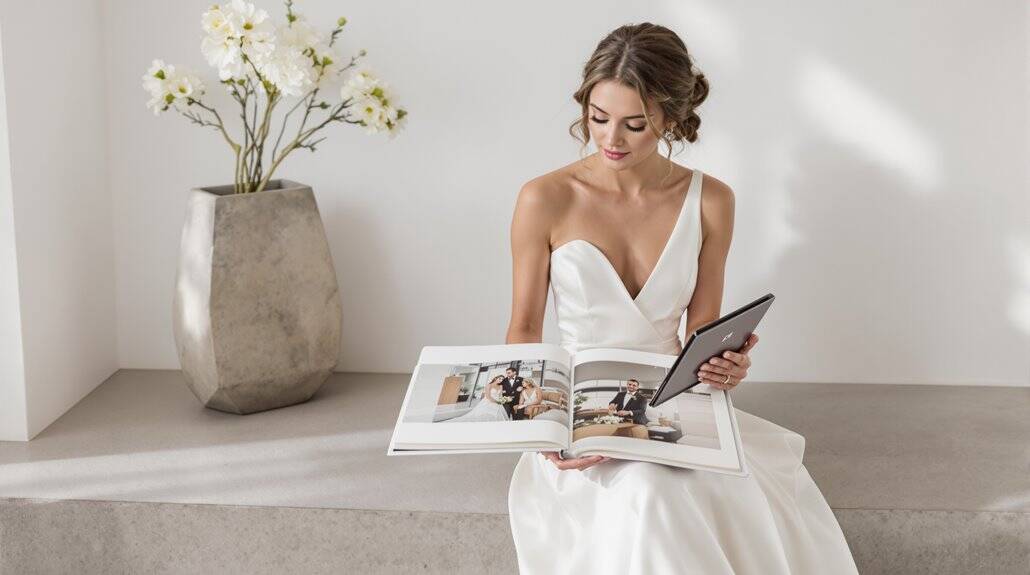
While technology has transformed how we capture life’s moments, the choice between digital galleries and printed albums isn’t merely practical—it’s deeply emotional. The numbers tell a startling story: 6 times more adults prefer viewing printed photographs over digital versions. And yet, 67% of us store photos solely on devices, creating a dangerous vulnerability to data loss.
Your digital album offers undeniable convenience—thousands of memories instantly accessible, shareable, searchable. But consider this: 86% of people with precious photo albums barely look at them, averaging just one viewing every 19 months. Physical prints displayed on walls serve as lasting visual reminders of cherished moments that digital-only collections cannot provide.
The reality of photo preservation methods reveals a paradox: we’re capturing more but experiencing less. Your online gallery houses over 1,000 images on average, yet you’ll print barely 2% of them. This matters because printed photos trigger 18% more feelings of love and 17% more gratitude than their digital counterparts. Whether you’re documenting intimate moments or planning special event photography at venues like the Getty Center and Villa, understanding the value of both formats ensures your memories endure in meaningful ways.
Digital Gallery Advantages: Accessibility Shareability
Digital galleries transform how you access your most precious moments in ways printed albums simply can’t match. Your memories become instantly available across all your devices—smartphones, tablets, laptops—wherever you have an internet connection. You’ll share wedding highlights with relatives across continents in seconds, not weeks. Making your gallery accessible is especially important for the approximately 1.3 billion people worldwide who live with some form of disability.
| Feature | Digital Gallery | Printed Album |
|---|---|---|
| Access Point | Any device, anywhere | Physical location only |
| Sharing Capacity | Unlimited recipients | Limited by physical presence |
| Distribution Speed | Instantaneous | Days to weeks for delivery |
And yet, this accessibility comes with responsibility. Your curated digital gallery requires maintenance—backing up files, updating software platforms, migrating to new services when old ones become obsolete. Platforms like Pinterest demonstrate how visual exploration enables you to organize and save favorite ideas, making digital collections both discoverable and meaningful. The shareability that makes your wedding photos go viral among family members simultaneously exposes them to potential privacy concerns, platform changes, and eventual digital decay. Your memories deserve the permanence of print alongside digital’s extraordinary convenience.
Digital Risks: Technological Obsolescence
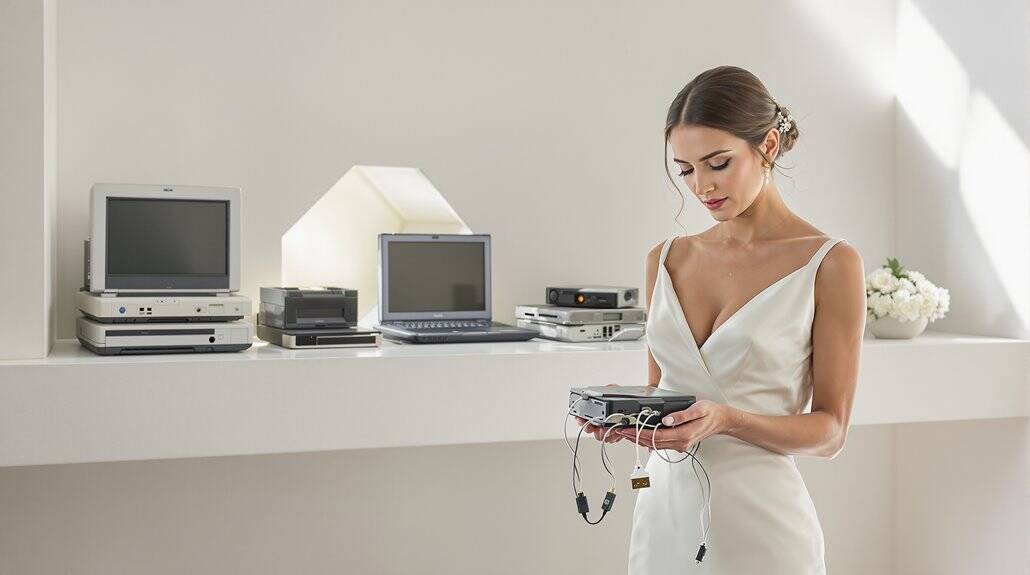
Despite today’s seamless digital convenience, your wedding photos face an invisible threat that printed albums never encounter—technological obsolescence. Remember those cherished family photos trapped on floppy disks? Your digital wedding gallery risks the same fate.
Hardware obsolescence strikes without warning. That external hard drive storing 3,000 precious moments? It fails at 3-5 years on average. Your cloud service might disappear tomorrow, taking your memories with it. And yet, it’s software incompatibility that truly devastates. Files created in 2010 often won’t open on systems just ten years newer.
Physical media degradation compounds these risks. Those backup DVDs you burned? They’re silently oxidizing, with archival-grade discs lasting just 20 years in ideal conditions. Standard discs? Five years, if you’re lucky.
Just as preserving legal marriage documents requires careful attention to official requirements, your wedding photos demand the same level of protection against digital decay.
Your wedding deserves better than becoming another casualty of digital extinction—trapped in formats future generations can’t access, can’t view, can’t cherish.
Printed Album Advantages: Tangibility Archival
The printed wedding album sitting on your coffee table has already outlasted three phones, two laptops, and countless software updates. This tangibility isn’t just nostalgic—it’s practical. Your archival-quality album, crafted with acid-free paper and chemical-stable binding, preserves your memories in a format designed to last generations, not gigabytes.
Digital memories fade with technology, but a printed album becomes a physical heirloom that endures beyond the next upgrade.
When you hold a printed album, you’re experiencing something digital galleries can never replicate: physical permanence that doesn’t require passwords, cloud subscriptions, or compatible devices.
- Acid-free pages resist deterioration for 100+ years when properly stored
- Professional binding withstands decades of handling and page-turning
- Physical copies distributed to family create multiple safeguards against loss
- Visible placement ensures memories get revisited, not forgotten in folders
You’ll pay $2,000-$4,000 for this permanence—steep, yes, but consider it an investment in your family’s visual heritage, immune to the digital amnesia that devours our virtual mementos. Just as couples invest in fine wedding bands that become cherished heirlooms, your printed album transforms wedding photography into a tangible legacy that future generations can touch and treasure.
Cost Comparison

When comparing costs between preservation methods, you’re not just weighing price tags—you’re calculating the true value of memory insurance. That ₹3,000-8,000 economy printed album seems expensive initially—and yet digital solutions demand invisible ongoing investments that accumulate silently.
Your online gallery versus album calculation must extend beyond year one. Free cloud platforms inevitably require premium subscriptions (₹1,300-6,500 annually) once your collection grows, while devices themselves demand replacement cycles costing ₹15,000+ periodically.
Long-term cost analysis reveals the surprising math: over a decade, digital preservation typically totals ₹25,000-80,000 including storage subscriptions and hardware updates. Traditional albums? A fixed ₹15,000-60,000 with zero recurring expenses.
The hybrid approach represents your smartest investment—a premium printed album (₹10,000-30,000) paired with selective cloud storage. Professional services now offer internet photo archives that combine the permanence of physical prints with the accessibility of digital galleries, giving you the best of both preservation strategies. You’ll optimize cost-per-viewing value while ensuring your memories remain both tangibly present and digitally preserved. Both/and, not either/or.
Why You Need Both: Different Memory Functions
Memories function differently depending on how we preserve them, which explains why limiting yourself to just digital or just print creates unnecessary blind spots in your memory scenery. Your print wedding album delivers tangible, ritualistic experiences—commanding full attention through physical page-turning that deepens emotional connection. And yet, your digital gallery offers instant accessibility across continents, connecting distant relatives through shared moments they’d otherwise miss.
- Print albums become visible daily reminders—physical objects that trigger remembrance without requiring you to “decide” to remember
- Digital collections allow for 3,000+ images versus the typical 80-120 in print albums
- Printed heirlooms pass down generationally, gathering significance as they age
- Digital galleries provide immediate access during conversations when you need to reference specific moments
Neither format completely replaces what the other offers. Instead, they work in complementary fashion—print for depth and ritual, digital for breadth and accessibility. Leading bridal designers like BERTA leverage both approaches, combining digital galleries to showcase new bridal collections alongside physical trunk show experiences where brides can engage with gowns in person.
Preservation Strategy

Despite our increasingly digital world, preservation strategies require thoughtful redundancy—not blind faith in either analog or digital solutions alone. Your wedding images deserve both physical albums and digital backups, working in tandem to guarantee longevity.
Consider this: museum-grade albums survive 100+ years while USB drives typically fail after just 10. Your digital gallery offers immediate shareability, but remains vulnerable to hard drive crashes, obsolete file formats, and discontinued cloud services. And yet, physical albums—immune to these digital pitfalls—have their own vulnerabilities: water damage, sunlight exposure, magnetic page degradation.
The most effective preservation approach? A hybrid strategy. Store digital copies across multiple devices and cloud platforms, but invest in a high-quality printed album as your definitive backup. When technology inevitably shifts, rendering today’s digital formats inaccessible, you’ll still have those tangible, archival-quality pages—requiring no electricity, no software, no passwords—ready to open and enjoy decades from now. Just as skincare brands like Drunk Elephant emphasize ingredient-elimination to achieve a total skin reset, your preservation strategy should eliminate single points of failure by combining both digital and physical formats.
Conclusion
The debate between digital galleries and printed albums reveals a false dichotomy—you don’t need to choose. The most effective memory preservation strategy embraces both formats, leveraging their complementary strengths to protect your precious moments. You’ll optimize accessibility through digital albums while ensuring permanence with printed keepsakes—a both/and approach that sidesteps technological obsolescence without sacrificing convenience.
Consider these essential truths about hybrid preservation:
- Digital albums provide unlimited storage for all-encompassing documentation—20,000+ images organized by date, location, and subject
- Printed albums force curation, transforming 2,500 vacation snapshots into 80 carefully selected moments that tell your story
- Physical books get opened 400% more frequently than digital galleries
- Combined strategies protect against both physical disasters and digital failures
Your memories deserve this dual-layer protection. Just as camera-friendly colors ensure your images remain timeless across different mediums, combining digital and physical formats ensures your memories endure regardless of technological shifts. And yet, implementation matters—start with cloud backup of everything, then commit to printing one curated album annually. Simple discipline, profound results.