
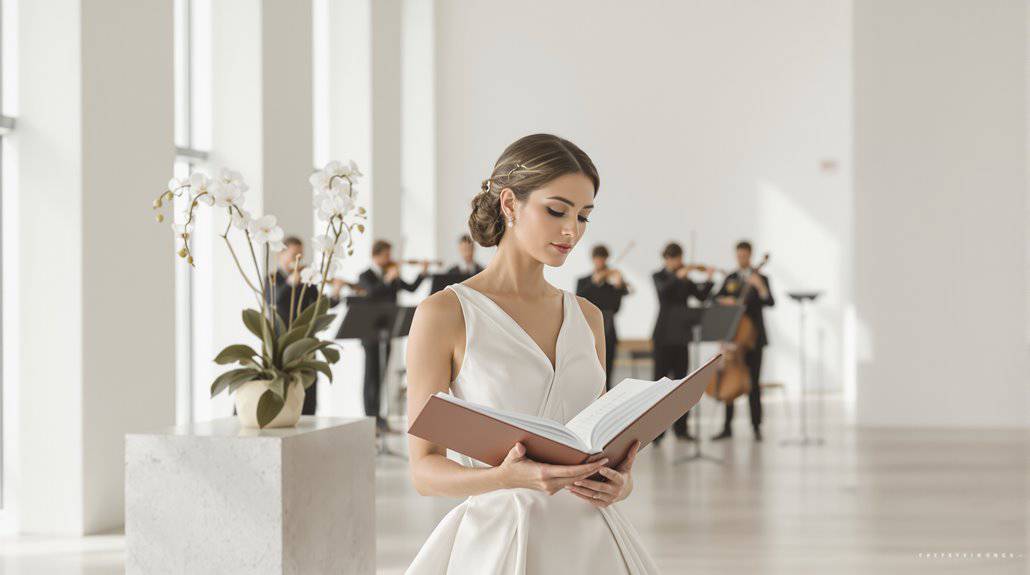
Your ceremony music acts as a neurological primer—an invisible emotional panorama guests experience 30 minutes before vows. Classical strings broadcast formality and elegance; acoustic guitars signal intimacy and authenticity; while recorded playlists reveal your priorities. This musical prologue triggers dopamine releases, connects with memory centers, and establishes a shared emotional communion that shapes your entire ceremony. It’s not background—it’s your first, wordless declaration of who you are as a couple. The instrumentation choices will shape expectations long before you speak.
Music as First Communication
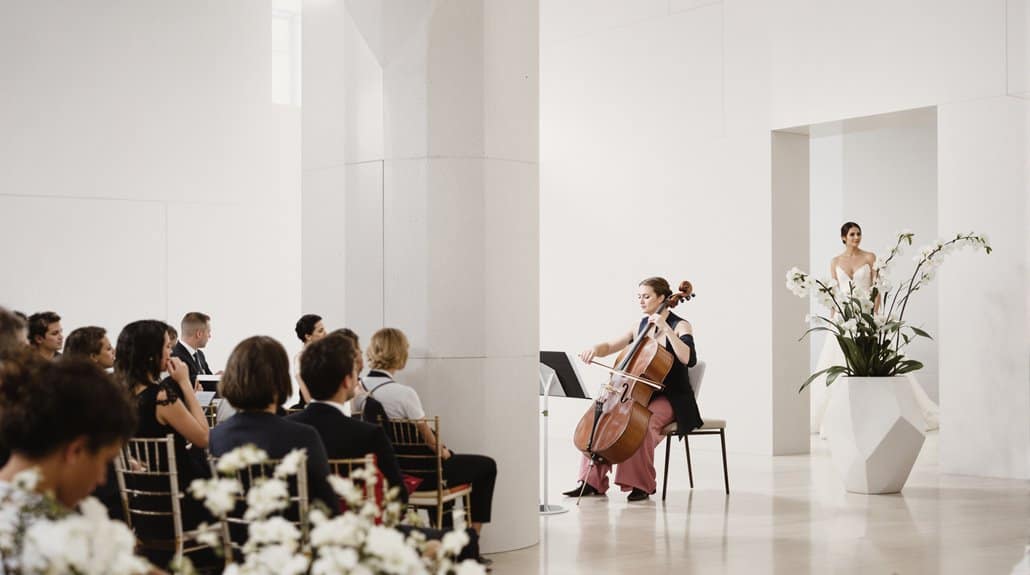
While your guests are still settling into their seats, before a single vow is exchanged, your ceremony music has already begun its critical work—communicating directly with everyone’s neural pathways. That classical string quartet? It’s triggering dopamine releases, priming emotional responses before anyone speaks. Your ceremony music communicates values, traditions, and expectations instantaneously.
The wedding music signals your intentions with extraordinary efficiency—60-80 BPM creates reverence; 120+ BPM promises celebration. That string quartet telegraphs formality; an acoustic guitarist suggests intimacy. A recorded playlist? Budget-conscious practicality. Music sets tone with neurological precision, connecting sound directly to memory centers and emotional regions simultaneously.
Your selection creates an invisible structure, a pre-verbal emotional terrain upon which your vows will later rest. It’s not background—it’s foreground communication, establishing the emotional baseline for everything that follows. Like the physical environment that acts as a silent facilitator of guest interaction, your musical choices shape the ceremonial atmosphere before conscious thought intervenes. Your first communication isn’t spoken; it’s played. Carefully chosen instrumentals or modern string versions of love songs can create emotional significance that resonates deeply with both you and your guests.
What Classical String Quartet Signals
As the first notes from a classical string quartet reverberate through your venue, you’re not just providing entertainment—you’re making a profound declaration about your wedding’s identity. The ceremony music meaning here is unmistakable: tradition, formality, and timeless elegance—a white wedding in its most polished form.
Your wedding music semiotics speak volumes. By selecting these four instruments with their 18th-century heritage, you’re communicating educational refinement, cultural appreciation, and yes, a certain socioeconomic status. But it’s more than showing off—it’s establishing atmosphere.
What ceremony music says through a quartet is paradoxically both bold and subtle: “We value history, precision, and beauty,” while simultaneously whispering, “We care enough to provide live music that adapts to our ceremony’s unpredictable moments.” The visual tableau—four formally dressed musicians with finely crafted instruments—becomes as meaningful as the Haydn or Mozart they’re playing, transforming your ceremony space into something truly transcendent. The quartet’s ability to perform custom arrangements of your favorite songs allows you to blend traditional elegance with personal meaning that reflects your unique love story.
What Acoustic Guitar Signals
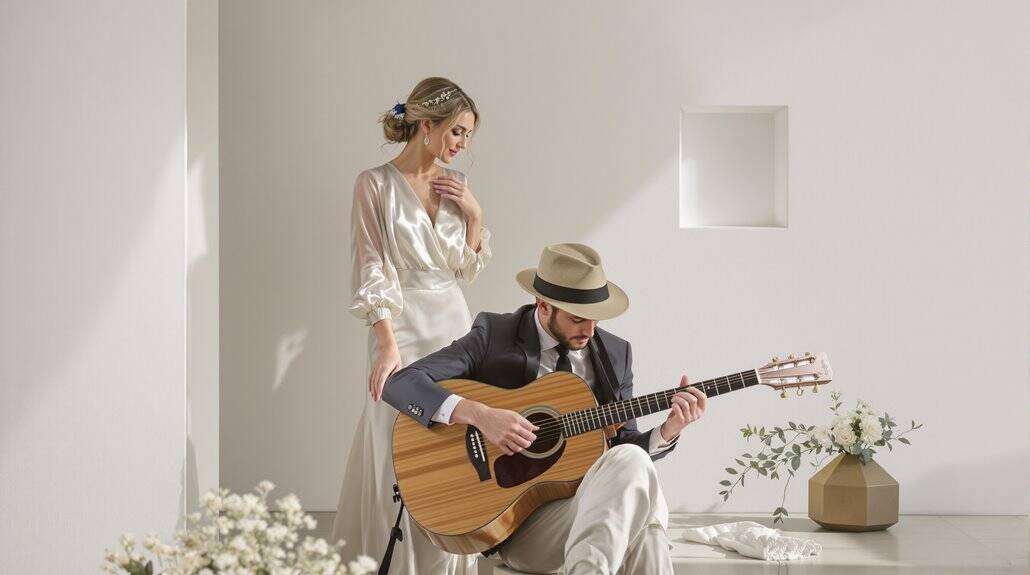
Why does the gentle strum of an acoustic guitar instantly transform your ceremony space into something unmistakably intimate? This seemingly simple ceremony music choice broadcasts volumes about your priorities—emotional depth over flash, connection over pretension. The acoustic guitar’s warm, natural tones signal authenticity in a world of digital shortcuts.
- You’re creating a vulnerable, emotionally transparent space where guests can truly feel rather than merely observe
- You’ve prioritized the ceremony’s emotional resonance over production value—a surprisingly bold choice in today’s Instagram-centered wedding culture
- Your musical selection demonstrates refined restraint, allowing the commitment itself to remain center stage
- You value versatility that adapts to unexpected ceremony moments—the guitarist can effortlessly extend a piece during that ring fumble
The acoustic guitar creates a low-key elegance that’s simultaneously deeply personal and universally welcoming—a rare combination that honors both your unique relationship and your community’s presence. Four Seasons’ dedicated wedding specialists understand how live acoustic performances shape these intimate moments, collaborating with couples to select musicians who align with their unique vision.
What Recorded Playlist Signals
Choosing a recorded playlist for your ceremony music transmits a clear message about your priorities: you’re a couple who leaves nothing to chance. Your music choice wedding decisions reveal a meticulous attention to narrative arc—each song precisely positioned to guide guests through emotional waypoints from anticipation to jubilation. The ceremony music meaning becomes absolutely fixed, unaffected by performer interpretation or venue acoustics.
You’re signaling control, yes, but also accessibility. Your playlist likely spans decades and genres impossible for most live musicians to master. You’ve tested each transition, verified volume levels, and guaranteed Aunt Margaret’s favorite instrumental plays exactly when she’s being seated.
And yet, what you’re really communicating might be deeper: that your relationship values certainty over spontaneity, precision over improvisation. Your budget-conscious approach isn’t merely practical—it’s a statement that your resources are allocated according to personal values, not wedding industry expectations. Much like digital display boards that enable instant updates and dynamic content, recorded playlists offer effortless updates and the flexibility to adjust your musical narrative until the very last moment.
Music and Formality Alignment
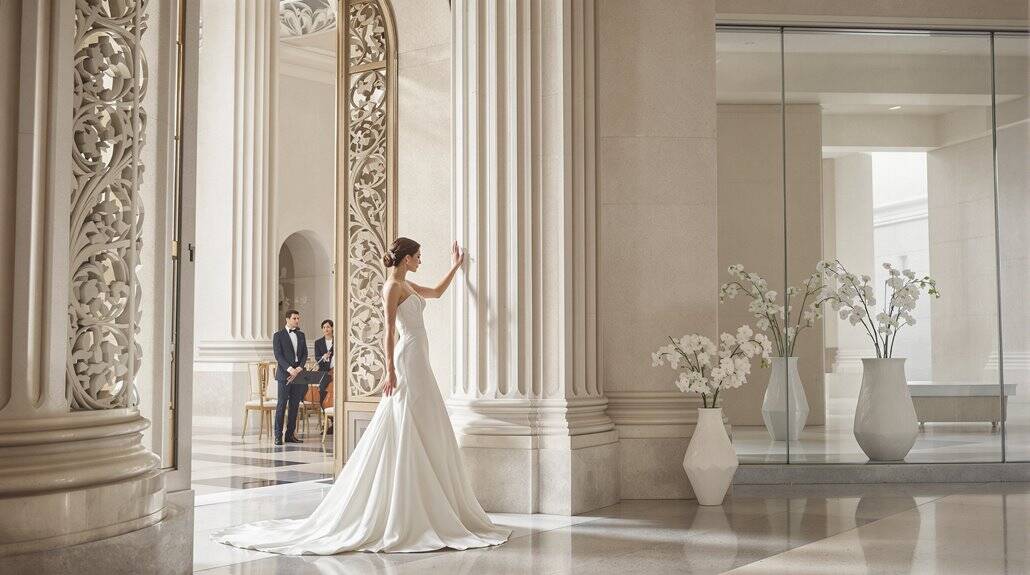
When your violinist draws their bow across strings for the first notes of “Canon in D,” they’re not merely producing music—they’re establishing the entire ceremonial atmosphere. Your ceremony music communicates a precise formality level that guests interpret instantly—a classical string quartet signals traditional reverence, while an acoustic guitarist covering Ed Sheeran suggests contemporary intimacy. This unspoken message frames everything that follows.
Music is the invisible architecture of your ceremony—it builds the emotional space where your vows will live.
What ceremony music says about your priorities reveals itself through:
- Ensemble size—quartets project sophistication for 200+ guests, while soloists create deliberate intimacy
- Selection timing—20-30 minutes of prelude music establishes gravitas before proceedings begin
- Instrument acoustics—amplified strings convey clarity and intentionality versus recorded options
- Repertoire choices—31% of couples choose Pachelbel for processional moments because tradition signals seriousness
Your musical choices establish ceremony weight long before vows—a $1,200 quartet communicates different intentions than a $250 Spotify playlist, and both are valid depending on your priorities. This same attention to formality extends to groomsmen attire, where traditional suiting from established clothiers reinforces the ceremonial tone you’ve set with your musical selections.
Ensuring Audio Doesn’t Contradict Visual
The jarring disconnect between what guests see and what they hear can shatter the ceremonial illusion faster than a dropped wedding ring. Your venue’s acoustics require methodical preparation—not last-minute panic.
Position speakers tactically for balanced sound distribution, ensuring no guest experiences audio dead zones that make your carefully choreographed moments feel amateur. Test microphones obsessively before guests arrive; the officiant’s wireless mic should capture every syllable of your vows without distracting pops or feedback. And yet, redundancy saves ceremonies: always deploy backup systems.
Your music volume should breathe with the ceremony’s rhythm—swelling during processionals, then fading precisely as speaking begins. This energetic control creates the seamless audio-visual harmony that guests perceive as “perfect timing.” When your DJ’s crescendo aligns exactly with your first appearance, or diminishes as you exchange rings, you’re not just playing music—you’re scoring a film where you’re the protagonist. Just as light influences emotional response and atmosphere without being overtly noticeable, your ceremony’s audio design should elevate the moment while remaining imperceptible to your guests.
Music Choice as Tone Setting
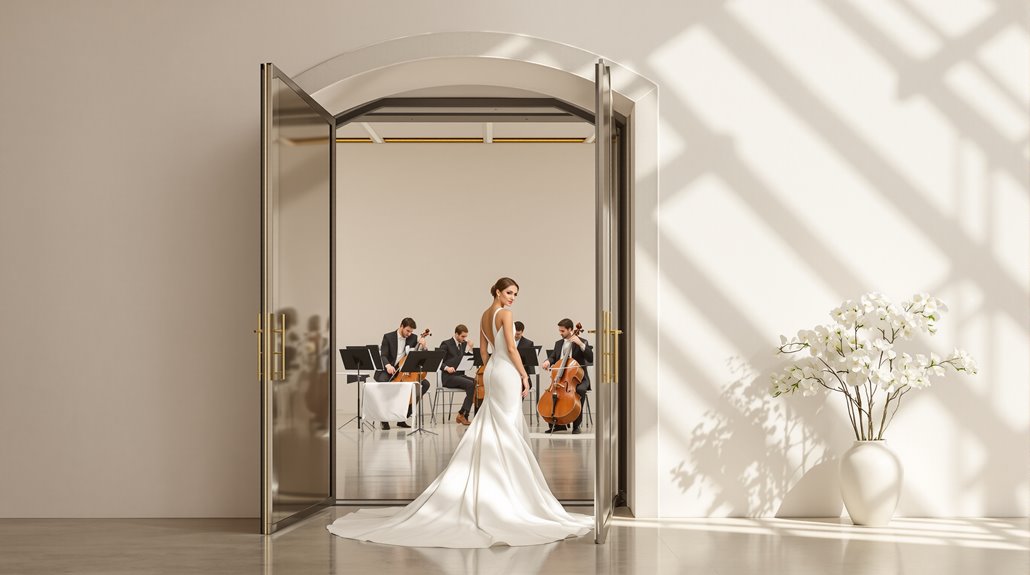
Your musical selections serve as more than auditory decoration—they become the invisible architecture that shapes your ceremony’s emotional terrain. When you choose between a string quartet’s formal resonance or an acoustic guitar’s intimate warmth, you’re telegraphing your ceremony’s emotional compass to guests before a single vow is uttered. The instrumentation itself communicates volumes—a classical quartet signals traditional formality, while recorded playlists suggest budget-conscious practicality.
- Match your musical elements to guest count: solo instruments for intimate gatherings under 50, string quartets for 200+
- Consider your venue’s acoustics—guitars and strings need amplification for ideal sound quality
- Select 4-6 prelude pieces that establish your desired emotional atmosphere during the 20-30 minute seating period
- Verify venue restrictions—religious settings often prohibit certain pieces that secular venues welcome
Your music choices create anticipatory momentum, building emotional readiness for the ceremony’s focal moments. They’re the unspoken prologue to your love story—choose deliberately.
Conclusion
As ceremony music draws your guests into shared emotional communion before a single vow is spoken, its significance transcends mere entertainment. It’s your first declaration of intent—communicating heritage, formality level, and emotional panorama to every witness present. Your processional song choice carries psychological weight, with classical quartets signaling tradition and acoustic guitars whispering intimacy.
Consider this: 80-90% of your reception’s success hinges on entertainment quality, yet the 5-10 minutes of prelude music establishes the emotional foundation everything else builds upon. Those first notes tell guests whether you’re traditional or iconoclastic, solemn or celebratory. But they’re also practical communicators—signaling shifts, covering unexpected moments, and guiding your community through collective experience.
Your ceremony music isn’t just background noise—it’s your first vow, made wordlessly through melody, declaring precisely who you are and what this gathering means. Just as Chanel’s beauty collection expresses elegance through carefully curated elements, your musical selections craft an atmosphere of intentional beauty and meaning. Choose accordingly.