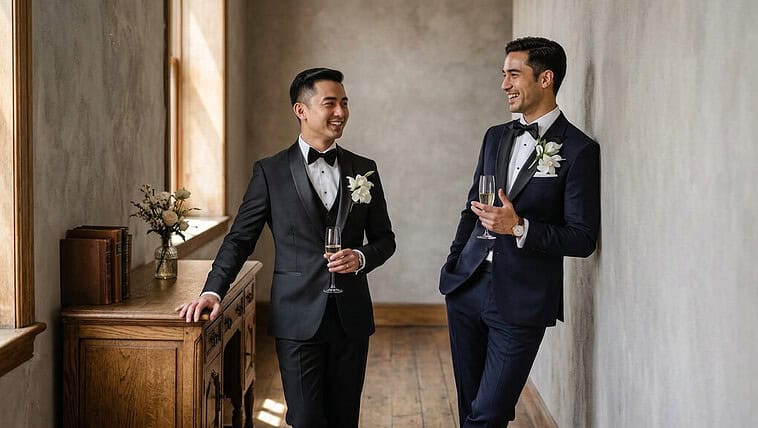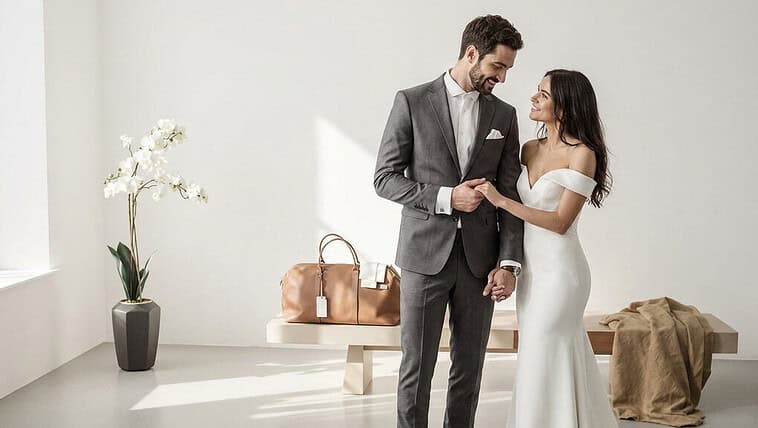

Contrary to popular belief, your wedding suit’s expensive look isn’t about fabric prestige—it’s construction and fit that signal luxury. A perfectly tailored $500 suit can outshine a poorly fitted $2,000 designer piece. Focus on shoulder precision, proper sleeve length, and clean draping. Hand-finished details (functional buttonholes, horn buttons) and classic proportions speak volumes. Color matters too; navy and midnight blue convey timeless sophistication. The suit’s silhouette tells the real story of craftsmanship, not the price tag.
The Fabric Fallacy
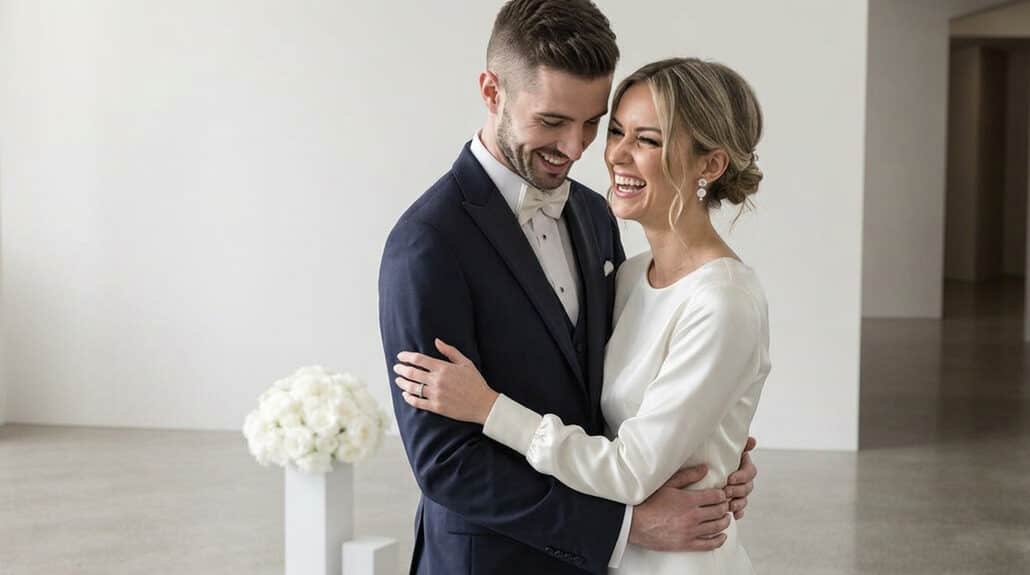
When most men shell out for an “expensive” suit, they’re falling prey to one of the fashion industry’s most persistent myths: that price tag and fabric quality are perfectly correlated with how impressive the final garment looks. They’re wrong—dead wrong.
Your suit’s expensive looking appearance hinges on construction quality, not astronomical Super 180s wool. That $3,000 designer label with sloppy buttonholes? It screams “amateur hour” compared to a $600 made-to-measure with hand-finished details. A suit look luxury comes from precision fit where the collar lays flat against your neck, shoulders don’t pull, and the jacket closes without strain—not from Italian-milled status fabrics. Professional tailoring adds expense but transforms even moderately priced suits into garments that appear significantly more luxurious. The art of elegant restraint is key to achieving that understated sophistication.
The suit quality markers professionals recognize? Functional sleeve buttons, hand-picked stitching, and canvassed construction. These details, not thread counts or brand names, separate refined gentlemen from fashion victims. You’re paying for expertise, not exotic sheep lineage.
Fit Precision as Luxury Signal
Beyond fabrics and labels lies the unassailable truth of tailoring: fit precision forms the bedrock of luxury signaling in menswear. When shoulders lie perfectly flat against your body—no pulling, no bunching—you’re broadcasting refinement that money alone can’t buy. Your wedding suit’s shoulder construction reveals everything about its pedigree; a full canvas allows proper drape while ensuring that snug fit at the neck that screams bespoke craftsmanship. The discerning groom should consider full canvassing over fused construction for superior quality and longevity. Additionally, the psychology of luxury weddings suggests that affluent couples are particularly attuned to the details that signify high value in their attire.
- Sleeve length hitting at precisely the half-inch mark of shirt cuff exposure—functional surgeon’s cuffs optional but devastatingly impressive
- Perfect jacket hem placement at the knuckle when arms hang naturally, accounting for your unique posture variations
- Shoulder positioning that creates a seamless progression from neck to arm without a hint of amateur bunching
You’ll need 8-10 weeks minimum for proper adjustments. And yet, even with this timeline, the final fitting (2-3 weeks pre-wedding) remains non-negotiable—your body shifts, and luxury adapts accordingly.
Detail Finishing That Communicates Quality

Though millions focus obsessively on fabric quality, the true markers of luxury exist in microscopic finishing touches that most never notice—yet experts spot instantly. Your wedding suit’s value isn’t hiding in its price tag but in the hand-stitched details decorating its edges, creating subtle dimpling that machine work simply cannot replicate. Effective tier allocation strategies can also enhance the perceived value of your suit by investing wisely in quality touches.
| Quality Indicator | Budget Suits | Luxury Suits |
|---|---|---|
| Button Selection | Plastic, 4-hole | Horn/Mother-of-pearl, 2-hole |
| Buttonholes | Machine-made, uniform | Hand-stitched, slightly irregular |
| Canvas Construction | Fused (glued) | Half or full canvas (sewn) |
| Interior Finishing | Basic lining | Silk/Bemberg with personalization |
The interior finishing of your jacket—where nobody but you will see—paradoxically communicates the most about its quality. Reinforced stress points, personalized details, and clean binding aren’t vanity; they’re structural integrity manifested through craftsmanship. Button selection might seem trivial, and yet the difference between mass-produced plastic and hand-cut horn represents centuries of tailoring philosophy.
Styling Restraint: Classic vs Trendy
Despite modern fashion’s relentless push toward innovation, the most expensive-looking wedding suits paradoxically embrace restraint. Your well tailored suit communicates luxury not through flashy elements but through disciplined execution of timeless principles. The finest grooms understand that restraint—in color, pattern, and silhouette—creates the backbone of suit quality markers that whisper rather than shout sophistication.
- A navy or charcoal suit with subtle texture variation creates depth without demanding attention—the hallmark of true suit look luxury
- Perfectly proportioned lapels (neither too wide nor too slim) that complement your shoulder width, creating balanced visual harmony
- Minimal pattern play that improves rather than competes with your natural presence—think subtle herringbone versus loud windowpane checks
The contemporary wedding suit may flirt with trendy elements—higher armholes, trimmer silhouettes, unexpected linings—and yet, the truly expensive-looking garment anchors these modern touches within classic structure. Your wedding photos deserve this timelessness.
Color and Pattern Sophistication
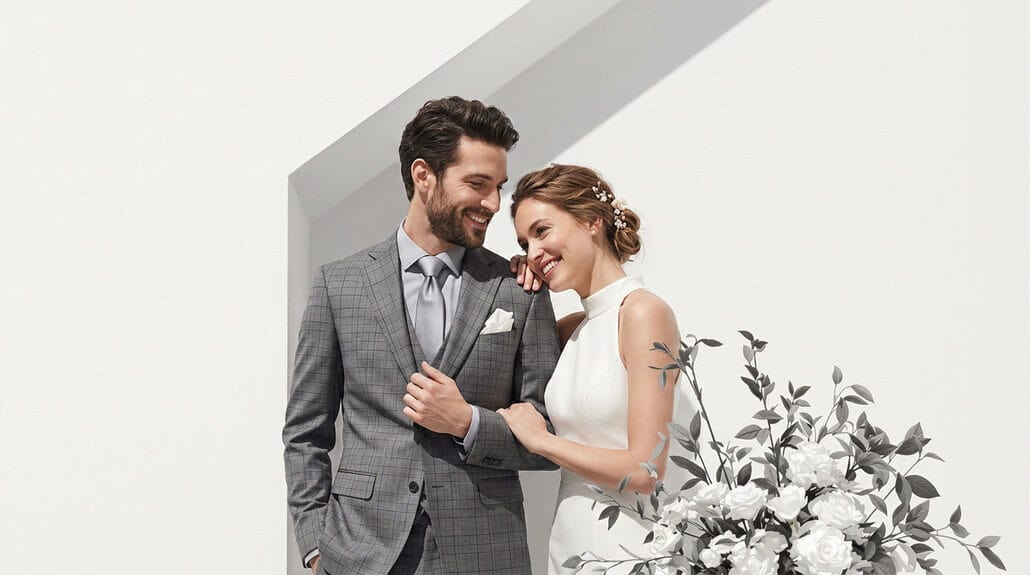
While your wedding suit’s fit serves as its foundation, color and pattern choices provide its soul—transforming even modestly-priced garments into statements of refined taste. Navy blue remains the undefeated champion of versatility, but midnight blue projects even greater formality under artificial light—a polished suit quality marker most guests won’t identify but will certainly register.
Pattern application demands precision: subtle checks or pinstripes add dimension without screaming for attention. You’ll appear thoughtful rather than trendy. Consider season with religious devotion—spring demands lighter grays and tans that reflect heat, while fall welcomes burgundy and emerald green’s richness. And yes, combinations matter profoundly. Navy with champagne gold accents creates royal opulence; dusty blue paired with rose gold balances cool elegance with warmth. These expensive suit details—barely perceptible color harmonies and restrained pattern play—telegraph wealth more effectively than any flashy designer label ever could.
How to Achieve Look at Different Budgets
The elegance of color and pattern only tells half the story—your wallet tells the other. You can achieve suit look luxury at virtually any price point when you understand the tactical hierarchy of quality markers. A $300 suit with $100 in precise alterations will outshine a $1,000 off-the-rack disaster every time, and yet the details make all the difference.
- $200-400 Range: Focus on proper fit above all—sleeve length showing ¼ inch of shirt cuff, trouser break kissing the shoe—then upgrade buttons from plastic to horn ($15) for an immediate elegant suit style upgrade.
- $400-700 Range: Seek half-canvassed construction, functional surgeon’s cuffs, and pattern matching at seams—telltale suit quality markers worth the modest premium.
- $700+ Range: Invest in full canvas construction only if wearing 12+ times annually; otherwise, allocate budget toward superior accessories and tailoring.
Off-Rack Suits That Look Expensive

Finding premium-caliber suits among off-rack selections requires maneuvering a terrain where perception and reality converge in surprising ways. The $400-700 range represents your sweet spot for an expensive looking suit without the four-figure investment. What separates luxury from ordinary isn’t the label, but construction fundamentals that create that unmistakable quality suit appearance.
| Construction Element | Budget ($200-300) | Mid-Tier ($400-500) | Premium ($700+) |
|---|---|---|---|
| Canvassing | Fused/Glued | Half-Canvas | Full Canvas |
| Material | Synthetic Blends | 100% Italian Merino | Super 120s+ |
| Buttonholes | Decorative | Functional | Hand-Finished |
| Internal Structure | Minimal | Multi-Layered | Horsehair |
You’re looking for Italian merino wool with half or full canvas construction—these create the drape that signals suit look luxury. The revelation? Many $500 suits can present identically to $2,000 designer pieces when properly altered, delivering perception-shifting value through tactical investment in construction rather than labels.
What Actually Matters vs What Costs
Understanding what genuinely matters versus what simply costs more reveals the counterintuitive truth about expensive-looking suits: perception rarely aligns with price tags. You’re paying thousands extra for Italian fabric that’s visually indistinguishable from alternatives costing 60% less—and yet, suit quality markers consistently revolve around fit precision rather than material origin.
Your expensive looking suit isn’t defined by the fabric’s price but by how it frames your body. Construction methodology dramatically impacts cost—bespoke handwork commands premium pricing—but it’s the resulting silhouette that signals luxury, not the invisible labor hours.
- Functional buttonholes and hand-picked stitching add hundreds to manufacturing costs while contributing minimally to visual perception
- Made-to-measure suits eliminate alterations that plague off-the-rack options, creating a suit look luxury effect through proper shoulder alignment
- Brand prestige inflates pricing 30-40% without corresponding quality improvements—the collar sitting properly matters infinitely more
Conclusion
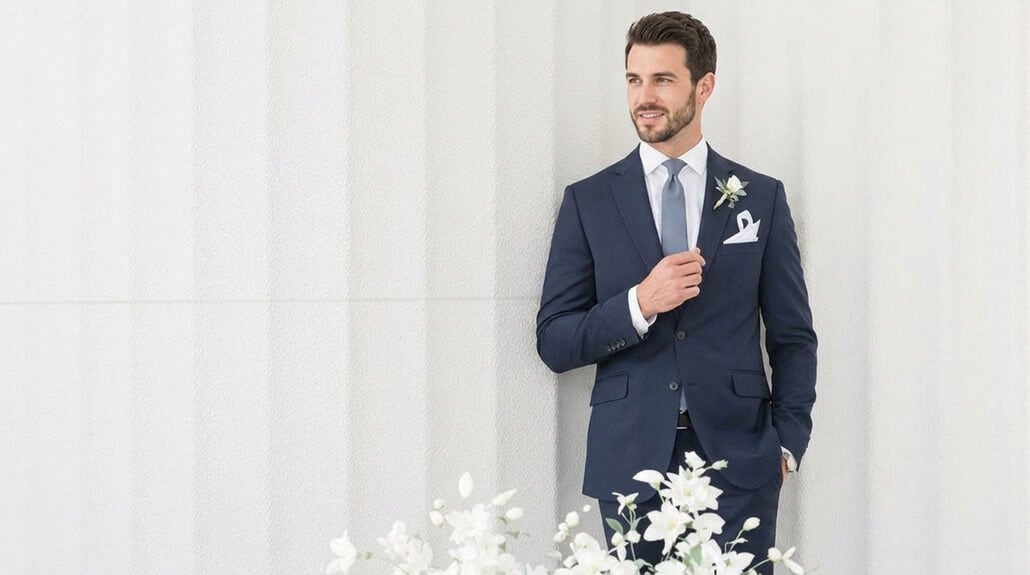
Looking expensive rarely means spending excessively—a truth that liberates grooms everywhere from unnecessary wedding suit expenditures. The secret isn’t throwing money at designer labels but investing thoughtfully in what makes objective visual impact.
Your wedding suit’s perceived value hinges on precision fit—where shoulders lie perfectly flat, jacket closes without strain, and trouser breaks hit exactly once above the shoe. Notice how $3,000 suits often showcase working buttonholes and hand-finished lapels? These details telegraph craftsmanship to discerning eyes. And yet, a $700 suit with $150 in deliberate tailoring often outshines an untailored $2,000 alternative.
Remember: restraint communicates sophistication. Skip trendy excesses—super-skinny cuts, contrast stitching, unnecessary pocket flourishes—that scream “fashion victim” rather than “refined taste.” The most expensive-looking wedding suits paradoxically avoid drawing attention to their expense, relying instead on impeccable execution of timeless proportions.