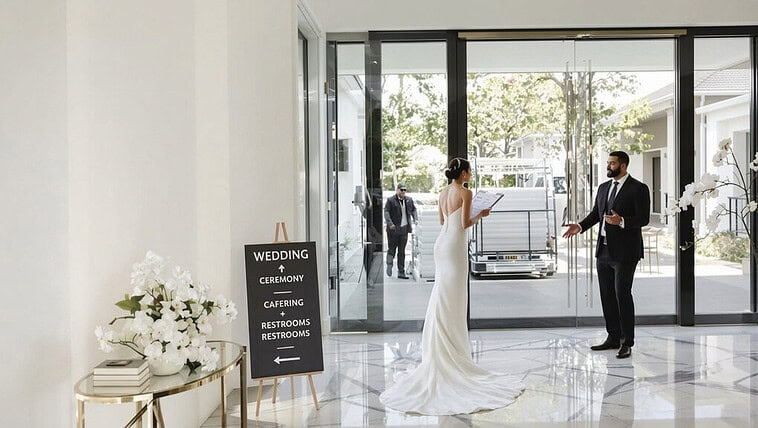

While family properties seem free, they’ll likely cost you $12,000+ for tents, bathrooms, generators, and furniture—infrastructure already included in estate rentals ($8,000-$15,000). You’re paying for convenience too; estates handle operations while backyard venues demand your time managing vendors, permits, and weather contingencies. The “zero-dollar” venue paradoxically becomes the pricier option when you factor in hidden costs, liability insurance, and operational complexity. The numbers tell a different story than your initial assumptions.
The Free Venue Assumption

While hosting your wedding at your parents’ sprawling property seems like the supreme budget hack—zero dollars for the venue itself!—this widespread assumption crumbles under mathematical scrutiny. The estate rental vs backyard wedding calculation demands forensic accounting beyond the visible ledger.
Your “free” family property transforms into a blank canvas requiring everything to be imported. That $12,000 for tent, bathroom trailers, furniture, and generators? Just the beginning. You’ll need infrastructure that established venues already possess—and you’re building it from scratch, at retail prices, for one-time use. Additionally, understanding spending optimization can help you make more informed decisions about allocating your budget effectively.
Your “free” venue is actually a construction site where you pay retail for temporary infrastructure that established venues include.
Private property versus rental venues represents a classic case of visible versus hidden costs. Home vs venue wedding cost analysis reveals the inconvenient truth: renting an intimate estate ($8,000-$15,000) often equals—sometimes undercuts—your backyard budget when all infrastructure requirements are tallied. Much like choosing between single-family and multi-family investments, the initial higher appreciation potential of using a family property is often offset by unexpected expenses.
The zero-dollar venue becomes, paradoxically, the most expensive option you could choose.
Estate Rental Costs: What’s Included
Estate rentals demand closer examination once you’ve shattered the “free venue” illusion. The typical luxury estate rental commands $8,000-$15,000 for a weekend—staggering, yes, but this figure warrants unpacking. Your investment secures infrastructure that backyard venues require as separate line items: professional-grade kitchen facilities, manicured grounds, elegant bathrooms, backup generators. Many luxury estates also include high-value amenities like private pools and dedicated parking that would otherwise be charged separately in other venues. In essence, this approach reflects the quality over quantity philosophy that guides discerning clients towards sophisticated experiences.
| Feature | Estate Rental | Family Property |
|---|---|---|
| Base Cost | $8,000-$15,000 | $0 (seemingly) |
| Infrastructure | Included | $12,000+ add-on |
| Staffing | Often included | DIY or additional |
The estate amenities justify their premium through all-encompassing rental price breakdown. You’re purchasing readiness, not merely space. Family properties require retrofitting—temporary bathrooms, weather contingency solutions, catering facilities—accumulating a $12,000+ rental tab before you’ve ordered a single centerpiece. The “free” venue suddenly demands substantial investment, while estates offer turnkey elegance with predictable pricing.
Family Property Costs: Infrastructure Build-Out
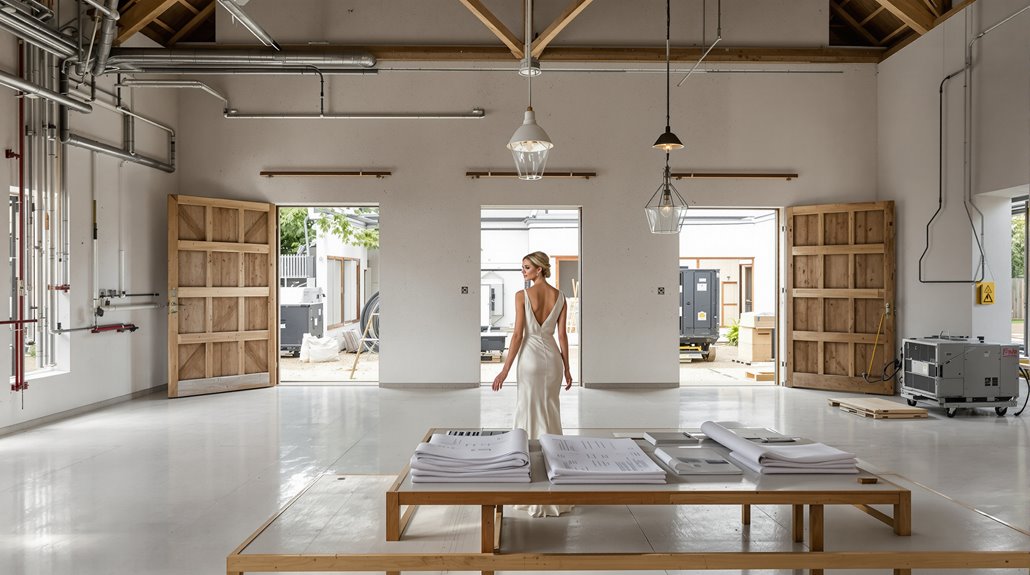
That mythical “free” family property transforms into a financial quicksand once infrastructure requirements surface. Your dream compound demands foundation work (averaging $9,260 and comprising 10.1% of construction costs), plus framing and roofing that swallow another 15.5% of your budget at nearly $30,000. And we haven’t even addressed utilities.
Plumbing connections ($18,260), electrical systems ($8,000), and heating installation ($7,000) form just the baseline for individual structures. The shared infrastructure—what truly makes a compound functional—requires private roads, septic systems, and power distribution networks that dwarf single-home requirements. Basic family compounds start at $500,000; complex ones with custom homes and workshops easily reach $2-5 million.
You’ll face soft costs too: architectural fees (5-10% of construction costs), phasing expenses (adding 25-50% to permitting), and those maddening regulatory fees—from $2,500 survey reviews to water tap connections exceeding $90,000. The psychology of luxury weddings may also influence decisions on how much to invest in these properties, as affluent couples often prioritize quality and perceived value in their spending.
Side-by-Side Cost Comparison
Beyond theoretical infrastructure costs lies the concrete financial reality: what you’ll pay for different venue options. Estate rental packages typically range from $8,000-$15,000—a princely sum, and yet these all-inclusive packages bundle what you’d otherwise piece together piecemeal. Your check covers infrastructure, staffing, and often basic décor elements.
Compare this with backyard wedding costs: zero dollars for the “venue,” right? But that misleading zero transforms into roughly $12,000 when you factor in tent rental, portable bathrooms, furniture, generators, and other necessities. The backyard option appears cheaper initially—and it can be—but hidden costs lurk in every corner.
The estate rental versus backyard calculation shifts dramatically when you consider capital requirements. That $15,000 venue fee feels steep until you realize DIY venues demand nearly equivalent infrastructure investment, without the professional support. You’re essentially building a temporary venue from scratch.
When Rental Is Actually Cheaper

While many assume property ownership automatically beats renting, surprising financial inversions occur when you crunch actual numbers rather than relying on conventional wisdom. The home vs venue wedding cost debate reveals counterintuitive truths—that “free” backyard weddings often cost more than estate rentals when accounting for infrastructure needs.
Consider these hidden expenses when comparing rent venue vs use home options:
- Infrastructure requirements – Backyard events demand $12,000+ for tents, portable bathrooms, furniture, and generators
- Liability considerations – Home insurance rarely covers large gatherings, requiring expensive supplemental policies
- Operational complexity – Self-managed events require your time and attention during moments you’d rather be celebrating
The estate rental vs backyard wedding calculation shifts dramatically when you factor these elements. You’re not just paying for beauty but operational simplicity. Estate venues handle these logistics invisibly, and sometimes—paradoxically—more affordably than DIY approaches.
When Family Property Makes Financial Sense
Despite the surprising cost advantages of estate rentals, family properties offer genuine financial wins under specific circumstances. That backyard wedding at your parents’ sprawling property? It’s not just sentimental—it’s potentially brilliant economics.
Let’s crunch numbers: while estate rentals cost $8,000-$15,000 with infrastructure included, family property costs $0 for the venue itself. Yes, you’ll still shell out approximately $12,000 for essentials—tent, bathroom facilities, furniture rentals, generators—but you’re eliminating hefty venue fees while maintaining complete control over vendors, timeline, and alcohol costs.
The family property vs venue rental calculation makes most sense when:
- The property requires minimal landscaping upgrades
- You’re planning multiple events (rehearsal dinner plus ceremony)
- Your guest count remains moderate
And yet, this equation shifts dramatically with weather uncertainties or restrictive HOA regulations. Estate rental vs backyard wedding comparisons demand brutal honesty about hidden costs and contingencies.
The Operational Ease Factor

In terms of day-to-day management, the distinction between estate rentals and family properties couldn’t be more stark—it’s the difference between hiring a conductor versus becoming the entire orchestra yourself. When analyzing wedding venue cost analysis, remember that the $8,000-$15,000 estate rental includes operational infrastructure you’ll never see but absolutely need.
Your backyard wedding demands you become the property manager handling:
- Communication coordination with every vendor, rental company, and family member involved
- Maintenance oversight before, during, and after—from lawn prep to post-event cleanup
- Administrative management of contracts, permits, and scheduling details
The home vs venue wedding cost equation isn’t just financial—it’s operational. Estate rentals centralize these responsibilities under professionals, while family properties distribute them directly to you. And yet, this operational burden creates intimacy; your hands shape every detail, every moment—exhausting, yes, but potentially transcendent.
Conclusion
The financial architecture separating estate rentals from family properties reveals itself through stark numerical truth: $8,000-$15,000 for the turnkey elegance of an estate versus the seemingly “free” family property that quietly accumulates $12,000 in rental infrastructure costs.
You’re faced with a deceptive dichotomy in the rent venue vs use home debate. The estate rental delivers immediate cost transparency—a single check covering all-encompassing amenities. Your backyard alternative? It’s a fragmented expense maze requiring generator coordination, bathroom trailer sourcing, and furniture procurement—each with its own contract, deposit, and delivery schedule.
When weighing home vs venue wedding cost, consider this: while multifamily investments benefit from 3-5% maintenance costs through economies of scale, your one-time backyard transformation cannot. You’ll shoulder full financial responsibility for every rental item without the cushion of distributed expenses. The estate rental vs backyard wedding question isn’t merely financial—it’s about the value of simplified logistics.