
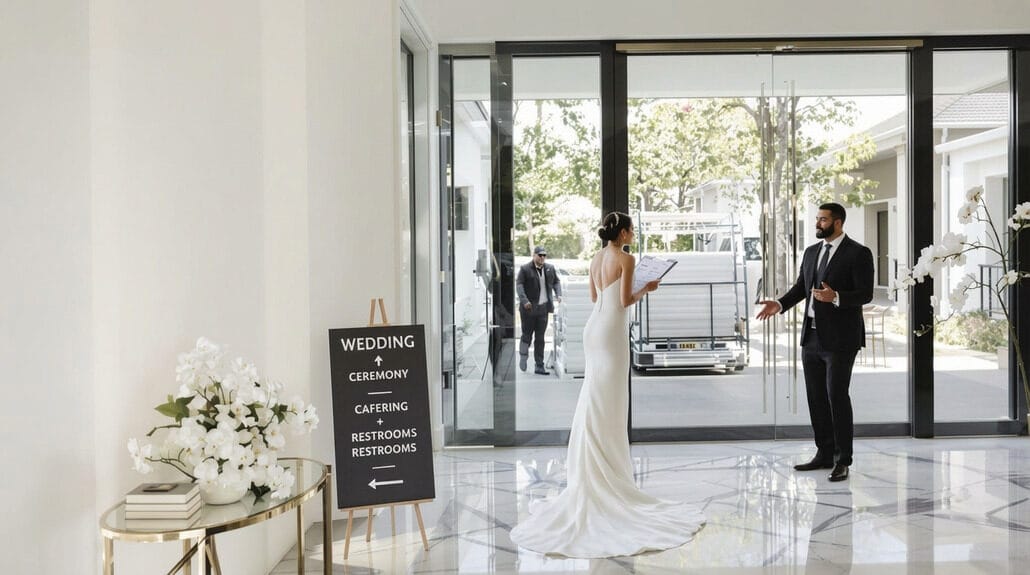
Private residence weddings aren’t the budget-savers you might expect. You’ll face hidden costs: bathroom trailers ($750-$1,200), liability insurance ($1M+ coverage), generators ($500-$2,500), and tent rentals ($2,000-$10,000). Factor in permits for alcohol, noise, and assembly—plus parking logistics for 25+ cars. Your “free venue” often exceeds 30% of professional venue packages, without the built-in infrastructure. The emotional value is irrefutable, but the logistical reality demands a clear-eyed assessment of the true financial commitment.
The Free Venue Isn’t Free
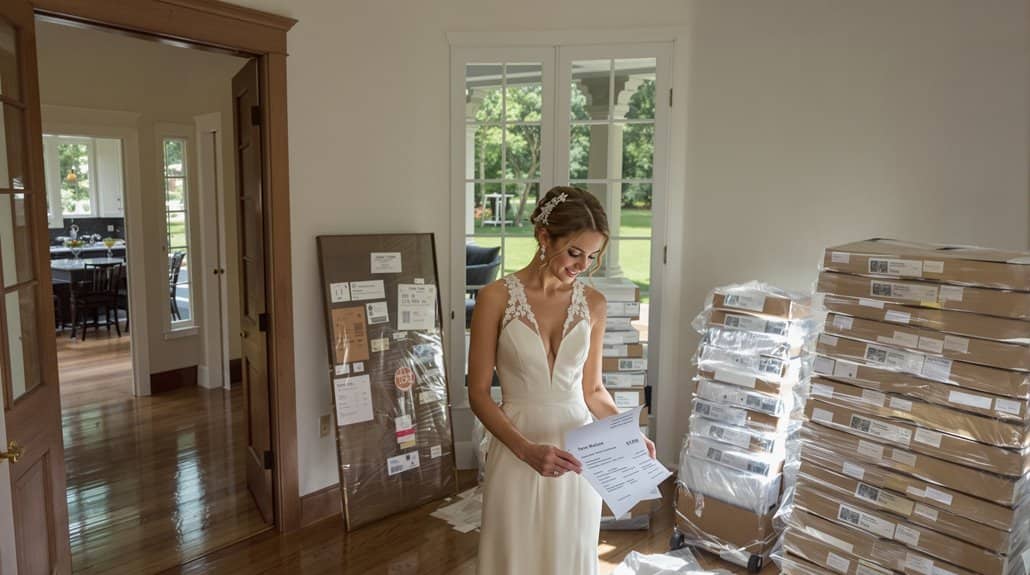
When your parents offer their sprawling backyard for your wedding day, the immediate financial relief feels like winning the venue lottery—and yet, that “free” space comes with a startling price tag hiding in plain sight.
The infrastructure costs alone will ambush your budget. Bathroom rentals ($750-$1,200 for luxury trailers), liability insurance ($500-$1,000), and parking management ($25-$40 per hour per attendant) transform your complimentary venue into a financial commitment rivaling commercial spaces. All-in-one properties combine ceremony spaces and guest accommodations, often providing better value than piecing together separate rentals for a home wedding. Additionally, many affluent couples prioritize decision-making quality when evaluating their wedding investments, impacting their overall spending.
Home wedding logistics demand precise planning—and capital. You’ll need permits for noise, alcohol service, and possibly zoning variances. Weather contingencies? Add another $2,000-$4,000 for tenting. Professional-grade power generators, catering equipment, and post-event landscaping restoration costs accumulate with brutal efficiency.
Zoning permits, generators, and tent rentals—the invisible infrastructure tax paid when trading venue fees for backyard bliss.
The backyard might be given freely, but the transformation into a wedding venue requires professional infrastructure that your favorite commercial spaces already have built in—and that you’ll pay for either way.
Infrastructure Requirements Checklist
Before considering your parents’ idyllic property for wedding vows, you’ll need a thorough understanding of what transforms residential space into event-ready infrastructure—and yet, most couples drastically underestimate these foundational elements until vendor contracts arrive.
Your backyard wedding logistics demand strategic foresight: generators (not household circuits) must power everything simultaneously—DJs, caterers, lighting systems—while one restroom trailer per 50 guests requires water access and discrete positioning. Tent installation isn’t simply unfolding canvas; it’s mapping underground utilities, securing proper anchoring systems, and installing flooring to compensate for uneven terrain. Understanding effective tier allocation strategies can help optimize your budget for these infrastructure needs.
The private residence wedding demands pathway lighting for safety, HVAC systems for guest comfort, and dedicated dance floors to prevent hazardous glass-on-grass scenarios. Yes, your childhood home feels deeply personal for exchanging vows, but transforming it requires industrial-grade infrastructure that matches commercial venues—except you’re assembling it from scratch rather than walking into turnkey solutions. Securing one-day event insurance is essential to protect against potential liability issues that may arise during your celebration at a private residence.
Bathroom Capacity Mathematics: 1 per 35 Guests

Unlike the seamless ceremony you’ve envisioned, bathroom logistics at your backyard wedding demand mathematical precision—and yet, most couples discover this reality only after guests begin crossing their legs uncomfortably.
Your private residence wedding requires one restroom per 35 guests as a baseline—but this ratio shifts dramatically based on real-world variables. Serving alcohol? Tighten that ratio to one per 25 guests, as cocktails increase bathroom traffic by nearly 30%. Planning beyond four hours? Add 15% capacity for each additional two-hour block. And while you’re calculating, remember your aunt’s bladder issues, your college friends’ drinking habits, and your father-in-law’s diabetes—all demographic factors that stretch standard formulas.
Backyard wedding logistics aren’t merely about total numbers but timing; post-dinner creates bathroom bottlenecks that can undermine your fastidious planned residence wedding infrastructure. The mathematics matter because dignity does. Understanding these emerging luxury trends can help you elevate your event planning strategies to avoid common pitfalls.
Parking Management and Neighbor Relations
Your bathroom mathematics might be airtight, but cars—unlike bladders—can’t simply wait their turn. For a private residence wedding, vehicle logistics represent perhaps the most visible intrusion into your community’s equilibrium. Twenty-five guests means at least twelve vehicles; fifty guests, twenty-five—sprawling beyond your property lines, encroaching on neighbors’ sightlines and access.
Street parking regulations in residential areas often prohibit extended clustering of non-resident vehicles. And yet, solutions exist: shuttle services from designated lots ($350-500 for a 15-passenger van), valet services ($35-45 per hour per attendant), or neighbor parking agreements (typically requiring compensation of $20-50 per space).
But logistics pale compared to relationship management. Your backyard wedding celebrations echo beyond property lines—conversations carrying across fences, music vibrating through shared walls. Professional notification isn’t merely courteous; it’s time defense against noise complaints. Consider creating neighbor packages with timeline details, contact information, and perhaps a bottle of wine—preemptive diplomacy for your matrimonial incursion.
Permit Requirements: Alcohol Noise Assembly

While most couples focus on centerpieces and vows, permit requirements lurk beneath every private residence wedding like foundation cracks—invisible until they threaten the entire structure. Your backyard wedding logistics require understanding of legal terrain.
| Permit Type | When Required | Typical Timeline |
|---|---|---|
| Alcohol License | When selling drinks or charging entry fees | 30-45 days prior |
| Noise Permit | Events with amplified sound past local quiet hours | 14-21 days prior |
| Assembly Permit | Gatherings exceeding local attendance thresholds | 30 days prior |
You’re fortunate regarding alcohol license exemptions—private residence weddings where you’re providing drinks free of charge generally don’t require liquor permits. But beware—the moment you charge admission fees or accept “suggested donations” for drinks, you’ve crossed into commercial territory requiring proper licensing. And while your parents’ backyard costs nothing, your responsibility for ensuring legal compliance remains priceless—and entirely yours.
Liability Insurance Essentials
Why do seemingly small gatherings require insurance policies typically associated with commercial events? Because your private residence wedding exists in a legal reality where good intentions offer zero protection against catastrophe. Your standard homeowner’s policy—that document you barely skimmed—contains gaping exclusions precisely for events like yours.
The hard truth: you need dedicated liability insurance with at least $1,000,000 in coverage limits. Your homeowner’s policy caps at $500,000 and won’t extend to accidents occurring at someone else’s residence. And yet, this isn’t merely paperwork—it’s financial armor against the $50,000+ medical bills when Aunt Marge slips on spilled champagne.
Beyond the standard policy, you’ll need specific endorsements: adding the property owner as additional insured, securing primary and non-contributory status, and obtaining a waiver of subrogation. Wedding bliss demands bureaucratic precision—because paradise quickly becomes purgatory when an uninsured guest injury decimates your savings.
Realistic Cost Totaling

The fantasy of hosting a “free” wedding at home crumbles instantly upon confrontation with actual numbers. Your backyard wedding logistics demand infrastructure investments that rival traditional venues—yet without their built-in amenities.
| Item | Typical Cost Range |
|---|---|
| Restroom Trailers | $1,500-$4,000 |
| Tent/Weather Contingency | $2,000-$10,000 |
| Generator/Power Solutions | $500-$2,500 |
| Liability Insurance | $300-$1,000 |
Private residence weddings require creating venue infrastructure from scratch. You’ll need temporary flooring ($1,500+), parking coordination ($500+), and kitchen staging areas for caterers. And that’s before considering the emotional cost of transforming your parents’ sanctuary into a construction zone for weeks.
Home wedding realities include municipal permits, noise ordinance compliance, and neighbor compensation—costs invisible until you’re neck-deep in planning. The true price? Often 30% more than comparable venue packages, and yet, the sentimental value remains immeasurable.
When Home Weddings Make Sense
Consider, too, the intimacy factor. Private property weddings create unrivaled personal connections—your childhood home becomes the backdrop for your next chapter, a symbolic continuity impossible to replicate elsewhere. Your closest fifteen friends sharing champagne where you built forts as a child? Priceless.
And yet, the most persuasive reason might be control. You’ll face no venue curfews, no mandatory vendor lists, no rushed setup windows. Your timeline, your rules. But this freedom demands someone—not you—to coordinate the labyrinth of details that venues typically manage behind the scenes.
Conclusion
While private residence weddings offer unmatched personal significance, they demand brutal honesty about the logistical mountain you’re choosing to climb. Your parents’ backyard might be free, but the infrastructure isn’t: bathroom rentals, parking management, neighbor notification, alcohol permits, liability insurance.
A backyard wedding’s requirements extend far beyond aesthetic considerations. You’ll need to evaluate electrical capacity—can your childhood home handle catering equipment, DJ systems, and lighting without blowing circuits? And yet, these technical hurdles often pale compared to municipal regulations governing residential gatherings.
The most successful private residence weddings acknowledge these constraints upfront. Calculate your true budget with ruthless precision, factoring in every rental item a commercial venue includes but your home lacks. The backyard wedding logistics become manageable only when you’ve abandoned romantic notions about simplicity and embraced the complexity. Your reward? A celebration genuinely yours—hard-earned, complicated, and worth every headache.