
Industrial venues work when you’ve got genuine design confidence and operational tolerance—not just Instagram aspirations. You’ll need $20-$60 per square foot for conversion costs, creative risk comfort, and appreciation for imperfection beyond mere aesthetic interest. Traditional venues better serve guest lists exceeding 150, offer operational certainty, and eliminate coordination stress. That Pinterest perfection? It’s professional photography magic, not reality. Your honest self-assessment about technological capabilities and raw-space comfort determines whether industrial charm becomes celebration or regret.
The Industrial Romance vs Reality

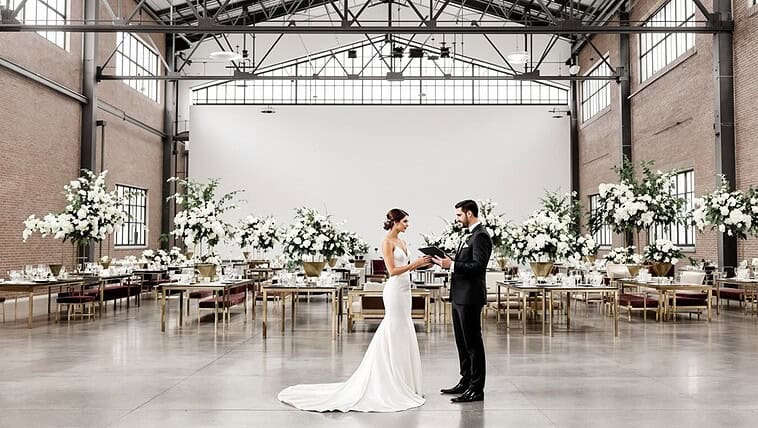
While industrial venues seduce with their raw authenticity and photogenic character, they demand a clear-eyed assessment of what you’re truly signing up for. Those exposed brick walls and weathered steel beams create a distinctive warehouse wedding style that requires minimal decoration—and yet, you’ll likely rent everything from chairs to lighting fixtures, transforming that “budget-friendly” space into an unexpectedly expensive proposition. Embracing quiet luxury in your design choices can enhance the overall ambiance without overwhelming the space.
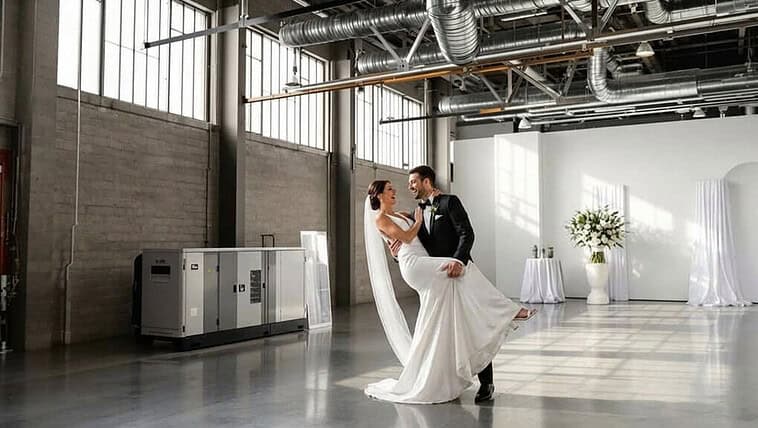
The industrial venue personality speaks to couples comfortable with aesthetic risk: design-confident, operationally savvy, unafraid of raw space suitability questions. You’re drawn to the romance of history etched into concrete floors and the unfiltered urban energy—but this charm demands trade-offs. The architectural character providing those stunning photo backdrops also means steering through limited outlet access, and potentially challenging acoustics. These venues often boast rich histories as former factories or warehouses that become fascinating conversation pieces for guests.
Remember: the most successful industrial celebrations embrace the venue’s inherent qualities rather than fighting them. The space works brilliantly when your vision aligns with what it naturally offers, not what you wish it could become.
Couple Profiles: Who Industrial Venues Suit
Beyond the surface appeal of exposed brick and steel beams lies a fundamental truth about industrial venues: they suit specific personality types rather than universal tastes. Your industrial venue personality must align with the fundamental tensions these spaces embody—raw yet curated, imposing yet intimate.
When considering choosing industrial space, know yourself first. These venues demand couples who are:
- Design-confident — You trust your aesthetic vision to transform concrete floors and metal trusses into something personally meaningful. Couples often find that effective tier allocation strategies can help them maximize their budgets while enhancing the overall aesthetic of their industrial wedding.
- Operationally tolerant — You’re comfortable with venues that may lack creature comforts of traditional spaces.
- Risk-embracing — You see beauty in imperfection and appreciate statements over safety.
The industrial venue fit reflects your relationship philosophy—finding beauty in honest imperfection rather than manufactured polish. And yet, it’s not for everyone. Your guests’ experience hinges on your ability to balance industrial edge with hospitality warmth. Industrial venues have surged in popularity alongside eco-friendly weddings, with many couples incorporating sustainable decor as part of their raw-space aesthetic.
Design Confidence Required for Blank Canvas

Unlike polished venues that offer pre-packaged aesthetics, industrial spaces demand genuine design confidence—you can’t simply show up and expect the space to do the heavy lifting. When considering if an industrial venue is right for you, recognize that these raw canvases require vision, decisiveness, and the ability to transform concrete potential into tangible beauty.
The warehouse vs traditional venue debate often hinges on this exact point: your comfort level with creative risk. Industrial venue personality emerges through your design choices, not from existing architectural flourishes that traditional spaces provide. You’ll need to make 15-20 significant design decisions—from lighting placement to furniture groupings—that polished venues have already resolved for you.
Your success depends on either having this design confidence yourself, hiring professionals who do, or embracing the stark, unadorned nature of the space. Furthermore, understanding the psychology of luxury weddings can help you navigate how affluent couples value their investment in a unique venue. And yet, this very challenge creates the potential for something unrepeatable, something unmistakably yours.
Operational Tolerance Assessment
Planning your industrial wedding demands an honest assessment of your operational tolerance—the nitty-gritty logistical challenges you’ll manage that traditional venues handle invisibly. You’re not just selecting a space; you’re adopting its quirks, limitations, and regulatory realities. And yet, with proper dependency mapping, these challenges become surmountable.
Your critical services require specific impact thresholds. Define them carefully:
- Maximum downtime tolerance – Can you handle 6+ hours without climate control if systems fail during your July reception?
- Dependency requirements – What third-party vendors (caterers, sound engineers) can navigate unfinished spaces?
- Monitoring capabilities – Who’ll track emerging issues throughout your event timeline?
Scenario testing isn’t theoretical—it’s essential. Walk through your venue at the exact hour of your ceremony, noting sunlight patterns, ambient noise, and traffic flow. Traditional venues handle these variables effortlessly; in industrial spaces, they become your responsibility. The payoff? A celebration uniquely, unmistakably yours.
Budget Minimum for Industrial Success

While the raw aesthetic appeal of industrial venues might seduce you with visions of Instagram-worthy celebrations, transforming these spaces into functional wedding venues demands a sobering financial commitment.
You’re looking at a minimum $20-$60 per square foot baseline for standard warehouse conversion—and that’s before you’ve addressed climate control, restrooms, or safety upgrades. For a modest 50,000-square-foot space, you’ll need $2.5-$5 million in total investment capital. Non-negotiable components include $5-$7 per square foot for proper concrete foundation work, $1-$4 for fire suppression, and another $3-$4 for lighting systems that won’t leave your guests squinting through industrial gloom.
The hard costs will consume 70% of your budget, but don’t overlook the 15% in soft costs—permits alone can derail your timeline. And yet, when executed with precision, these investments translate to distinctive experiences commanding premium rental rates—$33,333 monthly for that 50,000-square-foot showstopper.
When Traditional Venues Are Honest Choice
Sometimes the honest choice stares you right in the face while you’re chasing industrial fantasies. Traditional venues offer what raw spaces simply can’t—reliability, expertise, and established infrastructure that eliminates the exhausting logistical gymnastics of industrial conversion. You’re not just buying a space; you’re investing in peace of mind.
Traditional venues become your authentic choice when:
- Your guest list exceeds 150 people – purpose-built facilities handle large crowds with pre-installed systems and staff who’ve mastered high-volume hospitality
- Your planning bandwidth is limited – all-encompassing packages eliminate the need to coordinate 8-12 separate vendors
- You value operational certainty – climate control, accessible facilities, and professional coordination aren’t luxuries; they’re necessities
The prestige of established venues communicates something meaningful about your priorities—sophistication, yes, but also consideration for guests’ comfort. And yet, this practicality needn’t sacrifice uniqueness; traditional spaces offer reliable canvases for personalization without the construction headaches.
The Pinterest Image Problem

Why does that industrial dream space look so utterly different in person than it did in your carefully curated Pinterest board? The reality gap stems from Pinterest’s visual optimization ecosystem that fundamentally distorts your perception of these raw venues.
Those striking industrial pins you’ve saved? They’re meticulously crafted vertical images (2:3 aspect ratio, 1080p minimum) shot by professionals exploiting optimal lighting conditions with equipment you don’t possess. The algorithm literally prioritizes this perfection—vertical imagery outperforms horizontal by dramatic margins, with engagement rates 4× higher for ideal pins versus standard content.
And yet, real industrial spaces exist in harsh horizontal reality. Those soaring ceilings photograph magnificently from specific angles, but lack the warm, encompassing quality traditional venues provide. The concrete floor that looked charmingly raw online becomes a comfort liability for guests wearing formal shoes. Your dream venue isn’t false—it’s algorithmically enhanced in ways impossible to replicate without production budgets.
Self-Assessment Framework
Before you dive headfirst into an industrial venue commitment, you’ll need a brutally honest evaluation of your tolerance for both aesthetic and logistical realities. Your venue isn’t just about exposed ductwork and concrete floors—it’s a complex ecosystem demanding assessment across multiple dimensions. The raw, unvarnished truth: industrial spaces require couples with remarkable operational flexibility and design confidence.
Evaluate yourself through these critical lenses:
- Technology & Industrial Base – Can you navigate the national capabilities needed to support your design vision without compromise?
- Process Capability – Will you tolerate manufacturing processes that reflect design intent but might lack conventional refinement?
- Quality Management – Are you comfortable with continuous improvement rather than turnkey perfection?
Industrial venues seduce with their potential, and yet they ruthlessly expose weaknesses in couples’ ability to manage contingencies. The space’s raw charm becomes oppressive without a clear-eyed understanding of safety requirements, production environments, and workforce logistics.
Conclusion

The self-assessment structure reveals a fundamental truth: your personal alignment with industrial aesthetics matters far more than design trends or Instagram inspiration. You must ruthlessly interrogate your lifestyle, maintenance tolerance, and emotional response to exposed elements—seven out of ten homeowners who pursue industrial spaces without this introspection ultimately regret specific aspects within three years.
And yet, when matched correctly, these raw environments create remarkable living experiences that polished spaces simply cannot replicate. The marriage between your personality and industrial design requires both design confidence and operational flexibility—comfort with visible pipes means embracing their dust-collecting reality, not just their photogenic quality.
Your home should fundamentally reflect who you are, not who you wish to be. Raw spaces demand inhabitants who thrive amid authenticity, imperfection, and bold materiality. Be honest: Are you seeking an aesthetic, or recognizing yourself in one?