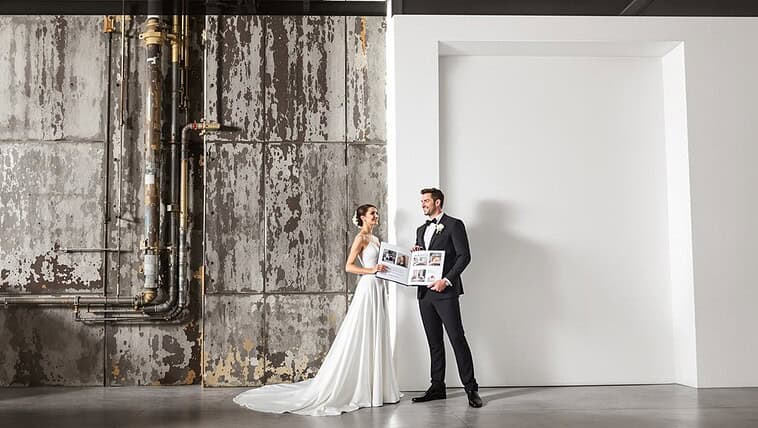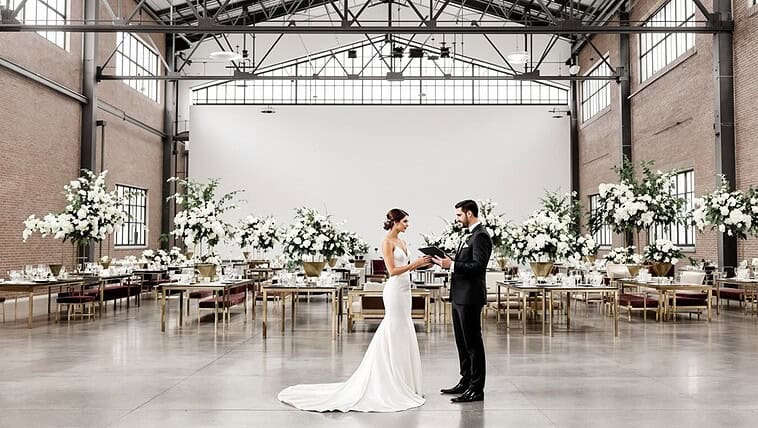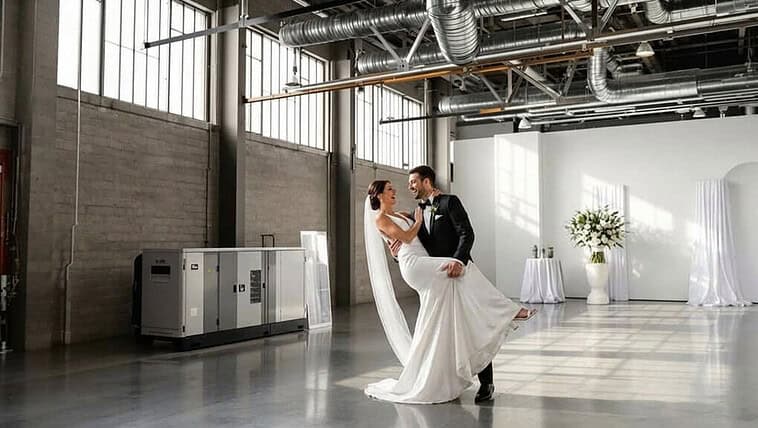
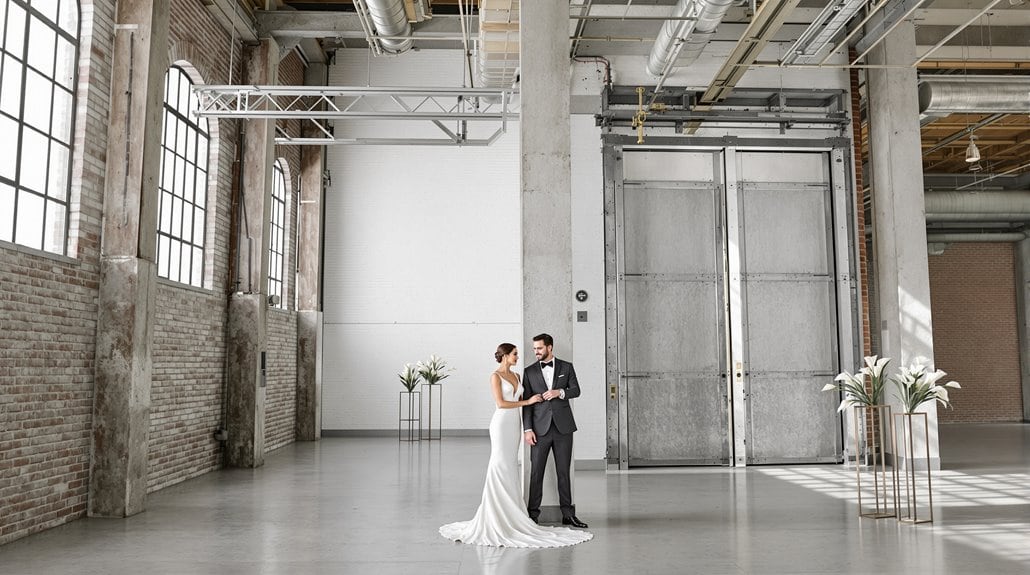
Industrial spaces have transformed luxury’s terrain—raw edges and exposed elements now define high-end venues. You’ll find these conversions nationwide: The Foundry LIC with its weathered 19th-century brick, Brooklyn’s Liberty Warehouse offering harbor views, Chicago’s Morgan Manufacturing spanning 30,000 square feet. They balance authenticity with comfort, contrasting rough materials against polished finishes. These spaces tell stories through preserved beams, original floors, and soaring ceilings—a deliberate imperfection that’s become the paramount status symbol. Explore these paradoxical sanctuaries to understand luxury’s evolution.
Introduction: Industrial as New Luxury
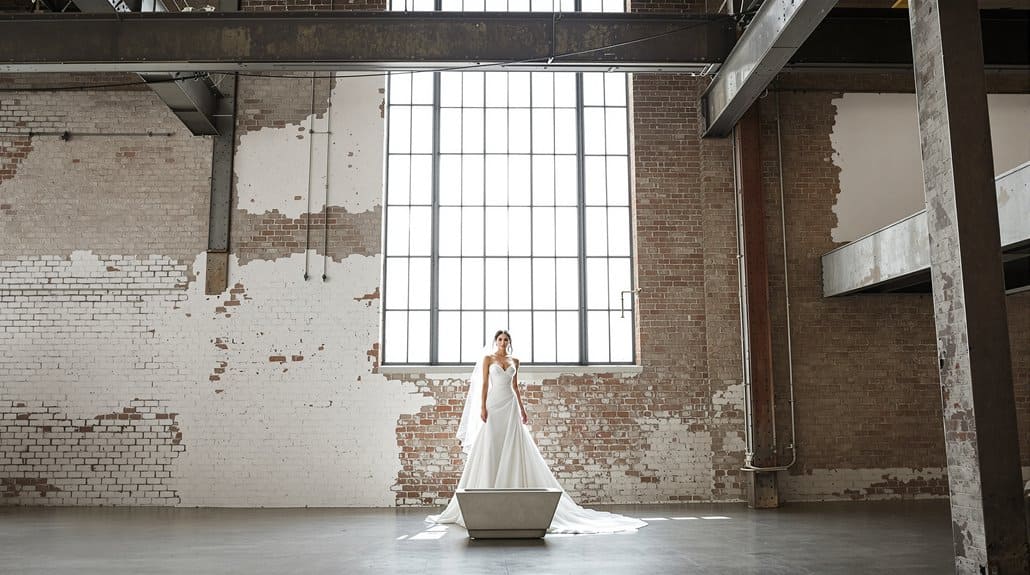
While traditional luxury once meant ornate moldings and polished marble, today’s most coveted spaces often feature exposed brick, visible ductwork, and soaring ceilings with nothing to hide. Industrial spaces have become luxury’s bold frontier—not despite their raw edges but because of them. Volume, flexibility, and unfiltered authenticity offer what carefully manicured venues can’t: character with room to breathe.
You’ll notice the industrial loft wedding trend isn’t merely aesthetic—it’s philosophical. The converted warehouse wedding represents our collective shift toward spaces that tell stories rather than manufacture perfection. When you walk into an urban industrial venue, you’re not just entering a room; you’re stepping into possibility incarnate, a canvas stretching 30 feet upward, waiting for your vision. This transformation coincides with unprecedented availability as over 1.5 billion SF of industrial space sits nationwide, creating abundant opportunities for conversion projects. Furthermore, this trend aligns with emerging design movements that celebrate minimalism and authenticity.
And yet, the industrial-as-luxury movement isn’t simply about aesthetics. It’s about freedom—the liberation from convention, the permission to reimagine space on your own terms, the luxury of unscripted potential.
Venue 1: The Foundry LIC – Long Island City, NY
How often does a venue’s very bones tell a story more enthralling than anything you might stage within it? The Foundry—a 19th-century iron manufactory standing defiantly amid Long Island City’s evolution—answers this question with its weathered brick and soaring ceilings.
You’ll find industrial wedding venues everywhere these days, but few boast authentic historical credentials: steel varnish production until 1906, abandoned by the 70s, lovingly restored in the 80s. The 3,000-square-foot space accommodates 180 guests across multiple areas—from the greenhouse with its floor-to-ceiling glass to the courtyard offering Manhattan skyline views. The venue’s newly renovated spaces perfectly balance modern amenities with preserved industrial charm, embodying the philosophy of elegant restraint that defines quiet luxury.
At $11,500 starting price, this warehouse wedding venue isn’t cheap, but you’re paying for irreplaceable character. The loft wedding space comes with practical advantages: tenting options April through November, three dedicated staff members, and that coveted Queensborough Bridge backdrop for photos that need no filter.
Venue 2: Liberty Warehouse – Brooklyn, NY
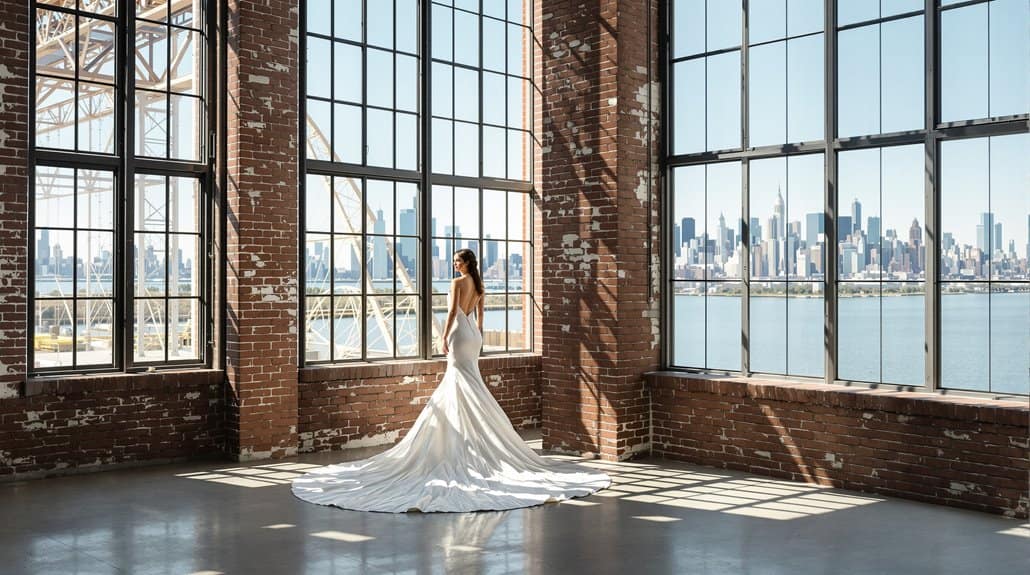
Few waterfront properties command the presence of Liberty Warehouse, a pre-Civil War relic from the 1850s perched defiantly at Pier 41 in Red Hook. This 15,000-square-foot industrial wedding venue boasts the only face-front view of Lady Liberty in the city—she’s literally looking at you, looking toward France. You’ll find four distinct spaces here, each with its own raw, charming character: exposed brick walls, original wooden beams, and those impossible harbor views.
The warehouse wedding venue accommodates 400 for seated dinners, 1,200+ for cocktails—numbers that matter when you’re balancing guest lists against your vision. Each room offers something distinctive: the Bridge Room’s wood-burning fireplace, the Governors Room’s expansive window wall. This factory wedding venue somehow pulls off the industrial-chic aesthetic without sacrificing warmth. It’s brutally authentic, and yet the on-site catering crew guarantees not a single guest leaves unsatisfied. Additionally, effective tier allocation strategies can help maximize your budget when planning events in such stunning venues.
Venue 3: Greenpoint Loft – Brooklyn, NY
Tucked away in the creative heart of Greenpoint’s waterfront district, this pre-WWII rope factory has transformed into one of Brooklyn’s most authentic industrial wedding venues—without sacrificing an ounce of its raw, historical integrity. You’ll find yourself surrounded by exposed beam ceilings, original wooden floors, and those coveted Manhattan skyline views that make industrial loft weddings so irresistibly photogenic.
| Feature | Detail |
|---|---|
| Capacity | 185 seated or standing |
| Space | 5,000 sq ft main loft + 1,000 sq ft mezzanine |
| Views | Manhattan skyline, East River proximity |
| Rental Window | 14 hours (11AM-1AM) |
| Vendor Policy | Complete freedom, no required lists |
What distinguishes this warehouse wedding venue isn’t just its aesthetic—though that exposed-beam drama certainly qualifies—but its versatility. You’ll get a true blank canvas with enough architectural character to need minimal décor, yet enough flexibility to realize even your most ambitious design schemes.
Venue 4: Morgan Manufacturing – Chicago, IL
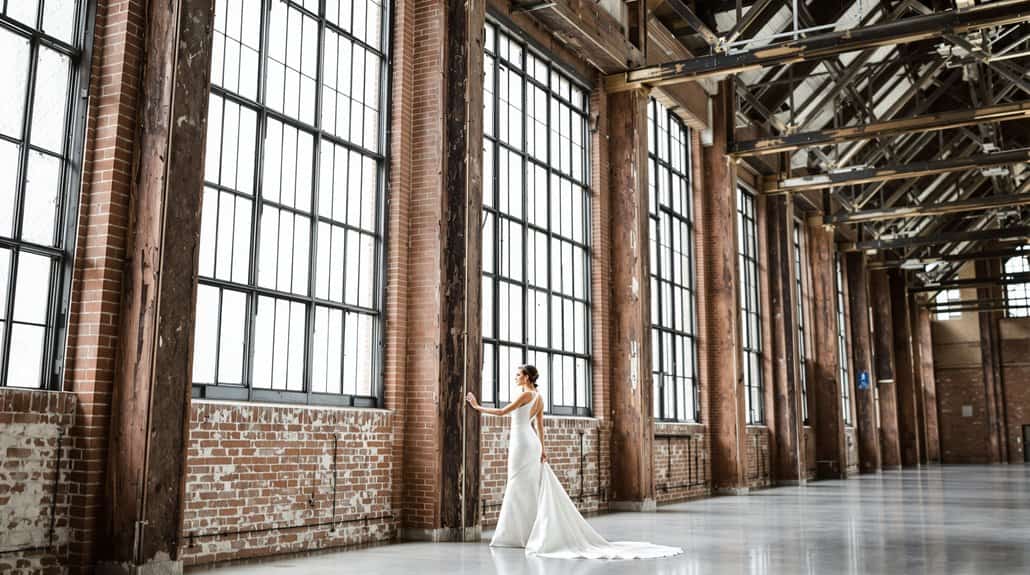
While Brooklyn offers waterfront industrial charm, Chicago’s West Loop counters with sheer monumental scale. At 401 N. Morgan St., you’ll discover over 30,000 square feet of renovated industrial magnificence—a pre-Chicago Fire factory now transformed into a world-class event destination. The former manufacturing complex retains its raw architectural integrity—soaring ceilings, exposed concrete, glass, and steel—yet functions with refined modern efficiency.
You’ll find Morgan Manufacturing enthralling because:
- Its modularity accommodates intimate gatherings or grand galas for up to 650 seated guests
- The dramatic concrete bar, illuminated by LED lighting, creates visual anchoring in the vast space
- Natural light floods through original glass skylights, transforming atmosphere from day to night
- The exposed industrial elements provide authenticity that can’t be manufactured in conventional venues
This space embodies industrial elegance—severe and uncompromising in its materiality, yet surprisingly warm in its volumetric generosity.
Venue 5: Ovation Chicago – Chicago, IL
As you venture deeper into Chicago’s industrial scenery, the former foundry at 2324 W Fulton Street emerges as a quintessential study in differences—raw industrial architecture housing unexpected luxuries. Opened in 2014 after meticulous renovation, Ovation transforms 5,500 square feet of raw potential into a space where brick walls frame Steinway performances.
You’ll notice immediately the venue’s unique division—ceremony flows to reception without awkward transitions. And yet, it’s the included amenities that separate Ovation from mere warehouse conversions.
| Unexpected Luxury | Technical Prowess | Practical Details |
|---|---|---|
| 1959 Rolls Royce | VOID tri-motion sound | 200-person capacity |
| Steinway Model B | 110″ video wall | BYOB model |
| Vintage photo booth | Custom lighting | $5,000-$12,000 fee |
What’s revolutionary here isn’t the industrial aesthetic—it’s how owner Spencer has weaponized it, creating environments where dance floors and conversation coexist without compromise, where Edison bulbs illuminate both rustic tables and cutting-edge projection technology.
Venue 6: Lacuna Lofts – Chicago, IL
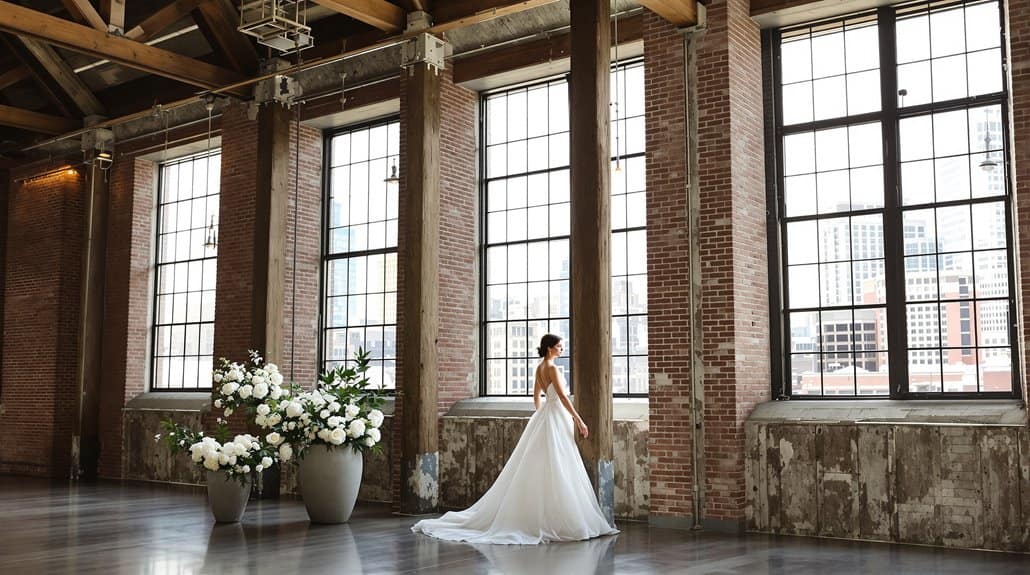
Beyond the expected trajectory of industrial conversions lies Lacuna Lofts, where pasta’s history becomes luxury’s present. This 1897 macaroni factory transformed under Joey Cacciatore’s vision offers 250,000 square feet of raw industrial elegance—exposed brick walls telling a century-old story while housing 156 working artists who infuse the space with contemporary creative energy.
You’ll experience luxury that’s unpretentious yet remarkable in this Pilsen District landmark, where shipping containers become bridal suites and vintage CTA train seats furnish classrooms. It’s magnificently contradictory, and yet perfectly cohesive.
Four reasons Lacuna captivates:
- The Skydeck’s panoramic Chicago skyline views create breathtaking ceremony backdrops
- LM Catering’s seasonal menus raise industrial dining to culinary art
- Original factory elements—polished concrete, timber beams—provide authenticity impossible to replicate
- The lively artist community ensures your event exists within a living cultural ecosystem
Venue 7: Millwick – Los Angeles, CA
Tucked within Downtown LA’s lively Arts District, Millwick emerges as luxury’s rebellious offspring—a former livery and cold-storage warehouse transformed into 7,000 square feet of contradiction. You’re stepping into an 80-year narrative where industrial bones meet lush tropical gardens, where wedding vows echo against wooden bow truss ceilings that once witnessed entirely different commerce.
| Space | Capacity | Aesthetic |
|---|---|---|
| Grand Hall | 150 seated | Light-filled, skylights, roll-up doors |
| Greenhouse Courtyard | 250 standing | Urban jungle, vertical gardens |
| Fondrevay Entry | Transitional | Decoupage tropical walls, magnetic customization |
The venue’s design philosophy rejects excess while celebrating abundance—minimalist in structure yet maximal in organic beauty. You’ll find handcrafted tables that seat 150, site-specific artwork, and a wooden bartop waiting for your initials. It’s brutally functional, and yet—through those oversized glass doors—sunlight transforms concrete into canvas.
Venue 8: Seventh Place – Los Angeles, CA
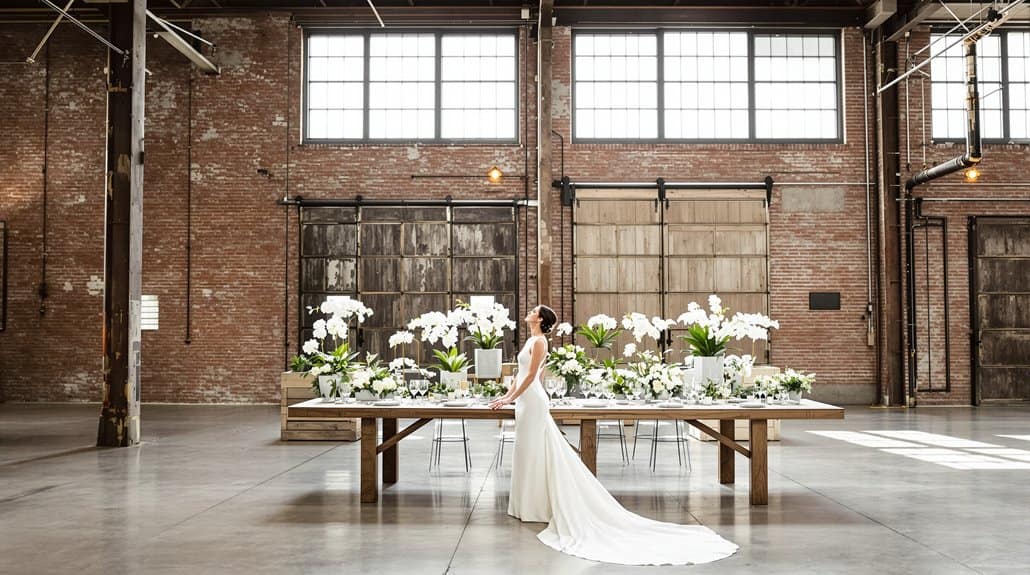
Standing proudly since 1947 in downtown LA’s Arts District, Seventh Place delivers industrial authenticity that luxury hotels desperately attempt to replicate—and fail. You’ll wander through 5,000 square feet of exposed brick, bow truss ceilings soaring 12-16 feet overhead, and polished concrete underfoot—not designer facsimiles, but the genuine article. That massive electric glass garage door isn’t decorative; it’s functional, blending the main space with a 2,000-square-foot verdant patio.
What makes this warehouse transcend mere venue status:
- The architectural bones—red brick walls and repurposed wood beams—tell an honest industrial narrative
- Natural illumination from skylights and windows that can’t be replicated in purpose-built spaces
- Raw flexibility that accommodates anywhere from 250-300 seated guests (though listings vary wildly)
- Proximity to Little Tokyo and artistic institutions that contextualizes your event within LA’s cultural geography
The pricing starts at $4,150—steep, and yet surprisingly reasonable for a slice of authentic industrial heritage.
Venue 9-11: Additional Industrial Venues
While our spotlight has illuminated Seventh Place’s raw industrial allure, California’s scenery brims with additional converted spaces that transform manufacturing history into event luxury—each with distinctive architectural signatures.
The Carrus House in Chatsworth juxtaposes exposed structural elements against refined design interventions—steel beams and concrete floors that somehow feel warmer, more inviting than any carpeted ballroom. Millwick, tucked into DTLA’s Arts District, converts 7,000 square feet of former marble finishing facility into a verdant industrial paradise with living walls that soften brick and metal. And yet it’s SmogShoppe—once an auto repair facility—that perhaps best embodies this paradox: oil-stained concrete now hosts sustainable weddings beneath a canopy of drought-resistant plantings and solar arrays.
You’ll find similar contradictions at The Majestic Downtown, where bank vaults become cocktail lounges and ceiling heights approach cathedral proportions—industrial spaces reimagined not as compromises but as sublime alternatives.
What Industrial Luxury Means

Beyond the obvious paradox of describing cement-floored factories as “luxurious,” industrial luxury represents design’s most persuasive contradiction—raw utility transformed into polished exclusivity. You’re witnessing the marriage of opposites: concrete slabs meeting plush leather, exposed ducts hovering above marble countertops. It’s not imitation—it’s elevation.
Industrial luxury doesn’t compromise—it elevates contradiction into art, where utility and refinement collide to create something unexpectedly authentic.
Industrial luxury succeeds when it:
- Preserves honesty – Celebrates structural elements rather than hiding them
- Creates tension – Juxtaposes rough materials against smooth finishes, creating visual electricity
- Balances volume – Uses high ceilings and open plans while maintaining human scale and warmth
- Respects heritage – Honors a building’s history while boldly reimagining its future
You’re drawn to these spaces precisely because they refuse to choose between comfort and character, between history and innovation. The luxury isn’t in perfection but in deliberate imperfection—controlled rawness that feels authentic yet intentional.
Booking Access and Realities
Though industrial spaces exude raw authenticity in marketing photos, securing these coveted venues involves maneuvering complex digital ecosystems that are anything but industrial. You’ll confront sophisticated reservation architectures designed for efficiency, not charm—dashboard interfaces that track your every interaction while algorithmically adjusting prices based on demand.
| Booking Reality | What They Show | What You Get |
|---|---|---|
| Availability | “Flexible scheduling” | Peak slots booked 6 months out |
| Pricing | Base rate advertised | Dynamic pricing up to 90% higher |
| Confirmation | “Easy booking” | Multi-step verification process |
| Access | “24/7 availability” | Limited after-hours support |
The warehouse-as-luxury trend has birthed a new paradox: spaces valued for their utilitarian simplicity now require navigating systems of startling complexity. And yet, this digital infrastructure enables unprecedented access—your smartphone transforms into a key that unlocks cathedral-like volumes previously reserved for industry insiders, democratizing industrial aesthetics through ruthlessly efficient technology.
Conclusion
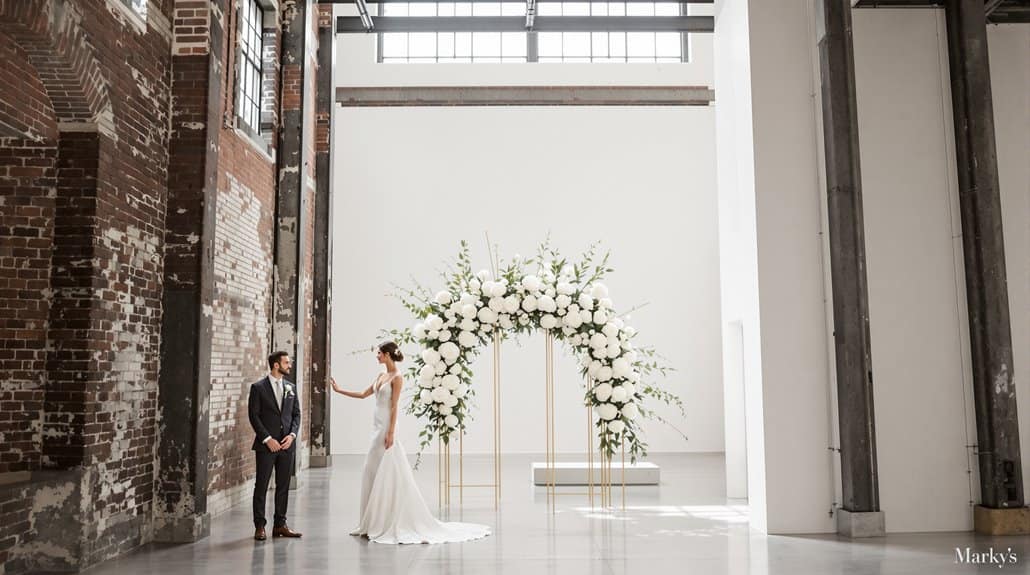
As industrial architecture has transformed from utilitarian necessity to curated luxury experience, you’ve witnessed the supreme commodification of authenticity—spaces once designed purely for function now command premium prices precisely because they weren’t designed to be beautiful. This extraordinary inversion, where raw functionality becomes aspirational, reveals our complex relationship with industrialism’s legacy.
When you enter these transformed spaces, you’re participating in a cultural shift that values:
- Volumetric abundance – the luxury of unconfined space in increasingly dense urban environments
- Material honesty – exposed brick, concrete, and steel as status symbols rather than economic necessities
- Historical resonance – the gravitas of occupying spaces with visible industrial heritage
- Adaptive potential – the freedom to reimagine space outside conventional architectural constraints
The warehouse aesthetic has transcended its utilitarian origins, and yet its luxury appeal hinges entirely on maintaining that industrial authenticity—a paradox where the most successful conversions simultaneously transform and preserve their industrial soul.