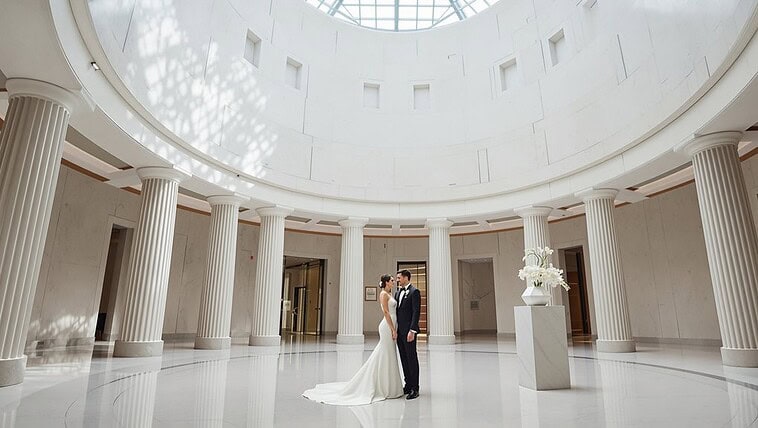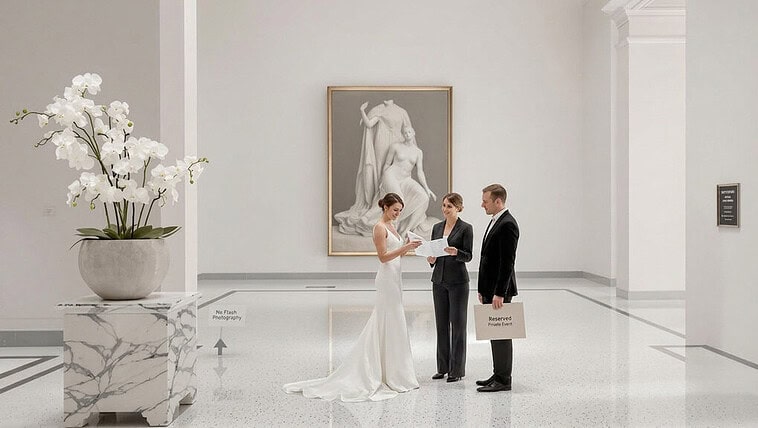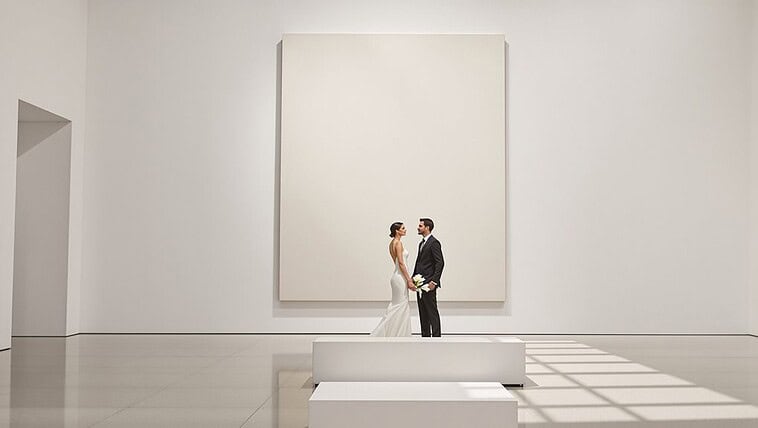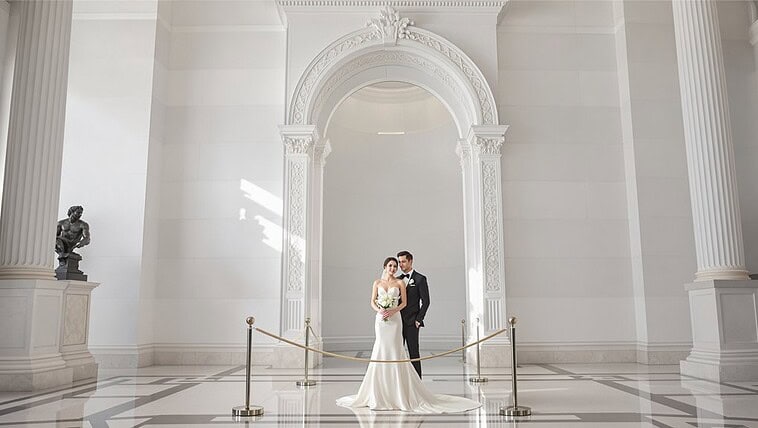
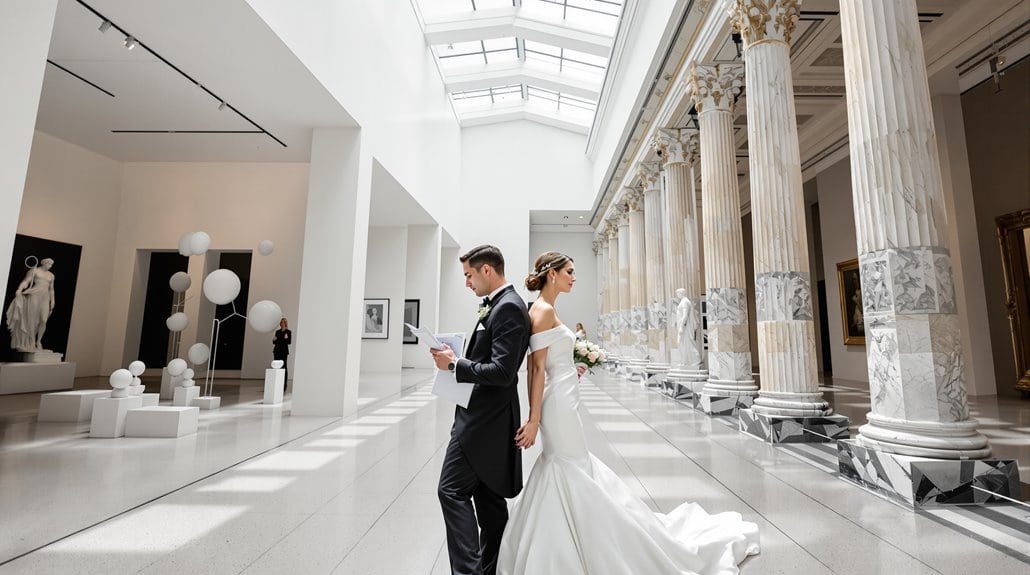
Contemporary museums offer sleek minimalism with white walls, natural light, and flexible spaces—perfect for creative couples wanting a blank canvas. Classical venues provide ornate grandeur through Ionic columns, gilded details, and historic elegance that requires less decoration. Your choice hinges on whether you’re drawn to modern simplicity or traditional gravitas. One creates serene openness, the other timeless formality. The venue’s architecture shapes not just your photos, but your entire wedding’s emotional setting.
Two Museum Aesthetics
Five classical design principles define the museum wedding backdrop you’ll encounter, each creating dramatically different experiences depending on your venue choice. When choosing museum venue options, consider the architectural structure—those 43-45 Ionic columns create a dramatically different feel than SFMOMA’s minimalist white walls. Your museum wedding style hinges on this fundamental contrast.
Classical spaces offer mathematical symmetry with triangular pediments and ceremonial proportions—grand staircases ascending 12 meters beneath domed ceilings. These venues command formality, rich with relief sculptures and laurel-wreathed ornamentation. And yet, they’re surprisingly adaptable with quadrangular layouts providing flexible configurations for your reception. Classical museum entrances often feature large, elegant doors that serve as focal points reinforcing the building’s symmetry and classical elegance.
Art museum types wedding venues diverge dramatically in material palette too. Portland stone and dark wood doors create a different emotional resonance than contemporary concrete floors and natural light. The classical museum’s hierarchical sophistication speaks of tradition, while modernist spaces offer cleaner canvases—both beautiful, utterly distinct in execution.
Contemporary Museums: Minimalist Modern Character
While classical architecture stands firmly rooted in tradition, contemporary museums offer a startlingly different experience—one defined by simplicity, openness, and an almost monastic serenity. You’ll find yourself wandering through minimalist interiors where expansive glass facades flood spaces with natural light, creating ethereal backdrops for your nuptials. The allure of these venues often resonates with affluent couples seeking a wedding that reflects their value decision-making in terms of quality and aesthetics.
Contemporary museum venues transform your wedding through their architectural poetry—45,000 square feet of possibility where open-floor plans allow seamless passage between ceremony and reception spaces. These modern venues often incorporate sheer planes and minimal decoration, creating clean visual lines that complement modern wedding aesthetics.
| Feature | Classical Museum | Contemporary Museum |
|---|---|---|
| Light Source | Chandeliers, sconces | Floor-to-ceiling glass |
| Wall Treatment | Ornate, gilded | White, gallery-clean |
| Floor Plan | Compartmentalized | Open, fluid circulation |
| Atmosphere | Opulent, historical | Serene, minimalist |
| Photography | Rich backgrounds | Clean, dramatic lines |
Your guests will move through these spaces like urban environments, experiencing non-hierarchical pathways that encourage personal journeys—perfect for creating wedding memories that feel both intimate and expansive.
Classical Museums: Traditional Grandeur

Have you ever stood beneath the towering columns of a neoclassical museum and felt instantly transported to another era? That’s the magic of a classical museum wedding—pure architectural grandeur that’s been mesmerizing visitors since the 1750s when the Greek Revival movement first emerged.
Your guests will be awestruck by the formal symmetrical design, with its grand porticos featuring imposing columns topped by Corinthian, Doric, or Ionic capitals. These aren’t just pretty features; they’re statements of power, stability, and timeless beauty developed through centuries of architectural polishing.
Inside, your celebration unfolds beneath coffered ceilings and among elaborate carved moldings—egg-and-dart, palmettes, honeysuckle motifs. Every detail matters. The massive stone slabs (often Portland stone facing brick construction) create an atmosphere of permanence that modern venues simply can’t replicate. And yet, beneath this classical aesthetic lies surprisingly groundbreaking 19th-century construction—iron beams supporting impossibly wide rooms perfect for your reception. Additionally, the elegance of these venues often reflects old money aesthetic principles that emphasize heritage and luxury in design.
Architectural Differences and Design Implications
Choosing between classical and contemporary museum spaces transforms every aspect of your wedding experience—from the photographs you’ll frame to the emotional tenor of the ceremony itself. When conducting your museum venue comparison, consider how architectural differences fundamentally shape atmosphere and flow.
| Feature | Classical Museum | Contemporary Art Museum Wedding |
|---|---|---|
| Light | Small windows, controlled illumination | Floor-to-ceiling glass, dramatic natural light |
| Space | Fixed, symmetrical 45,000 sq ft galleries | Flexible, customizable open-concept layouts |
| Walls | Ornate, gilded, textured | Minimalist white, blank canvas for decor |
| Structure | Column-based, traditional proportions | Reinforced concrete, unexpected angles |
| Detail | Carved cornices, decorative elements | “Poetic rationalism,” elegant simplicity |
Contemporary museums offer sleek, adaptable backdrops where your celebration becomes the exhibition—a modern blank canvas awaiting your vision. And yet, classical spaces infuse every moment with established grandeur, their ornate detailing doing much of the decorative work for you. Ultimately, the decision may reflect your preference for quality over quantity, as each architectural style embodies distinct narratives and atmospheres.
Guest Experience Comparison

Beyond the architectural features that frame your celebration, a museum wedding profoundly shapes how your guests experience your special day.
When choosing between contemporary vs classical museum settings, you’re selecting more than aesthetics—you’re curating distinct emotional terrains. Contemporary spaces with minimalist white walls and abundant natural light (like SFMOMA) foster a sense of openness, breathing room between conversations. Your guests might feel more relaxed, less constrained by formality. And yet, this modern museum guest experience can sometimes read as stark, lacking the built-in grandeur many expect from milestone celebrations.
Classical museums, by contrast, deliver gravitas through ornate details and historical weight—gilded frames at the Met don’t just house art; they telegraph significance. Your wedding inherits this significance. But this wedding venue comparison isn’t straightforward; the same classical elements that impress can intimidate. Some guests find themselves whispering, hesitant to fully inhabit the space, while others revel in the transportive quality, feeling themselves characters in a momentary, magnificent history.
Photographic Aesthetic: White Walls vs Gilded Galleries
When evaluating wedding venues, photography considerations deserve thorough attention—your photos will outlast every other investment you make. Museum aesthetics fundamentally shape your visual narrative, dictating everything from lighting approaches to compositional possibilities.
Contemporary spaces like SFMOMA offer minimalist white walls that create clean backgrounds, allowing your wedding’s colors to pop with striking clarity. The abundant natural light produces ethereal, airy images that feel timelessly modern—perfect if your photographic style leans editorial or documentary.
Classical museums, meanwhile, with their ornate moldings and gilded frames, infuse photos with instant gravitas. The Met’s richly textured gallery design provides built-in opulence that uplift every shot. These environments typically rely on directional artificial lighting, creating dramatic shadows and highlights that photographers can harness for theatrical portraits.
Neither aesthetic is inherently superior, but they’ll deliver fundamentally different visual stories. Consider which backdrop—clean modernism or historical grandeur—better complements your personal narrative.
Which Museum Type Matches Your Vision

The perfect museum for your wedding fundamentally reflects your personal aesthetic sensibilities and practical requirements—it’s the architectural embodiment of your relationship story. Contemporary art museum weddings deliver pristine backdrops and technological advantages—WiFi for 200+ guests, adaptable lighting systems, wheelchair accessibility throughout—but sacrifice the gilded grandeur of tradition. And yet, that minimalism creates freedom: 90% fewer decoration restrictions, unlimited color palette options.
Traditional museum weddings immerse you in history’s embrace—think 19th-century fireplaces, ornate crown molding, and cultural gravitas impossible to manufacture. But these atmospheric advantages demand workarounds: accessibility challenges, technology limitations, stricter preservation rules that might prohibit open flames or wall attachments.
Your museum venue comparison should prioritize practical matters alongside aesthetics. Modern spaces welcome multicultural ceremonies with dedicated zones for different traditions, while classical institutions require more coordination—beautiful complications that ultimately shape your celebration’s character.
Examples of Each Type
Stepping through actual museum doors reveals how architectural philosophy transforms your wedding experience beyond theoretical categories. The modern vs classical museum wedding choice creates fundamentally different atmospheres—and yet both offer distinctive advantages for couples seeking artistic backdrops.
The architecture isn’t just backdrop—it’s the foundational element that shapes every wedding moment within museum walls.
- Baltimore Museum of Art: Neoclassical elegance with Ionic columns and coffered ceilings that practically eliminate the need for additional décor
- SFMOMA: White walls and natural light create a contemporary canvas for bold, artistic expressions—perfect for couples wanting minimalist modernity
- Ringling Museum: European-inspired Ca’ d’Zan façade with rounded shapes and warm chestnut tones for traditional romantics
- Pizzagalli Center: Ann Beha’s award-winning contemporary design featuring wood paneling and picturesque windows overlooking 45 acres
When conducting your museum venue comparison, remember that classical structures deliver built-in gravitas through architectural heritage, while contemporary art museum wedding spaces offer technological flexibility and adaptability for experimental styling—your choice essentially depends on whether you want history to frame your story or a blank canvas to create it.
Conclusion

Choosing between contemporary and classical museum wedding venues decidedly demands self-reflection about which aesthetic best frames your relationship’s unique story. Consider how SFMOMA’s pristine white walls and natural light create an entirely different emotional setting than the Met’s gilded galleries—one isn’t superior, just fundamentally different in what it communicates about your partnership.
Your decision hinges on three critical factors: aesthetic resonance, practical logistics, and emotional connection. Contemporary spaces offer clean backdrops where your design choices become the focal point—75% of modern museum couples cite this creative freedom as decisive. Classical venues, with their inherent grandeur, require less decorative intervention but demand more alignment with their existing character.
And yet, the most successful museum weddings transcend these categories entirely. Your guests won’t remember whether your venue was built in 1890 or 2015—they’ll remember how perfectly the space reflected the couple they came to celebrate.