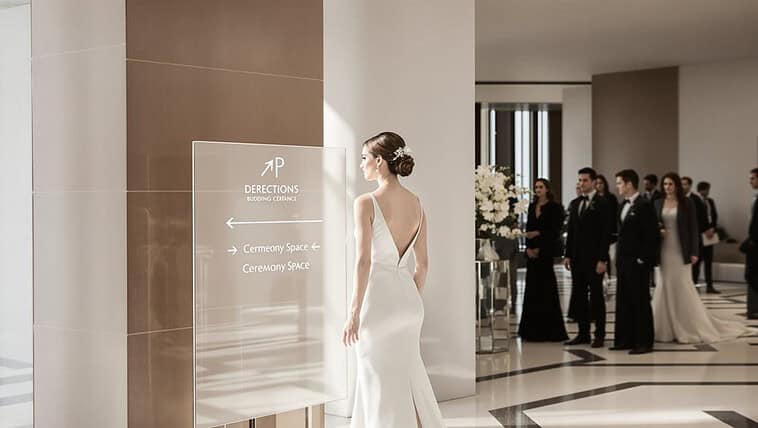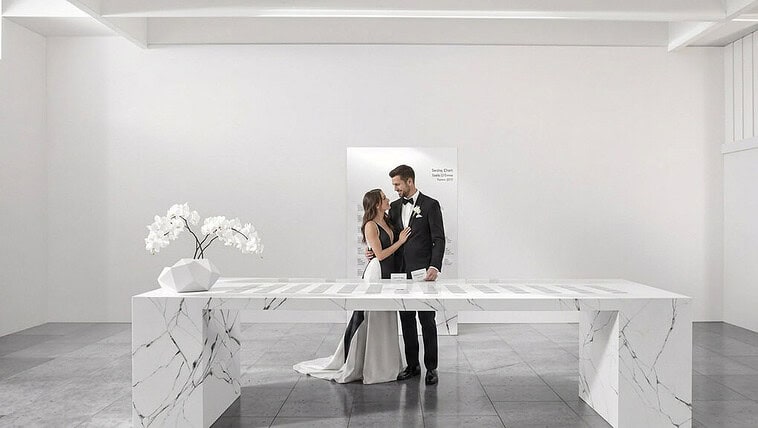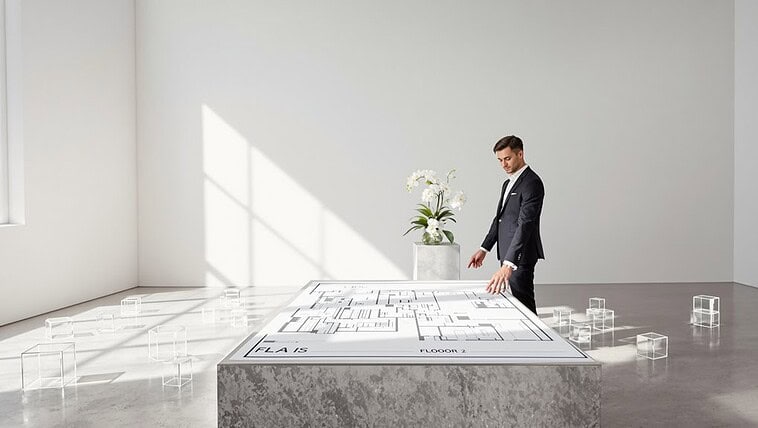

To make 150 guests feel like 50, create intimate “experience zones” within your venue using tactical clustering. Group tables into neighborhoods instead of spreading them evenly, and use layered lighting—bright at focal points, dim at perimeters—to psychologically compress space. Deploy acoustic dampening with fabric panels and rugs to minimize echo. Suspended installations draw eyes downward, making ceilings feel lower. Long, serpentine tables promote dinner-party familiarity despite the crowd. The magic lies not in physical space, but in perceptual manipulation.
The Scale Problem: Swimming in Space
While most couples dream of their perfect wedding day surrounded by loved ones, they rarely consider how spatial maneuvering fundamentally shape guest experience. You’ve gathered 150 of your nearest and dearest, yet in a venue designed for 300, they’re adrift—isolated islands in an ocean of empty floor space.
This is wedding intimacy scale’s critical paradox: a room at 50% capacity creates psychological distance. Your large wedding design must account for this counterintuitive truth—the more unoccupied space, the less connected everyone feels. That cavernous ballroom you booked? It’s actively undermining the intimate large wedding you envisioned. Research on space psychology reveals that this phenomenon parallels what astronauts experience as psychological closing when isolated in vast environments. Embracing quiet luxury in your venue selection can help create a more cohesive atmosphere that fosters connection among guests.
The human brain instinctively registers spatial density as safety, community, significance. When guests find themselves traversing vast empty zones between conversations, they unconsciously perceive the celebration as somehow lacking—not in people or love, but in essential energy. Addressing this mismatch between guest count and spatial volume becomes your first challenge in crafting true intimacy.
Spatial Division Strategies
Because large venues magnify psychological distance, tactical spatial division becomes your most powerful tool for creating intimacy within numerical abundance. Your 150 guests don’t need to occupy the entire ballroom—section it off deliberately. Create “rooms within rooms” using portable dividers, strategic furniture placement, or even hanging fabric panels to slice that cavernous space into human-scale pockets. Consider including breakout sessions that can help mitigate relational loss when working with larger groups. The principles of old money aesthetic can also inform the elegance of your spatial design, promoting a refined atmosphere.
Don’t underestimate the power of lighting to redefine spatial perception. Overhead chandeliers create vastness; table lamps and candlelight forge closeness. The most effective scale wedding intimacy techniques involve creating multiple “destinations” within your venue—conversation nooks, themed drink stations, photo areas—that draw guests into concentrated interaction zones rather than letting them disperse throughout the space.
These spatial division strategies transform your large wedding feel small through intentional constraints. And yet, maintaining visual flow between divided areas prevents claustrophobia. The goal isn’t cramping guests but crafting spaces that feel deliberately designed rather than underpopulated.
Lighting Zones for Intimacy
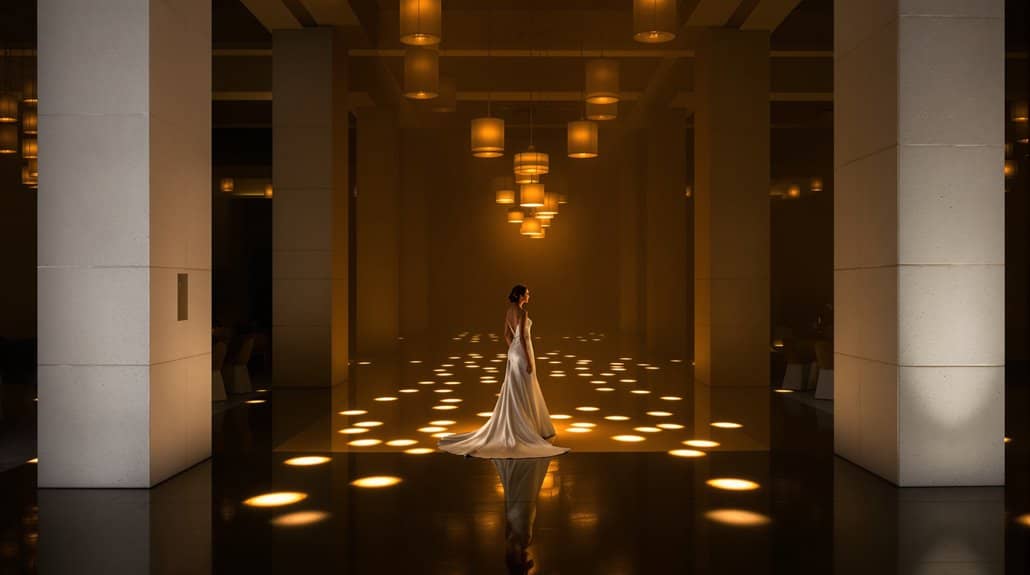
The secret language of lighting speaks directly to our primal instincts—transforming cold, cavernous venues into intimate gatherings through nothing more than photons and intention. You’ll create the illusion of closeness by establishing distinct lighting zones that segment your large reception into psychological “rooms”—without a single wall.
Start with layering lighting structure: chandeliers above, sconces along perimeters, candles at tables, and floor uplighting against architectural elements. Each layer adds dimension, making 4,000 square feet feel like 400. Position lounge areas under warmer, dimmer lighting (2700K, not 3500K), while conversation corners get pin-spotting that makes each table feel like its own universe.
Zoning and spatial definition through light creates pockets of intensity—bright dance floors contrasted with amber-toned dining sections. Dim lights progressively throughout the evening, dropping intensity 15% after dinner, another 10% during speeches. Your guests won’t know why they feel cocooned rather than exposed, but they will. This approach aligns with emerging luxury trends that emphasize spatial design for enhancing guest experiences.
Table Clustering vs Spreading
Most venue coordinators will cheerfully distribute your 150 guests across every available inch of their 5,000-square-foot ballroom—creating the social equivalent of butter scraped over too much bread. Resist this impulse. Your intimate large reception demands purposeful clustering, not diffusion.
Pull those tables together—yes, closer than the floor plan suggests. When you cluster seating arrangements into distinct “neighborhoods” of 3-4 tables each, you manufacture density where none exists. A big wedding feels small when you create pockets of energy rather than scattered islands of conversation.
The psychology is straightforward: humans crave proximity. We need the electricity of bodies nearby, the overlapping laughter from adjacent tables, the sense of being part of something lively. And yet, proximity requires intentional design—particularly when venues are built to accommodate twice your guest count.
Create three distinct table clusters instead of six spread-out sections. Your intimate large wedding depends on it.
Acoustic Dampening Techniques

While tables build social density, sound creates psychological intimacy—and your carefully clustered seating arrangement deserves equally thoughtful acoustic engineering.
To make a large wedding feel intimate, you’ll need targeted sound absorption—not elimination. Tactical ceiling baffles tame cavernous heights while fabric-wrapped wall panels (installed at conversation level) reduce the telltale echo of emptiness. You’d be shocked how 8-10 acoustic panels can transform a 5,000 square foot space from airport terminal to whispered confidence.
For an intimate large reception, consider acoustic curtains that section off peripheral areas—instant boundary control without permanent walls. Bass traps in corners prevent that hollow, institutional resonance that broadcasts “we’re rattling around in here.” Your intimate large wedding demands flooring intervention too: area rugs under key conversation zones absorb sound without requiring venue-wide carpeting. And yet, preserve some liveness—perfect acoustics feel artificial, while tactical dampening creates the natural warmth of a gathering that fits its space.
Furniture and Screens as Division
Tactical furniture placement transforms a cavernous venue into a collection of intimate enclaves—making your 150 guests feel like they’ve stepped into a series of connected smaller gatherings rather than one overwhelming event. It’s architectural psychology at work.
Movable walls and plexiglass screens create visual boundaries without permanent construction. You’ll want rectangular tables (space-efficient) for primary divisions, while round tables (conversation-friendly) establish natural social pods requiring 30-40 square feet per person. These aren’t just tables; they’re tactical conversation containers.
Stack modular furniture systems against walls when you need flow, pull them out to create distinct zones when intimacy matters. The magic lies in creating multiple focal points—preventing that swimming-in-space sensation that kills atmosphere. Your smartest move? Hollow square configurations for groups of 17-40, with stackable chairs that allow quick reconfiguration when energy shifts. Space dividers aren’t just practical; they’re perception-altering tools that trick the mind into feeling cozy.
The Perceptual Manipulation of Venue Size
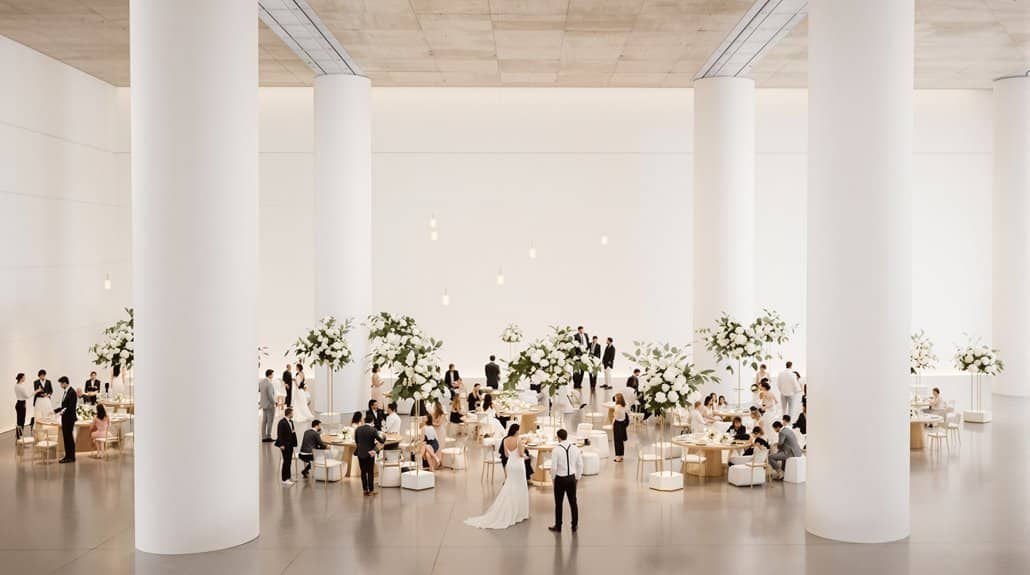
Our perception of space exists primarily in the mind, not in physical measurements. You’ve chosen a venue designed for 300 people, but your 150-guest wedding feels lost in the expansiveness—small clusters of conversation drowning in acoustic emptiness, intimate moments dissipating into cathedral-like ceilings. And yet, this spatial challenge can be turned to your advantage.
Tactical lighting transforms perception fundamentally—dim the perimeter, brighten gathering points. Your brain interprets darkness as absence, effectively shrinking the room’s perceived boundaries. Create visual anchors—suspended installations at 9-12 feet draw eyes downward, compressing vertical space that would otherwise soar ineffectively above guests’ heads.
Color saturation matters intensely—deep, rich tones advance visually while cool, pale colors recede. Paint isn’t required; deliberate fabric installations against walls can manipulate depth perception, pulling distant boundaries closer through nothing more than wavelength psychology and shadow play.
Examples: Large Weddings That Feel Intimate
Despite conventional wisdom suggesting that headcount determines intimacy, some of the most emotionally resonant celebrations I’ve witnessed have been 150-person weddings that felt as personal as a dinner party for 50. The magic lies in deliberate design choices—sectioning spaces into smaller “experience zones” that psychologically reset guests’ perception of crowd size.
| Strategy | Example | Impact |
|---|---|---|
| Long-table seating | Serpentine tables winding through venue | Creates dinner-party atmosphere despite numbers |
| Layered lighting | Low pendants over tables, ambient perimeter | Forms visual “ceilings” that shrink space perception |
| Sound zoning | Separate music volumes for dancing/conversation | Allows simultaneous activities without overwhelm |
| Lounge clusters | Conversation pits with 6-8 seats each | Enables private moments within public celebration |
| Thoughtful timing | Staggered food stations open at different hours | Prevents single-location crowding feeling |
These techniques create psychological compartmentalization—guests experience the wedding as a series of intimate moments rather than one massive event.
Conclusion
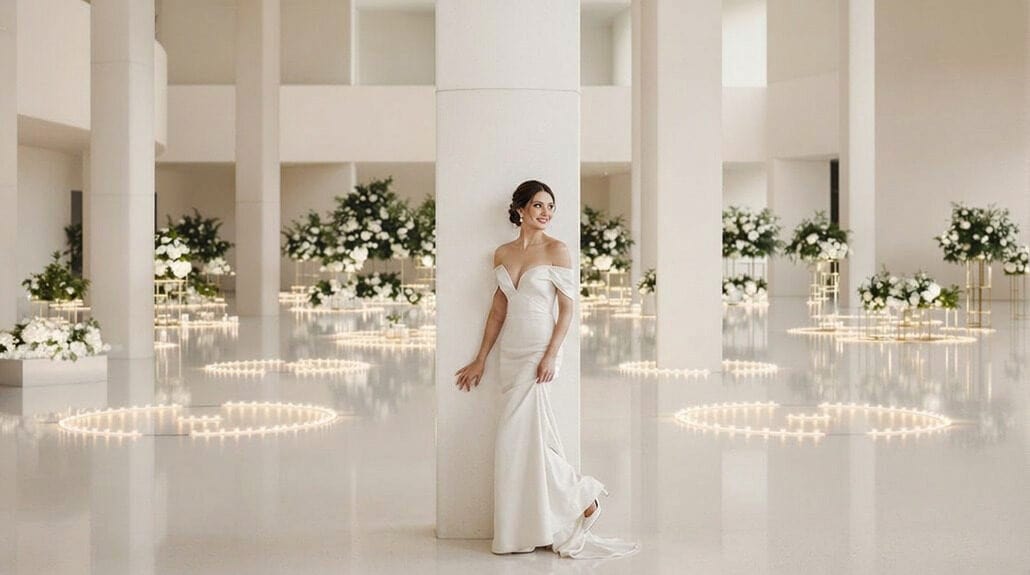
While the mathematics of guest counts remains immutable, the psychology of how space feels can be masterfully manipulated to create intimacy regardless of headcount. Your wedding’s emotional texture—not its numerical size—will define guests’ lasting impressions. The approaches throughout this guide offer pathways to crafting that coveted sense of closeness.
Remember these final truths as you plan:
- Intentional design trumps square footage – Thoughtful lighting, thoughtful seating, and ambient sound shape perception more powerfully than raw spatial dimensions.
- Connection blooms from curation – Every choice, from table arrangements to transition timing, either nurtures or fragments collective experience.
- Your presence anchors intimacy – Amid logistics and aesthetics, your genuine involvement with guests transforms anonymous attendance into meaningful witness.
Your 150-person celebration can indeed feel like an intimate gathering of 50—not through numerical sleight-of-hand, but through deliberate creation of spaces where genuine connection flourishes.