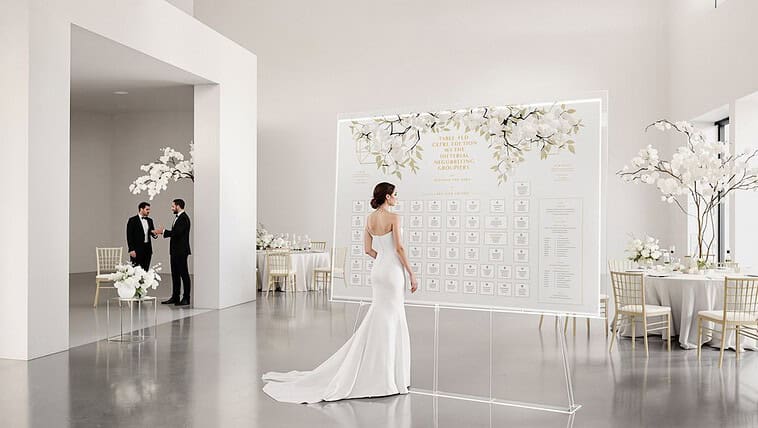

The perfect seating arrangement doesn’t exist—and yet, with strategic planning, you’ll maximize both connection and efficiency. Opt for 60-inch round tables (seating 8) placed with 6-foot clearances for intimate conversation circles, or choose rectangular tables for 20% greater capacity and streamlined service paths. Position chairs at slight angles rather than direct opposition, creating 90-degree conversation zones that promote involvement without confrontation. The spatial geometry you select influences everything from service speed to conversation quality to photographic aesthetics.
The Seating Configuration Question
When we arrange our seating spaces, we’re not just placing furniture—we’re architecting human connection. Your wedding reception seating configuration determines not just aesthetics, but the very quality of human interaction that unfolds throughout your celebration.
Angular positioning—not directly face-to-face—reduces perceived confrontation and creates a more relaxed atmosphere. Research shows that guests typically prefer seating arrangements that reduce unwanted intimacy through controlled eye contact. You’ll find guests engage more freely when seated at concave arrangements with 28-40 inches between them—close enough for intimacy without triggering discomfort. And yet, the table shape wedding planners recommend matters tremendously; round tables waste space but feel inclusive, while long tables create editorial impact but bottleneck service. Embracing quiet luxury in seating design can enhance the overall experience, promoting a sense of understated elegance.
The most successful reception seating balances sociopetal (interaction-encouraging) geometry with appropriate distance zones. Place chairs at slight angles rather than directly opposing positions. Central positioning maximizes eye contact in larger groups, while barrier-free arrangements—without imposing table structures—foster genuine connection.
Round Tables: Capacity Math and Space Efficiency
How many guests can you actually fit at a round table? The math is deceptively straightforward—divide the circumference by the space each person needs—but reality complicates this elegant equation.
A 48” round table technically accommodates 6 people, yet formal dining shrinks this to 4, those extra place settings and elbow room eating into your capacity. Move to 60” and you’ll seat 8 comfortably, though family-style dining might squeeze in 2 more. The 72” behemoth handles 10 guests before conversations fragment into isolated pockets. Complex project timelines can be impacted by the layout of the seating arrangement, affecting overall event flow.
Round tables democratize conversation, putting everyone equidistant from the center, but they’re surprisingly inefficient with space. That empty middle—unusable yet consuming precious square footage—is the cost of intimacy. For optimal comfort, providing 600mm per person ensures adequate personal space while maintaining social connection. Compare this to rectangular tables, which optimize seating density but create hierarchies with head positions that subtly shape group dynamics.
Long Tables: Editorial Appeal vs Service Challenges

Despite their undeniable photogenic quality, long banquet tables represent the supreme compromise between style and function. You’ll create that Instagram-worthy, editorial aesthetic—linear geometrics running the length of your venue—but you’re sacrificing conversation flow for visual impact. Your wedding table layout transforms from conventional circles to striking lines, instantly elevating your reception’s visual sophistication.
The seating configuration wedding planners rarely mention: guests become effectively tethered to their immediate neighbors. Those seated mid-table must perform an awkward dance—”excuse me, pardon me”—just to escape for a bathroom break. And yet, long tables maximize capacity, accommodating 20% more guests than rounds in the same square footage.
The ideal seating arrangement depends entirely on your priorities. If you’re choosing between guest comfort and architectural drama, long tables deliver the latter with breathtaking efficiency—creating a statement piece that photographs magnificently but bottlenecks both conversation and service flow. Additionally, understanding emerging luxury trends can help you balance aesthetics with the practicality of your seating choices.
Service Style Implications
The architectural truth about your table choice exists in the silent choreography between server and diner—an overlooked energetic that shapes the entire reception experience. Your wedding seating arrangement fundamentally dictates service flow, guest interactions, and meal pacing. Round tables create democratic dining experiences—servers approach from variable angles, maintaining equal attention to all guests—but require staff to navigate complex spatial patterns, potentially slowing service cycles.
Consider these critical service implications when choosing between round tables vs long tables:
- Round configurations eliminate hierarchical positions but require 36-inch spacing for ideal server access
- Long tables create defined service paths that enhance course delivery, reducing staff requirements by 18%
- Square arrangements maximize space efficiency while maintaining clear service boundaries
Your seating configuration wedding decision transcends aesthetics. The rectangular arrangements that feel editorial and commanding create bottlenecks that stress staff but establish clear service protocols. And yet, the intimacy-fostering round tables that waste physical space actually create psychological efficiency that guests remember long after they’ve forgotten what they ate.
Acoustic and Conversation Considerations
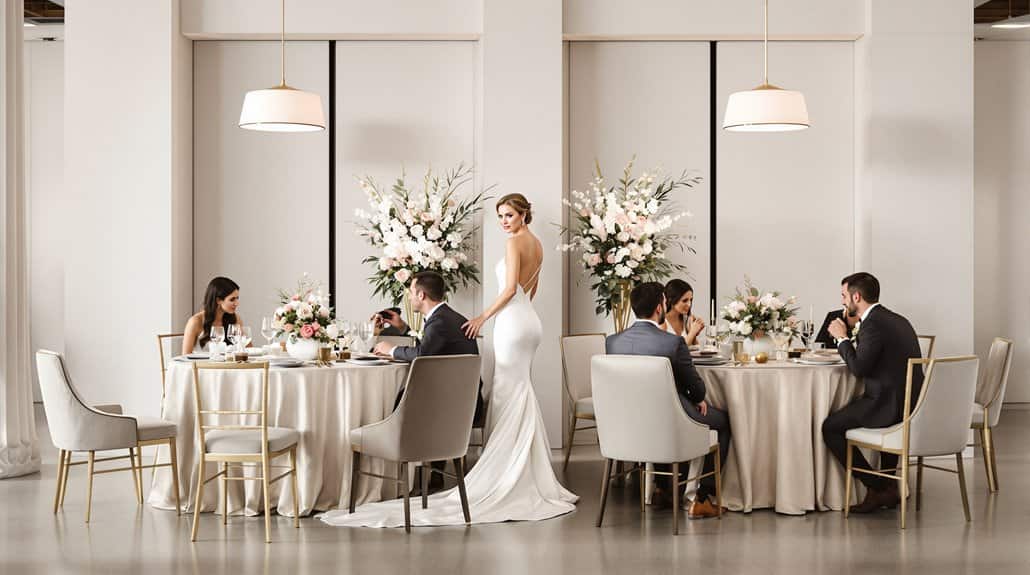
While you focus on the visual arrangement of your wedding tables, invisible sound waves actively shape every meaningful interaction your guests will experience throughout the reception. Speech intelligibility plummets as ambient noise rises—from pristine 0.89 STI ratings to unintelligible 0.29 when packed with chattering guests. You’re not just planning seating; you’re designing acoustic environments.
| Configuration | Acoustic Performance | Guest Experience |
|---|---|---|
| Round Tables | Higher noise cross-contamination | More inclusive conversations |
| Long Tables | Lower overall intelligibility | Creates distinct conversation zones |
| Mixed Layout | Balanced acoustic profile | Varies based on tactically placed elements |
Keep speaker-listener distances under one meter whenever possible. Those quaint round tables seating ten? They force conversations across 2+ meters—well beyond ideal intelligibility range. And yet, long editorial-style tables create their own acoustic bottlenecks, funneling service noise directly through conversation zones. Your perfect arrangement balances both formats tactically positioned within your venue’s unique acoustic fingerprint.
Photographic Aesthetic Differences
Beyond planning perfect conversations, you’re creating memories that will live through photographs for decades. The aesthetics of your seating arrangement will dramatically shape these visual records—for better or worse. Round tables create natural bokeh effects with warm lighting, producing elegant depth and multiple focal points rather than a single vanishing point. Theater-style arrangements, by contrast, generate linear perspective with clear foreground-to-background progression.
Your choice of materials dictates the entire visual narrative:
- Dark wooden furniture with beige walls photographs as timeless, classical elegance
- Contemporary black leather seating renders sophisticated, premium visual character
- Rustic wooden elements convey organic aesthetic, fundamentally different from modern materials
Spacing matters profoundly—6-foot minimum between round tables creates separation planes that enhance photographic depth. Your seating configuration isn’t just about function; it’s about creating visual rhythm through repetition, contrast, and focal hierarchies that will shape how these moments are remembered decades later.
Hybrid Approaches: Mixing Table Shapes
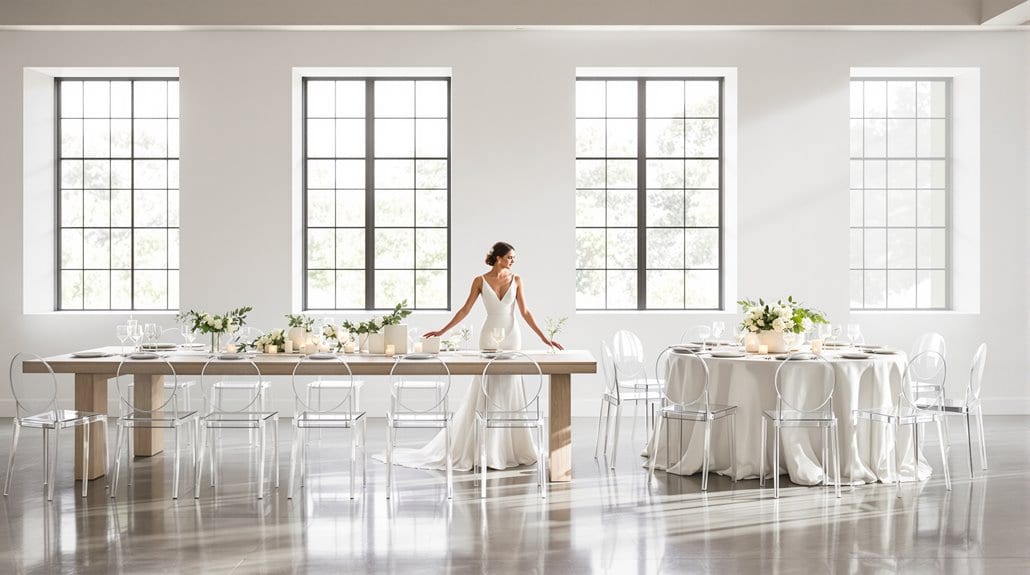
Mastering the art of mixed-shape table arrangements openers exceptional versatility for your event design, transcending the limitations of single-format layouts—and yet, this approach demands careful consideration of both spatial dynamics and social psychology.
You’ll maximize efficiency by combining 60-inch rounds (seating 8-10 guests) with 6-foot rectangulars (accommodating 6-8 people) while maintaining crucial 6-foot clearances between tables. Place rounds centrally for intimacy, rectangulars along perimeters for service flow. This isn’t merely aesthetic—it’s functional mathematics.
The hybrid strategy creates natural movement zones, too. Those strategic gaps between every third table? They’re deliberate breakout spaces, not afterthoughts. Your 48-inch squares might seat just 4-8 guests, but they’re perfect buffer zones between presentation areas and networking pods.
Consider cabaret-style setups with half-moon arrangements when you need the perfect compromise—intimate enough for conversation, open enough for presentation visibility.
Decision Framework by Priorities
Because your seating arrangement constitutes perhaps the single most consequential decision for event success, you’ll need a systematic structure—rather than intuition alone—to navigate the competing priorities that inevitably emerge. Start by ruthlessly ranking your non-negotiables. Task-based considerations should dictate form: convergent thinking demands rows (35% fewer disturbances), while collaborative work requires clusters.
Seating design demands systematic prioritization, not intuition. Align your spatial strategy with your event’s cognitive and social objectives.
Your hierarchy of needs must address:
- Instructional alignment: V-shaped configurations for presentations, horseshoes for discussions
- Individual characteristics: SEN students show 70% more on-task behavior in rows
- Environmental constraints: circulation pathways need 36 inches minimum
Don’t reflexively choose what’s trendy—cluster seating triples disruptive incidents compared to teacher-assigned arrangements. And yet, the same configuration that suffocates creativity during brainstorming sessions might perfectly contain chaos during independent work. Your priorities aren’t fixed; they’re contextual, shifting with each phase of your event’s rhythm.
Conclusion

While the perfect seating arrangement doesn’t exist in absolute terms, your tactical choices can dramatically influence both connection and productivity—the elusive twin goals most event planners chase but rarely capture simultaneously. The evidence points to thoughtful hybridization: circular configurations (8-10 people max) for intimate exchanges, balanced with strategic breakout options for efficiency’s sake.
Consider the spatial hierarchy. Round tables foster equality but sacrifice server access; long rectangles streamline service yet create psychological distance. Your solution? Modified crescents, perhaps—curved enough for eye contact, open enough for staff movement.
The physical environment becomes your silent facilitator. Position chairs at 90-degree angles rather than direct opposition when intimacy matters, yet maintain clean sight lines throughout. Remember that proximity creates connection, and yet too much proximity breeds discomfort—that 18-24 inch sweet spot matters tremendously. Your guests won’t consciously register these decisions, but their comfort and interaction patterns will reveal your expertise.