
To use candlelight safely, opt for enclosed candles in borosilicate or mason jars, maintaining a 12-inch barrier from combustibles. Limit quantities—four to six per table creates ample ambiance without unnecessary risk. Group candles in threes or fives for visual impact, and always designate a “candle captain” to monitor flames. LED alternatives eliminate fire hazards entirely while preserving that warm glow. Venue approval, secured in writing 12 months before your event, prevents last-minute disappointments and potential liability issues.
Why Candlelight Matters
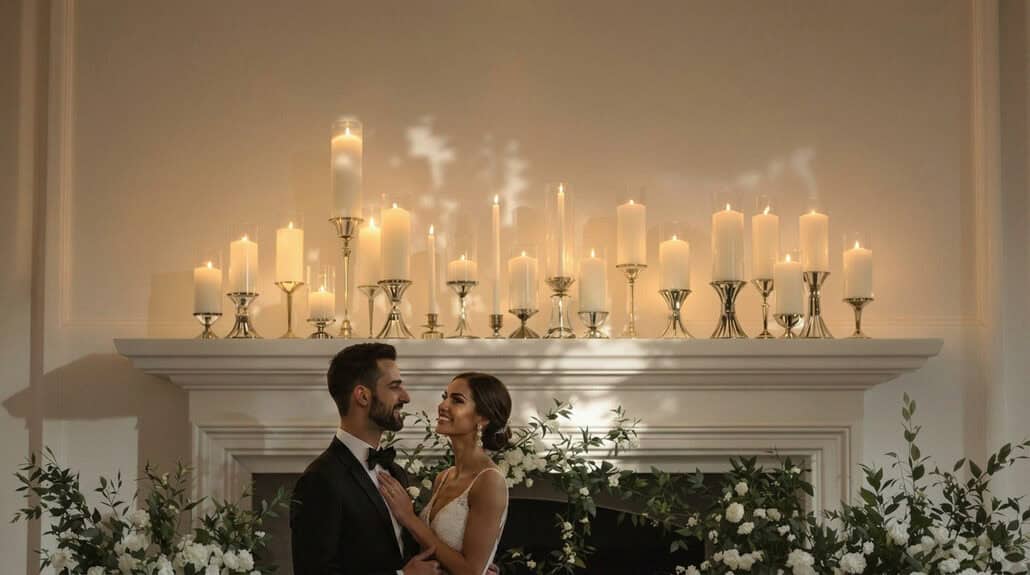
Why does a simple flame hold such power over our physiology and psyche? It’s science, not just romance. That flickering light triggers your parasympathetic nervous system, physically lowering cortisol levels—your body recognizes candlelight as safety, a primal response to our ancestors’ fire circles. When planning wedding candles safety, this matters tremendously. The use of candles in event settings can also enhance spending optimization by creating a more inviting atmosphere that keeps guests engaged.
Safe wedding candles create an environment where guests unconsciously relax, their breathing slows, their stress dissipates. The golden hue operates differently than harsh overhead lighting, preventing circadian disturbance while simultaneously inducing a meditative state. And yet, candles at weddings require careful consideration—the very power that calms can also create hazards.
The biological response is extraordinary: reduced anxiety, improved sleep quality, improved concentration. Your guests experience this transformation without realizing it’s happening. The flame that invites mindfulness also demands mindfulness in its handling—a beautiful paradox worth steering correctly. Consider incorporating hand-carved candles into your arrangements for enhanced calming effects through their natural flicker patterns and warm glow.
The Quantity Question: How Many Candles Actually Register
When planning candle-rich events, your impulse might tilt toward abundance—hundreds of tea lights, dozens of tapers, clusters on every surface—and yet, the psychology of impact operates more subtly than most realize. The emotional resonance of candlelight doesn’t necessarily increase proportionally with quantity. Safety experts suggest that tactical placement of fewer candles often creates more impact than hazardous overcrowding.
- Twenty thoughtfully positioned candles can create more atmosphere than fifty scattered haphazardly—while dramatically reducing wedding candle safety concerns. This approach aligns with the principle of quality over quantity, emphasizing that the essence of elegance is often found in restraint.
- Grouping candles in threes or fives creates visual anchors that register more powerfully than random distribution.
- Reception venues typically have unspoken candle quantities wedding planners should negotiate early—often 4-6 per table maximum.
- Consider battery-operated alternatives for perimeter lighting, reserving real flames for statement candle ideas at focal points.
Fire marshals don’t measure ambiance, but they do count flames. Your romantic vision needn’t become their cautionary tale. Always ensure candles are placed in sturdy holders that won’t tip over easily when planning your event lighting.
Vessel Types and Fire Safety

While candlelight creates magical ambiance for special events, the vessel holding your flame determines whether you’re crafting romance or risking disaster. Borosilicate glass containers offer superior thermal resistance—your safest bet for candle placement in any setting. Mason jars work beautifully too, withstanding temperatures up to 250°F, but those decorative vases you’ve been eyeing? Absolute fire hazards.
You’d think any pretty container would suffice, and yet the science proves otherwise. Tempered glass shatters dramatically when it fails; soda-lime varieties need specific annealing to prevent cracking. That repurposed jam jar might seem thrifty, but it wasn’t tested for prolonged flame exposure.
For candle safety that doesn’t compromise aesthetics, ceramic vessels labeled microwave-safe provide excellent alternatives. Just verify they’re properly sealed—two applications if unsealed—and inspect for cracks before lighting. Wood containers, despite their rustic charm, present unacceptable risks through absorption and ignition. Additionally, understanding historical luxury design principles can help you select vessels that are both safe and stylish.
Fire Code Compliance by Venue Type
Because fire safety regulations vary dramatically based on occupancy classification, you’ll need to navigate a complex web of requirements depending on where you’re placing those flickering flames. Restaurants operate under different candle safety protocols than educational facilities—a distinction that feels arbitrary until you’ve witnessed how quickly flame behavior changes in different environments.
Fire code regulations aren’t suggestions; they’re non-negotiable mandates with serious liability implications. Yet compliance needn’t kill your candlelit ambiance if you understand the nuanced requirements.
- Dining establishments require protected flames and self-extinguishing candles, with maximum heights of 24 inches above tables
- Assembly spaces (75+ occupants) demand continuous monitoring and functioning sprinkler systems
- Educational facilities prohibit candles in dormitories but may permit supervised ceremonial use
- Convention centers restrict candles to dining settings with strict flame height limitations
Master venue safety by anticipating requirements before your event coordinator raises objections.
Open Flame vs Enclosed Candles

Although aesthetically similar at a glance, open flame and enclosed candles present dramatically different safety profiles that could mean the difference between ambiance and ambulance. Your wedding candles safety strategy should prioritize containment—jar candles reduce risks of tipping, wax splatter, and accidental contact with flames.
| Feature | Open Flame | Enclosed Jars | Flameless LED |
|---|---|---|---|
| Fire Risk | High (5,910 annual fires) | Moderate | None |
| Placement Rules | 1-foot safety circle | Heat-resistant surface | Anywhere |
| Supervision | Never unattended | Reduced monitoring | Unneeded |
| Emissions | Soot, chemicals | Contained | None |
| Venue Approval | Rarely permitted | Often allowed | Universal acceptance |
When planning candle placement for your wedding, remember that 85% of candle fires stem from misuse, not product defects. You’re playing with literal fire—and yet, enclosed candles provide that ethereal glow without risking your venue deposit or, more critically, your guests’ safety.
Venue Coordinator Approval Strategy
Since most venue coordinators have witnessed the charred aftermath of wedding decoration disasters, you’ll need a tactical approach to gain their blessing for your candlelit vision. Start by securing explicit written confirmation of their candle policy—not verbal assurances that evaporate faster than tea lights in a drafty ballroom. Documentation transforms your wedding candles safety plan from wishful thinking into contractual obligation.
Secure written candle policies—verbal promises vanish faster than flames in a ballroom breeze.
- Request the venue’s fire code specifications in writing, including maximum candle quantities wedding regulations allow
- Create a detailed placement diagram showing every flame location with measurements from flammable materials
- Schedule a pre-event walkthrough specifically for candle approval, bringing sample setups
- Establish a designated point person who’ll monitor candles throughout your reception
Your venue coordinator approval strategy should begin 12 months out, not 12 days. Most coordinators aren’t reflexively anti-candle—they’re anti-surprise-inferno. Give them precise plans, and they’ll often work with you to illuminate responsibly.
Insurance and Liability Realities

Why does that warm, flickering glow come with such cold, hard financial risks? Your standard homeowners policy covers accidental fires, and yet placing wedding candles safety becomes questionable territory when dozens of drunken guests in flowing attire mingle near open flames. You’re legally responsible for maintaining a safe environment—full stop.
Candles at weddings create a triangulation of liability: venue, vendors, and you. The venue coordinator’s panic? It’s rooted in genuine financial exposure. A single claim involving third-party injuries could trigger legal fees reaching thousands, with settlements climbing exponentially higher.
The paradox of candle quantities wedding planners negotiate isn’t about aesthetics but calculated risk assessment. Ten pillar candles present less liability than 200 tealights scattered throughout a historic barn with limited exits. Your insurance likely covers sudden, accidental damage—but negligent placement of decorative elements? That’s where coverage becomes murky, contested terrain.
When to Use Flameless Alternatives
While the dancing flame of traditional candles creates unmatched ambiance, certain situations demand their battery-powered counterparts—no matter how desperately you crave that authentic glow. You’ll need to embrace LED alternatives when real flames present tangible risks rather than romantic aesthetics. Candlelight wedding dreams can still materialize without insurance nightmares or venue coordinator vetoes.
Sometimes safety must eclipse romance—your wedding memories should glow with joy, not insurance claims.
- Homes with curious toddlers or pets who view your wedding candles safety precautions as mere suggestions to ignore
- Venues with stringent fire codes that transform your candlelight wedding vision into a prohibited fantasy
- Events lasting 6+ hours where no one has time to monitor burning wicks
- Spaces with air circulation issues where traditional candles at weddings would mean respiratory distress for guests
Remember: authentic ambiance matters tremendously in creating memorable moments—and yet, the charred remains of your reception venue creates an entirely different sort of memory. Choose wisely.
Conclusion
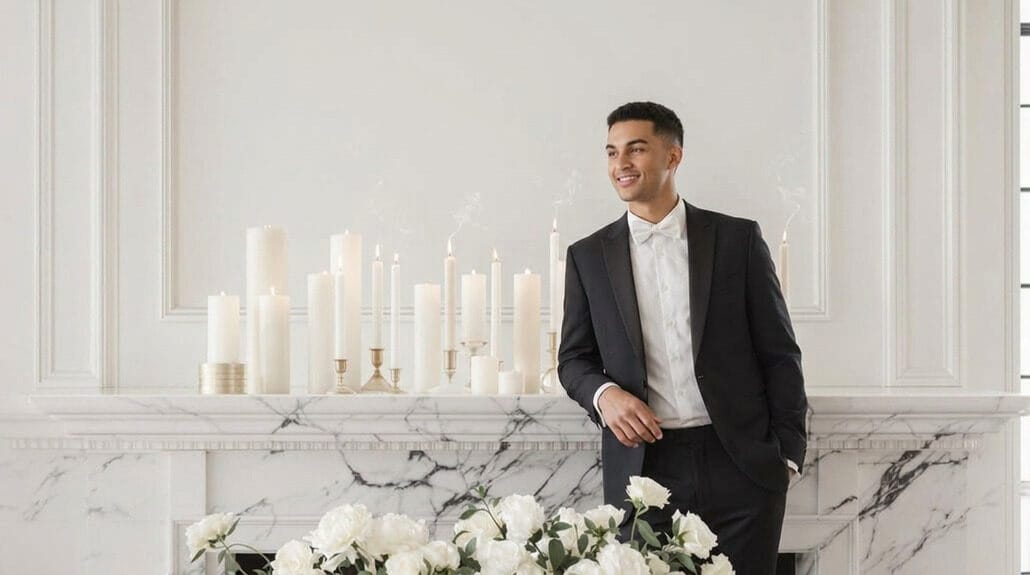
How deeply we’re drawn to the primal flicker of candlelight—that ancient dance of flame that transforms ordinary spaces into something magical, intimate, transcendent. And yet, as our data shows, this beauty comes with sobering risks: 20 daily home candle fires, 86 deaths in just four years, $374 million in property damage.
Your wedding candles’ safety requires vigilance, not paranoia. When managing candle quantities at weddings, remember the stark reality: 56% of fires start from combustibles placed too close to flames. Limit your vulnerability by maintaining that essential 12-inch barrier, using proper holders, and designating a “candle captain” to monitor and extinguish.
Candles at weddings create unparalleled ambiance, but alternatives exist. LED flames offer similar glow without the danger—particularly critical in venues with children, where 5% of candle fires originate.
Balance beauty with caution, romance with responsibility. The flicker you love needn’t become the flame you fear.