

Planning a wedding in six months isn’t just possible—it’s tactical. You’ll avoid decision fatigue while focusing resources on what truly matters. Start by confirming your date with family, establishing a non-negotiable budget ceiling, and drafting a preliminary guest count. Prioritize booking venue first, then lock in high-demand vendors like photographers. Consider a wedding planner—their industry relationships can bypass waiting lists and transform your compressed timeline from liability into advantage. The constraints will reveal what genuinely deserves your attention.
Why Everyone Says It’s Impossible And Why They’re Wrong
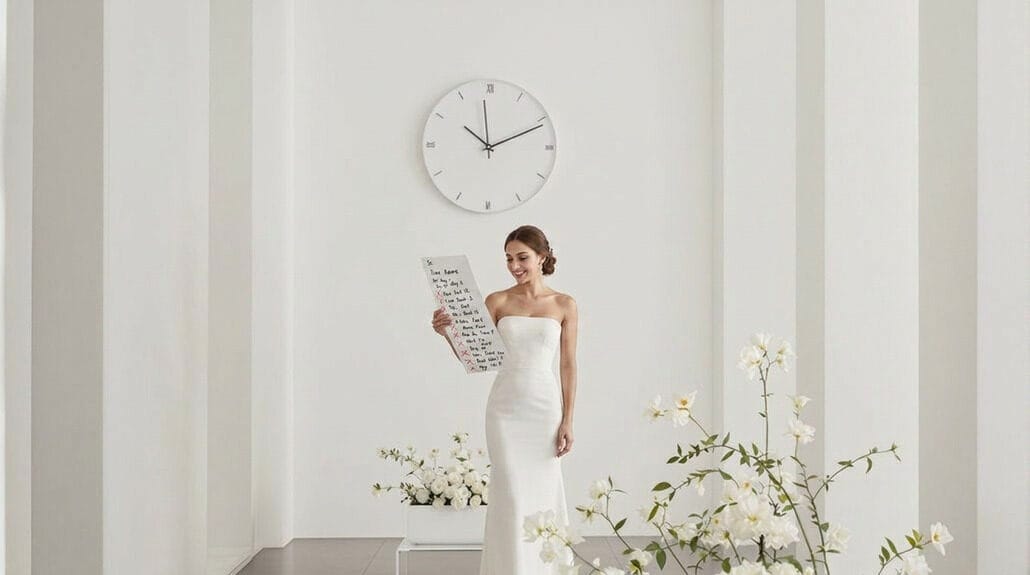
When you announce your six-month wedding timeline, you’ll likely face a barrage of concerned looks and cautionary tales—as though you’ve just declared you’ll be building the Taj Mahal by Tuesday. Yet this outdated benchmark of needing 18 months? Pure convention, not necessity.
The reality: 45% of couples plan in under a year, according to The Knot’s latest research. Your compressed wedding timeline isn’t radical—it’s increasingly standard. What traditionalists miss is how short engagement wedding planning actually eliminates decision fatigue rather than creating it. Consider exploring non-traditional venues for better availability and often more favorable pricing when working with a compressed timeline. Moreover, in today’s market, many couples are embracing emerging luxury trends that prioritize both aesthetics and efficiency.
Those wedding planning shortcuts everyone warns against? They’re tactical efficiencies. When you batch decisions by category and make choices in under ten minutes, you’re not compromising—you’re prioritizing. Six months forces clarity about what matters. The extended second-guessing that plagues 18-month planners evaporates when decisions can’t linger indefinitely. And ironically, couples report fewer regrets with tighter timelines, not more.
The Critical Path: Your First Two Weeks
Unlike casual wedding timelines that meander through possibilities, your six-month plan demands tactical precision from day one. Your critical path—those sequence-dependent tasks that dictate everything else—must be identified immediately.
Start by confirming your wedding date with immediate family before approaching venues. Simultaneously, draft your preliminary guest count (you’ll need this number for every vendor conversation) and establish your non-negotiable budget ceiling. Effective tier allocation strategies can help you maximize your budget when selecting vendors. These three decisions facilitate everything else.
While the standard planning duration typically spans 12 months, your compressed timeline requires more focused decision-making from the beginning.
Month 1: Foundation Weeks 1-4

Why does Month 1 matter so dramatically? It’s where your quick wedding planning either solidifies into something remarkable or crumbles under pressure. These four weeks demand ruthless prioritization—not perfection.
Establish your wedding budget immediately, dividing it into non-negotiable expenses (venue, photography) and flexible categories. Be brutally honest about numbers; $30,000 doesn’t stretch as far as Pinterest suggests. Create your wedding planning timeline with backward mapping—six months means compressed vendor booking windows, and yet this constraint forces clarity about what truly matters.
Select your venue first, then lock in your date. This single decision cascades through every subsequent choice. Simultaneously draft your preliminary guest list—a controversial task that many couples avoid, but one that determines almost every financial decision thereafter.
This foundation month isn’t glamorous, and yet it’s where smart couples win their abbreviated timeline battle through strategic decisiveness rather than panic-induced compromises. Embracing quiet luxury can guide couples in making tasteful choices that reflect their personal style without overwhelming their budget.
Month 2-3: Creative Development Weeks 5-12
Now that you’ve built your wedding’s sturdy foundation, these middle months transform your event from merely scheduled to deeply personalized. Your wedding planning timeline tightens here—this is where you’ll actually decide what your guests will eat, hear, and experience.
Start with reception décor decisions: centerpieces, linens, and rental items that reflect your aesthetic. Create a detailed mood board—not just Pinterest fantasies, but executable design schemes with confirmed vendors. Schedule that cake tasting (yes, the fun part), but arrive with clear parameters about budget and design expectations.
The ceremony deserves equal creative development. Meet with your officiant to craft a script that sounds like you, not a template. Select readings that reverberate, not merely tradition-appropriate passages.
Your attire timeline can’t slip: book that first dress fitting exactly 8 weeks out. Schedule hair and makeup trials immediately—photographers need these decisions finalized, and good artists book quickly.
Month 4-5: Execution Weeks 13-20

While the initial months built your wedding’s blueprint, these execution weeks transform plans into tangible reality—and you’ll need every minute. Your fast wedding planning now shifts from conceptual to concrete: schedule those dress alterations immediately, knowing a quality seamstress typically needs 2-3 sessions spaced across 4-6 weeks.
This phase demands ruthless prioritization. Begin vow writing now (not later), confirm your ceremony logistics with your officiant, and lock down entertainment details with deposits. The 6 month wedding planning timeline compresses what others do in twelve months—and yet success hinges not on having more time but on making smarter decisions faster.
Your decor strategy requires particular attention: rent don’t buy, coordinate colors across all elements, and finalize floral arrangements that work within budget constraints. Quick wedding planning succeeds when you treat vendor coordination like a military operation—collect insurance documentation, confirm timelines, and create backup plans for every critical element.
Month 6: Operational Lock Weeks 21-26
The operational lock phase has arrived—your last 6 weeks represent wedding planning’s highest-stakes endgame. This is where your 6 month wedding planning timeline shifts from creation to confirmation: finalize those guest counts (chase those infuriating non-responders), submit catering numbers, and distribute detailed timelines to your vendor army.
Your quick wedding planning strategy now demands ruthless delegation. Write those vendor checks in advance, assign payment responsibilities to a trusted lieutenant, and confirm every delivery schedule. Marriage license? Apply now. Final dress fitting? Schedule immediately.
Meet with your officiant, create day-specific checklists for your wedding party (who needs what, when), and assemble that emergency kit—safety pins, stain removers, bandages, pain relievers.
How to plan a wedding in 6 months requires this final sprint of administrative precision. You’ve beaten conventional wisdom by being methodical rather than magical—proving that thoughtful efficiency trumps extended timelines every time.
What to Skip Entirely on 6-Month Timeline

When planning a wedding with half the conventional timeline, ruthless elimination becomes your greatest tactical advantage. Your compressed schedule demands clarity about what genuinely matters versus what tradition merely suggests you include.
Skip elaborate DIY projects—they consume disproportionate time relative to impact. Ditch multi-venue celebrations that require coordinating transitions between ceremony and reception locations. Abandon custom-designed anything with long production cycles; opt instead for ready-made alternatives that can be personalized through styling.
Extensive bridal parties create coordination nightmares; consider limiting to 2-3 essential people. Wedding favors? Often forgotten or discarded—redirect that budget elsewhere. And while conventional wisdom insists you need save-the-dates, they’re redundant on a six-month timeline when invitations will follow shortly.
The most liberating elimination? Perfect-wedding mythology itself. Your celebration needn’t mirror others’ expectations or include every traditional element to be meaningful, beautiful, and precisely yours.
The Vendors Who Can’t Accommodate 6 Months
Despite your determination and organization, certain vendors simply can’t—or won’t—accommodate your six-month timeline, no matter how much you’re willing to pay. Photographers, venues, and elite planners book 12-18 months out during peak season, creating what industry insiders call “Hunger Games-style” competition for limited spots. You’re fighting against both time and mathematics: when three times the normal client load hits vendor calendars simultaneously, there’s simply nowhere to squeeze you in.
But—and this is essential—”no” from your dream vendor isn’t the end. Wedding professionals operate in tight-knit networks. When facing rejection, immediately ask, “Who would you recommend for my date?” This single question transforms dead-ends into new pathways. Contact local wedding associations for member directories, build backup vendor lists from day one, and consider wedding insurance to protect against last-minute cancellations. The six-month timeline isn’t impossible; it just demands strategic pivoting when doors close.
The Secret Weapon: Wedding Planner for Short Timelines

Facing vendor rejections brings us to your most powerful ally: a wedding planner specialized in compressed timelines. They’re not just organizers but negotiators who can secure your dream vendors when you’d otherwise hear “impossible.” A good planner capitalizes on years of industry relationships to bypass waiting lists and access preferential treatment—transforming your six-month window from liability to advantage.
| Planner Benefit | Standard Planning | With 6-Month Expert |
|---|---|---|
| Vendor Access | Limited availability | 72% better first-choice success |
| Budget Control | Scattered expenses | 58% improved budget adherence |
| Decision Making | Analysis paralysis | Focused, confident choices |
| Stress Level | Overwhelming | 64% reduced anxiety |
| Timeline Management | Chaotic scramble | Strategic execution structure |
You’ll pay for their expertise, certainly. And yet, their bundled services often reduce overall costs by eliminating separate vendor minimums while streamlining your already compressed decision-making process. The math works—emotionally and financially.
Decision-Making Framework for Speed
Because every decision in a six-month wedding timeline cascades into dozens of dependent choices, you’ll need a ruthlessly efficient structure—not just random planning. Your superpower is parallel processing—tackling multiple elements simultaneously rather than sequentially. Budget first, always. It’s the filter through which every subsequent decision must pass.
Three decision-acceleration techniques that actually work:
- Vendor bundling – Seek packages combining photography/videography or venue/catering, slashing negotiation time from weeks to days
- Pre-designed aesthetics – Select existing color palettes and themes rather than custom-building every visual element from scratch
- Centralized communication – Implement a single platform for vendor confirmations, eliminating the death-by-email syndrome
Your ability to make swift decisions separates successful short-timeline weddings from chaotic ones. And yet, speed doesn’t mean impulsivity—it means eliminating deliberation on non-consequential details while maintaining focus on high-impact elements that truly shape your day.
Conclusion

So what have we learned from this intense six-month sprint toward matrimony? That conventional wisdom—those whispered “impossibles” from well-meaning friends—deserves healthy skepticism. A compressed timeline doesn’t necessitate compromise; it demands strategic ruthlessness.
Your expedition required radical prioritization: identifying the non-negotiables (venue, photographer, your sanity) while releasing perfectionistic visions of hand-calligraphed place cards. And yet, the constraints yielded unexpected gifts—forcing clarity about what genuinely matters to you both as partners, not what Pinterest dictates.
The six-month structure demanded immediate action over endless deliberation. You learned to trust your instincts, make 24-hour decisions, and resist the paralysis of infinite options. But perhaps most critically, this quickened journey revealed that wedding planning—regardless of timeline—is merely practice for marriage itself: communication under pressure, unified decision-making, and remembering why you chose each other amidst the chaos. Not so impossible after all.