
Your estate wedding can honor family heritage while embracing modern restraint—it’s not an either/or proposition. Balance three generations of traditions by incorporating heirlooms (vintage silver, legacy photographs) while introducing contemporary elements like ghost chairs and purposeful lighting. Document your design decisions, create new rituals, and protect private moments. The tension between preservation and innovation isn’t a problem to solve, but the very essence of a meaningful celebration that bridges past and future.
Family Property Wedding Politics

When your family estate has hosted weddings for three generations, you’re not just planning an event—you’re steering a complex web of expectations, histories, and unspoken rules. Every corner of that property carries the weight of tradition and someone’s cherished memory.
Your grandmother believes the rose garden reception is non-negotiable. Your father insists the ceremony must face east—”as it always has.” Your mother quietly reminds you about Great-Aunt Mildred’s disappointment if you abandon the family property wedding traditions. And yet, these pressures come wrapped in love, in connection to something larger than yourself.
Navigating a heritage estate family celebration requires diplomatic skills worthy of international negotiations. Create a decision matrix: which traditions matter most to you, which can be honored in modified form, which must—respectfully—be laid to rest. It’s worth noting that these discussions may reflect broader social patterns, as Republican families tend to emphasize traditional marriage values and report greater family stability. Remember, you’re not just inheriting traditions, you’re creating them. The property remains; your wedding remains yours.
Three Generations of Wedding History
As you stand on the threshold of your estate wedding, you’re inheriting not just a venue but a living timeline spanning three distinct eras of matrimonial history. Your family property wedding represents three generations of shifting traditions—from your grandparents’ church ceremony with a home reception to your parents’ hotel ballroom affair with matching bridesmaids.
Your heritage family wedding carries this weight. The 1950s lace gown hanging in the attic, the formal dancing protocols your grandmother insists upon, the expectation that your father will foot the entire bill (though only 12% of couples followed this rule by 2015)—these aren’t just preferences but generational markers. And yet, your vision likely includes mixed-gender wedding parties, personalized attire, and cooperative financing arrangements. You may even consider wearing a dress in blush or gray tones rather than traditional white, reflecting contemporary bridal fashion trends. Before the ceremony itself, you’ll need to secure your Massachusetts marriage license, navigating documentation requirements that have evolved significantly from your grandparents’ era.
The family estate wedding paradox: honoring three generations of traditions while asserting your own identity—without anyone feeling their era has been erased.
Respecting Heritage Through Location

The terrain beneath your feet tells a story far older than your family’s wedding traditions. When selecting your family estate wedding venue, you’re not just choosing pretty photos—you’re participating in heritage conservation that extends beyond your lineage. Historic property management transforms your celebration into an act of preservation.
| Estate | Conservation Impact | Historical Significance |
|---|---|---|
| Aldie Mansion | Plants one tree per wedding | 10 acres of protected gardens |
| Linwood Estate | Dates to 1870 | 250-guest ballroom with original architecture |
| Howey Mansion | 1920s restoration | Century-old elegant details |
| Deering Estate | 450 waterfront acres | Biscayne Bay ecological preservation |
Your wedding becomes a conservation act—each booking at places like Aldie Mansion directly funds the protection of 16,000+ acres of natural terrains. Your celebration, while deeply personal, extends your family story into something greater: the preservation of cultural and ecological heritage that will outlast even the most established family traditions. For brides seeking refined elegance, Badgley Mischka’s wedding collection offers glamorous gowns that complement the grandeur of historic estate venues.
Asserting Modern Restraint Through Design
Your family’s wedding archives might overflow with ornate traditions, but modern restraint offers a pioneering path forward. Estate family dynamics often demand replication—your grandmother’s 17 floral arrangements, your mother’s four-tier cake—and yet, contemporary design thrives in selective editing. Neutral palettes punctuated with three carefully chosen accent colors allow your family estate wedding’s architecture to breathe rather than compete with decorative excess.
Consider the transformation: clean-lined furnishings against ornate moldings, warm bistro lighting creating intimate zones across 6,000 square feet of heritage space, and strategically placed textural elements—velvet napkins, billowing sheers—that honor tradition without smothering it.
When hosting on the wedding family property, your design strategy becomes intensely personal, balancing respect with revolution. The most successful celebrations incorporate architectural restraint: fewer, more intentional statements rather than the dense decorative layering your relatives might expect—or demand. This philosophy extends to your seating configuration, where spatial hierarchy determines whether guests experience genuine connection or merely occupy adjacent chairs.
Navigating Family Aesthetic Opinions

Navigating family aesthetic opinions creates perhaps the most complex social chess game you’ll ever play during wedding planning. When hosting at your family estate wedding, you’re not just choosing decor—you’re negotiating with generations of expectations. Gen Z couples face this acutely, embracing traditions at higher rates than millennials: 77% include cake-cutting versus 67% of millennials.
| Family Pressure Point | Your Modern Response | Generation Gap | Compromise Strategy |
|---|---|---|---|
| Heritage color scheme | Select one accent color | 32% ivory vs. 60% green | “Tradition with a twist” approach |
| Formal photography locations | Add candid moments | Old poses vs. new aesthetic | Schedule both formal and casual sessions |
| Heirloom decorations | Curate selectively | Maximalist vs. minimalist | Create heritage display area |
| Expected guest count | Quality over quantity | 131 Gen Z vs. smaller millennial lists | Intimate ceremony, larger reception |
Your family home wedding can honor lineage without surrendering your vision—and yet, finding this balance requires brutal honesty about which battles merit fighting. Consider channeling the same philosophy behind luxury beauty products when approaching your wedding aesthetic: timeless elegance doesn’t require overwhelming abundance.
Boundary Setting with Grace
While establishing healthy boundaries may seem confrontational, setting clear expectations with family members stands as the most compassionate gift you’ll give both yourselves and your relatives during estate wedding planning. When steering a family property wedding, you’ll need unwavering resolve—your wedding day, your rules. And yet, delivering these boundaries with empathy transforms potential conflicts into moments of deeper understanding.
Setting boundaries isn’t just self-protection—it’s a gift that honors everyone’s emotional wellbeing throughout the wedding journey.
Before diving into family estate wedding discussions, arm yourselves with:
- Written non-negotiables – Identify your absolute must-haves versus flexible areas
- United front strategy – Practice responding to predictable pressures as a team
- Empathetic scripts – “We appreciate your tradition of formal attire, but we’ve decided on cocktail dress”
- Strategic concessions – Yield on reception music, stand firm on ceremony readings
The American Psychological Association offers psychology resources specifically designed to help families navigate relationship dynamics and communication challenges during significant life transitions.
How Design Balanced Heritage and Contemporary
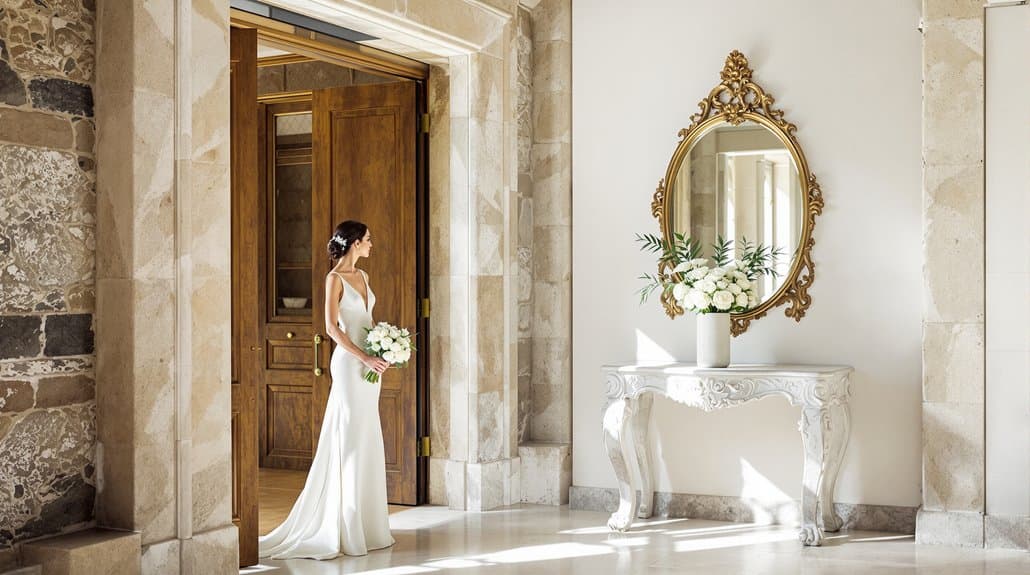
The ancient stone walls of family estates tell stories that span generations, yet these historic venues needn’t remain frozen in time for your wedding celebration.
The most successful estate weddings—35% of couples now choose these venues—embrace a delicate balance: honoring Gothic arches and wooden beams while introducing ghost chairs and geometric centerpieces. It’s tension made beautiful.
Your color choices matter profoundly here. Rich jewel tones and muted pastels amplify period architecture without competing with modern elements. And yet, it’s the lighting that truly bridges centuries—layered LEDs washing across Victorian balconies create visual cohesion impossible to achieve otherwise.
Consider spatial flow critically: those courtyards and terraces with arched walkways weren’t designed for Instagram moments, but they deliver them anyway. The most memorable designs don’t force guests to choose between heritage and contemporary—they experience both simultaneously, each elevating rather than diminishing the other’s power.
Position decorative installations within the 40-60% negative space to maintain clear sightlines to architectural features while allowing the estate’s historical elements to remain the focal point.
Conclusion
Estate weddings exist at the intersection of reverence and reinvention, a space where family histories breathe through contemporary design choices. When three generations have exchanged vows beneath the same oak arbor, every decision carries weight—and yet, the most memorable celebrations find balance between honoring what came before and writing your own chapter.
For couples navigating the complex waters of family estate weddings, remember:
- Document your compromises – photograph both the heirloom silver and your minimalist signage
- Create one entirely new tradition – something future generations might adopt
- Preserve private moments – dance alone in the library after guests leave
- Write a letter – detail your design decisions for the family archives
You’ll face pressure to recreate grandmother’s reception precisely—down to the champagne tower and place settings. But this tension between preservation and personal expression isn’t a problem to solve—it’s the very essence of what makes your celebration meaningful.
Consider how your format choice itself becomes part of this legacy: Super 8’s chemical certainty captures these heritage moments with grain and warmth that ages as gracefully as the estate itself, while digital precision preserves every polished detail for future generations to study.