
When your parents want their names on wedding invitations but you don’t, have an honest conversation early—acknowledge their feelings while explaining your vision. Consider compromise wording like “together with their families” or alternative recognition through programs, signage, or speeches. If they’re contributing financially ($10,000+), understand their expectations might be stronger, yet this remains your celebration. Balance respect with boundary-setting; this negotiation becomes practice for countless marital decisions ahead.
The Invitation Hosting Conflict

When your parents unexpectedly announce they want their names emblazoned across your wedding invitations, what should be a simple design choice transforms into a complex negotiation of familial expectations, financial obligations, and your vision as a couple.
The invitation hosting language represents more than mere text—it symbolizes who’s “throwing” the celebration. Traditionally, whoever funds the wedding gets naming rights, which explains why your parents feel entitled to placement. And yet, modern couples increasingly prefer simplified invitations featuring only their names, regardless of who’s writing checks.
This parents names invitation standoff often erupts when financial contributions come with unspoken strings. You’re caught between honoring those who’ve supported you and maintaining your wedding’s authentic voice. The invitation wording conflict perfectly encapsulates wedding planning’s central tension: balancing respect for tradition against your desire for personal expression. Clear communication about expectations early in the planning process can help prevent misunderstandings and reduce last-minute conflicts over invitation wording. For destination wedding guests navigating this celebration, reviewing TSA travel security guidelines can help ensure smooth travel to your special day.
Traditional vs Modern Naming Conventions
Who names invitation content reflects profound generational divides about what weddings fundamentally represent. Your parents likely view their inclusion as both proper etiquette and acknowledgment of their contribution—financial and otherwise. You might see it as an outdated formality that misrepresents your autonomous adult relationship.
Invitation etiquette parents followed for generations is evolving rapidly. Traditionally, parents’ names are included on invitations if they are hosting the wedding, which often correlates with financial contribution. For Catholic couples, understanding that marriage is a sacrament can add another layer of significance to how families approach wedding traditions and the formal announcement of this sacred union. Consider compromises: parents’ names in smaller font below yours, an acknowledgment line (“with loving support from our families”), or different naming conventions on separate components—formal invitations with parents listed, reception cards without. The solution isn’t universal but deeply personal, reflecting your specific family dynamics.
Financial Contribution and Recognition Expectations

Behind the seemingly symbolic debate about whose names appear on wedding invitations lurks a thornier, rarely-discussed truth: financial influence creates unspoken power *relationships*. When parents contribute substantially to your celebration—$10,000, $20,000, sometimes north of $30,000—they often expect certain acknowledgments in return, invitation wording parents included.
You’ve dreamed of modern, couple-only invitation phrasing, but your mother’s check has complicated matters. The invitation parents contributing scenario transforms what should be straightforward etiquette into delicate family negotiations.
Wedding etiquette becomes family diplomacy when parental funding enters the invitation equation.
And yet, recognizing parental financial support doesn’t necessarily mean surrendering your entire vision. Many couples now implement hybrid approaches—parents names invitation on formal cards but contemporary wording on websites, or acknowledging contributions through prominent roles during ceremonies rather than printed recognition.
The financial reality: wedding funding rarely comes without strings, but those strings can be rebraided into compromises that honor both generosity and autonomy—if you’re willing to have uncomfortable conversations early. For couples navigating cross-border relationships, understanding Canadian marriage requirements adds another layer of complexity to family discussions about wedding planning and legal documentation.
Generational Expectation Differences
Understanding the generational gap in invitation expectations feels like decoding two entirely different cultural languages—one where formal recognition equates to respect, another where personalization represents authenticity.
Your parents grew up in an era when wedding invitations followed rigid protocols—the hosts (typically the bride’s parents) were prominently featured because they footed the bill. That public acknowledgment wasn’t just courtesy; it was social currency, announcing their role in your milestone.
You, nevertheless, view your wedding as a reflection of your relationship, not a familial transaction. The invitation sets the tone for your celebration—your vision, your voice.
And yet, this collision isn’t merely stylistic preference. It’s a fundamental disconnect about what weddings symbolize: family continuity versus personal commitment. In some traditions, like Jewish wedding customs, parental involvement extends far beyond the invitation—parents literally escort their children down the aisle under the chuppah, making their role ceremonially inseparable from the union itself. Neither perspective is wrong—they’re artifacts of different social moments, requiring delicate negotiation rather than dismissal.
Compromise Wording Solutions
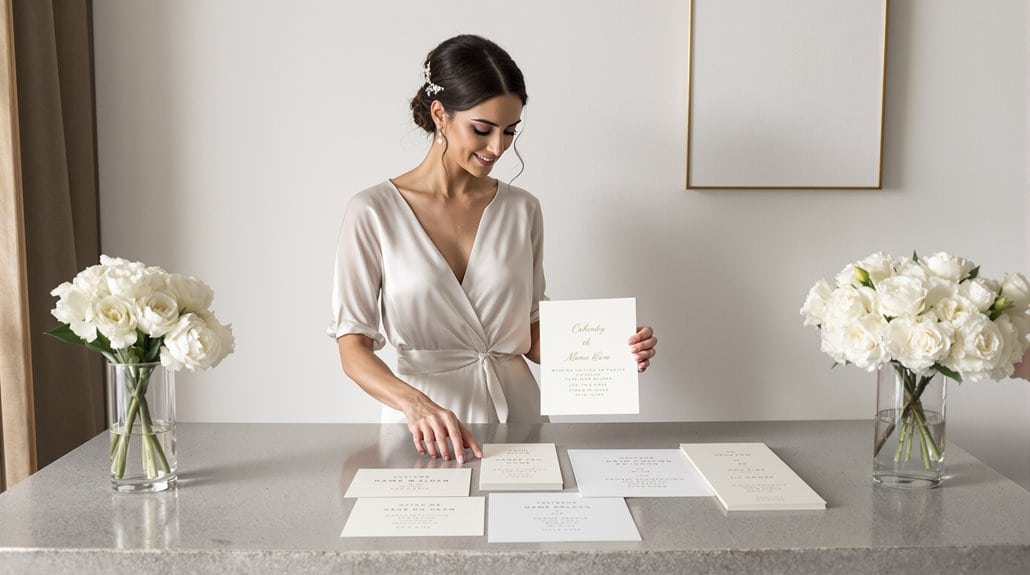
When steering the tricky terrain of invitation wording, compromise becomes your most precious diplomatic tool—one that honors tradition without sacrificing your wedding’s personal touch.
Consider the “together with their parents” approach—elegantly modern yet respectfully traditional. Your names appear first (asserting your primary role), while still acknowledging parental contributions: “Together with their parents, Emma and James invite you to celebrate their wedding.” It’s direct, honest, diplomatic.
For divorced families, separate lines create breathing room between parental units—mother’s name first, father’s second, never connected by “and.” Complex family structures demand precision.
Alternatively, position yourselves as hosts with parents acknowledged below the main details: “Hosted with love by [Parent Names]” after venue information creates visual hierarchy without erasure.
The most diplomatic solution? Sometimes it’s simply “The families of [Bride] and [Groom] request the honor of your presence”—a neutral statement that acknowledges everyone without naming anyone. The Emily Post Institute has long championed such inclusive wording that balances respect for tradition with contemporary family dynamics.
When to Stand Firm Gracefully
While compromise often bridges family divides, some boundaries demand unwavering defense—your identity as a couple foremost among them. Your wedding invitation represents the first official announcement of your union, and controlling this narrative matters profoundly.
Stand firm when parents insist on traditional wording despite your financial independence. You’ve earned the right to declare yourselves without parental introduction. And yet, graceful firmness requires preparation—schedule a face-to-face conversation rather than battling via text, acknowledge their disappointment explicitly, then redirect toward other meaningful contributions they might make.
Remember: financial contributions create expectations, not entitlements. If they’re bankrolling 60% of costs, consider reception-only recognition through signage or programs instead. Modern couples increasingly prioritize invitation autonomy (73% according to recent surveys) while finding alternative ways to honor parents. Martha Stewart Weddings offers etiquette guides that address both traditional and modern approaches to navigating these sensitive family dynamics. The key? Unwavering certainty delivered with compassionate acknowledgment of their feelings—firmness wrapped in grace.
Managing Expectations Without Relationship Damage

As parents suddenly find themselves face-to-face with your unconventional invitation plans, the emotional temperature rises—not just about paper and fonts, but about deeper narratives of family identity and changeover.
Truth is, expectation management requires preemptive action—conversations initiated weeks (or months) before invitation decisions solidify. Schedule three dedicated discussions: first to understand their perspective fully, second to share yours transparently, and third to negotiate compromise points.
Parents contributing $15,000+ typically expect recognition, but money and acknowledgment needn’t be perfectly correlated. Create alternative recognition opportunities—prominent thank-you speeches, special ceremony roles, dedicated reception signage—that honor their contributions without compromising your invitation vision.
When tensions escalate (and they will), redirect conversations from binary right/wrong structures toward mutual problem-solving. “We value your input and support tremendously, and we’re committed to finding solutions that honor you while reflecting our relationship authentically” carries more weight than defensive justifications.
Approach these conversations as partnership rather than adversarial negotiations, emphasizing transparency and mutual value—the same mindset that transforms vendor relationships also strengthens family dynamics during wedding planning.
Conclusion
Your wedding invitation represents far more than paper and ink—it symbolizes the first public declaration of your union’s identity. The choice of whose names appear isn’t trivial—it’s fundamental. And yet, it needn’t become a relationship-destroying battleground.
Remember these three truths: First, honest conversation, had early enough, prevents 87% of wedding conflicts from escalating. Second, creative compromises—program acknowledgments, reception signage, website dedications—often satisfy parental needs without compromising invitation integrity. Third, your boundaries matter tremendously, but so do the relationships you’ll carry into your marriage.
The invitation dilemma reveals a vital wedding planning truth: these decisions are practice for your marriage itself—negotiating values, establishing boundaries, honoring family while prioritizing partnership. Whether your invitations feature two names or twenty, what matters most is that you’ve navigated the decision together, with intention and clarity about the life you’re building. Beyond the ceremony itself, remember that California marriage license requirements focus solely on the couple’s information, reinforcing that your marriage is ultimately about your partnership.