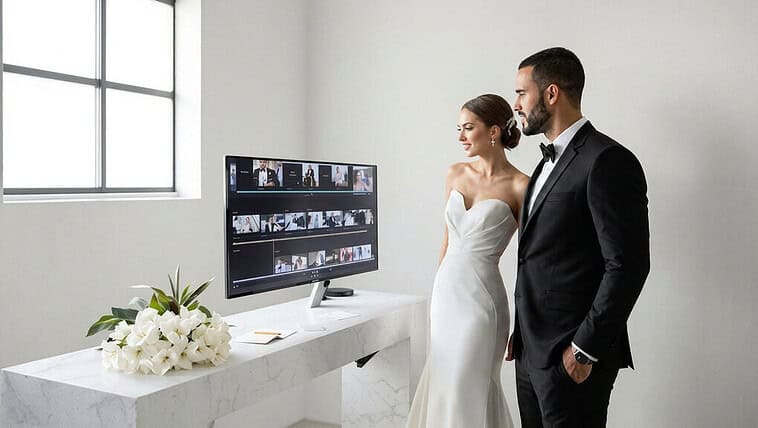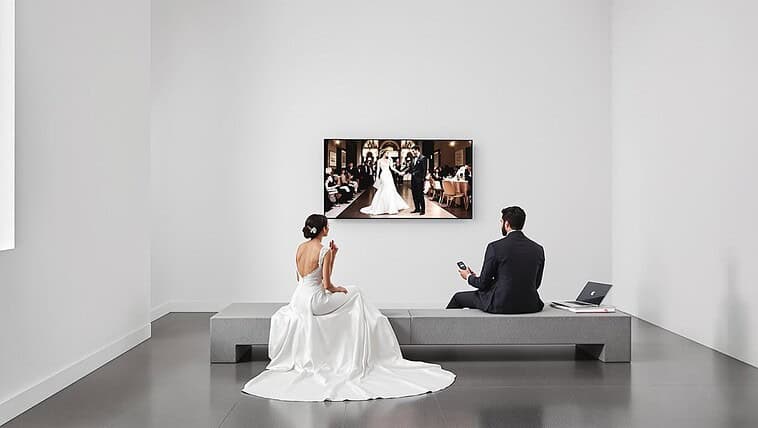
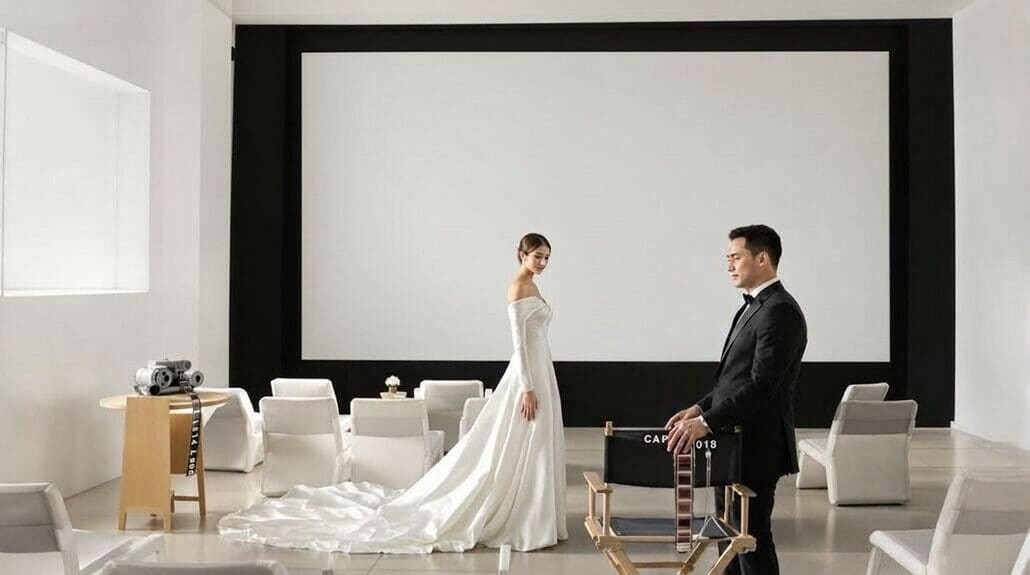
Your wedding film should transcend mere documentation, capturing your day as cinema—a 3-10 minute emotional journey with deliberate pacing, artistic editing, and narrative structure. While documentary approaches preserve every moment chronologically, cinematic storytelling guides viewers through your love story’s emotional peaks, creating a film you’ll actually rewatch. Brief your videographer like a director, specifying visual style and key narrative beats. The difference isn’t just aesthetic; it’s whether your memories feel lived or merely recorded.
Documentation vs Cinema – Essay opening
The traditional wedding video approach—chronological footage, unedited speeches, predictable structure—creates a record, not a story. And yet, your wedding deserves more than clinical documentation. It contains all the elements of compelling cinema: anticipation building through preparation, the emotional climax of vows exchanged, the celebratory resolution of reception festivities.
A cinematic storytelling wedding video transforms these moments into a 3-10 minute emotional journey rather than a 2-hour unabridged archive. It selects perfect vow fragments as voiceovers while showing reaction shots, creates deliberate pacing through transitions, and builds a narrative arc that captures not just what happened, but how it felt to be there. The cinematic style elevates your memories through artistic shots that emphasize beauty and emotional depth rather than merely recording events. Just as haute couture transforms fashion into art through meticulous attention to detail and craftsmanship, cinematic wedding videography elevates your celebration beyond simple recording into an emotionally resonant visual masterpiece.
Wedding as Short Film: Arc Tension Resolution
When you approach your wedding film as a cinematic narrative rather than documentation, you’re crafting an emotional journey that echoes far beyond the day itself. Your narrative wedding film deserves a three-act structure: exposition establishing your love story through atmospheric venue shots and family preparations; rising action building tension through parallel editing of your separate preparations; and a perfectly-paced climax that lingers—yes, lingers—on your vows and first kiss.
This isn’t pretentious artistry—it’s emotional engineering. Consider how a well-crafted film manipulates time: slowing down for the ring exchange (12-15 seconds minimum), accelerating through reception dancing with energetic cuts, creating breathable pauses before pivotal moments. The rhythm matters enormously. Every editing decision should focus on emotion rather than chronology to create a compelling narrative that resonates with viewers. Just as lighting influences emotional response without conscious awareness, your film’s visual treatment should guide viewers’ feelings through intentional choices in exposure, color grading, and shadow play.
Your love story contains natural tension points—anticipation before seeing each other, the suspended moment before “I do”—and resolves into celebration. Don’t just record these moments; shape them into the compelling short film they deserve to be.
Briefing Videographer as Film Director

Because your videographer arrives with equipment but no clairvoyance, your ability to articulate cinematic vision transforms the entire filming approach. Your wedding film narrative deserves more than just competent capture—it demands intentional direction. Schedule a pre-wedding consultation where you’ll outline the emotional arc, visual aesthetic, and storytelling elements that matter most.
| Direction Area | What to Specify | Why It Matters |
|---|---|---|
| Visual Style | Light (airy/moody), movement preferences, reference films | Establishes cinematic language |
| Narrative Focus | 3-4 emotional beats to emphasize | Creates story structure beyond chronology |
| Audio Direction | Key dialogue moments, music tone, ambient sound importance | Builds emotional resonance |
Don’t assume professionals inherently understand your vision. The most breathtaking wedding films result from couples who treat videographers like directors—providing clear parameters while trusting their technical expertise. Your film’s quality hinges on this delicate balance: specific direction without micromanagement, vision without restriction. Consider consulting modern etiquette guidance to ensure your directorial approach respects both your creative vision and the professional boundaries of your videography team.
Narrative Approach Discussion
Unlike documentation that mindlessly follows a timeline, narrative structure transforms scattered wedding moments into meaningful emotional journeys viewers can’t look away from. Your wedding film narrative should weave together interview soundbites, non-linear storytelling, and emotional anchors to create a cinematic experience that echoes long after the credits roll. Think about how personal vows and family reflections can serve as narrative pillars rather than chronological checkpoints.
To create a wedding film that evokes genuine emotion:
- Conduct pre-wedding interviews with family members to establish narrative foundation
- Incorporate voice-overs and personal letters as emotional centerpieces
- Structure footage non-chronologically to build tension and resolution
- Layer visual metaphors that symbolize your relationship journey
Your story deserves more than bland documentation—it demands cinematic treatment that captures not just what happened, but why it mattered. The difference isn’t just aesthetic; it’s the difference between forgettable footage and unforgettable storytelling. Just as complementary color palettes create deliberate tension and emotional impact through visual contrast, your film’s narrative structure should intentionally position opposing emotional moments to amplify their collective power.
Cinematic Techniques in Wedding Context
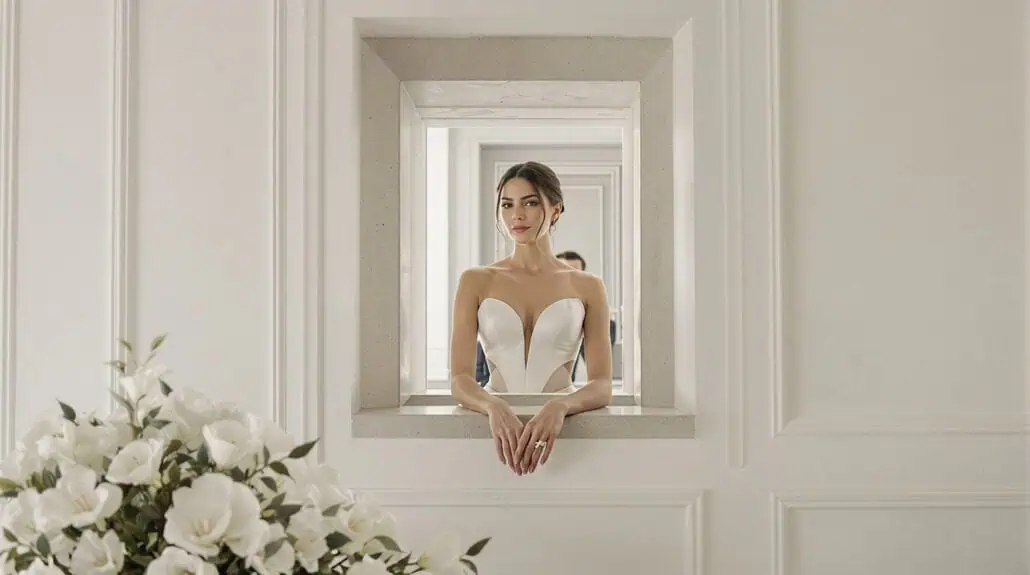
The narrative backbone of your wedding film needs technical mastery to fully breathe. Your cinematic wedding film must leverage composition principles—like the rule of thirds and negative space—to direct attention precisely where emotion lives. Frame your first kiss with symmetry, position cameras at eye-level to foster empathy, and capture silhouettes to elevate pivotal moments.
Light transforms ordinary documentation into cinema. Chase golden hour’s warm glow, embrace side-lighting for dimension, and don’t fear shadows—they’re where depth hides. Your movement choices telegraph emotion: stabilize during vows, go handheld for dancing’s electric energy.
Prime lenses (f/1.2-1.8) create that shallow depth of field separating your day from flat documentation. Vary your angles—low positions for empowerment, reflections for sophistication, zooms to isolate intimate exchanges amid chaos. These aren’t merely aesthetic choices, but narrative tools transforming documentation into something visceral, something cinema—and yet they remain invisible when deployed with restraint. Just as wedding makeup preparation requires weeks of skincare groundwork to achieve a flawless on-camera appearance, your film’s visual foundation demands meticulous attention to these technical fundamentals long before the ceremony begins.
Examples: Narrative vs Documentary
When you examine real wedding films side by side, the philosophical divide between documentary and cinematic approaches becomes immediately apparent. Documentary films present your day as it happened—comprehensive, chronological, unfiltered—while cinematic wedding film narratives transform those same moments into an emotional journey with deliberate pacing, carefully selected audio, and visually striking composition.
The emotional impact differs dramatically in four key ways:
- Documentary captures everything but leaves viewers to find meaning themselves
- Cinematic storytelling guides viewers through a deliberately crafted emotional experience
- Raw footage preserves history but often feels tedious during extended viewing
- Artful editing transforms ordinary moments into remarkable memories through narrative tension
You’re not just preserving what happened—you’re creating how it felt. The documentary approach is factually complete, and yet the narrative approach connects more deeply because it mirrors how memory itself works: selective, emotional, and thematically coherent rather than chronologically perfect. This cinematic philosophy extends beyond the film itself to every detail of your wedding day, from the glamorous wedding dresses that create visual elegance on screen to the way each frame captures the refined sophistication of your celebration.
Conclusion

Choosing between cinematic and documentary approaches fundamentally depends on what you’ll cherish most when revisiting your wedding day decades from now. The research reveals a nuanced truth: neither style claims universal superiority. Many couples opt for both—a cinematic wedding film for emotional resonance and shareability, paired with journalistic coverage for all-encompassing authenticity.
Your priorities matter most. Documentation excels at straightforward preservation—every toast captured, every dance move recorded—with minimal post-production complexity. And yet, cinematic approaches transform scattered moments into cohesive narratives with emotional arcs that transport viewers back into the feeling of the day, not just its chronology.
Consider this: perhaps the either/or structure itself creates a false choice. The most satisfying outcome might be finding a videographer skilled in both languages—one who documents thoroughly but edits cinematically, preserving both the raw material and the poetic distillation of what made your celebration uniquely yours. Just as intentional clustering transforms large venues into intimate spaces, thoughtful cinematography paired with comprehensive documentation creates films that feel both emotionally resonant and complete.