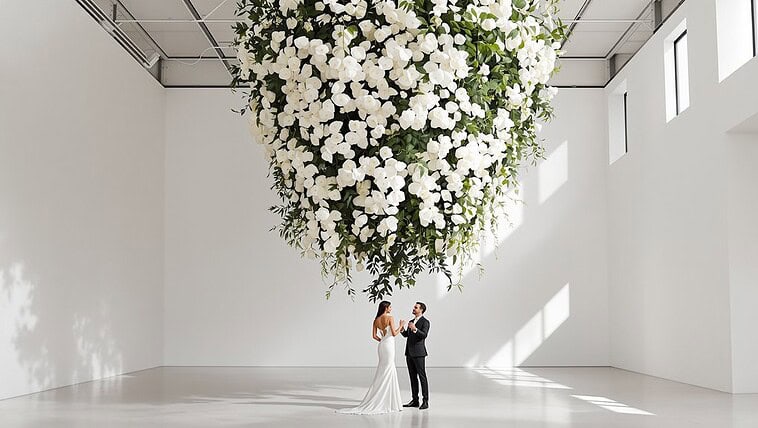

Suspended florals create ethereal, overhead drama that transforms spatial perception—drawing eyes upward while preserving sightlines ($1,200-$5,000+). Grounded arrangements, nonetheless, establish intimate focal points at eye level, promote conversation zones and tactile connection ($250-$450). Your choice impacts not just aesthetics, but guest flow and spatial experience. Suspended installations require special rigging and venue approval; grounded pieces offer traditional substance. The most influential strategy? Sometimes combining both to shape the complete spatial narrative.
Two Spatial Strategies

When it comes to designing your wedding’s floral scenery, you’re essentially choosing between two distinct spatial approaches—each with profound implications for your event’s visual narrative. Suspended floral installations command attention from above, drawing eyes upward and creating ethereal, floating gardens that transform ordinary venues into otherworldly spaces. And yet, they require structural reinforcement, venue approval, and typically higher installation costs—practical realities that ground even the most fantastical designs.
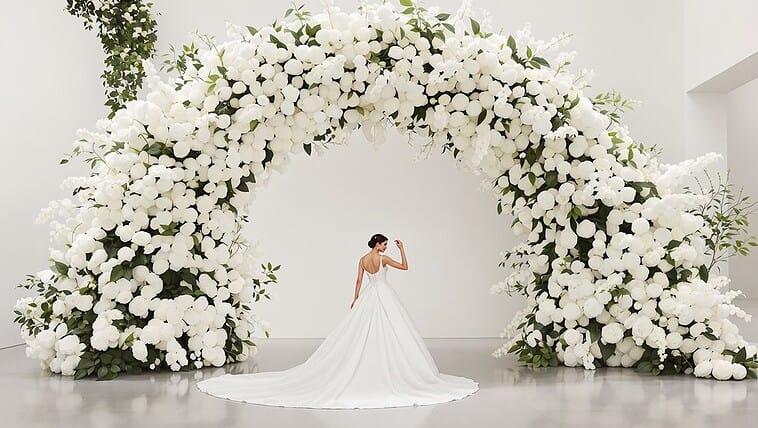
Grounded arrangements, particularly meadow-style installations using 3-5 foot modular sections, offer a different poetry. They mimic nature’s own logic—flowers emerging from earth, not sky. They’re anchored, substantial, traditional. But their innovation lies in asymmetrical, layered construction: stock and delphinium creating vertical lines, focal flowers (roses, dahlias) clustered in groups of three, moss providing foundation. Unlike overhead floral design, they become part of the landform rather than hovering above it—creating intimate, accessible beauty that feels both wild and intentional. Modern designs like Grounded Arches create a focal point backdrop that naturally enhances the ceremony’s visual appeal while maintaining a connection to the earth. For brides seeking cohesive design elements, these naturalistic arrangements complement vintage-inspired wedding dresses that echo the organic, timeless aesthetic.
Suspended Installation: Overhead Impact
Why do suspended florals command such reverence in modern event design? They revolutionize spaces through dramatic overhead focal points while preserving clean sightlines—the ceiling florals versus table decision isn’t merely aesthetic but functional. Your guests can converse without craning necks around centerpieces, creating unobstructed social flow.
Suspended floral cost runs higher, requiring specialized installation teams (typically 2-3 professionals), structural attachments to venue beams, and more complex mechanics using fishing line, chicken wire, and water picks. And yet, the investment yields transformative returns through “floral infinity” experiences—immersive canopies floating above dance floors or sweetheart tables that envelop guests in botanical atmospheres. These installations often incorporate trailing faux florals like Clematis and Jasmine to create a more realistic appearance.
Hanging flowers wedding installations create visual drama without sacrificing table space. They’re particularly stunning when asymmetrical, garden-styled, and strategically lit from within. The result? A floating illusion that photographs magnificently while allowing guests to experience your event through an enchanted, upward gaze.
Grounded Arrangements: Traditional Focal Points

The classic tabletop arrangement commands attention through deliberate design hierarchy—not floating overhead but anchored firmly at eye level. You’ll notice grounded arrangements create intimate connection with guests, a direct visual dialogue that suspended installations simply cannot replicate. Central placement of focal flowers—those magnificent garden roses, peonies with their dinner-plate diameter, butterfly ranunculus with impossible texture—establishes immediate authority.
Your focal blooms become the undisputed monarchs of the table. Position them at the highest point, letting secondary flowers cascade outward in perfect symmetrical balance. The most successful arrangements maintain exquisite proportions: one spectacular 5-inch peony commanding attention while delicate spray roses provide context and scale. And yet, unity remains paramount—your showstopping focal flower establishes the arrangement’s entire personality, a single bloom dictating the emotional tenor for everything that follows. The design feels inevitable, each element in precise conversation with the next. For wedding day celebrations specifically, consider incorporating luxury French beauty elements through complementary cosmetics displays or perfume accents that enhance the sensory experience of your grounded floral arrangements.
Spatial Impact Comparison
Choosing between suspended and grounded florals fundamentally transforms your entire wedding atmosphere—beyond mere decoration into architectural statement. When you hang ceiling florals, you’re utilizing vertical space that typically goes wasted, creating an ethereal canopy that alters guests’ visual height perception and expands the room’s dimensions. Grounded installations, nevertheless, anchor the experience, establishing contained boundaries while framing you and your partner at eye level.
- Vertical drama – Suspended installations draw eyes upward, creating magical depth illusions while preserving precious table space
- Horizontal flow – Grounded arrangements create intimate, garden-like settings that naturally channel guest movement
- Venue transformation – Ceiling installations mask rustic beams or bland ceilings; grounded pieces adapt to any location without infrastructure requirements
- Space perception – Suspended elements create airy openness; grounded designs establish deliberate focal boundaries
Your choice isn’t just aesthetic—it’s architectural, determining how guests physically experience and move through your celebration space. Some museum wedding venues feature architectural grandeur so complete that couples eliminate florals entirely, allowing spaces like the Guggenheim’s spiral rotunda or SFMOMA’s living green wall to serve as the sole design element.
Cost Differences and Installation Complexity

While dreams of floating blooms might enchant you, suspended floral installations command markedly higher investment than their grounded counterparts—with costs ranging from $1,200 to $5,000+ compared to modest $250 to $450 for traditional arrangements. This cost differential stems from technical demands you can’t see but absolutely pay for: rigging equipment ($1,000-$8,000), scissor lift rentals, and specialized labor.
The installation complexity of suspended florals extends beyond mere price tags. You’ll need qualified professionals—not just any florist—to ensure safety measures protect everyone beneath your botanical masterpiece. What once cost $500 seven years ago has skyrocketed as expertise requirements have intensified. And yet, there’s something uniquely revolutionary about overhead installations that makes couples continue choosing them despite the premium.
Ground installations offer simplicity: quicker setup, fewer staff hours, minimal equipment—but they’ll never create that floating, dreamlike quality that suspended designs deliver.
Venue Requirements for Suspension
Before dreaming of ethereal blooms suspended above your reception, you’ll need to confront the architectural reality of your venue’s ceiling—which will either embrace or entirely thwart your floating floral vision. Ceiling rigging demands structural integrity that many pretty spaces simply don’t possess, and yet knowing exactly what to look for transforms this potential roadblock into manageable logistics.
Your venue’s ceiling isn’t just architecture—it’s the canvas that determines whether your suspended floral dreams become reality or remain Pinterest fantasies.
- Open ceiling rafters, exposed pipes, or pre-installed ballroom rigging points offer ideal attachment options without additional infrastructure costs
- Ceiling height dictates access method—ladders work for 8-12 feet, but anything higher requires cherry pickers that’ll add $500-1200 to your budget
- Fire suppression systems, HVAC, emergency lighting, and exit signage create no-go zones that can dramatically limit your suspended florals placement
- Venue coordinator approval isn’t optional—it’s mandatory, often requiring engineering calculations proving a 10:1 safety factor for anything hung over guests
Design Psychology of Each Approach

The spatial position of your floral displays fundamentally alters how guests perceive and interact with your entire event space, creating psychological ripple effects that extend far beyond mere decoration. Suspended florals transform ceiling voids into active design elements, drawing eyes upward—and yet, this vertical gaze redirection subtly expands perceived room dimensions while freeing sightlines across tables. The floating quality creates an ethereal, dreamlike atmosphere that grounds guests within a defined spatial narrative.
Grounded arrangements, by contrast, anchor visual flow at eye level, creating intimate conversation bubbles around each table. These traditional focal points provide psychological comfort through their tangibility and proximity—but they simultaneously fragment the room’s cohesive experience into discrete islands of attention. However, historic venues introduce critical constraints: original ceiling beams may not support rigging equipment for suspended installations, requiring structural load calculations before any design decisions are finalized. Your choice ultimately shapes spatial perception at a subconscious level: suspended arrangements create unified, expansive environments while table arrangements prioritize immediate, tactile connection within smaller social clusters.
Decision Framework
Selecting between suspended and grounded florals requires maneuvering a complex decision matrix that extends far beyond aesthetic preferences into practical considerations of venue architecture, budget parameters, and desired guest experiences. The suspended vs ground florals decision demands ruthless honesty about your venue’s infrastructure—those soaring ceilings might beckon hanging installation logistics, and yet without proper rigging points, you’re building castles in air.
- Venue constraints: ceiling height (minimum 12-15ft for suspended installations), weight-bearing capacity, and existing architectural features that complement or compete
- Guest flow: ceiling florals versus table arrangements dramatically shift how people physically move through and visually experience your space
- Budget allocation: suspended installations front-load costs (often $1,500-3,000 for rigging alone)
- Timeline implications: hanging installations require earlier setup (typically 6-8 hours versus 2-3 for grounded pieces)
Industrial venues present additional complexity, as their raw spaces often lack the electrical infrastructure necessary to support elaborate lighting that showcases suspended florals, potentially requiring generator systems and specialized wiring that can add thousands to your floral installation budget. Your decision crystallizes when you prioritize either immersive overhead drama or traditional tabletop intimacy—rarely can you financially justify both.
Conclusion

Whether suspended in mid-air or grounded firmly on tables, your floral installations become the architectural language through which your wedding speaks to guests. The suspended vs ground florals debate isn’t about which is superior—it’s about spatial transformation that aligns with your vision. Overhead floral installations create celestial wonder, drawing eyes upward into a dimension often left unadorned, while grounded arrangements root your celebration in earth-inspired abundance.
Your choice reflects practical considerations—venue restrictions, budget parameters, aesthetic goals—and yet transcends mere logistics. It’s about manipulating space itself. The most successful designs often blend both approaches: suspended drama above dance floors, complemented by 26-inch meadow-inspired tablescapes below. Consider how guests will move through and photograph your space from multiple angles.
Authentic estates with mature landscaping provide a natural foundation that both suspended and grounded florals can enhance rather than compete against, whereas commercial venues often require more dramatic floral interventions to establish character.
Remember: florals aren’t just decorative elements but dimensional sculptures that reshape perception, transform ordinary venues into extraordinary environments, and silently communicate your celebration’s emotional landscape.