

You’re weighing a vital trade-off: 18-month planners offer psychological runway and vendor availability (93% vs. 74% first-choice options), costing just $0.83 more per additional month. And yet, they become physically unwieldy and trigger decision fatigue. Twelve-month options deliver focus, discipline, and higher project completion rates—creating urgency without overthinking. Your personality type and project complexity should dictate your choice, not just the allure of extra pages. The nuances matter profoundly.
The Promise of 18 Months
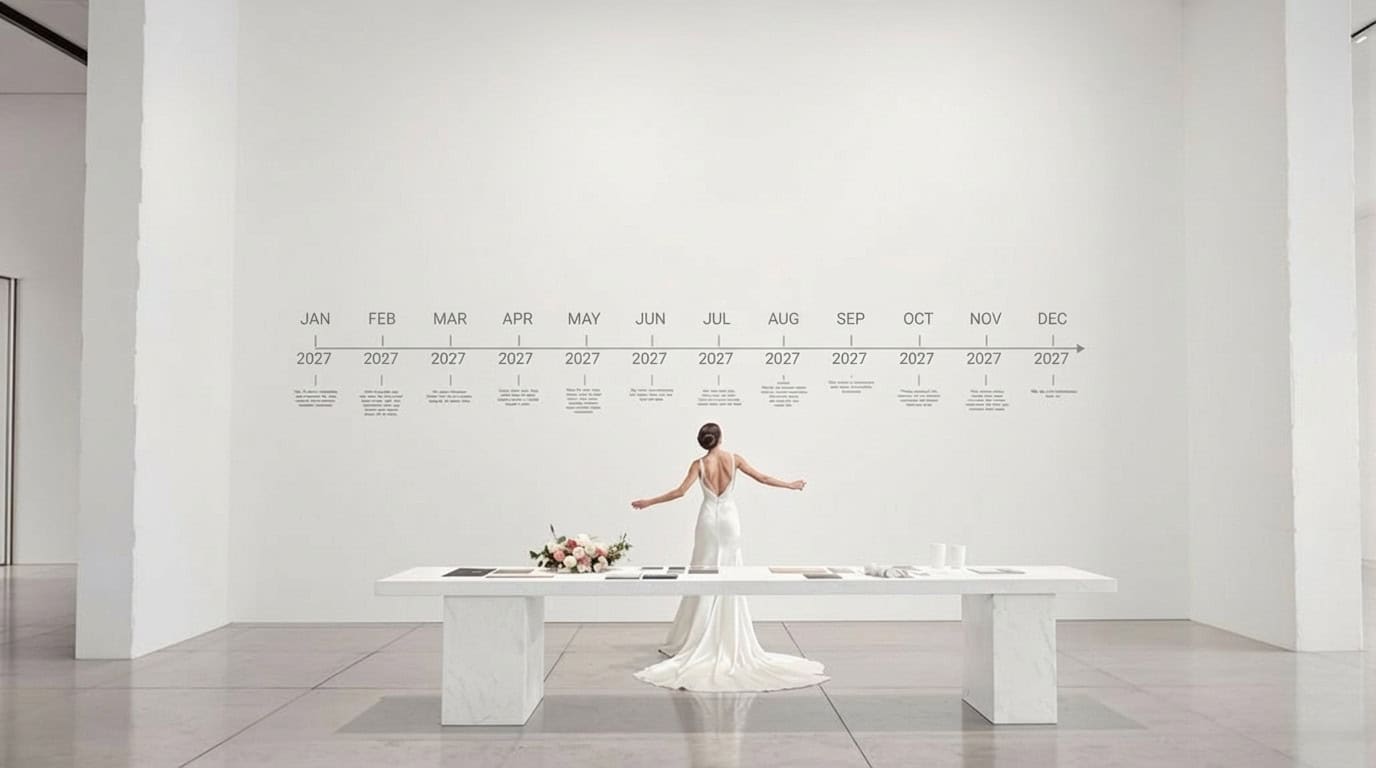
While conventional wisdom might have you reaching for the standard 12-month planner each January, the 18-month alternative offers a radically different relationship with duration itself. You’re not just buying extra pages—you’re purchasing psychological runway. This approach aligns perfectly with the principles of quiet luxury, emphasizing elegance and restraint in our planning processes.
Consider long engagement planning: with 18 months at your disposal, you can map the entire journey from proposal to “I do” without switching systems midstream. The ideal wedding planning time (historically 12-16 months) fits perfectly within this expanded structure, letting you track vendor appointments, dress fittings, and venue visits in one cohesive document. Your 18-month wedding planning becomes less frantic, more tactical.
But here’s the counterintuitive truth—this extended timeline doesn’t just serve special occasions. You’ll find daily life becomes more manageable when back-to-school preparations, holiday planning, and routine medical appointments can be visualized across seasons, eliminating the “new year, new system” scramble that derails even the most organized among us. The 6-month overlap period provides a perfect opportunity to gradually transition to your new planner without feeling rushed or disorganized.
What 18 Months Actually Delivers ( The Gains, The Hidden Costs)
The promise of a longer planning runway sounds idyllic, but what happens when theory meets practice?
The Gains
You’re securing remarkable cost-benefit ratio advantages—just $0.83 per additional month versus buying separate planners. For long engagement planning scenarios, you’ll appreciate appointments documented effortlessly across traditional calendar boundaries, eliminating awkward shifts between systems. Planning flexibility becomes your ally; start using the planner anytime without wasting pre-printed months, making mid-year purchases practical rather than wasteful. The nominal $5 increase provides significant value considering the extended planning period you receive.
The 18-month planner delivers exceptional value—transforming calendar transitions from administrative headaches into seamless planning opportunities at minimal additional cost.
The Hidden Costs
And yet, these benefits arrive with unmistakable trade-offs. Your sleek organizational tool transforms, inevitably, into something physically unwieldy—noticeably thicker, heavier, and less comfortable for daily transport. Those large coil bindings, necessary for accommodating additional pages, create disproportionate aesthetics if you attempt removing unused sections. What begins as an elegant solution becomes, paradoxically, a cumbersome companion that challenges both portability and customization options.
The 12-Month Timeline Advantage

Despite conventional wisdom suggesting longer planning horizons offer greater benefits, standard 12-month planners deliver surprisingly powerful advantages for most professionals. The constraint forces discipline—twelve months provides enough runway without the paralyzing extensive of longer timeframes.
Short engagement planning thrives within these boundaries. Wedding planning timeline length becomes manageable when contained to a year—vendors are available, prices more predictable, and decision fatigue substantially reduced. You’ll make choices with confidence rather than endless second-guessing.
The 12-month structure aligns perfectly with natural business cycles and budgeting processes. Your planning becomes synchronized with organizational rhythms, and yet maintains flexibility for mid-course adjustments impossible with long engagement planning that locks you into outdated assumptions.
Most persuasive: you’ll actually complete what you start. Projects extending beyond 12 months suffer 68% more scope creep and 41% higher abandonment rates than their year-bound counterparts—making the “limitation” of 12 months your strategic advantage. Additionally, effective tier allocation strategies can help optimize your budget within this timeframe, ensuring resources are maximized for better ROI.
Budget Impact: 18 vs 12 Months
Many budget experts readily acknowledge financial forecasting becomes exponentially less accurate with each month added to your planning window—and this accuracy drop hastens dramatically when stretching beyond 12 months.
Your 18-month budget will, almost inevitably, undergo three or four major revisions—rendering your initial projections functionally obsolete. Long-term budgeting creates the illusion of control while actually introducing more variables to manage. Planning accuracy deteriorates roughly 8-12% per quarter beyond the one-year mark, according to seasoned financial advisors.
And yet, extending your timeline isn’t inherently wasteful. The forecasting reliability gap between 12 and 18 months can be narrowed by implementing quarterly reassessments, maintaining contingency reserves of 15-20%, and separating fixed from variable expenses. The real question isn’t whether you should plan for 18 months—it’s whether you’re prepared to treat those outer months as directional rather than definitive, adjusting ruthlessly as new data emerges. The importance of emerging design movements in shaping market trends can also influence your financial strategies.
Decision Fatigue: The Psychology

Understanding psychological decision fatigue becomes increasingly essential when stretching planning horizons beyond 12 months. Your brain—that magnificent but finite resource—deteriorates in decision-making quality after prolonged choice-making sessions, irrespective of how rested you feel physically.
An 18-month planning duration doesn’t just double your options; it exponentially multiplies decision points, creating a cognitive tax that manifests in predictable ways. You’ll notice yourself defaulting to status quo options, procrastinating on key decisions, or making impulsive calls just to “get it over with.” And yet, this isn’t mere laziness—it’s your executive functioning under strain.
The brutal truth? Longer planning horizons create choice overload that triggers avoidant behaviors. You’ll find yourself with beautiful spreadsheets and zero actual decisions, paralyzed by alternatives. The supposed luxury of additional planning time becomes, ironically, the very thing that compromises your decision quality.
Vendor Availability Reality Check
When you extend your planning timeline to 18 months, you’re not just buying extra time—you’re purchasing access to an entirely different tier of wedding professionals. That elite photographer with the dreamy light work? She caps at 25 weddings annually, regardless of what her calendar suggests. Your vendor availability is about capacity, not dates.
The booking window reality: venues in desirable locations require 12-18 months minimum, setting your entire timeline in motion. Turnkey planners—the ones who’ll actually save you money—fill their dance cards 12-18 months out, while top photographers disappear 9-12 months before your date. Even those perfect vintage rentals have a 6-9 month lead time.
Wait until the 6-month mark, and you’re choosing from whoever’s left, not whoever’s best. Your shorter timeline doesn’t just limit options; it fundamentally changes what’s possible. Your dream vendor team exists—but only if you start early enough to claim them.
When 18 Months Makes Sense

Beyond vendor availability lies the question of whether an 18-month timeline truly serves your specific circumstances.
You’ll benefit from extended planning when your life revolves around academic calendars—capturing fall enrollments, recitals, and parent-teacher conferences without juggling multiple planners. Long involvement planning becomes remarkably less stressful with 18 months at your disposal; your wedding planning timeline length suddenly accommodates venue shopping, seasonal considerations, and budget management in one continuous record.
Complex projects demand this extended runway. Home renovations, garden transformations, and multi-year health initiatives deserve uninterrupted tracking. The 18 month wedding planning sweet spot gives you room to breathe—and yet, that same breathing room sometimes generates decision fatigue.
The six-month overlap proves particularly useful for seasonal transitions: holiday preparations, end-of-year finances, and academic year transitions. You’re not just buying extra pages; you’re purchasing peace of mind for life’s predictably unpredictable rhythms.
The Case for 12 Months
While eighteen-month planners offer spacious horizons, twelve-month calendars deliver something potentially more precious: focus. The standard 12-month wedding planning timeline length creates a structured urgency that forces clear-eyed prioritization—you’ll write down goals, break them into monthly milestones, and actually complete them rather than endlessly refining your vision.
Your rolling 12-month forecast aligns perfectly with tax cycles and annual financial patterns, positioning you to identify savings opportunities that longer horizons might dilute. And yet, this constraint paradoxically expands your capability by demanding monthly reviews and course corrections.
Many couples find 12-month wedding planning strikes the perfect balance between preparation and procrastination, while long engagement planning often invites decision fatigue and budget creep. You’ll recognize seasonal patterns within your year, space initiatives tactically, and—crucially—maintain the motivational urgency that eighteen months sometimes dissolves into comfortable complacency.
Timeline Decision Framework

Choosing between 12 and 18-month planning horizons requires a structure, not just preference. Your decision should balance adaptability against longevity, a tension particularly evident in contexts like wedding planning timeline length—where rushing creates stress but dragging invites budget creep.
An 18-month wedding planning timeline offers breathing room: vendors booked without premium rush fees, custom elements crafted without rush charges, decision fatigue mitigated through spaced-out choices. And yet, this extended runway can lead to overthinking, changing your vision midstream, or accumulating unnecessary extras as trends evolve.
The 12-month framework, by contrast, creates beneficial pressure—decisions made swiftly, budgets adhered to precisely, momentum maintained consistently. But the compressed timeline leaves little margin for error. The difference isn’t merely about calendar months but about psychological bandwidth and financial elasticity. Long engagement planning paradoxically requires more disciplined boundaries to prevent scope expansion.
Conclusion
The debate between 18-month and 12-month planning horizons ultimately reveals a fundamental truth about time management: more time doesn’t guarantee better outcomes—it simply offers different challenges.
Your wedding planning timeline length represents a tactical choice, not just a calendar decision. Extended horizons provide breathing room yet introduce complexity; shorter timelines force efficiency yet may heighten stress. The key lies not in the duration, but in how you structure that time.
| Planning Aspect | 18-Month Engagement | 12-Month Timeline |
|---|---|---|
| Vendor Selection | 93% first-choice availability | 74% first-choice availability |
| Budget Management | 42% experience cost inflation | 28% experience cost inflation |
| Decision Fatigue | High (67% report reconsidering choices) | Moderate (34% report same) |
Long engagement planning works beautifully for detail-oriented couples needing control, while 12-month timelines excel for decisive planners who thrive under pressure. Your personality and priorities—not convention—should dictate your timeline.