
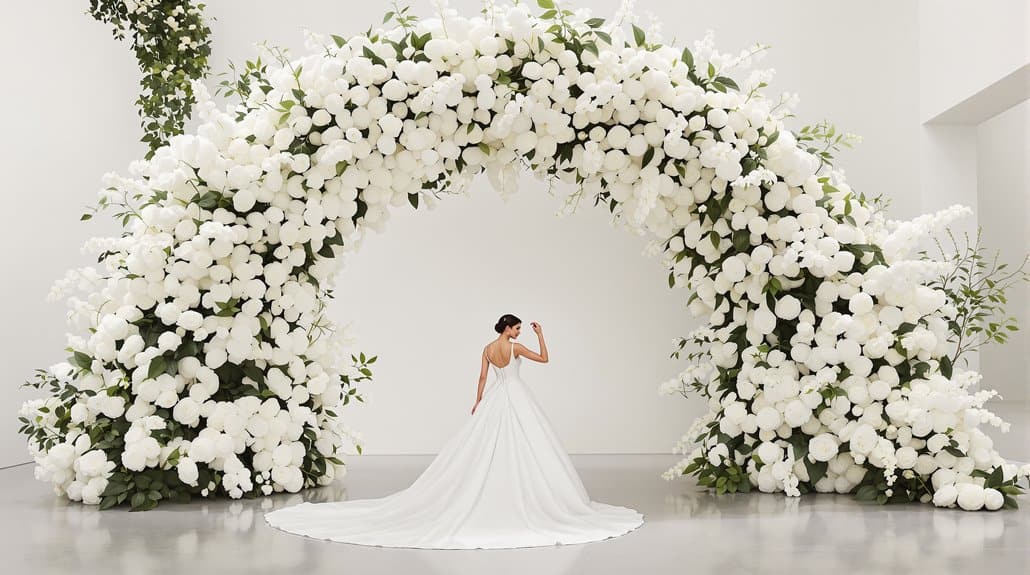
A $15,000 floral budget buys you more than just flowers—it’s investing in innovative environmental artistry. You’re securing 700+ premium blooms, a team of 4-6 professionals working 12+ hours, engineering expertise for structural installations, and refined logistics (refrigeration systems, ethylene inhibitors). That sticker shock? It covers specialized vessels, custom-built structures, and the invisible architecture making those cascading ceiling installations possible. The difference between nice arrangements and immersive experiences that reshape your entire venue lies in these details.
The $15K Sticker Shock
When you first hear “$15,000 for wedding flowers,” your jaw might hit the floor—and understandably so. That’s a down payment on a car, several months’ rent, or a lavish international vacation. But that luxury wedding floral budget, once dissected, reveals itself to be surprisingly… remarkable?
Here’s why: Your expensive flower budget isn’t just buying stems—it’s purchasing artistry, infrastructure, and excruciating attention to detail. Those 700+ blooms require skilled hands to transform them into structural installations that won’t topple during your vows. You’re paying for a team (often 4-6 professionals) working 12+ hours between setup and breakdown. At this level, you’re investing in a dramatic sweetheart table and sophisticated cocktail hour arrangements that create cohesive elegance throughout your event.
And yet, the high end floral cost becomes clearer when itemized: $2,000 for personal flowers, $5,500 for that ceremony moment everyone photographs, $6,000+ for tablescapes that transform ballrooms into enchanted gardens. Just as you’d consult wedding skincare preparation guides months in advance, premium florals require meticulous planning and expert execution. It’s the difference between florals as afterthought and florals as revolutionary design element.
Labor Costs: Installation Crew and Time
The breakdown of a $15,000 floral budget becomes even more transparent when examining what actually happens behind the scenes. Your dreamy floral arch isn’t just blooms—it’s people, hours, and expertise. When you’re quoted that seemingly eye-popping number, you’re paying for a lead designer ($40-50/hour) plus multiple assistants ($20-30/hour), all commanding wedding-specific rates that account for taxes and overhead.
- Pre-event setup requires 4-6 hours minimum before guests arrive—unloading trucks, building structures, and thorough quality checks
- Complex installations (hanging florals, ceremony backdrops) demand specialized labor, consuming 20-25% of your total floral budget
- Travel matters—$1 per mile plus hourly rates for driver time adds up quickly
- Safety protocols for elevated installations require additional crew members and time
Labor costs represent the invisible architecture of your wedding florals—unglamorous, yet utterly essential. For elaborate floral structures like arches or chuppahs with full coverage, expect to pay thousands of dollars due to the hundreds of stems and extensive labor hours required. Professional coordination ensures smoother execution and fewer last-minute issues that could compromise your floral vision. Without this installation crew, your Pinterest dreams would remain just that: dreams.
Material Costs: Bloom Quantities and Grades
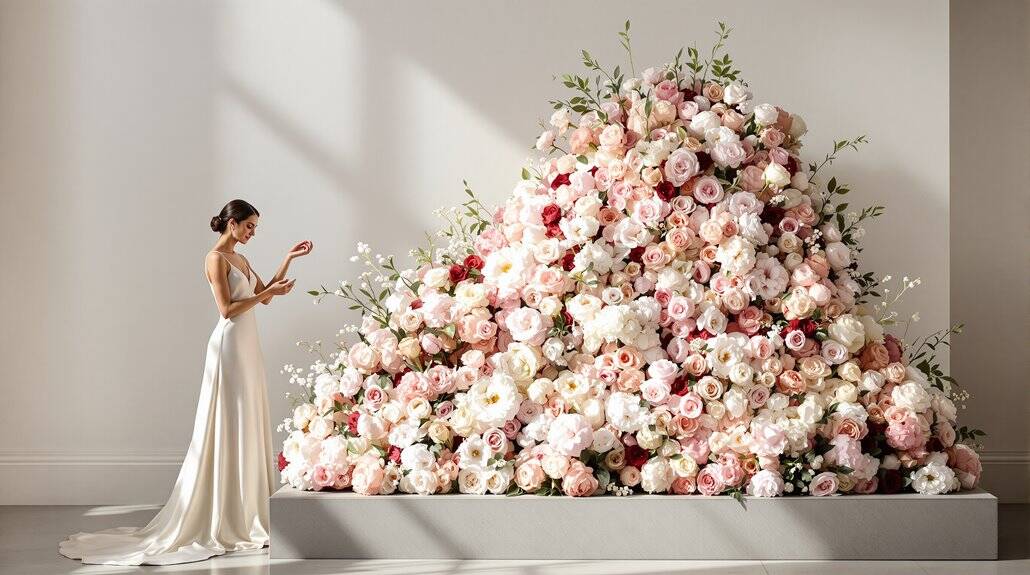
Behind those jaw-dropping centerpieces and cascading installations lies a mathematical reality most couples never glimpse: raw stem count. Your luxury wedding floral budget translates to approximately 700-1,000 stems minimum for an all-encompassing design—and that’s before we factor in quality grades.
Premium blooms command premium prices. Those garden roses you’ve pinned? $8-15 per stem. Peonies out of season? $25 each. And yet, grade matters as much as variety. A single AA-grade orchid costs triple its B-grade counterpart but delivers quadruple the visual impact in expensive floral arrangements.
The floral budget breakdown reveals a brutal efficiency: 40% toward premium focal flowers (peonies, garden roses, orchids), 35% for supporting blooms (ranunculus, lisianthus), and 25% for textural elements and greenery. But these percentages shift dramatically based on seasonality, availability, and design complexity—meaning your $15,000 might stretch gloriously in May yet barely cover basics in February. Beyond florals, consider pairing your botanical investments with luxury French beauty products like Lancôme to ensure your bridal glow matches the elegance of your arrangements.
Design Complexity and Structural Requirements
Most couples fixate on flower choices while overlooking the engineering marvels underpinning luxurious floral displays. Your floral budget breakdown reveals an inconvenient truth: what appears simply beautiful requires invisible architectural foundations. Cascading bouquets demand precise wiring techniques—each bloom individually secured—while ceiling installations require custom structure that won’t collapse mid-reception.
Behind every breathtaking floral masterpiece lies an unseen world of structural engineering that most couples never consider.
Complex arrangement types multiply labor costs dramatically. A simple centerpiece becomes exponentially more expensive when reimagined as a suspended garden or seven-foot ceremony arch requiring scaffolding and a three-person installation team.
- Support structures constitute 15-25% of costs for elaborate installations
- Complexity multipliers: basic arrangements (×1.0), cascades (×3.0)
- Large installations require specialized mechanics costing $200-800 before a single flower is added
- On-site assembly demands 4-8 hours of skilled labor for statement pieces
You’re not just paying for flowers—you’re commissioning temporary botanical architecture that must appear effortless while withstanding hours of scrutiny.
Vessel and Container Investment
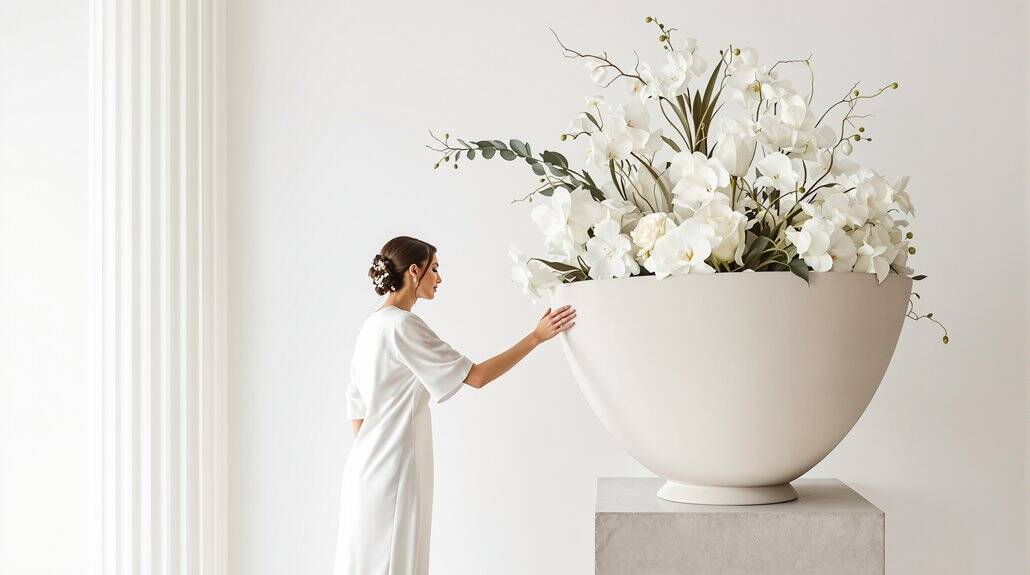
While breathtaking flower varieties captivate your attention, vessels and containers silently determine whether your floral investment sinks or soars. That ceramic compote vase holding your centerpiece? It’s a $12 wholesale item marked up 2.5x—and yet this seemingly simple markup finances the entire ecosystem of vessel maintenance, from storage infrastructure to specialized transport containers.
You’re not just buying flowers; you’re investing in an elaborate vessel hierarchy. Reception tables demand multiple container types—tall statement pieces ($750-$1800), mid-level arrangements ($400-$800), and low lush designs ($300-$500). Smart florists utilize wholesale container sourcing, purchasing in bulk to optimize margins while offering you diverse options.
Those premium container investments like floral walls can exceed $12,000 alone. Specialty installations—wreaths, garlands, hanging focal points—require substantial structural support systems. Historic venues often impose hanging décor restrictions that prohibit nails and tape, requiring florists to invest in alternative rigging solutions like free-standing structures. Even a simple window box refill ranges from $119 to $339, reflecting the true cost of containing botanical beauty.
Logistics: Transport Refrigeration Backup
You’d never suspect that a $15,000 floral budget includes thousands for what amounts to refined life support systems. Behind those perfect blooms lies an invisible, temperature-controlled environment maintaining flowers at precisely 33-35°F—the sweet spot that suspends aging. Your arrangements require constant real-time temperature monitoring from field to centerpiece, with dual sensors tracking conditions 24/7 and alerting teams when readings approach danger zones.
Behind every petal lies an unseen refrigerated dance—where 33°F science preserves the artistry you’ll remember forever.
Transport refrigeration backup isn’t glamorous, but it’s non-negotiable. Every remarkable arrangement depends on it.
- GPS-equipped refrigerated vehicles with double thermal insulation ($1,800-2,200)
- Ethylene gas inhibitors preventing premature aging during transit ($650)
- Emergency response systems with instant notification protocols ($900)
- Multi-modal temperature control from farm to venue ($1,150)
You’re not just paying for flowers—you’re funding a cold chain ballet choreographed across continents, a precision operation where a single degree means the difference between breathtaking beauty and wilted disappointment. Like industrial venues that appear budget-friendly at $3,000 but balloon to $17,000 with hidden infrastructure costs, floral logistics reveal expenses invisible to clients who see only the finished product.
What Each Budget Level Delivers
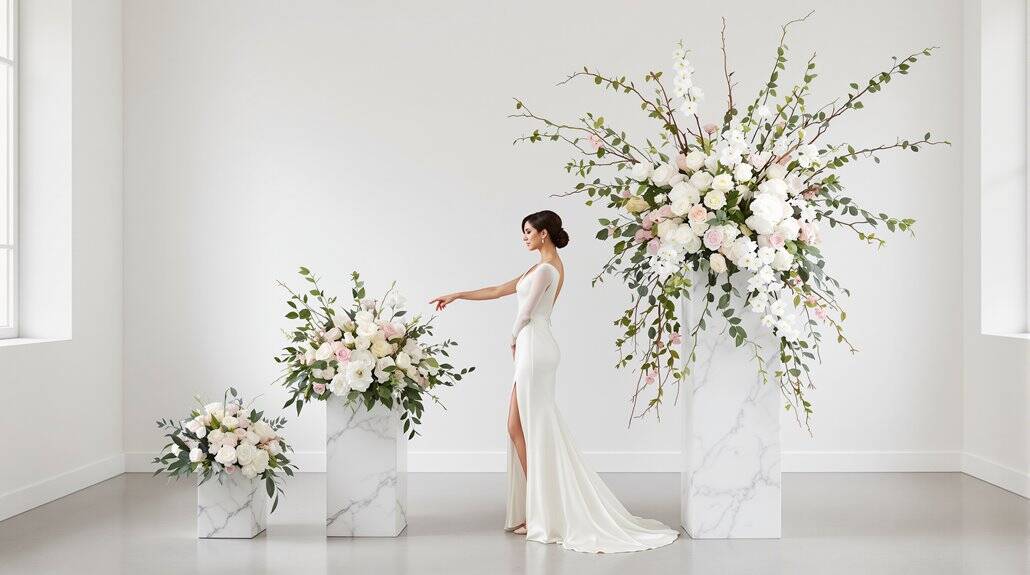
The difference between a $1,000 and a $15,000 floral budget isn’t just zeros—it’s an entirely different universe of possibilities.
At the budget-conscious tier ($1,000-$2,200), you’re getting essential personal flowers with basic design elements. Your bridal bouquet costs around $120, with bridesmaid bouquets at $40-$50 each. But jump to that luxury wedding floral budget of $7,500-$10,000, and suddenly you’re commissioning statement ceremony installations with elaborate arches, mixed centerpiece collections, and designer-quality personal flowers featuring rare botanicals.
The $15,000 wedding flowers tier? That’s when true transformation happens—comprehensive floral services covering every inch of your venue with bespoke installations. Your floral budget breakdown would include specialized décor elements like greenery walls and unique installation features that require significant labor hours. You’re not just paying for prettier flowers, but for the structural engineering and artistic vision that turns botanical elements into immersive experiences. Many of these premium blooms benefit from plant breeding programs that develop new varieties with enhanced characteristics like longer vase life and unique colors.
Conclusion
Investing $15,000 in wedding florals represents far more than simple decorative elements—it’s purchasing artistic transformation of your entire venue. When broken down, this luxury flower investment translates to specialized labor, premium materials, and complex design expertise that creates immersive, magazine-worthy environments—not just centerpieces.
Luxury florals aren’t décor—they’re environmental artistry that fundamentally transforms your celebration’s entire atmosphere.
Your investment delivers:
- Structural installations requiring engineering-level expertise (hanging installations, flower walls, custom arches)
- Premium access to 700+ stems of specialty varieties often unavailable at lower price points
- Professional installation crews with specialized training in large-scale floral architecture
- Custom vessel creation or rental of high-end containers rarely seen elsewhere
What initially feels shocking becomes understandable when you grasp the sheer volume of product, expertise, and labor-intensive craftsmanship required. And yet, this investment isn’t purely aesthetic—it’s creating an emotional atmosphere, a sensory experience that transforms how your celebration feels and photographs, becoming the artistic foundation upon which your entire wedding builds. Drawing inspiration from luxury home architecture, the same principles of elevated design and intentional space transformation apply to high-end floral installations that reshape your venue into an unforgettable environment.