
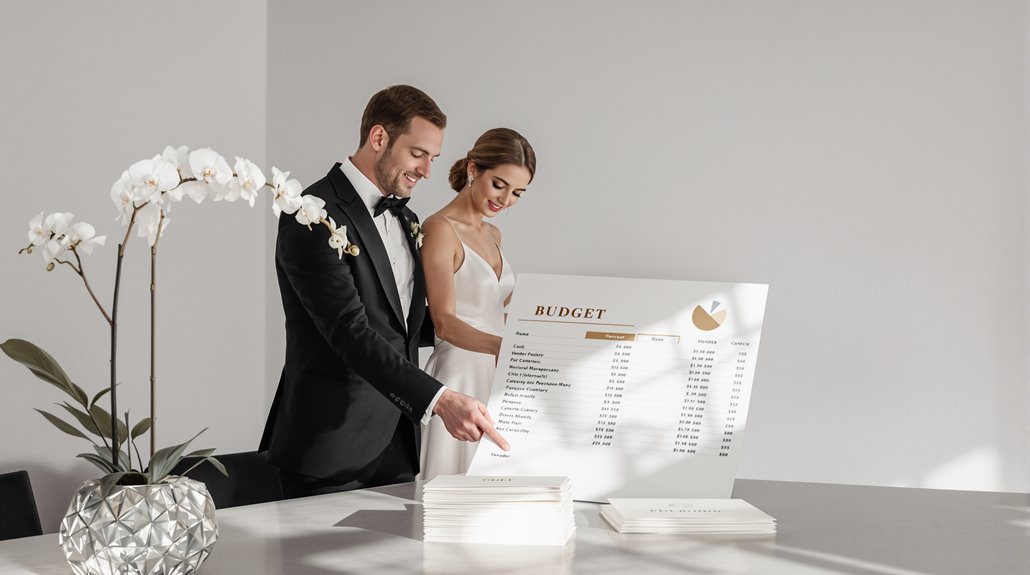
A $100K wedding budget—simultaneously lavish and limiting. Your money goes primarily to venue (40%, ~$40,000), catering (22%, ~$22,000), florals (12%, ~$12,000), and photography (8-15%, ~$8,000). Hidden costs devour what remains: service charges, gratuities, overtime fees, venue minimums. You’ll afford premium experiences but face trade-offs—San Francisco vs. Nashville pricing differs dramatically. Even six figures demands tactical allocation, prioritizing what creates memories over Instagram-worthy extravagance. The real wisdom lies in knowing where to compromise.
Why $100K Feels Both Huge and Insufficient

While $100,000 represents an astronomical sum for most Americans—landing squarely in the top 2-3% of wedding budgets nationwide—it simultaneously feels both extravagant and strangely constraining once you begin allocating funds.
Your luxury wedding budget exists in a bewildering paradox: triple the national average yet somehow insufficient in premium markets. The high-end wedding cost in San Francisco ($84,649) devours most of your budget before adding a single specialty service, while that identical celebration costs half as much in Milwaukee ($42,571).
Location becomes destiny. Your expensive wedding budget breakdown shifts dramatically across regions—$100K buys opulence in Nashville but mere adequacy in Manhattan. Even with a wedding planner costing $8,800 to reduce stress and manage vendors, the math is brutally straightforward: with 150 guests, you’re working with approximately $667 per person. Sounds lavish, and yet top-tier catering alone consumes $100+ per guest before addressing venue, photography, or flowers.
The Breakdown: Where Every Dollar Goes – Venue 40% Catering 22% Photo 8% Florals 12% etc
As you shift from dreaming to planning your six-figure celebration, understanding precisely where each dollar flows becomes your financial roadmap to wedding day success.
Your $100000 wedding budget dissects with ruthless predictability—venues devour 40% ($40,000+) in metropolitan areas, creating your event’s foundation and eating the largest slice of your expensive wedding budget breakdown. Catering follows at 22% ($22,000-$25,000), translating to roughly $200 per guest for that five-star dining experience. Photography and videography claim a modest 8-15% ($6,000-$8,000), preserving memories that outlast the champagne. Florals demand 12% ($12,000+)—those Instagram-worthy centerpieces aren’t cheap—and yes, that’s before factoring in installation fees. The old money aesthetic often inspires exquisite floral arrangements that elevate the overall elegance of the event.
The luxury wedding budget math becomes brutally clear: these four categories alone consume 82% of your budget, and we haven’t touched entertainment, planning services, attire, or those custom cocktail napkins you’re inexplicably obsessed with. Remember that regional differences can cause your total costs to fluctuate dramatically, with luxury weddings in major cities like Manhattan or D.C. commanding significantly higher vendor rates than those in less expensive markets.
Hidden Costs at the $100K Tier

The beautifully organized wedding budget you’ve carefully crafted? Prepare to watch it implode when hidden costs infiltrate every line item. Your $100,000 luxury wedding budget quickly becomes a mathematical puzzle where venue ancillary fees devour unexpected thousands—we’re talking $5,000+ just for tables, chairs, and that mandatory dance floor installation.
Taxes and service charges silently consume 20-33% of your spending, particularly devastating against food and beverage minimums. You’ll need at least $800 for gratuities beyond contractual service charges, distributed across vendors you didn’t even realize existed. Overtime charges accrue mercilessly when your reception extends by mere minutes—$250 per half-hour for the photographer, $500 for the band, $600 for venue staffing.
And yet, most couples underbudget these exact categories. The true challenge isn’t securing gorgeous florals or premium catering, but anticipating the administrative machinery silently grinding behind your celebration—fees accumulating while you’re sampling cake flavors. Effective tier allocation strategies can help manage these costs more efficiently.
What $100K Buys vs What It Doesn’t
Many couples fixate on that six-figure milestone with visions of unlimited luxury, only to discover $100,000 stretches surprisingly thin once distributed across dozens of wedding categories. Your luxury wedding budget will secure a premium venue and exceptional catering—perhaps $45,000 worth—but won’t cover week-long buyouts or Michelin-starred experiences at $200+ per person.
You’ll afford exhaustive photography and cinematography ($18,000) capturing every moment through multiple lenses, yet celebrity photographers remain out of reach. The costly wedding budget breakdown continues: elaborate floral installations transform spaces, but custom sculptural elements or rare imported blooms might exceed allocations.
Your luxury wedding budget breakdown allows for elevated guest experiences—premium open bars, live entertainment, welcome events—while destination travel for guests or museum-quality décor installations simply won’t fit. The math is unforgiving: $100,000 buys a beautiful, detailed crafted celebration, not an unlimited fantasy without financial constraints. Additionally, understanding emerging luxury trends can help couples make informed choices that enhance their wedding experience within budget.
Budget Allocation Strategy for Six-Figure Weddings

Successful allocation of a six-figure wedding budget hinges on proportional distribution—your $100,000 won’t feel endless unless you’ve mapped every dollar tactically. The math is sobering: with luxury wedding budget proportions mirroring standard allocations, you’ll still commit $40,000-$45,000 to venue and catering alone.
Your six figure wedding demands calculated investment: $8,500+ for venue, nearly $7,000 for catering (jumping to $10,000 for 100 guests), and another $5,500 for bar service. Photography and videography will claim $8,400 combined—non-negotiables for preserving memories that justify your expensive wedding budget breakdown.
The remaining $25,000-ish splits between planning services ($4,000+), flowers and décor ($6,300+), and appearance services ($6,000+). And yet, location transforms everything. Your identical celebration costs twice as much in San Francisco ($84,649) as Milwaukee ($42,571)—proving that where you marry matters as much as how.
When to Spend More vs Save at This Tier
While steering a six-figure wedding budget grants you exceptional possibilities, it doesn’t eliminate the need for tactical financial decisions—you’ll still face critical trade-offs requiring surgical precision. Your $100k wedding budget demands ruthless prioritization of experiential impact versus fleeting aesthetics.
| Splurge Worthy | Strategic Savings |
|---|---|
| Venue (17-20% of budget) | Day-of stationery |
| Premium catering ($85-100/person) | Wedding party gifts |
| Expert photography/videography team | Transportation between venues |
| Statement floral installations | Elaborate welcome bags |
| Live entertainment | Excessive cake tiers |
The luxury wedding budget math is unforgiving—allocate 40-45% to venue, food, and beverages before even considering other elements. Photography warrants significant investment at this tier, as it’s what you’ll revisit decades later. Expensive wedding budget breakdowns reveal a counterintuitive truth: even with six figures, you’ll need to make calculated compromises. Your guests will remember extraordinary food and seamless service long after forgetting those custom napkins you agonized over.
The Lifestyle Creep Problem

Even with a luxurious six-figure budget at your disposal, your dream wedding faces an insidious threat that financial planners call “lifestyle creep.” You know the pattern—yesterday’s extravagances become today’s necessities, and suddenly that $100,000 feels restrictively modest.
You’ve likely already experienced it: you started with reasonable expectations, but after browsing Instagram or visiting that first luxury venue, your baseline reset. The $5,000 photographer became inadequate when you saw $9,000 portfolios. The $15,000 reception venue seemed sparse without the $4,000 lighting package. And that reasonable $3,500 dress? It’s now competing with a $7,800 couture gown you’ve convinced yourself you can’t live without.
This silent inflation transforms your once-generous budget into a seemingly insufficient sum through the gradual normalization of premium options. Each upgrade feels small in isolation, yet collectively they’ll cannibalize funds allocated for long-term goals—like that down payment you’re saving for.
Conclusion
Planning a $100,000 wedding forces you into the uncomfortable truth about luxury: it comes with boundaries, not boundless possibilities.
That six-figure sum—once imagined as your ticket to wedding nirvana—dissolves quickly when distributed across venue minimums ($30,000+), photography ($10,000), floral design ($15,000), and a premium band ($15,000). And yet, these investments create the sensory architecture of your celebration—what guests actually remember.
Where couples find clarity is in recognizing what wealth truly buys: not endless excess, but tactical abundance. Your $100,000 allows you to eliminate exactly one layer of compromise—perhaps securing that cliffside venue without sacrificing the documentary photographer, but not both plus the celebrity florist. The math remains stubborn.
The most satisfied six-figure couples aren’t those who spent indiscriminately, but those who identified their non-negotiables early and spent lavishly there, while practicing tactical restraint elsewhere. Money buys options, not immunity from choices.